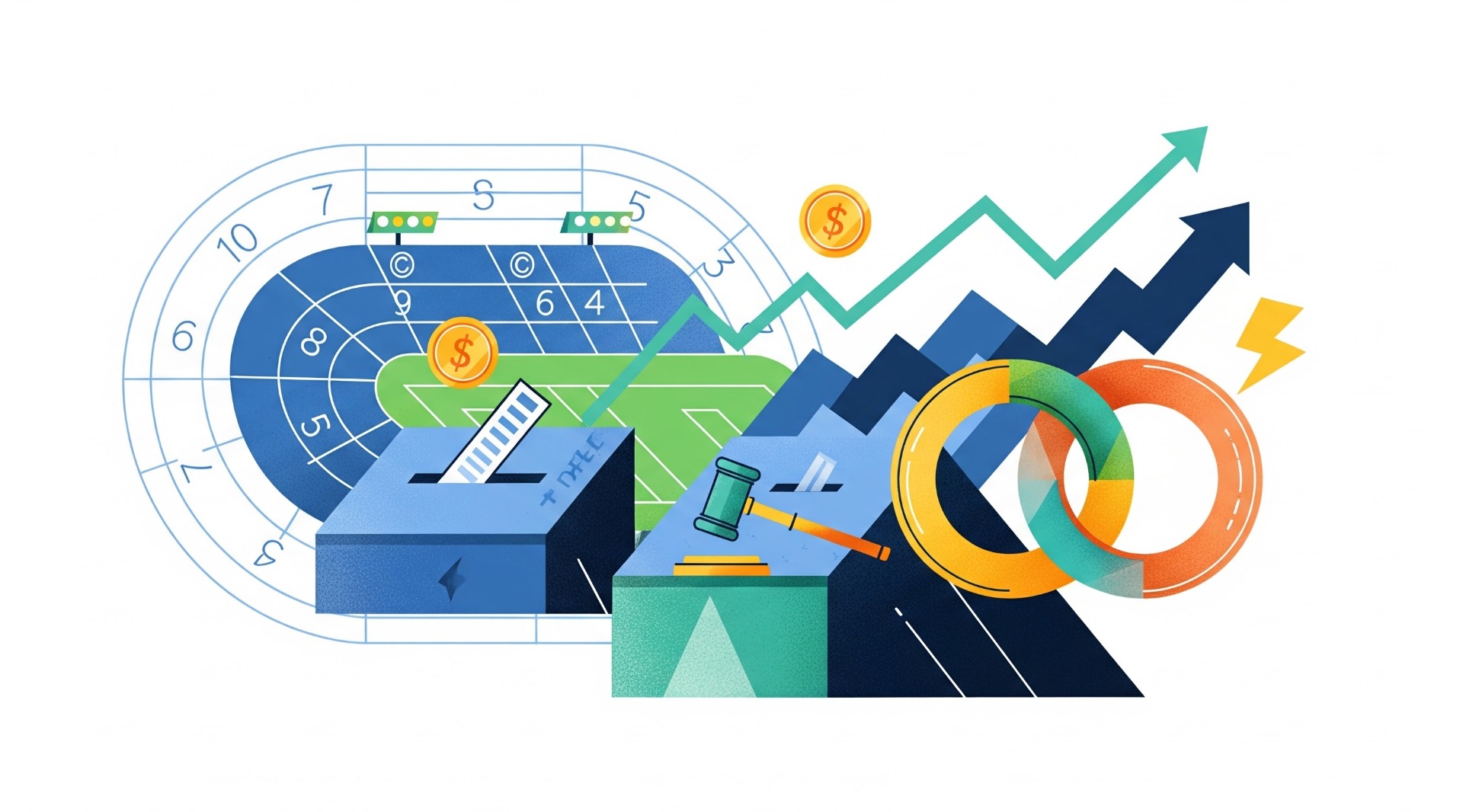
Why More People Are Using Prediction Markets to Follow Sports, Politics and the Economy
Tuesday,24/03/2026|06:36GMTby
Bazoom
Prediction markets are growing as the natural, interactive way to track major world events.
The clearest sign that event-based participation has become a mainstream habit came before this year’s Super Bowl, when the American Gaming Association estimated that Americans would legally wager $1.76 billion on Super Bowl LX, a figure Reuters said was almost 27% higher than the previous year’s estimate. ESPN added that the estimate covered only legal sportsbook wagers in 39 states and Washington, D.C., and that the AGA based it on publicly reported numbers from state gaming regulators. That's important because it shows how comfortable ordinary users have become with following big events through live prices and fast-moving probabilities.
Prediction markets tap into that same instinct, but they take it a step further. When you open one of these apps, including platforms such as the Fanatics Markets prediction platform, you are not just checking who might win. You are watching confidence move.
In this piece, we look at three reasons the category is drawing more people in.
Why sports are still the easiest way in.
Why the same format works for politics and the economy.
Why clearer rules and smarter contract design are making the experience easier to trust.
Brackets to Big Questions
Sports is where the appeal makes immediate sense. Reuters reported that legal NFL wagering for the 2025 season was expected to reach $30 billion, up 8.5% from $27.6 billion in 2024, and that the estimate included preseason games and futures bets placed as early as March. That tells you something useful about behavior: people do not wait for kickoff to care about an outcome; they like following the whole arc of the story.
That habit fits prediction markets naturally. Reports citing the AGA said the 2026 men’s and women’s NCAA tournaments would offer more than 100 games to bet on, keeping attention spread across multiple rounds, multiple days and dozens of changing narratives. For someone using a phone, that creates a rhythm of checking, updating and reacting that feels close to following live news.
Sports gives prediction markets a friendly entry point because the rules are already familiar. You know the teams, you know the schedule and you understand why expectations rise or fall. Once that behavior feels natural, it becomes much easier to carry it into other kinds of events.
Far More Than a Scoreboard
That is where prediction markets get more interesting. A 2025 SocArXiv working paper by Joshua D. Clinton and TzuFeng Huang analyzed more than 2,500 political prediction markets across Iowa Electronic Markets, Kalshi, PredictIt and Polymarket during the final five weeks of the 2024 U.S. presidential campaign, covering $2.4 billion in transactions. That is large enough to treat the category as something serious, measurable and worth understanding on its own terms.
The findings were nuanced. The paper found that 93% of PredictIt markets, 78% of Kalshi markets and 67% of Polymarket markets predicted outcomes better than chance, while also finding price divergence and arbitrage opportunities across exchanges. In plain language, these markets can be informative without being flawless, and that makes them more useful for readers than any grand claim about perfect foresight could.
Reuters reported in March 2026 that prediction markets gained credibility after the 2024 election because their live probability signals outperformed polls in forecasting Donald Trump’s win. You can see why that resonated with readers who were already used to watching markets react faster than commentary. If one app lets you track a Senate race, a central bank question and a championship game in the same basic format, it starts to feel less like a niche product and more like a practical layer on top of the news.
That is part of the appeal. A prediction market turns a headline into a moving signal.
Rules and Relevance
Interest grows more easily when a category is easier to understand. Reuters reported on March 11, 2026, that the CFTC had started rulemaking for prediction markets and described event contracts as tradable yes-or-no wagers tied to sports, politics and the economy. For ordinary readers, that kind of official framing matters because it makes a vague idea clearer and easier to place.
At the same time, the products themselves are becoming more intuitive. Reuters reported on March 9, 2026, that Cboe planned to launch prediction market contracts with partial payouts based on forecast precision rather than a strict all-or-nothing result. That may sound technical at first, but the consumer benefit is simple: many real-world questions are not perfectly binary, so tools that reflect that feel closer to how people actually think about events.
There is also a regional reason this subject has traction beyond the United States. Finance Magnates reported in March 2025 that Interactive Brokers expanded prediction markets beyond the U.S. and launched them in Canada. For Canadian media and U.S. readers alike, that makes the category feel less distant and more connected to the stories they already follow, from sports calendars to political cycles to economic releases.
Once a format becomes easier to access, easier to explain and easier to understand within a rules framework, more people are willing to try it. That willingness turns curiosity into habit.
When News Becomes Interactive
The appeal of prediction markets is fairly natural. People like following major events together, they like seeing confidence change in real time and they like tools that reduce a complicated story to a number they can read at a glance. That helps explain why the category now makes sense across sports, politics and the economy rather than sitting in separate boxes.
What gives the topic staying power is the combination of familiarity and structure. Sports brings people in, research gives the format informational weight and clearer rules plus smarter contract design make it easier to take seriously without pretending every market is perfect. That is a healthy place for a consumer product to be.
The realistic case is that prediction markets are becoming a more natural way for ordinary people to follow important events because they make those events immediate, legible and engaging. When the next big story breaks, more people may watch the probability move as closely as the headline.
The clearest sign that event-based participation has become a mainstream habit came before this year’s Super Bowl, when the American Gaming Association estimated that Americans would legally wager $1.76 billion on Super Bowl LX, a figure Reuters said was almost 27% higher than the previous year’s estimate. ESPN added that the estimate covered only legal sportsbook wagers in 39 states and Washington, D.C., and that the AGA based it on publicly reported numbers from state gaming regulators. That's important because it shows how comfortable ordinary users have become with following big events through live prices and fast-moving probabilities.
Prediction markets tap into that same instinct, but they take it a step further. When you open one of these apps, including platforms such as the Fanatics Markets prediction platform, you are not just checking who might win. You are watching confidence move.
In this piece, we look at three reasons the category is drawing more people in.
Why sports are still the easiest way in.
Why the same format works for politics and the economy.
Why clearer rules and smarter contract design are making the experience easier to trust.
Brackets to Big Questions
Sports is where the appeal makes immediate sense. Reuters reported that legal NFL wagering for the 2025 season was expected to reach $30 billion, up 8.5% from $27.6 billion in 2024, and that the estimate included preseason games and futures bets placed as early as March. That tells you something useful about behavior: people do not wait for kickoff to care about an outcome; they like following the whole arc of the story.
That habit fits prediction markets naturally. Reports citing the AGA said the 2026 men’s and women’s NCAA tournaments would offer more than 100 games to bet on, keeping attention spread across multiple rounds, multiple days and dozens of changing narratives. For someone using a phone, that creates a rhythm of checking, updating and reacting that feels close to following live news.
Sports gives prediction markets a friendly entry point because the rules are already familiar. You know the teams, you know the schedule and you understand why expectations rise or fall. Once that behavior feels natural, it becomes much easier to carry it into other kinds of events.
Far More Than a Scoreboard
That is where prediction markets get more interesting. A 2025 SocArXiv working paper by Joshua D. Clinton and TzuFeng Huang analyzed more than 2,500 political prediction markets across Iowa Electronic Markets, Kalshi, PredictIt and Polymarket during the final five weeks of the 2024 U.S. presidential campaign, covering $2.4 billion in transactions. That is large enough to treat the category as something serious, measurable and worth understanding on its own terms.
The findings were nuanced. The paper found that 93% of PredictIt markets, 78% of Kalshi markets and 67% of Polymarket markets predicted outcomes better than chance, while also finding price divergence and arbitrage opportunities across exchanges. In plain language, these markets can be informative without being flawless, and that makes them more useful for readers than any grand claim about perfect foresight could.
Reuters reported in March 2026 that prediction markets gained credibility after the 2024 election because their live probability signals outperformed polls in forecasting Donald Trump’s win. You can see why that resonated with readers who were already used to watching markets react faster than commentary. If one app lets you track a Senate race, a central bank question and a championship game in the same basic format, it starts to feel less like a niche product and more like a practical layer on top of the news.
That is part of the appeal. A prediction market turns a headline into a moving signal.
Rules and Relevance
Interest grows more easily when a category is easier to understand. Reuters reported on March 11, 2026, that the CFTC had started rulemaking for prediction markets and described event contracts as tradable yes-or-no wagers tied to sports, politics and the economy. For ordinary readers, that kind of official framing matters because it makes a vague idea clearer and easier to place.
At the same time, the products themselves are becoming more intuitive. Reuters reported on March 9, 2026, that Cboe planned to launch prediction market contracts with partial payouts based on forecast precision rather than a strict all-or-nothing result. That may sound technical at first, but the consumer benefit is simple: many real-world questions are not perfectly binary, so tools that reflect that feel closer to how people actually think about events.
There is also a regional reason this subject has traction beyond the United States. Finance Magnates reported in March 2025 that Interactive Brokers expanded prediction markets beyond the U.S. and launched them in Canada. For Canadian media and U.S. readers alike, that makes the category feel less distant and more connected to the stories they already follow, from sports calendars to political cycles to economic releases.
Once a format becomes easier to access, easier to explain and easier to understand within a rules framework, more people are willing to try it. That willingness turns curiosity into habit.
When News Becomes Interactive
The appeal of prediction markets is fairly natural. People like following major events together, they like seeing confidence change in real time and they like tools that reduce a complicated story to a number they can read at a glance. That helps explain why the category now makes sense across sports, politics and the economy rather than sitting in separate boxes.
What gives the topic staying power is the combination of familiarity and structure. Sports brings people in, research gives the format informational weight and clearer rules plus smarter contract design make it easier to take seriously without pretending every market is perfect. That is a healthy place for a consumer product to be.
The realistic case is that prediction markets are becoming a more natural way for ordinary people to follow important events because they make those events immediate, legible and engaging. When the next big story breaks, more people may watch the probability move as closely as the headline.
Why Data Security Is Not a Compliance Checkbox for Brokers
CMC Markets’ Artur Delijergijevs on Metals Demand, Volatility, & Stable Execution
CMC Markets’ Artur Delijergijevs on Metals Demand, Volatility, & Stable Execution
In this exclusive Executive Interview, Finance Magnates speaks with Artur Delijergijevs, Head of Systematic Market Making at CMC Markets, about the current state of metals demand and market volatility.
Delijergijevs offers a desk-level view on:
- Metals Demand: Why metals are seeing the strongest demand from both retail and institutional clients right now.
- The Safe-Haven Debate: Questioning whether gold still fits the classic safe-haven definition given large daily price movements.
- Volatile Market Prep: How a market-making desk prepares its systems and pricing for stressed market conditions and high-impact economic events.
- Hybrid Execution: Why the best execution model combines electronic speed with human relationship support, especially during volatility.
- AI in Workflow: Where CMC Markets is integrating machine learning for risk management and pricing, and the limitations of AI during stressed markets.
- Dubai's Role: The strategic importance of Dubai’s location for covering global trading sessions across Asia, Europe, and the US.
Watch to understand how CMC Markets maintains stable pricing and reliable execution quality in high-volatility environments.
#CMCmarkets #forex #metals #gold #trading #volatility #MarketMaking #iFXDubai #FinanceMagnates #Finance #Fintech #Execution #AlgorithmicTrading #RiskManagement
In this exclusive Executive Interview, Finance Magnates speaks with Artur Delijergijevs, Head of Systematic Market Making at CMC Markets, about the current state of metals demand and market volatility.
Delijergijevs offers a desk-level view on:
- Metals Demand: Why metals are seeing the strongest demand from both retail and institutional clients right now.
- The Safe-Haven Debate: Questioning whether gold still fits the classic safe-haven definition given large daily price movements.
- Volatile Market Prep: How a market-making desk prepares its systems and pricing for stressed market conditions and high-impact economic events.
- Hybrid Execution: Why the best execution model combines electronic speed with human relationship support, especially during volatility.
- AI in Workflow: Where CMC Markets is integrating machine learning for risk management and pricing, and the limitations of AI during stressed markets.
- Dubai's Role: The strategic importance of Dubai’s location for covering global trading sessions across Asia, Europe, and the US.
Watch to understand how CMC Markets maintains stable pricing and reliable execution quality in high-volatility environments.
#CMCmarkets #forex #metals #gold #trading #volatility #MarketMaking #iFXDubai #FinanceMagnates #Finance #Fintech #Execution #AlgorithmicTrading #RiskManagement
Finance Magnates Awards 2026 – Nominations Now Open
Finance Magnates Awards 2026 – Nominations Now Open
The Finance Magnates Awards 2026 nominations are now open. 🏆
From fintech innovators to leading brokers, this is where the finance industry celebrates its biggest achievements.
Winners will be announced at the Cyprus Gala Dinner on November 6, 2026.
Nominate your brand now.
https://awards.financemagnates.com/?utm_source=linkedin&utm_medium=video&utm_campaign=nominations-open
#FMAwards #FinanceMagnates #FintechAwards #Fintech #FinanceIndustry
The Finance Magnates Awards 2026 nominations are now open. 🏆
From fintech innovators to leading brokers, this is where the finance industry celebrates its biggest achievements.
Winners will be announced at the Cyprus Gala Dinner on November 6, 2026.
Nominate your brand now.
https://awards.financemagnates.com/?utm_source=linkedin&utm_medium=video&utm_campaign=nominations-open
#FMAwards #FinanceMagnates #FintechAwards #Fintech #FinanceIndustry
Finance Magnates Awards 2026 | Nominations Now Open 🏆#Fintech #FMAwards #TradingIndustry
Finance Magnates Awards 2026 | Nominations Now Open 🏆#Fintech #FMAwards #TradingIndustry
Lights on. Cameras ready. 🎬
Finance Magnates Awards 2026 nominations are now open. 🏆
#FMAwards #FinanceMagnates #FintechAwards #Fintech
Lights on. Cameras ready. 🎬
Finance Magnates Awards 2026 nominations are now open. 🏆
#FMAwards #FinanceMagnates #FintechAwards #Fintech
Exness sees trust as the key theme for growth in MENA Trading Growth for 2026
Exness sees trust as the key theme for growth in MENA Trading Growth for 2026
Mohammad Amer, Regional Commercial Director at Exness, sits down to discuss the booming MENA financial trading market. Find out why Dubai is key to the company's growth strategy, how a mobile-first generation is changing expectations, and why trust will be the defining theme for traders in 2026.
In this interview, you'll learn:
* Why Dubai and the MENA region are critical growth markets for fintech and online trading.
* How Exness is addressing the demands of mobile-first, younger traders through engineering, platform stability, and transparent conditions.
* The essential role local talent plays in providing a culturally relevant and compliant user experience.
* Mohammad Amer's outlook on the future of the online trading industry and why stronger controls and systems are necessary.
* Why "trust" isn't just a brand value, but has commercial value—and why he predicts 2026 will be the "Year of Trust."
Key Takeaways:
➡️ The MENA region is rapidly shaping global financial markets.
➡️ New traders expect stability, precise execution, and transparency.
➡️ Local expertise is key to regulatory compliance and user experience.
➡️ Future success belongs to firms capable of meeting rising standards across regulation and platform consistency.
Read the full article at: https://www.financemagnates.com/thought-leadership/exness-sees-trust-as-the-key-theme-for-growth-in-mena-trading-growth-for-2026/
#Exness #MENA #Trading #FinTech #Dubai #OnlineTrading #FinanceMagnates #MohammadAmer #Trust #MobileTrading
Mohammad Amer, Regional Commercial Director at Exness, sits down to discuss the booming MENA financial trading market. Find out why Dubai is key to the company's growth strategy, how a mobile-first generation is changing expectations, and why trust will be the defining theme for traders in 2026.
In this interview, you'll learn:
* Why Dubai and the MENA region are critical growth markets for fintech and online trading.
* How Exness is addressing the demands of mobile-first, younger traders through engineering, platform stability, and transparent conditions.
* The essential role local talent plays in providing a culturally relevant and compliant user experience.
* Mohammad Amer's outlook on the future of the online trading industry and why stronger controls and systems are necessary.
* Why "trust" isn't just a brand value, but has commercial value—and why he predicts 2026 will be the "Year of Trust."
Key Takeaways:
➡️ The MENA region is rapidly shaping global financial markets.
➡️ New traders expect stability, precise execution, and transparency.
➡️ Local expertise is key to regulatory compliance and user experience.
➡️ Future success belongs to firms capable of meeting rising standards across regulation and platform consistency.
Read the full article at: https://www.financemagnates.com/thought-leadership/exness-sees-trust-as-the-key-theme-for-growth-in-mena-trading-growth-for-2026/
#Exness #MENA #Trading #FinTech #Dubai #OnlineTrading #FinanceMagnates #MohammadAmer #Trust #MobileTrading
Paytiko CEO Razi Salih on Why Payment Orchestration is a MUST-HAVE for Brokers in 2026
Paytiko CEO Razi Salih on Why Payment Orchestration is a MUST-HAVE for Brokers in 2026
At iFX Expo Dubai, Finance Magnates spoke with Razi Salih, CEO at Paytiko, about the evolution of the payments ecosystem and why payment orchestration has shifted from an option to a necessity for brokers, prop firms, and exchanges.
Mr. Salih explains how global expansion, the need for deep localisation, and the sheer number of new payment methods, from instant banking to stablecoins, are driving this critical infrastructure shift.
#PaymentOrchestration #Fintech #Brokerage #TradingPayments #RaziSalih #Paytiko #iFXExpoDubai #Stablecoins #AIinFintech
At iFX Expo Dubai, Finance Magnates spoke with Razi Salih, CEO at Paytiko, about the evolution of the payments ecosystem and why payment orchestration has shifted from an option to a necessity for brokers, prop firms, and exchanges.
Mr. Salih explains how global expansion, the need for deep localisation, and the sheer number of new payment methods, from instant banking to stablecoins, are driving this critical infrastructure shift.
#PaymentOrchestration #Fintech #Brokerage #TradingPayments #RaziSalih #Paytiko #iFXExpoDubai #Stablecoins #AIinFintech