Financial and Business News

The FX and Crypto Landscape Entering 2026

Thursday, 18/12/2025 | 07:00 GMT by Shift Markets
  • FX and crypto markets are converging. New infrastructure makes it easy for brokers to adopt digital assets.
shiftmarkets

At Shift Markets, we’ve spent over 15 years building trading infrastructure for brokers and crypto exchanges worldwide, giving us a front-row seat to one of the most important industry shifts we’ve seen since retail FX came online: the convergence of FX and digital assets. As we approach 2026, the line between the two is fading faster than most brokers realize.

Traders now expect 24/7 markets, instant funding, stablecoin rails, and the ability to move capital with the same speed they move information. FX alone wasn’t built for this. Meanwhile, crypto markets have matured: liquidity is deeper, regulation is finally taking shape, and operational risks are dramatically lower than even a few years ago.

This shift is forcing brokers toward true multi-asset models. What was once an experiment at the fringes is now a baseline expectation. The divide between FX and crypto infrastructure is collapsing and client expectations are accelerating that collapse.

Global FX brokers are facing their most significant product shift in a decade. Digital assets are quickly becoming the competitive line between stagnant platforms and those building for the future. The brokers who internalize this now will lead in the next cycle.

FX Infrastructure Wasn’t Built for Crypto

For years, brokers have understood the demand for digital assets. The issue was never interest, it was infrastructure. FX tech stacks are famously siloed. CRMs, bridges, PSPs, risk engines, and back-office systems all operate independently, and none were designed to support 24/7 assets, blockchain settlement, or real-time stablecoin flows.

Adding crypto used to mean standing up entirely new systems, rewriting workflows, retraining teams, and absorbing new operational risks. Timelines stretched into quarters. Costs ran high. Many projects never left the planning stage.

The demand was there but the technical lift was enormous. And until recently, there simply wasn’t a practical path to bring digital assets into an FX brokerage without tearing the house down and rebuilding it.

FX and Crypto Converging at the Infrastructure Layer

That’s now changing. Quietly, over the past year, FX technology vendors have started adapting their systems to support digital assets more natively. Bridges, CRMs, PSPs, and risk tools are opening their architectures, expanding API coverage, and plugging into crypto liquidity, settlement flows, and trading infrastructure.

This marks the beginning of a structural shift where crypto no longer lives on an island outside the brokerage. It becomes just another asset class routed through the same operational workflows brokers already know.

Funding, onboarding, reporting, and compliance stay exactly where they are. The difference is that crypto now fits into the model instead of breaking it.

What once required a major rebuild is starting to look like a simple activation step.

How New Integrations Are Making It Easy for Brokers to Add Crypto

At Shift Markets, we’ve invested heavily in solving this specific problem. We have seen exactly where brokers get stuck, and over the past year, we’ve completed a wave of integrations across the FX stack so brokers can add crypto without replacing the tech they rely on.

These integrations connect our digital asset infrastructure directly into the systems brokers use every day:

  • Liquidity Bridges: Centroid, PrimeXM, and OneZero.
  • CRMs: DynamicWorks and CurrentDesk.
  • Gateways: PSPs like Praxis.

Rather than learning new workflows or managing parallel systems, brokers can activate crypto trading within familiar operational environments. This foundation is what finally makes crypto "plug-and-play" for FX. The brokerage gains a new product line, the trader gains a 24/7 market, and the operation continues uninterrupted.

The Business Case for Brokers in 2026

This infrastructure shift unlocks new revenue streams without adding operational complexity.

  • Revenue: Crypto trading introduces wider spreads and continuous volume, especially during hours FX markets sleep.

  • Efficiency: Stablecoins compress funding friction to near-zero, turning deposits and withdrawals into real-time events.

  • Speed: Integrating crypto into current systems reduces go-to-market timelines from months to weeks.

Brokers who delay risk more than slow adoption; they risk losing entire cohorts of younger, crypto-native traders who won’t consider a brokerage that can’t meet the expectations shaped by major crypto exchanges. In 2026, the ability to activate crypto quickly—without rebuilding your tech stack—will become one of the most important differentiators in the market.

What FX & Crypto Will Look Like in 2026

As infrastructure catches up, digital assets are moving from “experimental add-on” to a standard product. By 2026, most mid-sized FX brokers will support a core set of crypto markets: spot assets, stablecoin funding, and increasingly, crypto derivatives.

The FX technology stack will follow suit. CRMs, bridges, PSPs, and risk systems will treat digital assets the same way they treat FX or CFDs. That shift will accelerate competition and expand the definition of what a brokerage can be. And the platforms that fail to evolve will feel as outdated as pre-mobile trading apps do today.

Brokers that act now will shape this next phase. Brokers that wait will play catch-up in a market that rewards speed, agility, and product breadth.

Closing Thoughts

As the market evolves, the question for brokers is no longer whether to offer digital assets — it’s how to add them without disrupting the business. By integrating crypto directly into the FX systems brokers already trust, we’re removing that barrier. The firms that embrace this convergence early will define the next generation of multi-asset brokerage. We are assisting brokers make this transition. Contact us to learn more.

About Ian McAfee & Shift Markets

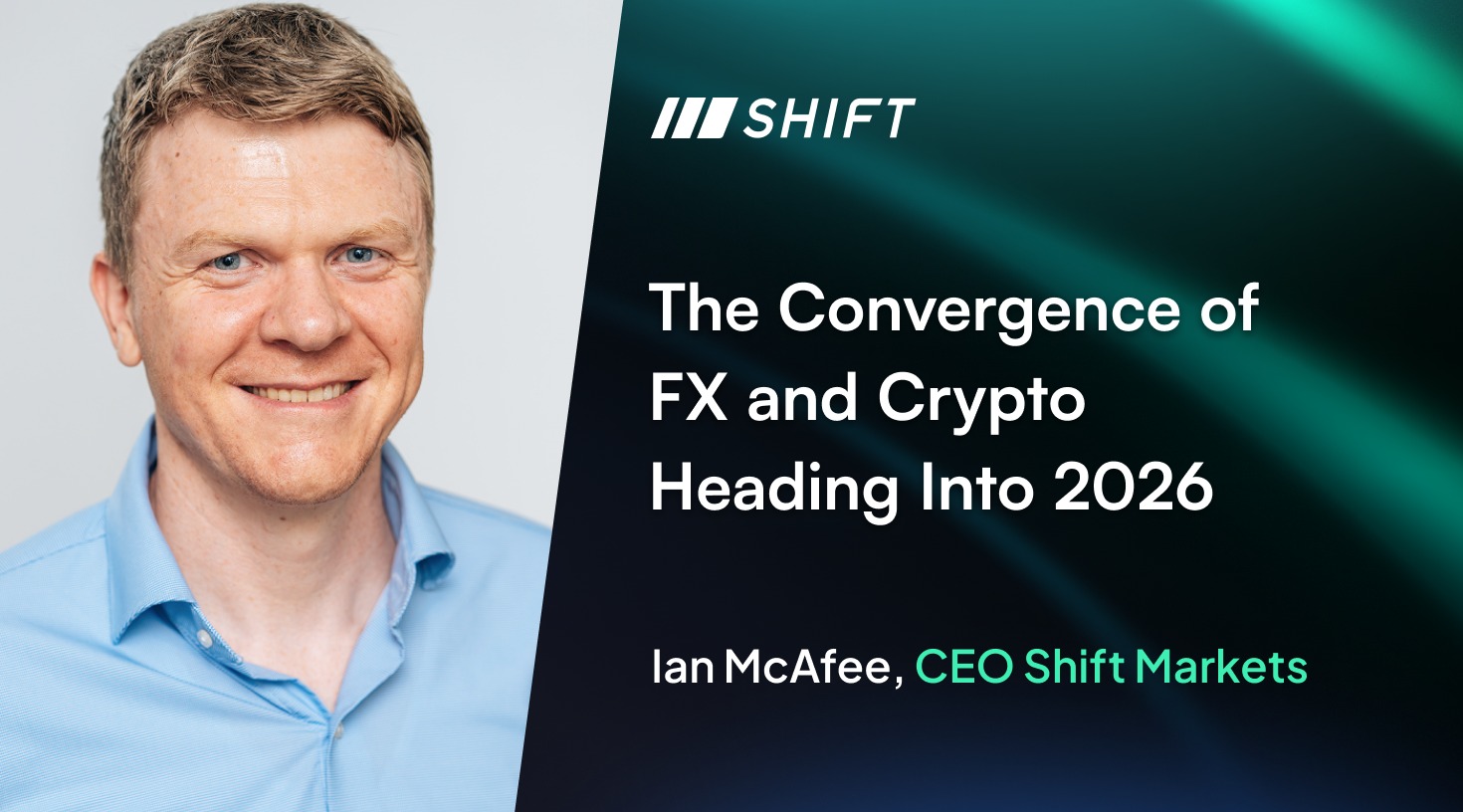
Ian McAfee is the co-founder and CEO of Shift Markets, with over 18 years of experience in the foreign exchange and cryptocurrency sectors. Founded in 2009, Shift Markets started in FX trading infrastructure but has since embraced blockchain and cryptocurrency, aiming to make these technologies accessible to a broad range of businesses. Under Ian’s guidance, Shift Markets provides easy-to-integrate white label exchange technology, enabling businesses to offer their users a compliant and scalable crypto trading platform.

At Shift Markets, we’ve spent over 15 years building trading infrastructure for brokers and crypto exchanges worldwide, giving us a front-row seat to one of the most important industry shifts we’ve seen since retail FX came online: the convergence of FX and digital assets. As we approach 2026, the line between the two is fading faster than most brokers realize.

Traders now expect 24/7 markets, instant funding, stablecoin rails, and the ability to move capital with the same speed they move information. FX alone wasn’t built for this. Meanwhile, crypto markets have matured: liquidity is deeper, regulation is finally taking shape, and operational risks are dramatically lower than even a few years ago.

This shift is forcing brokers toward true multi-asset models. What was once an experiment at the fringes is now a baseline expectation. The divide between FX and crypto infrastructure is collapsing and client expectations are accelerating that collapse.

Global FX brokers are facing their most significant product shift in a decade. Digital assets are quickly becoming the competitive line between stagnant platforms and those building for the future. The brokers who internalize this now will lead in the next cycle.

FX Infrastructure Wasn’t Built for Crypto

For years, brokers have understood the demand for digital assets. The issue was never interest, it was infrastructure. FX tech stacks are famously siloed. CRMs, bridges, PSPs, risk engines, and back-office systems all operate independently, and none were designed to support 24/7 assets, blockchain settlement, or real-time stablecoin flows.

Adding crypto used to mean standing up entirely new systems, rewriting workflows, retraining teams, and absorbing new operational risks. Timelines stretched into quarters. Costs ran high. Many projects never left the planning stage.

The demand was there but the technical lift was enormous. And until recently, there simply wasn’t a practical path to bring digital assets into an FX brokerage without tearing the house down and rebuilding it.

FX and Crypto Converging at the Infrastructure Layer

That’s now changing. Quietly, over the past year, FX technology vendors have started adapting their systems to support digital assets more natively. Bridges, CRMs, PSPs, and risk tools are opening their architectures, expanding API coverage, and plugging into crypto liquidity, settlement flows, and trading infrastructure.

This marks the beginning of a structural shift where crypto no longer lives on an island outside the brokerage. It becomes just another asset class routed through the same operational workflows brokers already know.

Funding, onboarding, reporting, and compliance stay exactly where they are. The difference is that crypto now fits into the model instead of breaking it.

What once required a major rebuild is starting to look like a simple activation step.

How New Integrations Are Making It Easy for Brokers to Add Crypto

At Shift Markets, we’ve invested heavily in solving this specific problem. We have seen exactly where brokers get stuck, and over the past year, we’ve completed a wave of integrations across the FX stack so brokers can add crypto without replacing the tech they rely on.

These integrations connect our digital asset infrastructure directly into the systems brokers use every day:

  • Liquidity Bridges: Centroid, PrimeXM, and OneZero.
  • CRMs: DynamicWorks and CurrentDesk.
  • Gateways: PSPs like Praxis.

Rather than learning new workflows or managing parallel systems, brokers can activate crypto trading within familiar operational environments. This foundation is what finally makes crypto "plug-and-play" for FX. The brokerage gains a new product line, the trader gains a 24/7 market, and the operation continues uninterrupted.

The Business Case for Brokers in 2026

This infrastructure shift unlocks new revenue streams without adding operational complexity.

  • Revenue: Crypto trading introduces wider spreads and continuous volume, especially during hours FX markets sleep.

  • Efficiency: Stablecoins compress funding friction to near-zero, turning deposits and withdrawals into real-time events.

  • Speed: Integrating crypto into current systems reduces go-to-market timelines from months to weeks.

Brokers who delay risk more than slow adoption; they risk losing entire cohorts of younger, crypto-native traders who won’t consider a brokerage that can’t meet the expectations shaped by major crypto exchanges. In 2026, the ability to activate crypto quickly—without rebuilding your tech stack—will become one of the most important differentiators in the market.

What FX & Crypto Will Look Like in 2026

As infrastructure catches up, digital assets are moving from “experimental add-on” to a standard product. By 2026, most mid-sized FX brokers will support a core set of crypto markets: spot assets, stablecoin funding, and increasingly, crypto derivatives.

The FX technology stack will follow suit. CRMs, bridges, PSPs, and risk systems will treat digital assets the same way they treat FX or CFDs. That shift will accelerate competition and expand the definition of what a brokerage can be. And the platforms that fail to evolve will feel as outdated as pre-mobile trading apps do today.

Brokers that act now will shape this next phase. Brokers that wait will play catch-up in a market that rewards speed, agility, and product breadth.

Closing Thoughts

As the market evolves, the question for brokers is no longer whether to offer digital assets — it’s how to add them without disrupting the business. By integrating crypto directly into the FX systems brokers already trust, we’re removing that barrier. The firms that embrace this convergence early will define the next generation of multi-asset brokerage. We are assisting brokers make this transition. Contact us to learn more.

About Ian McAfee & Shift Markets

Ian McAfee is the co-founder and CEO of Shift Markets, with over 18 years of experience in the foreign exchange and cryptocurrency sectors. Founded in 2009, Shift Markets started in FX trading infrastructure but has since embraced blockchain and cryptocurrency, aiming to make these technologies accessible to a broad range of businesses. Under Ian’s guidance, Shift Markets provides easy-to-integrate white label exchange technology, enabling businesses to offer their users a compliant and scalable crypto trading platform.

Thought Leadership