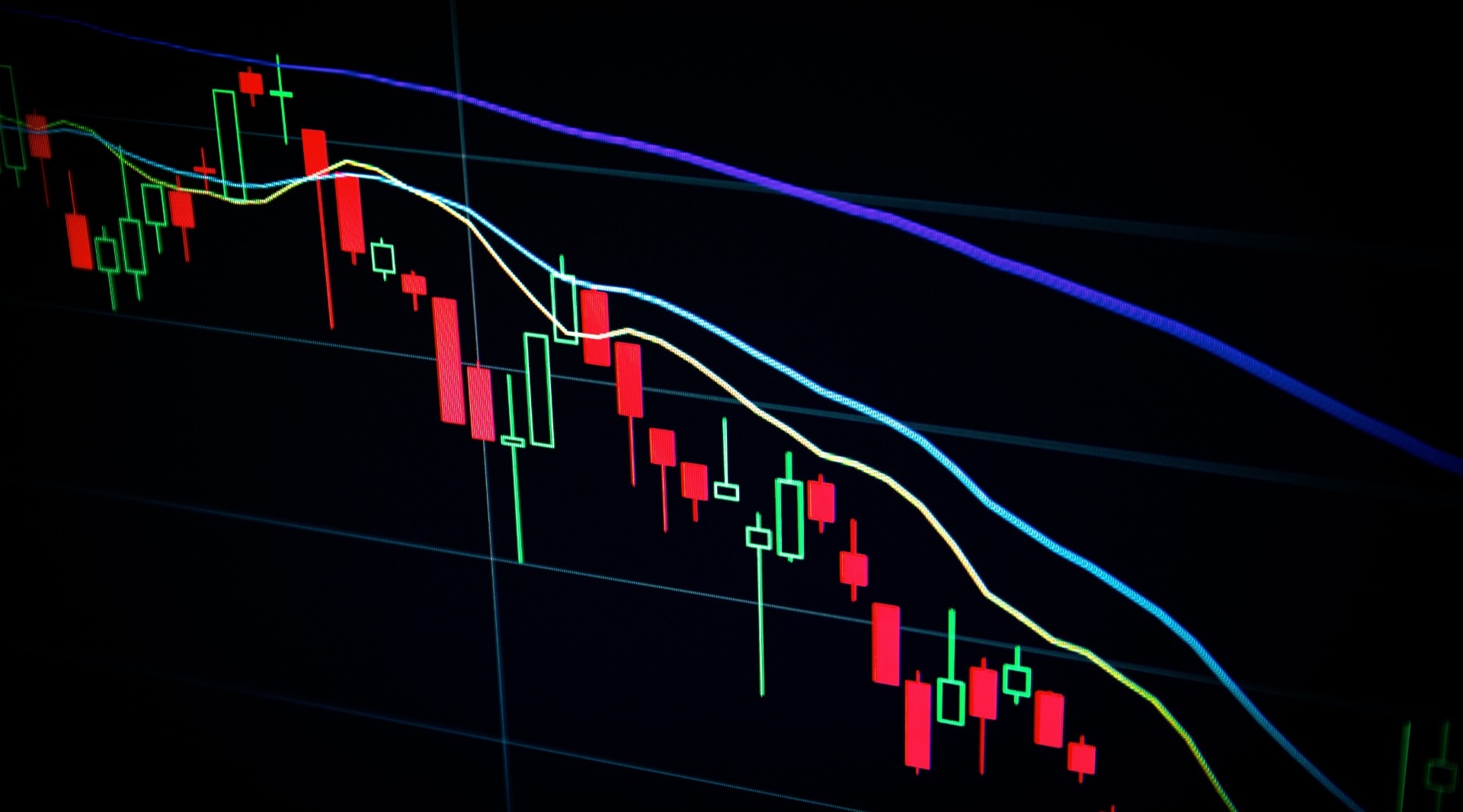
The Evening Star pattern is a useful tool for traders to identify potential reversals.
The Evening Star pattern is a highly reliable reversal pattern that occurs in upward trends and signals a potential peak or slowdown in price advancement. It's a three-candlestick pattern that is often used by traders as a signal for when to sell their position or even enter a short position.
The first candlestick in the Evening Star pattern is a large bullish candle, which closes at its highest point. This represents the continuation of an existing uptrend. The second candlestick gaps up and is a small-bodied candle (either bullish or bearish), indicating a possible change in trend. The third candlestick is a large bearish candle that closes within the body of the first candlestick, suggesting a reversal from the uptrend.
The Evening Star pattern is more significant after an extended uptrend or if the pattern appears at a resistance level. Traders often look for confirmation of the pattern with a gap down or long black candlestick on the following day.
Here are some tips for trading the Evening Star pattern:
1. Confirmation: Always wait for confirmation before acting on an Evening Star pattern. Confirmation could be a gap down or a long black (bearish) candlestick on the following day.
2. Volume: Volume should be higher during the first and third candlesticks compared to the second one. A higher volume on the third candlestick confirms the bearish reversal.
3. Resistance Levels: The Evening Star pattern is more significant if it appears at a resistance level, such as a major moving average, pivot point, or Fibonacci retracement level.
4. Risk Management: As with any trading strategy, risk management is crucial. Always set a stop loss above the highest point of the Evening Star pattern to limit potential losses if the price doesn't reverse as expected.
5. Use with Other Indicators: The Evening Star pattern can be used in conjunction with other technical analysis tools such as trend lines, moving averages, and oscillators to increase its reliability.
The Evening Star pattern is a bearish reversal signal in technical analysis, often appearing at the end of an uptrend. It consists of three candlesticks: a large bullish candle, a small-bodied candle (indicating indecision), and a large bearish candle.
However, it carries certain risks. The pattern may not always accurately predict a market downturn. Market volatility, economic indicators, or unexpected news events can disrupt the pattern. Also, it's crucial to consider the overall trend and other technical indicators for confirmation. Therefore, relying solely on the Evening Star pattern for trading decisions can lead to potential financial risk.
In conclusion, the Evening Star pattern is a useful tool for traders to identify potential reversals in an uptrend. However, like all trading strategies, it should be used in conjunction with other indicators and tools, and proper risk management techniques should always be employed.
The Evening Star pattern is a highly reliable reversal pattern that occurs in upward trends and signals a potential peak or slowdown in price advancement. It's a three-candlestick pattern that is often used by traders as a signal for when to sell their position or even enter a short position.
The first candlestick in the Evening Star pattern is a large bullish candle, which closes at its highest point. This represents the continuation of an existing uptrend. The second candlestick gaps up and is a small-bodied candle (either bullish or bearish), indicating a possible change in trend. The third candlestick is a large bearish candle that closes within the body of the first candlestick, suggesting a reversal from the uptrend.
The Evening Star pattern is more significant after an extended uptrend or if the pattern appears at a resistance level. Traders often look for confirmation of the pattern with a gap down or long black candlestick on the following day.
Here are some tips for trading the Evening Star pattern:
1. Confirmation: Always wait for confirmation before acting on an Evening Star pattern. Confirmation could be a gap down or a long black (bearish) candlestick on the following day.
2. Volume: Volume should be higher during the first and third candlesticks compared to the second one. A higher volume on the third candlestick confirms the bearish reversal.
3. Resistance Levels: The Evening Star pattern is more significant if it appears at a resistance level, such as a major moving average, pivot point, or Fibonacci retracement level.
4. Risk Management: As with any trading strategy, risk management is crucial. Always set a stop loss above the highest point of the Evening Star pattern to limit potential losses if the price doesn't reverse as expected.
5. Use with Other Indicators: The Evening Star pattern can be used in conjunction with other technical analysis tools such as trend lines, moving averages, and oscillators to increase its reliability.
The Evening Star pattern is a bearish reversal signal in technical analysis, often appearing at the end of an uptrend. It consists of three candlesticks: a large bullish candle, a small-bodied candle (indicating indecision), and a large bearish candle.
However, it carries certain risks. The pattern may not always accurately predict a market downturn. Market volatility, economic indicators, or unexpected news events can disrupt the pattern. Also, it's crucial to consider the overall trend and other technical indicators for confirmation. Therefore, relying solely on the Evening Star pattern for trading decisions can lead to potential financial risk.
In conclusion, the Evening Star pattern is a useful tool for traders to identify potential reversals in an uptrend. However, like all trading strategies, it should be used in conjunction with other indicators and tools, and proper risk management techniques should always be employed.
FP Markets Winner Spotlight 🏆 | Global Broker of the Year 2025 #Trading #Broker #Innovation #Shorts
FP Markets Winner Spotlight 🏆 | Global Broker of the Year 2025 #Trading #Broker #Innovation #Shorts
FP Markets takes the spotlight as Global Broker of the Year 2025 at the Finance Magnates Awards.
Martin Stoilov, Head of Client Experience, shares that trust, innovation, and people played a key role in the company’s success, supported by a strong foundation of integrity and client-centricity.
Following this milestone, FP Markets continues to focus on growth, technology investment, and its core values of transparency and excellence.
👉 Be part of FM Awards 2026: https://awards.financemagnates.com/#nominate
FP Markets takes the spotlight as Global Broker of the Year 2025 at the Finance Magnates Awards.
Martin Stoilov, Head of Client Experience, shares that trust, innovation, and people played a key role in the company’s success, supported by a strong foundation of integrity and client-centricity.
Following this milestone, FP Markets continues to focus on growth, technology investment, and its core values of transparency and excellence.
👉 Be part of FM Awards 2026: https://awards.financemagnates.com/#nominate
In this video, we review @HolaPrimeMarketsOfficial, a multi-asset forex and CFDs broker offering different account types, trading platforms, and flexible trading conditions.
We cover the broker’s overall offering, including account options, trading environment, platforms like MT4 and MT5, and additional services such as managed accounts and fast withdrawals.
Watch the full video to see if Hola Prime Markets fits your trading needs.
📣 Stay up to date with the latest in finance and trading. Follow Finance Magnates for industry news, insights, and global event coverage.
Connect with us:
🔗 LinkedIn: /financemagnates
👍 Facebook: /financemagnates
📸 Instagram: https://www.instagram.com/financemagnates
🐦 X: https://x.com/financemagnates
🎥 TikTok: https://www.tiktok.com/tag/financemagnates
▶️ YouTube: /@financemagnates_official
#HolaPrime #ForexBroker #CFDTrading #FinanceMagnates #Trading #Forex #BrokerReview
In this video, we review @HolaPrimeMarketsOfficial, a multi-asset forex and CFDs broker offering different account types, trading platforms, and flexible trading conditions.
We cover the broker’s overall offering, including account options, trading environment, platforms like MT4 and MT5, and additional services such as managed accounts and fast withdrawals.
Watch the full video to see if Hola Prime Markets fits your trading needs.
📣 Stay up to date with the latest in finance and trading. Follow Finance Magnates for industry news, insights, and global event coverage.
Connect with us:
🔗 LinkedIn: /financemagnates
👍 Facebook: /financemagnates
📸 Instagram: https://www.instagram.com/financemagnates
🐦 X: https://x.com/financemagnates
🎥 TikTok: https://www.tiktok.com/tag/financemagnates
▶️ YouTube: /@financemagnates_official
#HolaPrime #ForexBroker #CFDTrading #FinanceMagnates #Trading #Forex #BrokerReview
Hola Prime Review: What You Need to Know | Full Breakdown by Finance Magnates
Hola Prime Review: What You Need to Know | Full Breakdown by Finance Magnates
In this video, we review @HolaPrime_Global, a proprietary trading firm offering evaluation programs and performance-based payouts in simulated market environments.
We cover how the challenge model works, including account types, profit splits (up to 95%), trading rules, and what it takes to reach a funded account. You’ll also learn about available platforms like MT4, MT5, cTrader, and more, along with insights into payouts, support, and trading conditions.
Watch the full video to see if Hola Prime fits your trading style.
📣 Stay up to date with the latest in finance and trading. Follow Finance Magnates for industry news, insights, and global event coverage.
Connect with us:
🔗 LinkedIn: /financemagnates
👍 Facebook: /financemagnates
📸 Instagram: https://www.instagram.com/financemagnates
🐦 X: https://x.com/financemagnates
🎥 TikTok: https://www.tiktok.com/tag/financemagnates
▶️ YouTube: /@financemagnates_official
#HolaPrime #PropFirm #Trading #FinanceMagnates #Forex #FuturesTrading #TradingReview #PropFirmReview
In this video, we review @HolaPrime_Global, a proprietary trading firm offering evaluation programs and performance-based payouts in simulated market environments.
We cover how the challenge model works, including account types, profit splits (up to 95%), trading rules, and what it takes to reach a funded account. You’ll also learn about available platforms like MT4, MT5, cTrader, and more, along with insights into payouts, support, and trading conditions.
Watch the full video to see if Hola Prime fits your trading style.
📣 Stay up to date with the latest in finance and trading. Follow Finance Magnates for industry news, insights, and global event coverage.
Connect with us:
🔗 LinkedIn: /financemagnates
👍 Facebook: /financemagnates
📸 Instagram: https://www.instagram.com/financemagnates
🐦 X: https://x.com/financemagnates
🎥 TikTok: https://www.tiktok.com/tag/financemagnates
▶️ YouTube: /@financemagnates_official
#HolaPrime #PropFirm #Trading #FinanceMagnates #Forex #FuturesTrading #TradingReview #PropFirmReview
Axi Winner Spotlight 🏆 | Global Most Innovative Broker 2025 #Innovation #Trading #Fintech #Broker
Axi Winner Spotlight 🏆 | Global Most Innovative Broker 2025 #Innovation #Trading #Fintech #Broker
Axi takes the spotlight at the Finance Magnates Awards, winning Global Most Innovative Broker 2025.
Olivia Xenofontos and Ivanna Openko share how the team will feel: proud, motivated, and ready to keep delivering.
They also describe the night as well-organized, focused, and enjoyable for all.
👉 Be part of FM Awards 2026.
Axi takes the spotlight at the Finance Magnates Awards, winning Global Most Innovative Broker 2025.
Olivia Xenofontos and Ivanna Openko share how the team will feel: proud, motivated, and ready to keep delivering.
They also describe the night as well-organized, focused, and enjoyable for all.
👉 Be part of FM Awards 2026.
Recognition that matters.
Built on transparency.
Driven by the industry.
The Finance Magnates Awards 2026.
Nominations are now open.
🔗 https://awards.financemagnates.com/?utm_source=SM&utm_medium=social&utm_campaign=recognition-matters
Recognition that matters.
Built on transparency.
Driven by the industry.
The Finance Magnates Awards 2026.
Nominations are now open.
🔗 https://awards.financemagnates.com/?utm_source=SM&utm_medium=social&utm_campaign=recognition-matters