Security Spend Is Rising Faster Than Marketing Budgets and That's Reshaping Crypto Competition in 2026
Tuesday,24/02/2026|07:47GMTby
FM
Crypto competition shifts: Security spend beats marketing; trust, compliance, and resilience are key.
Cybersecurity Ventures' data shows that global spending on security products and services is projected to reach $522 billion in 2026. This figure represents a fundamental decoupling from the logic that drove the previous market cycle. In 2021 and 2022, exchange dominance was often measured by stadium naming rights and celebrity endorsements. By the close of 2025, that metric shifted increasingly to the "cost of doing business"—specifically, the cost of infrastructure hardening.
As digital assets integrated deeper into traditional finance over the last twelve months, the primary driver for user acquisition stopped being marketing visibility. It became trust. Capital allocation strategies have pivoted aggressively from customer acquisition costs to operational resilience. In this matured environment, a platform's ability to remain solvent and secure during stress events offers a higher return on investment than any advertising campaign.
Why Security Investment Scales Non-Linearly
The math regarding risk management has changed. As platforms expand, the attack vectors become increasingly driven by artificial intelligence, requiring defensive spending that outpaces user growth.
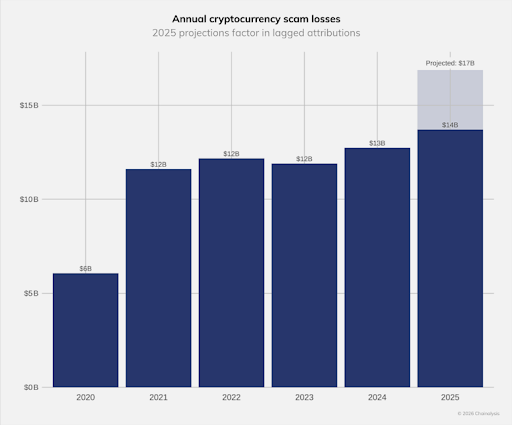
Chainalysis estimates that cryptocurrency scams and fraudreached $17 billion in 2025 alone, which suggest that the primary vector is no longer just code vulnerabilities but the human element.
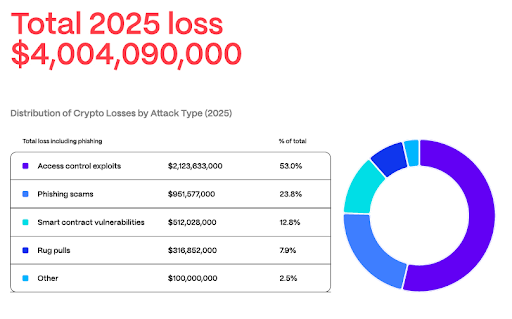
Hacken’s data shows that access control failures accounted for approximately$2.12 billion in losses in 2025. This figure represents roughly 53% of all recorded incidents and signals that smart contracts are hardening but internal access remains a critical battlefield.
This environment demands a regulatory framework that enforces rigorous internal controls. Binance Co-CEO Richard Teng notes thatsecuring the first global exchange license under the ADGM framework "means that we adhere to the gold standard on risk management, governance, and compliance prescribed by the ADGM across the entire spectrum of our activities." This adherence is not merely bureaucratic; it is the structural prerequisite for handling scale, as the platform recently "crossed300 million users globally."
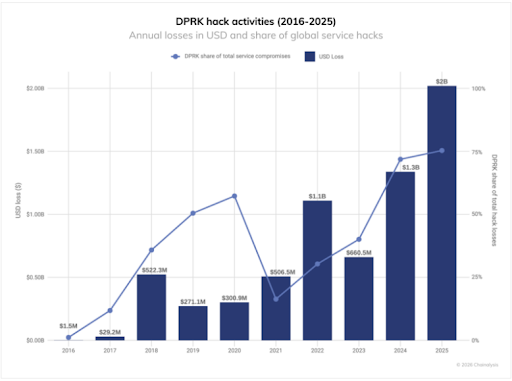
The necessity for such scaling becomes clear when viewing the sophistication of state-sponsored actors. The Lazarus Group alone was responsible forstealing $2.02 billion in 2025, according to Chainalysis, turning large, centralized platforms into high-stakes targets. A doubling of users does not simply double the risk; it creates a honeypot effect that requires exponential investment in defense systems to counter AI-driven social engineering and sophisticated intrusion attempts.
Retail traders might chase volatility, but institutional capital demands custodial certainty. TheBasel Committee on Banking Supervision's principles for operational resilience now dictate that financial entities must be judged by their "tolerance for disruption." This shift has effectively ended the wild west era of asset management; institutions will not deploy capital where infrastructure cannot withstand severe stress scenarios.
Data from 2025 supports this flight to quality. Binance's Year in Review noted a 21% YoY increase in institutional trading volume. It's an influx that suggests that sophisticated market participants are prioritizing venues that demonstrate robust infrastructure over those offering novel and untested features. Binance Head of VIP & Institutional Catherine Chen expanded on this during the WEF in Davos recently, “We believe smart regulation is essential to unlocking further institutional participation.” Chen continued, “The next step is consistent, risk-based implementation across jurisdictions, with clear licensing, custody, and consumer-protection standards.”
The threat landscape reinforces this caution. TRM Labs observed a distinct shift in attacker focus during 2025 moving fromdecentralized cross-chain bridges toward centralized infrastructure. As attackers target centralized exchanges with greater frequency, the security burden on these platforms has increased, forcing budgets to divert rapidly from marketing departments to compliance and cold storage technologies. Institutional partners require assurance that a platform can defend against these targeted strikes before they integrate their order books.
Platforms Competing on Resilience Rather Than Reach
In the current market structure, compliance functions act less like legal safeguards and more like product features that ensure longevity. The ability to stop funds from leaving the ecosystem illicitly is a measurable value proposition.
In 2025, Binance's risk controls prevented $6.69 billion in potential losses for 5.4 million users. Furthermore, the platform recorded a 96% reduction in direct exposure to illicit funds between 2023 and 2025.
Noah Perlman, Chief Compliance Officer at Binance, highlights this trend, noting that the "analysis of independent industry data shows a steep reduction in our direct illicit exposure," a feat accomplished "even as Binance handled growing volumes comparable to the next six largest exchanges combined." This illustrates a new competitive reality: compliance teams are effectively growth engines—preserving the license to operate in a tightening global jurisdiction.
This performance contrasts sharply with the broader Web3 ecosystem (where governance often lags). In this sector, Hacken reported that $4 billion was lost to Web3 incidents in 2025.
The disparity between platforms capable of preventing billions in fraud and a broader market that continues to bleed capital defines the new competitive landscape. Users are migrating toward safety, and platforms are competing on their ability to provide it.
Why Security Investment Now Correlates with User Retention
As the industry moves through 2026, the marketing budget of the past has effectively morphed into the security budget of the present. The most effective advertisement is a platform that remains solvent and operational during a crisis.
TheNIST Cybersecurity Framework 2.0 emphasizes that governance is now the core component of risk management. Platforms that govern risk effectively are the ones positioned to survive the next cycle. In mature crypto markets, capital flows not to the loudest voice, but to the strongest vault.
Cybersecurity Ventures' data shows that global spending on security products and services is projected to reach $522 billion in 2026. This figure represents a fundamental decoupling from the logic that drove the previous market cycle. In 2021 and 2022, exchange dominance was often measured by stadium naming rights and celebrity endorsements. By the close of 2025, that metric shifted increasingly to the "cost of doing business"—specifically, the cost of infrastructure hardening.
As digital assets integrated deeper into traditional finance over the last twelve months, the primary driver for user acquisition stopped being marketing visibility. It became trust. Capital allocation strategies have pivoted aggressively from customer acquisition costs to operational resilience. In this matured environment, a platform's ability to remain solvent and secure during stress events offers a higher return on investment than any advertising campaign.
Why Security Investment Scales Non-Linearly
The math regarding risk management has changed. As platforms expand, the attack vectors become increasingly driven by artificial intelligence, requiring defensive spending that outpaces user growth.
Chainalysis estimates that cryptocurrency scams and fraudreached $17 billion in 2025 alone, which suggest that the primary vector is no longer just code vulnerabilities but the human element.
Hacken’s data shows that access control failures accounted for approximately$2.12 billion in losses in 2025. This figure represents roughly 53% of all recorded incidents and signals that smart contracts are hardening but internal access remains a critical battlefield.
This environment demands a regulatory framework that enforces rigorous internal controls. Binance Co-CEO Richard Teng notes thatsecuring the first global exchange license under the ADGM framework "means that we adhere to the gold standard on risk management, governance, and compliance prescribed by the ADGM across the entire spectrum of our activities." This adherence is not merely bureaucratic; it is the structural prerequisite for handling scale, as the platform recently "crossed300 million users globally."
The necessity for such scaling becomes clear when viewing the sophistication of state-sponsored actors. The Lazarus Group alone was responsible forstealing $2.02 billion in 2025, according to Chainalysis, turning large, centralized platforms into high-stakes targets. A doubling of users does not simply double the risk; it creates a honeypot effect that requires exponential investment in defense systems to counter AI-driven social engineering and sophisticated intrusion attempts.
Retail traders might chase volatility, but institutional capital demands custodial certainty. TheBasel Committee on Banking Supervision's principles for operational resilience now dictate that financial entities must be judged by their "tolerance for disruption." This shift has effectively ended the wild west era of asset management; institutions will not deploy capital where infrastructure cannot withstand severe stress scenarios.
Data from 2025 supports this flight to quality. Binance's Year in Review noted a 21% YoY increase in institutional trading volume. It's an influx that suggests that sophisticated market participants are prioritizing venues that demonstrate robust infrastructure over those offering novel and untested features. Binance Head of VIP & Institutional Catherine Chen expanded on this during the WEF in Davos recently, “We believe smart regulation is essential to unlocking further institutional participation.” Chen continued, “The next step is consistent, risk-based implementation across jurisdictions, with clear licensing, custody, and consumer-protection standards.”
The threat landscape reinforces this caution. TRM Labs observed a distinct shift in attacker focus during 2025 moving fromdecentralized cross-chain bridges toward centralized infrastructure. As attackers target centralized exchanges with greater frequency, the security burden on these platforms has increased, forcing budgets to divert rapidly from marketing departments to compliance and cold storage technologies. Institutional partners require assurance that a platform can defend against these targeted strikes before they integrate their order books.
Platforms Competing on Resilience Rather Than Reach
In the current market structure, compliance functions act less like legal safeguards and more like product features that ensure longevity. The ability to stop funds from leaving the ecosystem illicitly is a measurable value proposition.
In 2025, Binance's risk controls prevented $6.69 billion in potential losses for 5.4 million users. Furthermore, the platform recorded a 96% reduction in direct exposure to illicit funds between 2023 and 2025.
Noah Perlman, Chief Compliance Officer at Binance, highlights this trend, noting that the "analysis of independent industry data shows a steep reduction in our direct illicit exposure," a feat accomplished "even as Binance handled growing volumes comparable to the next six largest exchanges combined." This illustrates a new competitive reality: compliance teams are effectively growth engines—preserving the license to operate in a tightening global jurisdiction.
This performance contrasts sharply with the broader Web3 ecosystem (where governance often lags). In this sector, Hacken reported that $4 billion was lost to Web3 incidents in 2025.
The disparity between platforms capable of preventing billions in fraud and a broader market that continues to bleed capital defines the new competitive landscape. Users are migrating toward safety, and platforms are competing on their ability to provide it.
Why Security Investment Now Correlates with User Retention
As the industry moves through 2026, the marketing budget of the past has effectively morphed into the security budget of the present. The most effective advertisement is a platform that remains solvent and operational during a crisis.
TheNIST Cybersecurity Framework 2.0 emphasizes that governance is now the core component of risk management. Platforms that govern risk effectively are the ones positioned to survive the next cycle. In mature crypto markets, capital flows not to the loudest voice, but to the strongest vault.
Why the Future of Brokerage Technology Is Built Around Unified Trader Journeys — and How Markets CRM Helps Enable It
Axi Winner Spotlight 🏆 | Global Most Innovative Broker 2025 #Innovation #Trading #Fintech #Broker
Axi Winner Spotlight 🏆 | Global Most Innovative Broker 2025 #Innovation #Trading #Fintech #Broker
Axi takes the spotlight at the Finance Magnates Awards, winning Global Most Innovative Broker 2025.
Olivia Xenofontos and Ivanna Openko share how the team will feel: proud, motivated, and ready to keep delivering.
They also describe the night as well-organized, focused, and enjoyable for all.
👉 Be part of FM Awards 2026.
Axi takes the spotlight at the Finance Magnates Awards, winning Global Most Innovative Broker 2025.
Olivia Xenofontos and Ivanna Openko share how the team will feel: proud, motivated, and ready to keep delivering.
They also describe the night as well-organized, focused, and enjoyable for all.
👉 Be part of FM Awards 2026.
Recognition that matters.
Built on transparency.
Driven by the industry.
The Finance Magnates Awards 2026.
Nominations are now open.
🔗 https://awards.financemagnates.com/?utm_source=SM&utm_medium=social&utm_campaign=recognition-matters
Recognition that matters.
Built on transparency.
Driven by the industry.
The Finance Magnates Awards 2026.
Nominations are now open.
🔗 https://awards.financemagnates.com/?utm_source=SM&utm_medium=social&utm_campaign=recognition-matters
Tickmill Winner Spotlight | Broker of the Year 2025 (LATAM) 🏆 | Finance Magnates Awards #Trading
Tickmill Winner Spotlight | Broker of the Year 2025 (LATAM) 🏆 | Finance Magnates Awards #Trading
What helped Tickmill stand out this year?
In this Winner Spotlight, Johnny Khalil, Executive Director at Tickmill Europe, shares how listening closely to clients and delivering strong trading conditions made the difference.
A big thank you to the community whose support continues to drive progress every day.
👉 Think your brand has what it takes? Nominate for the 2026 Finance Magnates Awards: https://awards.financemagnates.com/#nominate
What helped Tickmill stand out this year?
In this Winner Spotlight, Johnny Khalil, Executive Director at Tickmill Europe, shares how listening closely to clients and delivering strong trading conditions made the difference.
A big thank you to the community whose support continues to drive progress every day.
👉 Think your brand has what it takes? Nominate for the 2026 Finance Magnates Awards: https://awards.financemagnates.com/#nominate
CMC Markets’ Artur Delijergijevs on Metals Demand, Volatility, & Stable Execution
CMC Markets’ Artur Delijergijevs on Metals Demand, Volatility, & Stable Execution
In this exclusive Executive Interview, Finance Magnates speaks with Artur Delijergijevs, Head of Systematic Market Making at CMC Markets, about the current state of metals demand and market volatility.
Delijergijevs offers a desk-level view on:
- Metals Demand: Why metals are seeing the strongest demand from both retail and institutional clients right now.
- The Safe-Haven Debate: Questioning whether gold still fits the classic safe-haven definition given large daily price movements.
- Volatile Market Prep: How a market-making desk prepares its systems and pricing for stressed market conditions and high-impact economic events.
- Hybrid Execution: Why the best execution model combines electronic speed with human relationship support, especially during volatility.
- AI in Workflow: Where CMC Markets is integrating machine learning for risk management and pricing, and the limitations of AI during stressed markets.
- Dubai's Role: The strategic importance of Dubai’s location for covering global trading sessions across Asia, Europe, and the US.
Watch to understand how CMC Markets maintains stable pricing and reliable execution quality in high-volatility environments.
#CMCmarkets #forex #metals #gold #trading #volatility #MarketMaking #iFXDubai #FinanceMagnates #Finance #Fintech #Execution #AlgorithmicTrading #RiskManagement
In this exclusive Executive Interview, Finance Magnates speaks with Artur Delijergijevs, Head of Systematic Market Making at CMC Markets, about the current state of metals demand and market volatility.
Delijergijevs offers a desk-level view on:
- Metals Demand: Why metals are seeing the strongest demand from both retail and institutional clients right now.
- The Safe-Haven Debate: Questioning whether gold still fits the classic safe-haven definition given large daily price movements.
- Volatile Market Prep: How a market-making desk prepares its systems and pricing for stressed market conditions and high-impact economic events.
- Hybrid Execution: Why the best execution model combines electronic speed with human relationship support, especially during volatility.
- AI in Workflow: Where CMC Markets is integrating machine learning for risk management and pricing, and the limitations of AI during stressed markets.
- Dubai's Role: The strategic importance of Dubai’s location for covering global trading sessions across Asia, Europe, and the US.
Watch to understand how CMC Markets maintains stable pricing and reliable execution quality in high-volatility environments.
#CMCmarkets #forex #metals #gold #trading #volatility #MarketMaking #iFXDubai #FinanceMagnates #Finance #Fintech #Execution #AlgorithmicTrading #RiskManagement
Finance Magnates Awards 2026 – Nominations Now Open
Finance Magnates Awards 2026 – Nominations Now Open
The Finance Magnates Awards 2026 nominations are now open. 🏆
From fintech innovators to leading brokers, this is where the finance industry celebrates its biggest achievements.
Winners will be announced at the Cyprus Gala Dinner on November 6, 2026.
Nominate your brand now.
https://awards.financemagnates.com/?utm_source=linkedin&utm_medium=video&utm_campaign=nominations-open
#FMAwards #FinanceMagnates #FintechAwards #Fintech #FinanceIndustry
The Finance Magnates Awards 2026 nominations are now open. 🏆
From fintech innovators to leading brokers, this is where the finance industry celebrates its biggest achievements.
Winners will be announced at the Cyprus Gala Dinner on November 6, 2026.
Nominate your brand now.
https://awards.financemagnates.com/?utm_source=linkedin&utm_medium=video&utm_campaign=nominations-open
#FMAwards #FinanceMagnates #FintechAwards #Fintech #FinanceIndustry