How Transnational Businesses Are Using Blockchain to Solve Real World Problems
Monday,13/06/2022|12:37GMTby
FM
Let’s take a closer look at how businesses harness blockchain to solve real world problems
A blockchain is a series of timestamped database entries that are virtually impossible to forge or alter after the fact. It doesn’t sound like game-changing technology, and yet blockchain has arguably been the most disruptive breakthrough of the last 20 years. To its proponents it’s the greatest invention since the Internet itself and the backbone of a revolution that’s shaking up industries the world over.
As is so often the case, the truth of the matter lies somewhere between the two extremes: blockchain is indeed transformative tech, but it’s not a panacea for all the world’s woes. In reality, its prime beneficiaries are those businesses that straddle continents, countries, and markets. The sort of transnational entities whose goods – be they tangible or intangible – pass through an array of intermediaries as they traverse the globe.
Let’s take a closer look at some of these businesses and the ways in which they’re harnessing blockchain to solve real world problems.
In the Beginning There Was One
Long before blockchain became synonymous with business, there was Bitcoin. The distributed ledger used by Satoshi Nakomoto to power the world’s first cryptocurrency didn’t attract much attention at first; then again, neither did Bitcoin. By 2017, however, both had been thrust into the spotlight as BTC hit record highs of $20,000 and blockchain was being talked up as a possible solution to all kinds of enterprise conundrums.
The dust has since settled on the excesses of 2017, and a number of things have become evident:
1.
Bitcoin is here to stay.
2.
Blockchain has a number of applications beyond moving money.
3.
Many of these use cases revolve around logistics and transportation.
The first two statements do not require elucidation. The third demands more detail. Why does the movement of goods – an industry that has been in existence for millennia – suddenly require blockchain? Let’s dive in and find out.
Harboring Trust in a Trustless World
In the modern world, the bulk of the world’s freight is manufactured in the east and then shipped west in hulking container ships. The management of these goods, as they wend their way slowly across the ocean, is a labyrinthine task that involves multiple intermediaries: manufacturers, packers, shippers, lorry transporters, port services, customs, shipping operators – and that’s just to leave China. It’s the same story again at every port the ship alights at on its journey.
Many of the goods being transported in this manner are temperature and time sensitive. It’s important for the recipient to be able to determine that these conditions have been maintained throughout their passage. Bills of lading can be tampered with, however, and inspection receipts forged. Without being present at every point at which the goods were inspected or transported, it’s impossible to attest to the veracity of the documentation.
It’s here that blockchain enters the equation, providing a system for establishing proof that certain conditions were met at a specific date or time. As a December 2021 academic paper on blockchain for port operations and logistics management observed, “existing systems fall short of providing traceability, transparency, information security, and immutability of data stored and exchanged during various operational processes. As a result, the productivity of port terminals is adversely affected. Blockchain…provides traceability, transparency, auditability through immutable provenance data of on-chain trusted transactions.”
In 2021, the Global Shipping Business Network (GSBN) was established to help digitize the global logistics industry. “The supply chain is a very fragmented market with participants who largely rely on paper,” explains the firm’s CEO Bertrand Chen. “The biggest issue is: how do we share the data?”
From Harbors to Waterways
Where there’s water, there’s invariably blockchain it appears. While port authorities have their own reasons for utilizing the tech – Spain’s introduced a blockchain pilot as far back as 2018 – there are other maritime entities following suit. SeaCoast is a startup intent on provisioning informational services for maritime travelers; tourists, sea captains, rowers, beachcombers and anyone else whose excursions incorporate littoral areas.
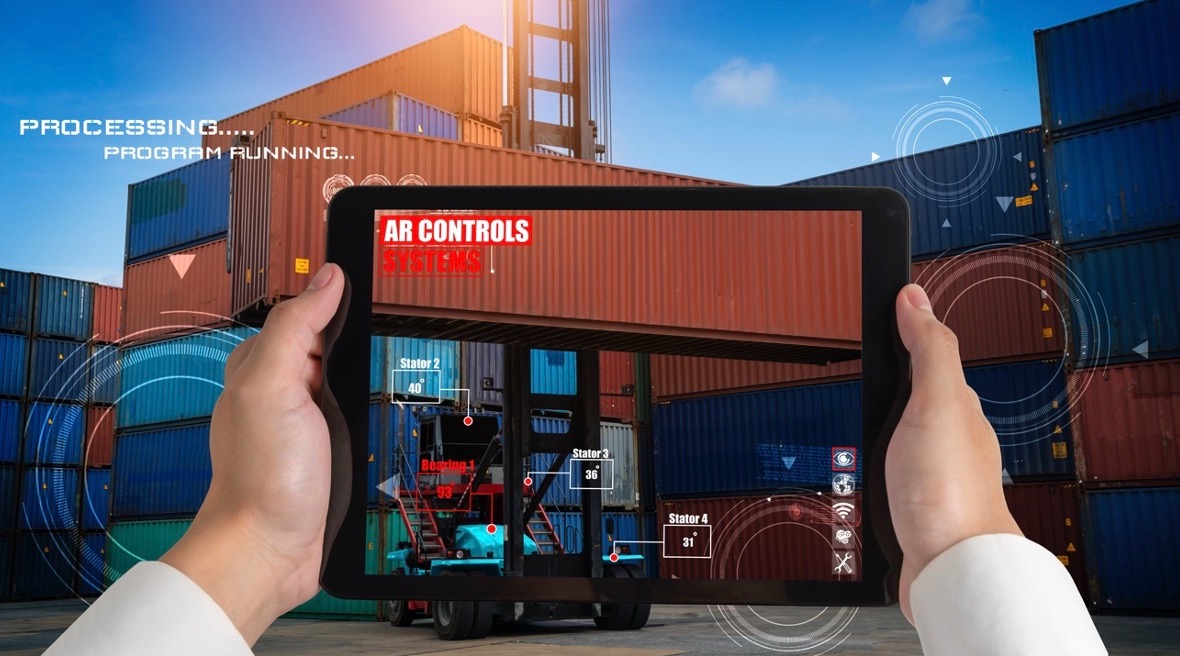
Using augmented reality, SeaCoast’s technology overlays data points onto smartphone footage of local amenities, detailing shops, points of interest and, in the case of its PortView app, mooring and harbor navigation information to improve safety when docking. SeaCoast is using blockchain to power a tokenized rewards system that incentivizes maritime visitors to submit up-to-date information and exchange coastal data.
The Logistics of Blockchain
We live in a hyperconnected and increasingly complex world. As the Internet of Things proliferates, we will ultimately arrive at IoT’s singularity, whereupon the number of humans using the web will be dwarved by the number of automated networked devices. Smart sensors will be built into everything, including every carton, packet, and package being shipped around the world in container ships, beaming their status to a mainframe that will update every intermediary in the supply chain as to its status. And the database being used to record this hive of activity? Naturally, it’s a blockchain.
A blockchain is a series of timestamped database entries that are virtually impossible to forge or alter after the fact. It doesn’t sound like game-changing technology, and yet blockchain has arguably been the most disruptive breakthrough of the last 20 years. To its proponents it’s the greatest invention since the Internet itself and the backbone of a revolution that’s shaking up industries the world over.
As is so often the case, the truth of the matter lies somewhere between the two extremes: blockchain is indeed transformative tech, but it’s not a panacea for all the world’s woes. In reality, its prime beneficiaries are those businesses that straddle continents, countries, and markets. The sort of transnational entities whose goods – be they tangible or intangible – pass through an array of intermediaries as they traverse the globe.
Let’s take a closer look at some of these businesses and the ways in which they’re harnessing blockchain to solve real world problems.
In the Beginning There Was One
Long before blockchain became synonymous with business, there was Bitcoin. The distributed ledger used by Satoshi Nakomoto to power the world’s first cryptocurrency didn’t attract much attention at first; then again, neither did Bitcoin. By 2017, however, both had been thrust into the spotlight as BTC hit record highs of $20,000 and blockchain was being talked up as a possible solution to all kinds of enterprise conundrums.
The dust has since settled on the excesses of 2017, and a number of things have become evident:
1.
Bitcoin is here to stay.
2.
Blockchain has a number of applications beyond moving money.
3.
Many of these use cases revolve around logistics and transportation.
The first two statements do not require elucidation. The third demands more detail. Why does the movement of goods – an industry that has been in existence for millennia – suddenly require blockchain? Let’s dive in and find out.
Harboring Trust in a Trustless World
In the modern world, the bulk of the world’s freight is manufactured in the east and then shipped west in hulking container ships. The management of these goods, as they wend their way slowly across the ocean, is a labyrinthine task that involves multiple intermediaries: manufacturers, packers, shippers, lorry transporters, port services, customs, shipping operators – and that’s just to leave China. It’s the same story again at every port the ship alights at on its journey.
Many of the goods being transported in this manner are temperature and time sensitive. It’s important for the recipient to be able to determine that these conditions have been maintained throughout their passage. Bills of lading can be tampered with, however, and inspection receipts forged. Without being present at every point at which the goods were inspected or transported, it’s impossible to attest to the veracity of the documentation.
It’s here that blockchain enters the equation, providing a system for establishing proof that certain conditions were met at a specific date or time. As a December 2021 academic paper on blockchain for port operations and logistics management observed, “existing systems fall short of providing traceability, transparency, information security, and immutability of data stored and exchanged during various operational processes. As a result, the productivity of port terminals is adversely affected. Blockchain…provides traceability, transparency, auditability through immutable provenance data of on-chain trusted transactions.”
In 2021, the Global Shipping Business Network (GSBN) was established to help digitize the global logistics industry. “The supply chain is a very fragmented market with participants who largely rely on paper,” explains the firm’s CEO Bertrand Chen. “The biggest issue is: how do we share the data?”
From Harbors to Waterways
Where there’s water, there’s invariably blockchain it appears. While port authorities have their own reasons for utilizing the tech – Spain’s introduced a blockchain pilot as far back as 2018 – there are other maritime entities following suit. SeaCoast is a startup intent on provisioning informational services for maritime travelers; tourists, sea captains, rowers, beachcombers and anyone else whose excursions incorporate littoral areas.
Using augmented reality, SeaCoast’s technology overlays data points onto smartphone footage of local amenities, detailing shops, points of interest and, in the case of its PortView app, mooring and harbor navigation information to improve safety when docking. SeaCoast is using blockchain to power a tokenized rewards system that incentivizes maritime visitors to submit up-to-date information and exchange coastal data.
The Logistics of Blockchain
We live in a hyperconnected and increasingly complex world. As the Internet of Things proliferates, we will ultimately arrive at IoT’s singularity, whereupon the number of humans using the web will be dwarved by the number of automated networked devices. Smart sensors will be built into everything, including every carton, packet, and package being shipped around the world in container ships, beaming their status to a mainframe that will update every intermediary in the supply chain as to its status. And the database being used to record this hive of activity? Naturally, it’s a blockchain.
FP Markets Winner Spotlight 🏆 | Global Broker of the Year 2025 #Trading #Broker #Innovation #Shorts
FP Markets Winner Spotlight 🏆 | Global Broker of the Year 2025 #Trading #Broker #Innovation #Shorts
FP Markets takes the spotlight as Global Broker of the Year 2025 at the Finance Magnates Awards.
Martin Stoilov, Head of Client Experience, shares that trust, innovation, and people played a key role in the company’s success, supported by a strong foundation of integrity and client-centricity.
Following this milestone, FP Markets continues to focus on growth, technology investment, and its core values of transparency and excellence.
👉 Be part of FM Awards 2026: https://awards.financemagnates.com/#nominate
FP Markets takes the spotlight as Global Broker of the Year 2025 at the Finance Magnates Awards.
Martin Stoilov, Head of Client Experience, shares that trust, innovation, and people played a key role in the company’s success, supported by a strong foundation of integrity and client-centricity.
Following this milestone, FP Markets continues to focus on growth, technology investment, and its core values of transparency and excellence.
👉 Be part of FM Awards 2026: https://awards.financemagnates.com/#nominate
In this video, we review @HolaPrimeMarketsOfficial, a multi-asset forex and CFDs broker offering different account types, trading platforms, and flexible trading conditions.
We cover the broker’s overall offering, including account options, trading environment, platforms like MT4 and MT5, and additional services such as managed accounts and fast withdrawals.
Watch the full video to see if Hola Prime Markets fits your trading needs.
📣 Stay up to date with the latest in finance and trading. Follow Finance Magnates for industry news, insights, and global event coverage.
Connect with us:
🔗 LinkedIn: /financemagnates
👍 Facebook: /financemagnates
📸 Instagram: https://www.instagram.com/financemagnates
🐦 X: https://x.com/financemagnates
🎥 TikTok: https://www.tiktok.com/tag/financemagnates
▶️ YouTube: /@financemagnates_official
#HolaPrime #ForexBroker #CFDTrading #FinanceMagnates #Trading #Forex #BrokerReview
In this video, we review @HolaPrimeMarketsOfficial, a multi-asset forex and CFDs broker offering different account types, trading platforms, and flexible trading conditions.
We cover the broker’s overall offering, including account options, trading environment, platforms like MT4 and MT5, and additional services such as managed accounts and fast withdrawals.
Watch the full video to see if Hola Prime Markets fits your trading needs.
📣 Stay up to date with the latest in finance and trading. Follow Finance Magnates for industry news, insights, and global event coverage.
Connect with us:
🔗 LinkedIn: /financemagnates
👍 Facebook: /financemagnates
📸 Instagram: https://www.instagram.com/financemagnates
🐦 X: https://x.com/financemagnates
🎥 TikTok: https://www.tiktok.com/tag/financemagnates
▶️ YouTube: /@financemagnates_official
#HolaPrime #ForexBroker #CFDTrading #FinanceMagnates #Trading #Forex #BrokerReview
Hola Prime Review: What You Need to Know | Full Breakdown by Finance Magnates
Hola Prime Review: What You Need to Know | Full Breakdown by Finance Magnates
In this video, we review @HolaPrime_Global, a proprietary trading firm offering evaluation programs and performance-based payouts in simulated market environments.
We cover how the challenge model works, including account types, profit splits (up to 95%), trading rules, and what it takes to reach a funded account. You’ll also learn about available platforms like MT4, MT5, cTrader, and more, along with insights into payouts, support, and trading conditions.
Watch the full video to see if Hola Prime fits your trading style.
📣 Stay up to date with the latest in finance and trading. Follow Finance Magnates for industry news, insights, and global event coverage.
Connect with us:
🔗 LinkedIn: /financemagnates
👍 Facebook: /financemagnates
📸 Instagram: https://www.instagram.com/financemagnates
🐦 X: https://x.com/financemagnates
🎥 TikTok: https://www.tiktok.com/tag/financemagnates
▶️ YouTube: /@financemagnates_official
#HolaPrime #PropFirm #Trading #FinanceMagnates #Forex #FuturesTrading #TradingReview #PropFirmReview
In this video, we review @HolaPrime_Global, a proprietary trading firm offering evaluation programs and performance-based payouts in simulated market environments.
We cover how the challenge model works, including account types, profit splits (up to 95%), trading rules, and what it takes to reach a funded account. You’ll also learn about available platforms like MT4, MT5, cTrader, and more, along with insights into payouts, support, and trading conditions.
Watch the full video to see if Hola Prime fits your trading style.
📣 Stay up to date with the latest in finance and trading. Follow Finance Magnates for industry news, insights, and global event coverage.
Connect with us:
🔗 LinkedIn: /financemagnates
👍 Facebook: /financemagnates
📸 Instagram: https://www.instagram.com/financemagnates
🐦 X: https://x.com/financemagnates
🎥 TikTok: https://www.tiktok.com/tag/financemagnates
▶️ YouTube: /@financemagnates_official
#HolaPrime #PropFirm #Trading #FinanceMagnates #Forex #FuturesTrading #TradingReview #PropFirmReview
Axi Winner Spotlight 🏆 | Global Most Innovative Broker 2025 #Innovation #Trading #Fintech #Broker
Axi Winner Spotlight 🏆 | Global Most Innovative Broker 2025 #Innovation #Trading #Fintech #Broker
Axi takes the spotlight at the Finance Magnates Awards, winning Global Most Innovative Broker 2025.
Olivia Xenofontos and Ivanna Openko share how the team will feel: proud, motivated, and ready to keep delivering.
They also describe the night as well-organized, focused, and enjoyable for all.
👉 Be part of FM Awards 2026.
Axi takes the spotlight at the Finance Magnates Awards, winning Global Most Innovative Broker 2025.
Olivia Xenofontos and Ivanna Openko share how the team will feel: proud, motivated, and ready to keep delivering.
They also describe the night as well-organized, focused, and enjoyable for all.
👉 Be part of FM Awards 2026.
Recognition that matters.
Built on transparency.
Driven by the industry.
The Finance Magnates Awards 2026.
Nominations are now open.
🔗 https://awards.financemagnates.com/?utm_source=SM&utm_medium=social&utm_campaign=recognition-matters
Recognition that matters.
Built on transparency.
Driven by the industry.
The Finance Magnates Awards 2026.
Nominations are now open.
🔗 https://awards.financemagnates.com/?utm_source=SM&utm_medium=social&utm_campaign=recognition-matters