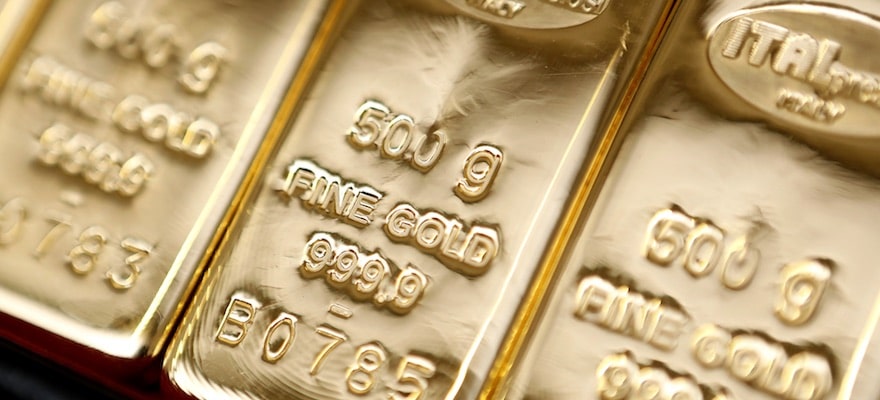
With US equity markets at their highs and bond yields falling, gold is once again regaining its luster
Bloomberg
Ongoing discussions are swirling about President Trump and President Xi’s meeting at the G20 summit In Japan. This was a high-stakes meeting with concerns about a slowdown in global growth, through a protracted trade war, the forefront of investors’ minds.
It is not hard to see why this is the case since 40% of the world’s GDP comes from the combined economies of the US and China. The meeting left many questions unanswered, and ultimately a backpedaling from the implementation of tariffs.
However, given Trump’s volatile nature, nobody knows if further tariffs will be threatened, making traditional safe haven assets enticing. This article will point out some of the go to safe haven assets that should interest you should the ongoing trade war take a turn for the worst.
Going for Gold
With the Federal Reserve having recently signaled a rate cut in July there is now a growing expectation of a global low interest rate landscape that could last for some time. One of the results of this has been the growing value of Gold against the USD.
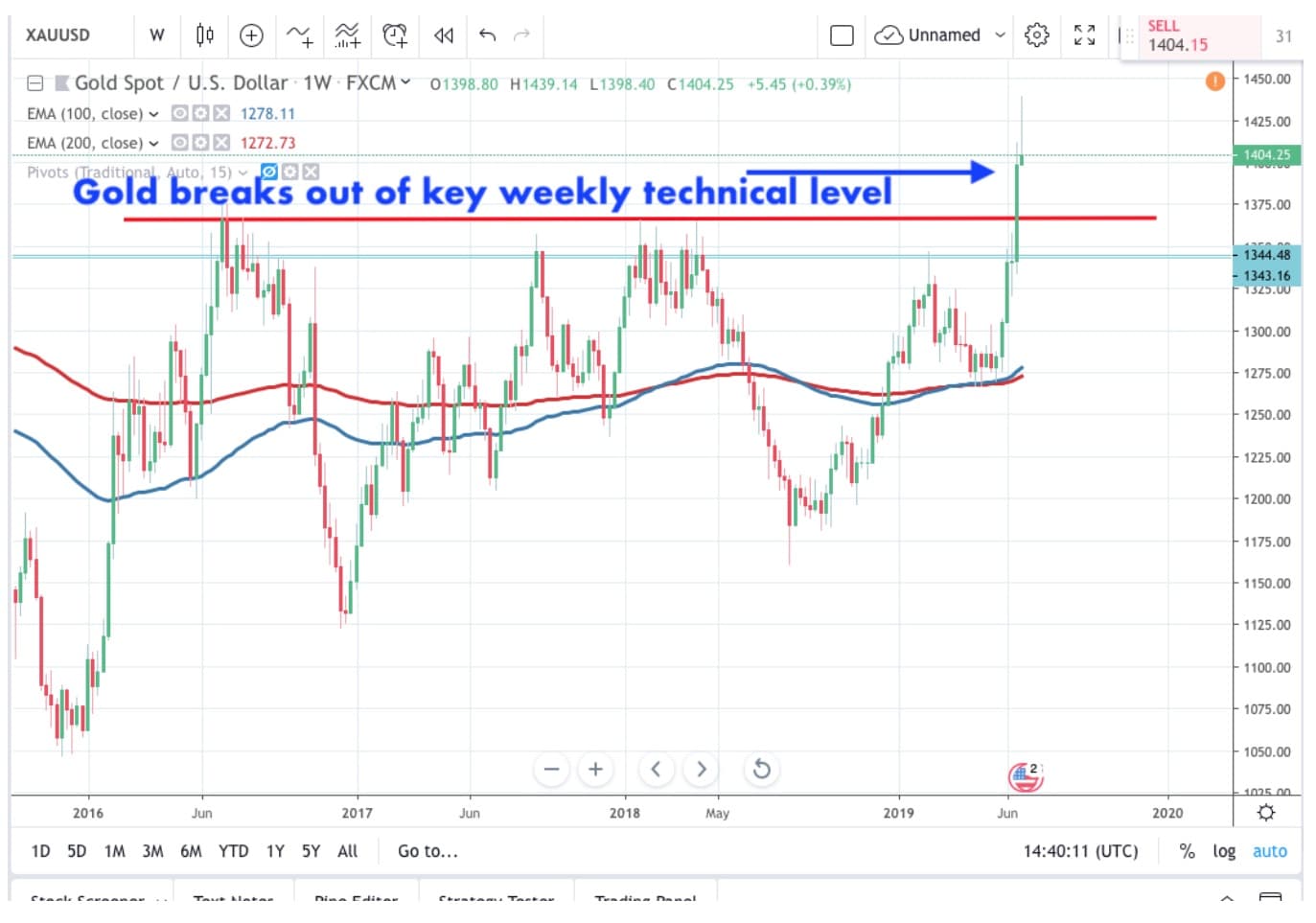
Before the last FOMC meeting Gold was kept underneath key weekly resistance on the XAU/USD chart, but with the dovish shift from the Fed Gold broke out of that level. See chart below:
The technical breakout is clean and convincing and a downturn in the latest G20 US-China trade talks will result in further Gold buying. The downside of owning Gold is that, unlike Bonds and Stocks, you do not get a return for holding the asset.
So, with US equity markets at their highs and bond yields falling across the world, Gold is once again regaining its attraction.
A US-China trade war storm will complete the fundamental picture to that technical and result in further gold strength going forward. When investors face very stormy markets, they like to go for Gold.
Bolting for Bonds
High grade bonds become a place of safety in uncertain times, since they are a better than holding cash, but they still do offer a fixed rate of return if the blind is kept for its full term.
The investing legend, Benjamin Graham, recommended having a 50-50 split between bonds and Equities and not allowing that ratio to differ by more than a 75-25 ratio split.
In other words, in uncertain times, he recommended having up to 75% of your portfolio in bonds. This would therefore make high grade government bonds, like US treasuries and UK gilts, attractive in stormy and uncertain financial.
Yearning for Yen
The Japanese Yen is a traditional safe haven currency. Negative interest rates, like the Bank of Japan currently has, would typically discourage currency capital inflows. However, the debt structuring of Japan means that the currency is considered very stable and safe for uncertain times.
As a result, when investors and speculators are fearful, there are sudden and marked inflows into the Japanese Yen. The pair that stands out for particular downside in a fresh round of the ongoing US-China trade war would be the AUD/JPY pair.
As around 30% of Australia’s economy is made up of trade with China it stands to lose out on a US-China trade war. Further trade strain would result in AUD weakness and JPY strength on safe haven flows.
Swinging to the Swiss franc
Another safe haven currency that would attract safe haven flows would be the Swiss Franc. That would see safe haven flows resulting in CHF strength.
However, it is worth bearing in mind that the Swiss National Bank (SNB) has an interest in ensuring that the CHF does not become too strong.
As Switzerland has an export economy a strong CHF hurts its exporters. As a result, the SNB maintains periodic intervention in the CHF. If the CHF becomes too strong, be alert to the possibility of intervention.
In uncertain times let the US Dollar Index be your guide
The Federal Reserve is the most important central bank in the world with the US dollar being the most traded currency in the world, comprising of around 70% of all transactions on a given day.
So, having a handle on what the Dollar is doing overall on any given day is going to be a key advantage for any trader. The Dollar Index will help you do just that.
The US Dollar Index is a guide for the direction of the USD in any pair
Trading any pair with a USD half will be guided by the USD index, so here are a couple of key facts to keep in your mind:
If the USD is the base currency (USD/xxx), then the US dollar Index and the currency pair will typically move in the same direction.
If the USD is the quote currency. (xxx/USD) then the US dollar index and the currency pair will typically move in opposite directions.
The US dollar index and the smile theory
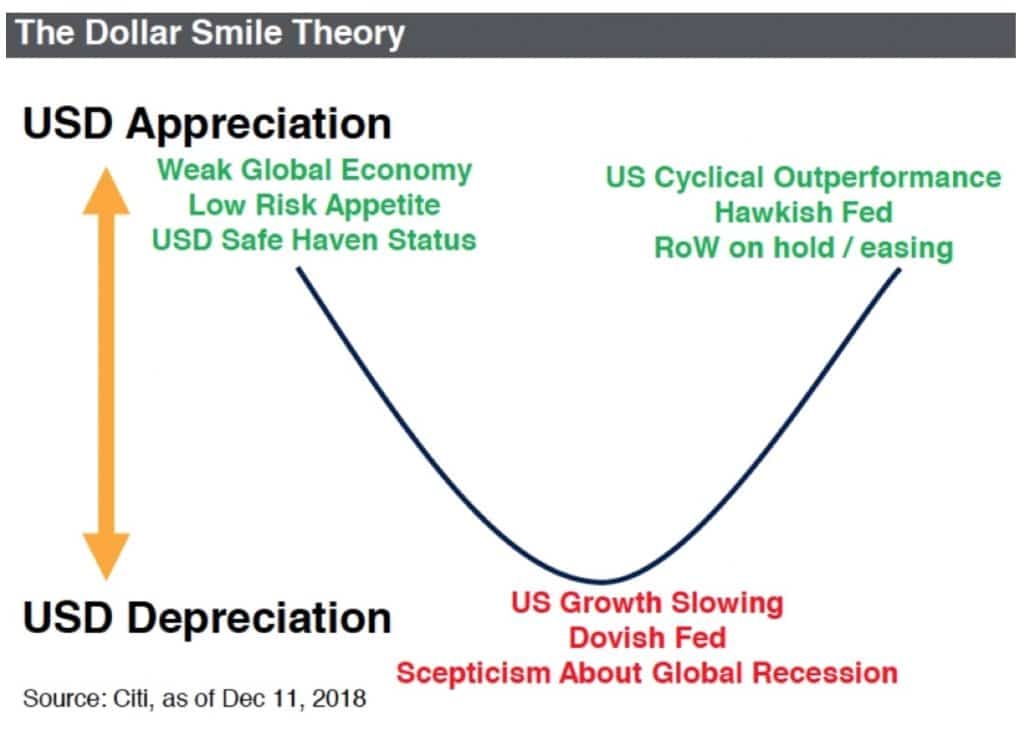
The US dollar index can give you a quick broad picture of the dollar and help you see what is going on with the market. The smile theory is worth mentioning since it is such a good way of expelling the three varying ways the dollar responds to different situations. If you look at the picture above you can see a smile.
On the left-hand side of the smile you have USD strength, which is when the global economy is struggling. This is where you have JPY, CHF strength and USD gains too as it acts as a safe haven currency.
The bottom part of the smile is where the USD depreciates on a dovish Fed. At the time of writing, in June 2019, the USD is falling with a more reserved Jerome Powell looking at a rate cut in July.
The right part of the smile is when the USD gains value on a hawkish fed and a risk on environment. This smile theory is useful as a quick rule of thumb for understanding the dollars present position and what is likely to happen next.
There is normally an inverse relationship between the value of the dollar and commodity prices. By getting into the habit of noticing the USD index as soon as you start trading you can speed up your analysis on the dollar and also gain invaluable insights to inform your next trading decision.
Disclaimer: The content of this article is sponsored and does not represent the opinions of Finance Magnates.
Ongoing discussions are swirling about President Trump and President Xi’s meeting at the G20 summit In Japan. This was a high-stakes meeting with concerns about a slowdown in global growth, through a protracted trade war, the forefront of investors’ minds.
It is not hard to see why this is the case since 40% of the world’s GDP comes from the combined economies of the US and China. The meeting left many questions unanswered, and ultimately a backpedaling from the implementation of tariffs.
However, given Trump’s volatile nature, nobody knows if further tariffs will be threatened, making traditional safe haven assets enticing. This article will point out some of the go to safe haven assets that should interest you should the ongoing trade war take a turn for the worst.
Going for Gold
With the Federal Reserve having recently signaled a rate cut in July there is now a growing expectation of a global low interest rate landscape that could last for some time. One of the results of this has been the growing value of Gold against the USD.
Before the last FOMC meeting Gold was kept underneath key weekly resistance on the XAU/USD chart, but with the dovish shift from the Fed Gold broke out of that level. See chart below:
The technical breakout is clean and convincing and a downturn in the latest G20 US-China trade talks will result in further Gold buying. The downside of owning Gold is that, unlike Bonds and Stocks, you do not get a return for holding the asset.
So, with US equity markets at their highs and bond yields falling across the world, Gold is once again regaining its attraction.
A US-China trade war storm will complete the fundamental picture to that technical and result in further gold strength going forward. When investors face very stormy markets, they like to go for Gold.
Bolting for Bonds
High grade bonds become a place of safety in uncertain times, since they are a better than holding cash, but they still do offer a fixed rate of return if the blind is kept for its full term.
The investing legend, Benjamin Graham, recommended having a 50-50 split between bonds and Equities and not allowing that ratio to differ by more than a 75-25 ratio split.
In other words, in uncertain times, he recommended having up to 75% of your portfolio in bonds. This would therefore make high grade government bonds, like US treasuries and UK gilts, attractive in stormy and uncertain financial.
Yearning for Yen
The Japanese Yen is a traditional safe haven currency. Negative interest rates, like the Bank of Japan currently has, would typically discourage currency capital inflows. However, the debt structuring of Japan means that the currency is considered very stable and safe for uncertain times.
As a result, when investors and speculators are fearful, there are sudden and marked inflows into the Japanese Yen. The pair that stands out for particular downside in a fresh round of the ongoing US-China trade war would be the AUD/JPY pair.
As around 30% of Australia’s economy is made up of trade with China it stands to lose out on a US-China trade war. Further trade strain would result in AUD weakness and JPY strength on safe haven flows.
Swinging to the Swiss franc
Another safe haven currency that would attract safe haven flows would be the Swiss Franc. That would see safe haven flows resulting in CHF strength.
However, it is worth bearing in mind that the Swiss National Bank (SNB) has an interest in ensuring that the CHF does not become too strong.
As Switzerland has an export economy a strong CHF hurts its exporters. As a result, the SNB maintains periodic intervention in the CHF. If the CHF becomes too strong, be alert to the possibility of intervention.
In uncertain times let the US Dollar Index be your guide
The Federal Reserve is the most important central bank in the world with the US dollar being the most traded currency in the world, comprising of around 70% of all transactions on a given day.
So, having a handle on what the Dollar is doing overall on any given day is going to be a key advantage for any trader. The Dollar Index will help you do just that.
The US Dollar Index is a guide for the direction of the USD in any pair
Trading any pair with a USD half will be guided by the USD index, so here are a couple of key facts to keep in your mind:
If the USD is the base currency (USD/xxx), then the US dollar Index and the currency pair will typically move in the same direction.
If the USD is the quote currency. (xxx/USD) then the US dollar index and the currency pair will typically move in opposite directions.
The US dollar index and the smile theory
The US dollar index can give you a quick broad picture of the dollar and help you see what is going on with the market. The smile theory is worth mentioning since it is such a good way of expelling the three varying ways the dollar responds to different situations. If you look at the picture above you can see a smile.
On the left-hand side of the smile you have USD strength, which is when the global economy is struggling. This is where you have JPY, CHF strength and USD gains too as it acts as a safe haven currency.
The bottom part of the smile is where the USD depreciates on a dovish Fed. At the time of writing, in June 2019, the USD is falling with a more reserved Jerome Powell looking at a rate cut in July.
The right part of the smile is when the USD gains value on a hawkish fed and a risk on environment. This smile theory is useful as a quick rule of thumb for understanding the dollars present position and what is likely to happen next.
There is normally an inverse relationship between the value of the dollar and commodity prices. By getting into the habit of noticing the USD index as soon as you start trading you can speed up your analysis on the dollar and also gain invaluable insights to inform your next trading decision.
Disclaimer: The content of this article is sponsored and does not represent the opinions of Finance Magnates.
FP Markets Winner Spotlight 🏆 | Global Broker of the Year 2025 #Trading #Broker #Innovation #Shorts
FP Markets Winner Spotlight 🏆 | Global Broker of the Year 2025 #Trading #Broker #Innovation #Shorts
FP Markets takes the spotlight as Global Broker of the Year 2025 at the Finance Magnates Awards.
Martin Stoilov, Head of Client Experience, shares that trust, innovation, and people played a key role in the company’s success, supported by a strong foundation of integrity and client-centricity.
Following this milestone, FP Markets continues to focus on growth, technology investment, and its core values of transparency and excellence.
👉 Be part of FM Awards 2026: https://awards.financemagnates.com/#nominate
FP Markets takes the spotlight as Global Broker of the Year 2025 at the Finance Magnates Awards.
Martin Stoilov, Head of Client Experience, shares that trust, innovation, and people played a key role in the company’s success, supported by a strong foundation of integrity and client-centricity.
Following this milestone, FP Markets continues to focus on growth, technology investment, and its core values of transparency and excellence.
👉 Be part of FM Awards 2026: https://awards.financemagnates.com/#nominate
In this video, we review @HolaPrimeMarketsOfficial, a multi-asset forex and CFDs broker offering different account types, trading platforms, and flexible trading conditions.
We cover the broker’s overall offering, including account options, trading environment, platforms like MT4 and MT5, and additional services such as managed accounts and fast withdrawals.
Watch the full video to see if Hola Prime Markets fits your trading needs.
📣 Stay up to date with the latest in finance and trading. Follow Finance Magnates for industry news, insights, and global event coverage.
Connect with us:
🔗 LinkedIn: /financemagnates
👍 Facebook: /financemagnates
📸 Instagram: https://www.instagram.com/financemagnates
🐦 X: https://x.com/financemagnates
🎥 TikTok: https://www.tiktok.com/tag/financemagnates
▶️ YouTube: /@financemagnates_official
#HolaPrime #ForexBroker #CFDTrading #FinanceMagnates #Trading #Forex #BrokerReview
In this video, we review @HolaPrimeMarketsOfficial, a multi-asset forex and CFDs broker offering different account types, trading platforms, and flexible trading conditions.
We cover the broker’s overall offering, including account options, trading environment, platforms like MT4 and MT5, and additional services such as managed accounts and fast withdrawals.
Watch the full video to see if Hola Prime Markets fits your trading needs.
📣 Stay up to date with the latest in finance and trading. Follow Finance Magnates for industry news, insights, and global event coverage.
Connect with us:
🔗 LinkedIn: /financemagnates
👍 Facebook: /financemagnates
📸 Instagram: https://www.instagram.com/financemagnates
🐦 X: https://x.com/financemagnates
🎥 TikTok: https://www.tiktok.com/tag/financemagnates
▶️ YouTube: /@financemagnates_official
#HolaPrime #ForexBroker #CFDTrading #FinanceMagnates #Trading #Forex #BrokerReview
Hola Prime Review: What You Need to Know | Full Breakdown by Finance Magnates
Hola Prime Review: What You Need to Know | Full Breakdown by Finance Magnates
In this video, we review @HolaPrime_Global, a proprietary trading firm offering evaluation programs and performance-based payouts in simulated market environments.
We cover how the challenge model works, including account types, profit splits (up to 95%), trading rules, and what it takes to reach a funded account. You’ll also learn about available platforms like MT4, MT5, cTrader, and more, along with insights into payouts, support, and trading conditions.
Watch the full video to see if Hola Prime fits your trading style.
📣 Stay up to date with the latest in finance and trading. Follow Finance Magnates for industry news, insights, and global event coverage.
Connect with us:
🔗 LinkedIn: /financemagnates
👍 Facebook: /financemagnates
📸 Instagram: https://www.instagram.com/financemagnates
🐦 X: https://x.com/financemagnates
🎥 TikTok: https://www.tiktok.com/tag/financemagnates
▶️ YouTube: /@financemagnates_official
#HolaPrime #PropFirm #Trading #FinanceMagnates #Forex #FuturesTrading #TradingReview #PropFirmReview
In this video, we review @HolaPrime_Global, a proprietary trading firm offering evaluation programs and performance-based payouts in simulated market environments.
We cover how the challenge model works, including account types, profit splits (up to 95%), trading rules, and what it takes to reach a funded account. You’ll also learn about available platforms like MT4, MT5, cTrader, and more, along with insights into payouts, support, and trading conditions.
Watch the full video to see if Hola Prime fits your trading style.
📣 Stay up to date with the latest in finance and trading. Follow Finance Magnates for industry news, insights, and global event coverage.
Connect with us:
🔗 LinkedIn: /financemagnates
👍 Facebook: /financemagnates
📸 Instagram: https://www.instagram.com/financemagnates
🐦 X: https://x.com/financemagnates
🎥 TikTok: https://www.tiktok.com/tag/financemagnates
▶️ YouTube: /@financemagnates_official
#HolaPrime #PropFirm #Trading #FinanceMagnates #Forex #FuturesTrading #TradingReview #PropFirmReview
Axi Winner Spotlight 🏆 | Global Most Innovative Broker 2025 #Innovation #Trading #Fintech #Broker
Axi Winner Spotlight 🏆 | Global Most Innovative Broker 2025 #Innovation #Trading #Fintech #Broker
Axi takes the spotlight at the Finance Magnates Awards, winning Global Most Innovative Broker 2025.
Olivia Xenofontos and Ivanna Openko share how the team will feel: proud, motivated, and ready to keep delivering.
They also describe the night as well-organized, focused, and enjoyable for all.
👉 Be part of FM Awards 2026.
Axi takes the spotlight at the Finance Magnates Awards, winning Global Most Innovative Broker 2025.
Olivia Xenofontos and Ivanna Openko share how the team will feel: proud, motivated, and ready to keep delivering.
They also describe the night as well-organized, focused, and enjoyable for all.
👉 Be part of FM Awards 2026.
Recognition that matters.
Built on transparency.
Driven by the industry.
The Finance Magnates Awards 2026.
Nominations are now open.
🔗 https://awards.financemagnates.com/?utm_source=SM&utm_medium=social&utm_campaign=recognition-matters
Recognition that matters.
Built on transparency.
Driven by the industry.
The Finance Magnates Awards 2026.
Nominations are now open.
🔗 https://awards.financemagnates.com/?utm_source=SM&utm_medium=social&utm_campaign=recognition-matters