Gold surges past $4,900 amid geopolitical shocks and poor equity reactions to earnings beats.
The $5,000 Mark: Gold is Eclipsing Earnings This January
The narrative of 2025 was dominated by "AI at any price." But as the Q4 earnings season kicks into gear this January, that narrative has hit a wall of reality. While 81% of S&P 500 firms have beaten profit expectations so far, investors are delivering the worst share-price reactions on record, a scenario that underscores a deep-seated uncertainty over 2026 valuations even amidst the relief rally seen following the de-escalation of trade tensions in Davos.
Tech has underperformed so far this month, with the broader market slipping as investors confront the gap between long-term AI narratives and near-term fiscal pressure.
Normally, this would trigger a rotation into bonds. But with the Federal Reserve facing renewed pressure over its independence and tariff threats stoking inflation worries, the bond market is no longer the sanctuary it once was.
Capital wants safety, but it also wants performance. In 2026, that outlet increasingly appears to be gold. Investors are moving beyond pure defensive positioning and focusing on value preservation.
After holding near record highs through much of 2025, gold has carried that momentum into the new year, just reaching a staggering $4,930 and reinforcing its role as both a stabiliser and a leader in relative performance.
Watching the S&P-to-Gold Ratio
One way to understand this shift is through the S&P-to-Gold ratio, which tells a story of equity dominance and might act as an early indicator.
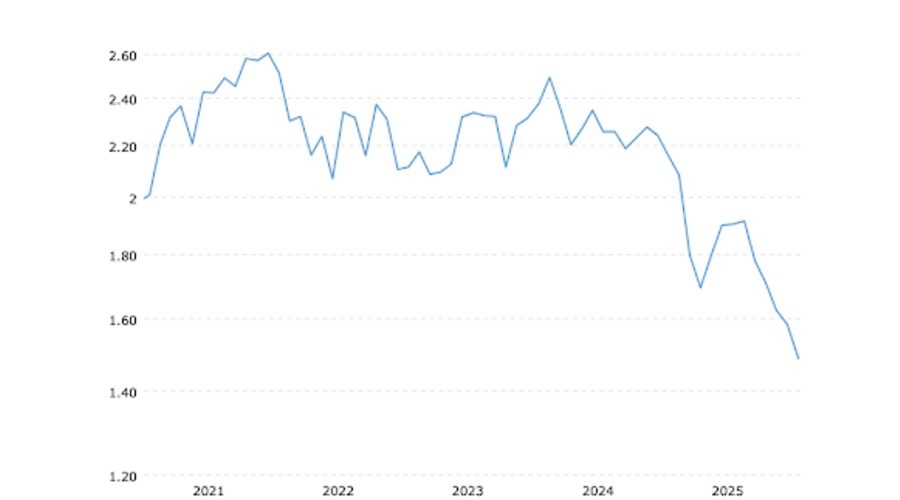
For much of the past five years, this ratio reflects optimism in the equity market. However, it is flashing a warning recently. The ratio has fallen to approximately 1.4, its lowest level in five years, marking a clear change in market leadership.
S&P 500 to Gold Ratio (Source: Macro Trends)
As noted in our recent thought leadership analysis, the dropping ratio signals a gradual shift away from "growth at any cost" toward a market that prioritises momentum, resilience, and protection against policy uncertainty.
In that environment, gold stands out as one of the few assets offering both stability and directional conviction.
Is the January Effect Still a Thing?
Historically, gold has looked to the first quarter of the year with a sense of seasonal optimism. This "January Effect", a period where institutional rebalancing and lunar new year demand often push bullion higher, has been providing a tailwind during this period.
Under normal conditions, gold's performance during earnings season follows a familiar pattern shaped by the earnings–dollar–gold relationship.
Typically, strong earnings and a firm dollar cap gold's upside. But 2026 is proving different.
Even as the dollar remained resilient, gold surged to a historic peak of over $4,900 on January 22, driven by geopolitical friction over Greenland and the subsequent tariff threats against NATO allies.
While equities have rebounded today following President Trump's pause on those specific tariffs, gold has refused to surrender its gains, consolidating firmly above the $4,840 level.
Gold is no longer responding only after markets break. It has evolved from a reactive safe haven into a proactive momentum asset of potentiality.
A New Rulebook for a New Era
The old rulebook said that when the VIX (the fear index) rises, investors and traders flock to gold as a safe haven. The new rulebook suggests something else: capital is moving into gold because it is where relative strength and liquidity now converge.
With major institutions like Goldman Sachs now raising their end-of-year targets to $5,400, the ceiling is being redefined in real-time.
While the January Effect may still be helping, the real story is that gold has stopped waiting for the dollar to weaken or merely absorbing shockwaves. It is defining where capital chooses to go next.
The $5,000 Mark: Gold is Eclipsing Earnings This January
The narrative of 2025 was dominated by "AI at any price." But as the Q4 earnings season kicks into gear this January, that narrative has hit a wall of reality. While 81% of S&P 500 firms have beaten profit expectations so far, investors are delivering the worst share-price reactions on record, a scenario that underscores a deep-seated uncertainty over 2026 valuations even amidst the relief rally seen following the de-escalation of trade tensions in Davos.
Tech has underperformed so far this month, with the broader market slipping as investors confront the gap between long-term AI narratives and near-term fiscal pressure.
Normally, this would trigger a rotation into bonds. But with the Federal Reserve facing renewed pressure over its independence and tariff threats stoking inflation worries, the bond market is no longer the sanctuary it once was.
Capital wants safety, but it also wants performance. In 2026, that outlet increasingly appears to be gold. Investors are moving beyond pure defensive positioning and focusing on value preservation.
After holding near record highs through much of 2025, gold has carried that momentum into the new year, just reaching a staggering $4,930 and reinforcing its role as both a stabiliser and a leader in relative performance.
Watching the S&P-to-Gold Ratio
One way to understand this shift is through the S&P-to-Gold ratio, which tells a story of equity dominance and might act as an early indicator.
For much of the past five years, this ratio reflects optimism in the equity market. However, it is flashing a warning recently. The ratio has fallen to approximately 1.4, its lowest level in five years, marking a clear change in market leadership.
S&P 500 to Gold Ratio (Source: Macro Trends)
As noted in our recent thought leadership analysis, the dropping ratio signals a gradual shift away from "growth at any cost" toward a market that prioritises momentum, resilience, and protection against policy uncertainty.
In that environment, gold stands out as one of the few assets offering both stability and directional conviction.
Is the January Effect Still a Thing?
Historically, gold has looked to the first quarter of the year with a sense of seasonal optimism. This "January Effect", a period where institutional rebalancing and lunar new year demand often push bullion higher, has been providing a tailwind during this period.
Under normal conditions, gold's performance during earnings season follows a familiar pattern shaped by the earnings–dollar–gold relationship.
Typically, strong earnings and a firm dollar cap gold's upside. But 2026 is proving different.
Even as the dollar remained resilient, gold surged to a historic peak of over $4,900 on January 22, driven by geopolitical friction over Greenland and the subsequent tariff threats against NATO allies.
While equities have rebounded today following President Trump's pause on those specific tariffs, gold has refused to surrender its gains, consolidating firmly above the $4,840 level.
Gold is no longer responding only after markets break. It has evolved from a reactive safe haven into a proactive momentum asset of potentiality.
A New Rulebook for a New Era
The old rulebook said that when the VIX (the fear index) rises, investors and traders flock to gold as a safe haven. The new rulebook suggests something else: capital is moving into gold because it is where relative strength and liquidity now converge.
With major institutions like Goldman Sachs now raising their end-of-year targets to $5,400, the ceiling is being redefined in real-time.
While the January Effect may still be helping, the real story is that gold has stopped waiting for the dollar to weaken or merely absorbing shockwaves. It is defining where capital chooses to go next.
FP Markets Winner Spotlight 🏆 | Global Broker of the Year 2025 #Trading #Broker #Innovation #Shorts
FP Markets Winner Spotlight 🏆 | Global Broker of the Year 2025 #Trading #Broker #Innovation #Shorts
FP Markets takes the spotlight as Global Broker of the Year 2025 at the Finance Magnates Awards.
Martin Stoilov, Head of Client Experience, shares that trust, innovation, and people played a key role in the company’s success, supported by a strong foundation of integrity and client-centricity.
Following this milestone, FP Markets continues to focus on growth, technology investment, and its core values of transparency and excellence.
👉 Be part of FM Awards 2026: https://awards.financemagnates.com/#nominate
FP Markets takes the spotlight as Global Broker of the Year 2025 at the Finance Magnates Awards.
Martin Stoilov, Head of Client Experience, shares that trust, innovation, and people played a key role in the company’s success, supported by a strong foundation of integrity and client-centricity.
Following this milestone, FP Markets continues to focus on growth, technology investment, and its core values of transparency and excellence.
👉 Be part of FM Awards 2026: https://awards.financemagnates.com/#nominate
In this video, we review @HolaPrimeMarketsOfficial, a multi-asset forex and CFDs broker offering different account types, trading platforms, and flexible trading conditions.
We cover the broker’s overall offering, including account options, trading environment, platforms like MT4 and MT5, and additional services such as managed accounts and fast withdrawals.
Watch the full video to see if Hola Prime Markets fits your trading needs.
📣 Stay up to date with the latest in finance and trading. Follow Finance Magnates for industry news, insights, and global event coverage.
Connect with us:
🔗 LinkedIn: /financemagnates
👍 Facebook: /financemagnates
📸 Instagram: https://www.instagram.com/financemagnates
🐦 X: https://x.com/financemagnates
🎥 TikTok: https://www.tiktok.com/tag/financemagnates
▶️ YouTube: /@financemagnates_official
#HolaPrime #ForexBroker #CFDTrading #FinanceMagnates #Trading #Forex #BrokerReview
In this video, we review @HolaPrimeMarketsOfficial, a multi-asset forex and CFDs broker offering different account types, trading platforms, and flexible trading conditions.
We cover the broker’s overall offering, including account options, trading environment, platforms like MT4 and MT5, and additional services such as managed accounts and fast withdrawals.
Watch the full video to see if Hola Prime Markets fits your trading needs.
📣 Stay up to date with the latest in finance and trading. Follow Finance Magnates for industry news, insights, and global event coverage.
Connect with us:
🔗 LinkedIn: /financemagnates
👍 Facebook: /financemagnates
📸 Instagram: https://www.instagram.com/financemagnates
🐦 X: https://x.com/financemagnates
🎥 TikTok: https://www.tiktok.com/tag/financemagnates
▶️ YouTube: /@financemagnates_official
#HolaPrime #ForexBroker #CFDTrading #FinanceMagnates #Trading #Forex #BrokerReview
Hola Prime Review: What You Need to Know | Full Breakdown by Finance Magnates
Hola Prime Review: What You Need to Know | Full Breakdown by Finance Magnates
In this video, we review @HolaPrime_Global, a proprietary trading firm offering evaluation programs and performance-based payouts in simulated market environments.
We cover how the challenge model works, including account types, profit splits (up to 95%), trading rules, and what it takes to reach a funded account. You’ll also learn about available platforms like MT4, MT5, cTrader, and more, along with insights into payouts, support, and trading conditions.
Watch the full video to see if Hola Prime fits your trading style.
📣 Stay up to date with the latest in finance and trading. Follow Finance Magnates for industry news, insights, and global event coverage.
Connect with us:
🔗 LinkedIn: /financemagnates
👍 Facebook: /financemagnates
📸 Instagram: https://www.instagram.com/financemagnates
🐦 X: https://x.com/financemagnates
🎥 TikTok: https://www.tiktok.com/tag/financemagnates
▶️ YouTube: /@financemagnates_official
#HolaPrime #PropFirm #Trading #FinanceMagnates #Forex #FuturesTrading #TradingReview #PropFirmReview
In this video, we review @HolaPrime_Global, a proprietary trading firm offering evaluation programs and performance-based payouts in simulated market environments.
We cover how the challenge model works, including account types, profit splits (up to 95%), trading rules, and what it takes to reach a funded account. You’ll also learn about available platforms like MT4, MT5, cTrader, and more, along with insights into payouts, support, and trading conditions.
Watch the full video to see if Hola Prime fits your trading style.
📣 Stay up to date with the latest in finance and trading. Follow Finance Magnates for industry news, insights, and global event coverage.
Connect with us:
🔗 LinkedIn: /financemagnates
👍 Facebook: /financemagnates
📸 Instagram: https://www.instagram.com/financemagnates
🐦 X: https://x.com/financemagnates
🎥 TikTok: https://www.tiktok.com/tag/financemagnates
▶️ YouTube: /@financemagnates_official
#HolaPrime #PropFirm #Trading #FinanceMagnates #Forex #FuturesTrading #TradingReview #PropFirmReview
Axi Winner Spotlight 🏆 | Global Most Innovative Broker 2025 #Innovation #Trading #Fintech #Broker
Axi Winner Spotlight 🏆 | Global Most Innovative Broker 2025 #Innovation #Trading #Fintech #Broker
Axi takes the spotlight at the Finance Magnates Awards, winning Global Most Innovative Broker 2025.
Olivia Xenofontos and Ivanna Openko share how the team will feel: proud, motivated, and ready to keep delivering.
They also describe the night as well-organized, focused, and enjoyable for all.
👉 Be part of FM Awards 2026.
Axi takes the spotlight at the Finance Magnates Awards, winning Global Most Innovative Broker 2025.
Olivia Xenofontos and Ivanna Openko share how the team will feel: proud, motivated, and ready to keep delivering.
They also describe the night as well-organized, focused, and enjoyable for all.
👉 Be part of FM Awards 2026.
Recognition that matters.
Built on transparency.
Driven by the industry.
The Finance Magnates Awards 2026.
Nominations are now open.
🔗 https://awards.financemagnates.com/?utm_source=SM&utm_medium=social&utm_campaign=recognition-matters
Recognition that matters.
Built on transparency.
Driven by the industry.
The Finance Magnates Awards 2026.
Nominations are now open.
🔗 https://awards.financemagnates.com/?utm_source=SM&utm_medium=social&utm_campaign=recognition-matters