From Discounts to Dividends: A New Mindset Around Black Friday
Tuesday,02/12/2025|12:36GMTby
Maclear
Black Friday is shifting from spending to investing, driven by younger, financially aware consumers.
Once synonymous with midnight queues, doorbuster chaos, and cart-stuffing impulsivity, Black Friday — the world’s biggest discount season — is quietly undergoing a structural reset. Consumers, especially younger and more financially aware ones, are beginning to treat this period not as a hunt for short-lived bargains, but as a moment to strengthen their long-term financial position.
And this shift isn’t about the recent pre–Black Friday stock market drop or any overdue technical correction washing out speculators. It runs deeper. After years of rising financial literacy, tighter budgets, and a growing skepticism toward mindless consumption, people are increasingly turning to investment opportunities — from discounted brokerage tiers to promo-driven alternative assets — instead of chasing yet another flash sale. Black Friday is evolving from a season of spending into a season of investing and preserving. Here’s what that transformation looks like.
A Mindset Shift Driven by Economic Reality
The consumer psychology behind Black Friday isn’t changing because people have suddenly lost interest in discounts. The economic landscape has quietly and persistently reshaped its priorities. In 2025, high inflation, tighter budgets, and prolonged uncertainty continue to pressure households, forcing many to reassess what “value” really means. For example, the global economy has effectively split into what economists call a “K-shaped” recovery: one group has benefited from rising wages and asset growth, while the other struggles as income fails to keep up with inflation. In Europe, real wages that fell sharply in 2022–2023 managed to recover only partially in 2024–2025, making lower-income households spend a higher share of income on essentials. Consumers feel the shift every time they open their banking app or grocery bill.
The data reflects this growing pressure. According to Deloitte’s 2025 Holiday Outlook, 57% of consumers expect the economy to weaken in the next six months — the most pessimistic reading since tracking began in 1997. With confidence this low, non-essential spending is the first to go. Holiday budgets are set to drop by 10%, and even Black Friday–Cyber Monday — typically one of the most resilient shopping periods — is expected to see its first decline in four years, down 4%. The sharpest shift comes from Gen Z, who plan to cut spending by 34%, making them the most cautious cohort this season.
Saving Instead of Spending
Black Friday hasn’t lost its allure — it has simply evolved. What was once a race to grab the best discount has expanded into a broader conversation about financial priorities. Today, many consumers are asking not just, “How much can I save today?” but “How much can I grow in the long term?”. For Millennials and Gen Z, this shift has been building for years, shaped by tighter budgets, financial uncertainty, and growing awareness of wealth-building tools.
The numbers tell the story. 59% of Gen Z aged 18 to 25 say a well-funded savings account is a top priority. Beyond saving, younger consumers increasingly see investing as a default strategy for stability, not an optional skill reserved for finance professionals. Even during seasons traditionally dominated by shopping sprees, like Black Friday and the holiday rush, Millennials and Gen Z are more likely to think in terms of growing their money rather than depleting it.
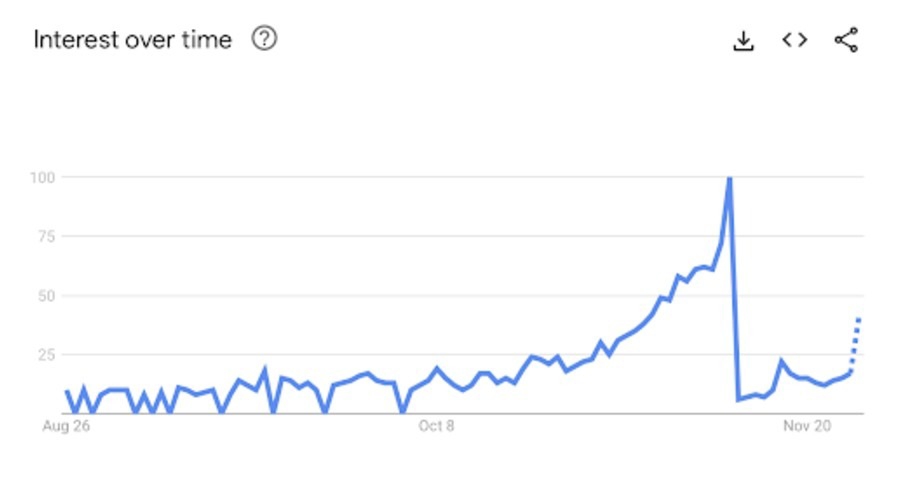
Digital behavior mirrors this trend. Interest in financial alternatives spikes as the holiday shopping season approaches. Google searches for “investment Black Friday” climbed sharply, peaking on 11 November 2025, before dropping and gradually recovering by the end of the month. European countries dominate the top-10 search volumes, with the UK ranking fifth. South Korea leads the pack, generating almost twice the search volume of the US, which comes in second. This global pattern underscores that the mindset shift toward investing over spending resonates with younger, digitally engaged audiences worldwide.
Source: Google Trends
This tendency is also reflected in crowdlending platform behavior. According to Alexander Lang, CFO & Co-Founder of Maclear:
“We are seeing the same pattern among our users. Even during peak spending periods like Black Friday, a growing number of clients choose to allocate part of their funds into investment portfolios or fixed-return products rather than spending the entire amount. This signals a more conscious and financially mature approach to money management.”
What Does an “Investment Black Friday” Look Like?
Fintech platforms are adjusting their offers to meet a new kind of consumer demand, where value takes center stage. According to Deloitte, seven in ten shoppers across all income groups engage in value-seeking behaviors. Consumers are making frugal trade-offs: choosing affordable retailers over preferred ones or redeeming loyalty points. This mindset has translated naturally into the investment world: people are seeking ways to maximize returns on every euro, rather than simply spending it.
Retail investors are increasingly equipped for this shift. Platforms such as Robinhood now boast over 23 million funded accounts, Revolut reports more than 3 million users trading stocks and crypto, and European platforms like Trade Republic and eToro continue to expand rapidly. Meanwhile, financial content has gone mainstream: investing tutorials on TikTok and YouTube rack up millions of views each month, reflecting growing interest from younger generations in learning and participating in the markets.
For Black Friday, these platforms roll out special, lucrative offers. Discounted trading fees, bonus deposits, or increased rates like a +1% APR voucher from Maclear are typical tools to attract both new and seasoned investors. Some launch campaigns to increase engagement such as a giveaway from 8lends, a crypto crowdlending platform: it included cash rewards, slots in a closed high-yield pool and NFTs. Sometimes, giveaways elaborate into a more complex yet retention-driven mechanics — competitions similar to the upcoming New Year raffle from Maclear with tangible rewards and luxury travel packages.
Final Thoughts
Financial markets now have their own versions of Black Friday. Some brokers run zero-fee trading days, investment apps offer cashback or boosted interest on deposits, and select platforms provide exclusive access to premium financial products. These initiatives prove that the Black Friday concept exists in finance, but in a fragmented way. A coordinated Invest Friday could unify these offers into a single, widely recognized event.
Once synonymous with midnight queues, doorbuster chaos, and cart-stuffing impulsivity, Black Friday — the world’s biggest discount season — is quietly undergoing a structural reset. Consumers, especially younger and more financially aware ones, are beginning to treat this period not as a hunt for short-lived bargains, but as a moment to strengthen their long-term financial position.
And this shift isn’t about the recent pre–Black Friday stock market drop or any overdue technical correction washing out speculators. It runs deeper. After years of rising financial literacy, tighter budgets, and a growing skepticism toward mindless consumption, people are increasingly turning to investment opportunities — from discounted brokerage tiers to promo-driven alternative assets — instead of chasing yet another flash sale. Black Friday is evolving from a season of spending into a season of investing and preserving. Here’s what that transformation looks like.
A Mindset Shift Driven by Economic Reality
The consumer psychology behind Black Friday isn’t changing because people have suddenly lost interest in discounts. The economic landscape has quietly and persistently reshaped its priorities. In 2025, high inflation, tighter budgets, and prolonged uncertainty continue to pressure households, forcing many to reassess what “value” really means. For example, the global economy has effectively split into what economists call a “K-shaped” recovery: one group has benefited from rising wages and asset growth, while the other struggles as income fails to keep up with inflation. In Europe, real wages that fell sharply in 2022–2023 managed to recover only partially in 2024–2025, making lower-income households spend a higher share of income on essentials. Consumers feel the shift every time they open their banking app or grocery bill.
The data reflects this growing pressure. According to Deloitte’s 2025 Holiday Outlook, 57% of consumers expect the economy to weaken in the next six months — the most pessimistic reading since tracking began in 1997. With confidence this low, non-essential spending is the first to go. Holiday budgets are set to drop by 10%, and even Black Friday–Cyber Monday — typically one of the most resilient shopping periods — is expected to see its first decline in four years, down 4%. The sharpest shift comes from Gen Z, who plan to cut spending by 34%, making them the most cautious cohort this season.
Saving Instead of Spending
Black Friday hasn’t lost its allure — it has simply evolved. What was once a race to grab the best discount has expanded into a broader conversation about financial priorities. Today, many consumers are asking not just, “How much can I save today?” but “How much can I grow in the long term?”. For Millennials and Gen Z, this shift has been building for years, shaped by tighter budgets, financial uncertainty, and growing awareness of wealth-building tools.
The numbers tell the story. 59% of Gen Z aged 18 to 25 say a well-funded savings account is a top priority. Beyond saving, younger consumers increasingly see investing as a default strategy for stability, not an optional skill reserved for finance professionals. Even during seasons traditionally dominated by shopping sprees, like Black Friday and the holiday rush, Millennials and Gen Z are more likely to think in terms of growing their money rather than depleting it.
Digital behavior mirrors this trend. Interest in financial alternatives spikes as the holiday shopping season approaches. Google searches for “investment Black Friday” climbed sharply, peaking on 11 November 2025, before dropping and gradually recovering by the end of the month. European countries dominate the top-10 search volumes, with the UK ranking fifth. South Korea leads the pack, generating almost twice the search volume of the US, which comes in second. This global pattern underscores that the mindset shift toward investing over spending resonates with younger, digitally engaged audiences worldwide.
Source: Google Trends
This tendency is also reflected in crowdlending platform behavior. According to Alexander Lang, CFO & Co-Founder of Maclear:
“We are seeing the same pattern among our users. Even during peak spending periods like Black Friday, a growing number of clients choose to allocate part of their funds into investment portfolios or fixed-return products rather than spending the entire amount. This signals a more conscious and financially mature approach to money management.”
What Does an “Investment Black Friday” Look Like?
Fintech platforms are adjusting their offers to meet a new kind of consumer demand, where value takes center stage. According to Deloitte, seven in ten shoppers across all income groups engage in value-seeking behaviors. Consumers are making frugal trade-offs: choosing affordable retailers over preferred ones or redeeming loyalty points. This mindset has translated naturally into the investment world: people are seeking ways to maximize returns on every euro, rather than simply spending it.
Retail investors are increasingly equipped for this shift. Platforms such as Robinhood now boast over 23 million funded accounts, Revolut reports more than 3 million users trading stocks and crypto, and European platforms like Trade Republic and eToro continue to expand rapidly. Meanwhile, financial content has gone mainstream: investing tutorials on TikTok and YouTube rack up millions of views each month, reflecting growing interest from younger generations in learning and participating in the markets.
For Black Friday, these platforms roll out special, lucrative offers. Discounted trading fees, bonus deposits, or increased rates like a +1% APR voucher from Maclear are typical tools to attract both new and seasoned investors. Some launch campaigns to increase engagement such as a giveaway from 8lends, a crypto crowdlending platform: it included cash rewards, slots in a closed high-yield pool and NFTs. Sometimes, giveaways elaborate into a more complex yet retention-driven mechanics — competitions similar to the upcoming New Year raffle from Maclear with tangible rewards and luxury travel packages.
Final Thoughts
Financial markets now have their own versions of Black Friday. Some brokers run zero-fee trading days, investment apps offer cashback or boosted interest on deposits, and select platforms provide exclusive access to premium financial products. These initiatives prove that the Black Friday concept exists in finance, but in a fragmented way. A coordinated Invest Friday could unify these offers into a single, widely recognized event.
FP Markets Winner Spotlight 🏆 | Global Broker of the Year 2025 #Trading #Broker #Innovation #Shorts
FP Markets Winner Spotlight 🏆 | Global Broker of the Year 2025 #Trading #Broker #Innovation #Shorts
FP Markets takes the spotlight as Global Broker of the Year 2025 at the Finance Magnates Awards.
Martin Stoilov, Head of Client Experience, shares that trust, innovation, and people played a key role in the company’s success, supported by a strong foundation of integrity and client-centricity.
Following this milestone, FP Markets continues to focus on growth, technology investment, and its core values of transparency and excellence.
👉 Be part of FM Awards 2026: https://awards.financemagnates.com/#nominate
FP Markets takes the spotlight as Global Broker of the Year 2025 at the Finance Magnates Awards.
Martin Stoilov, Head of Client Experience, shares that trust, innovation, and people played a key role in the company’s success, supported by a strong foundation of integrity and client-centricity.
Following this milestone, FP Markets continues to focus on growth, technology investment, and its core values of transparency and excellence.
👉 Be part of FM Awards 2026: https://awards.financemagnates.com/#nominate
In this video, we review @HolaPrimeMarketsOfficial, a multi-asset forex and CFDs broker offering different account types, trading platforms, and flexible trading conditions.
We cover the broker’s overall offering, including account options, trading environment, platforms like MT4 and MT5, and additional services such as managed accounts and fast withdrawals.
Watch the full video to see if Hola Prime Markets fits your trading needs.
📣 Stay up to date with the latest in finance and trading. Follow Finance Magnates for industry news, insights, and global event coverage.
Connect with us:
🔗 LinkedIn: /financemagnates
👍 Facebook: /financemagnates
📸 Instagram: https://www.instagram.com/financemagnates
🐦 X: https://x.com/financemagnates
🎥 TikTok: https://www.tiktok.com/tag/financemagnates
▶️ YouTube: /@financemagnates_official
#HolaPrime #ForexBroker #CFDTrading #FinanceMagnates #Trading #Forex #BrokerReview
In this video, we review @HolaPrimeMarketsOfficial, a multi-asset forex and CFDs broker offering different account types, trading platforms, and flexible trading conditions.
We cover the broker’s overall offering, including account options, trading environment, platforms like MT4 and MT5, and additional services such as managed accounts and fast withdrawals.
Watch the full video to see if Hola Prime Markets fits your trading needs.
📣 Stay up to date with the latest in finance and trading. Follow Finance Magnates for industry news, insights, and global event coverage.
Connect with us:
🔗 LinkedIn: /financemagnates
👍 Facebook: /financemagnates
📸 Instagram: https://www.instagram.com/financemagnates
🐦 X: https://x.com/financemagnates
🎥 TikTok: https://www.tiktok.com/tag/financemagnates
▶️ YouTube: /@financemagnates_official
#HolaPrime #ForexBroker #CFDTrading #FinanceMagnates #Trading #Forex #BrokerReview
Hola Prime Review: What You Need to Know | Full Breakdown by Finance Magnates
Hola Prime Review: What You Need to Know | Full Breakdown by Finance Magnates
In this video, we review @HolaPrime_Global, a proprietary trading firm offering evaluation programs and performance-based payouts in simulated market environments.
We cover how the challenge model works, including account types, profit splits (up to 95%), trading rules, and what it takes to reach a funded account. You’ll also learn about available platforms like MT4, MT5, cTrader, and more, along with insights into payouts, support, and trading conditions.
Watch the full video to see if Hola Prime fits your trading style.
📣 Stay up to date with the latest in finance and trading. Follow Finance Magnates for industry news, insights, and global event coverage.
Connect with us:
🔗 LinkedIn: /financemagnates
👍 Facebook: /financemagnates
📸 Instagram: https://www.instagram.com/financemagnates
🐦 X: https://x.com/financemagnates
🎥 TikTok: https://www.tiktok.com/tag/financemagnates
▶️ YouTube: /@financemagnates_official
#HolaPrime #PropFirm #Trading #FinanceMagnates #Forex #FuturesTrading #TradingReview #PropFirmReview
In this video, we review @HolaPrime_Global, a proprietary trading firm offering evaluation programs and performance-based payouts in simulated market environments.
We cover how the challenge model works, including account types, profit splits (up to 95%), trading rules, and what it takes to reach a funded account. You’ll also learn about available platforms like MT4, MT5, cTrader, and more, along with insights into payouts, support, and trading conditions.
Watch the full video to see if Hola Prime fits your trading style.
📣 Stay up to date with the latest in finance and trading. Follow Finance Magnates for industry news, insights, and global event coverage.
Connect with us:
🔗 LinkedIn: /financemagnates
👍 Facebook: /financemagnates
📸 Instagram: https://www.instagram.com/financemagnates
🐦 X: https://x.com/financemagnates
🎥 TikTok: https://www.tiktok.com/tag/financemagnates
▶️ YouTube: /@financemagnates_official
#HolaPrime #PropFirm #Trading #FinanceMagnates #Forex #FuturesTrading #TradingReview #PropFirmReview
Axi Winner Spotlight 🏆 | Global Most Innovative Broker 2025 #Innovation #Trading #Fintech #Broker
Axi Winner Spotlight 🏆 | Global Most Innovative Broker 2025 #Innovation #Trading #Fintech #Broker
Axi takes the spotlight at the Finance Magnates Awards, winning Global Most Innovative Broker 2025.
Olivia Xenofontos and Ivanna Openko share how the team will feel: proud, motivated, and ready to keep delivering.
They also describe the night as well-organized, focused, and enjoyable for all.
👉 Be part of FM Awards 2026.
Axi takes the spotlight at the Finance Magnates Awards, winning Global Most Innovative Broker 2025.
Olivia Xenofontos and Ivanna Openko share how the team will feel: proud, motivated, and ready to keep delivering.
They also describe the night as well-organized, focused, and enjoyable for all.
👉 Be part of FM Awards 2026.
Recognition that matters.
Built on transparency.
Driven by the industry.
The Finance Magnates Awards 2026.
Nominations are now open.
🔗 https://awards.financemagnates.com/?utm_source=SM&utm_medium=social&utm_campaign=recognition-matters
Recognition that matters.
Built on transparency.
Driven by the industry.
The Finance Magnates Awards 2026.
Nominations are now open.
🔗 https://awards.financemagnates.com/?utm_source=SM&utm_medium=social&utm_campaign=recognition-matters