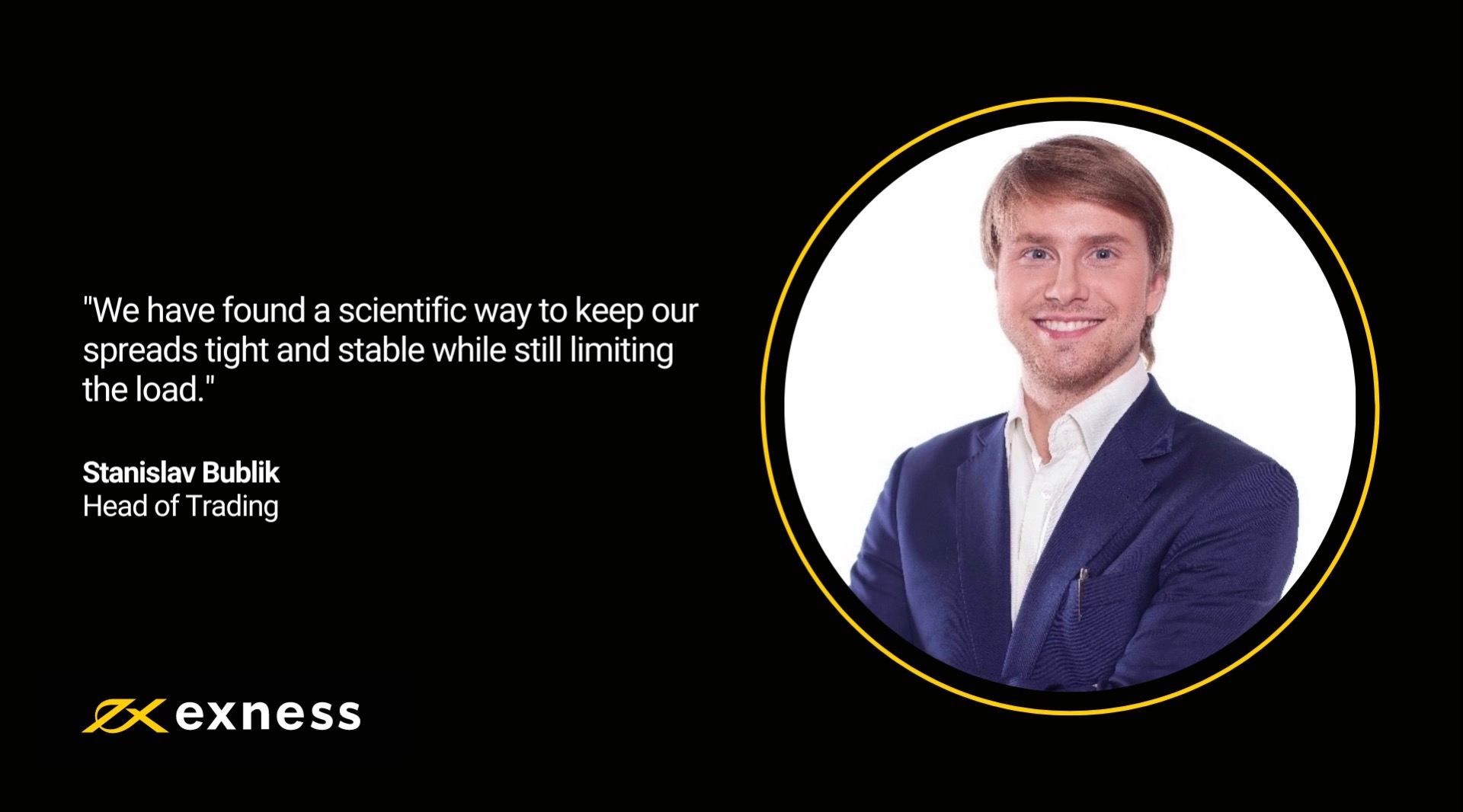
Exness Head of Trading Products Stanislav Bublik Talks Pricing, Stability, and More
Thursday,05/01/2023|13:36GMTby
FM
Finance Magnates spoke with Stanislav Bublik, Head of Trading Products at Exness.
How does Exness ensure proper quality of the trading experience for its traders?
Exness has 6 millions trades executed on average daily and over 350,000 active traders around the world, it is hard to name a silver bullet. We have to address the trading experience aspect holistically.
Firstly, we ensure proper geographical scale and round-the-clock monitoring of our trading infrastructure. Secondly, we provide fair and reliable pricing for every single tick and thirdly, we address common pain-points that traders may face in the trade execution area.
So what does this consistent and reliable service look like in action?
Let's take the common challenges many traders face:
Spread instability is very common over highly volatile periods, for example, high economic news. Naturally, brokers will try to keep your spreads as tight as possible, however that means quotes have to be updated extremely fast, which can cause slowness and freezes across the price distribution chain.
Another common challenge is the execution of stop orders and stop losses. By nature, those orders cause slippages that are painful for clients and may cause dissatisfaction. Brokers should also find ways to minimize slippages when possible.
Additionally, brokers must remember that fair position liquidation is extremely important in case an account faces margin call and consecutive stop out. Often market situations such as spread widening can trigger position liquidation, causing a lot of unease from clients.
So how do you find balance between tightness of spreads and performance?
We have alerts and monitoring at every step of the price-making and execution process in order to make sure that we are always staying informed about what is going on.
The simple omission of certain quotes is actually not a very good option because you would lose some important market data updates or even execute at a price that has never been sent to the client.
We have found a scientific way to keep our spreads tight and stable while still limiting the load.
There are complex calculations that are happening inside our trading engine, mathematically optimizing the feed we’re sending through the data infrastructure, keeping it at maximum efficient capacity while filtering the market noise that does not affect the execution quality.
All this is happening in high-performance trading engines that have the most processing capacity throughout the whole chain across our regions of presence.
The chart below shows our spreads on GBPUSD during non-farm payrolls, compared with some of our top competitors.
This is made possible thanks to the strong collaboration between different teams - support engineers, quantitative researchers, and developers.
In what ways do you ensure transparency and reliability of the trading experience?
As I said earlier, pricing is only one part of the puzzle. We execute on every tick we send to the client, meaning proper price transparency and the ability to reliably backtest your trading strategies.
More than that we aim to provide certain enhancements to the product which are similar to institutional markets, but for our retail clients. When executing stop orders we aim to fill the client at the requested price, despite moderate market gaps.
That means we effectively offset slippage for ~90+% of orders, making execution more predictable and stable.
Of course, there may be some cases of slippage despite this, but for the vast majority of clients we ensure low slippage and no stop-level experience, which is a rare combination.
Another problematic area is position liquidation in case an account faces a stop-out. We benchmark account stop-out thresholds from mid-price, ensuring price volatility protection for clients, except for rare cases of extremely leveraged positions where it is technically impossible.
Price volatility protection is covering individual accounts, delaying stop outs and protecting from liquidation in case of sudden spread widening, for example during rollover period.
To make sure clients see those mechanisms in action, we will soon add detailed information in the Personal Area, to provide even better visualization and transparency.
How does Exness ensure proper quality of the trading experience for its traders?
Exness has 6 millions trades executed on average daily and over 350,000 active traders around the world, it is hard to name a silver bullet. We have to address the trading experience aspect holistically.
Firstly, we ensure proper geographical scale and round-the-clock monitoring of our trading infrastructure. Secondly, we provide fair and reliable pricing for every single tick and thirdly, we address common pain-points that traders may face in the trade execution area.
So what does this consistent and reliable service look like in action?
Let's take the common challenges many traders face:
Spread instability is very common over highly volatile periods, for example, high economic news. Naturally, brokers will try to keep your spreads as tight as possible, however that means quotes have to be updated extremely fast, which can cause slowness and freezes across the price distribution chain.
Another common challenge is the execution of stop orders and stop losses. By nature, those orders cause slippages that are painful for clients and may cause dissatisfaction. Brokers should also find ways to minimize slippages when possible.
Additionally, brokers must remember that fair position liquidation is extremely important in case an account faces margin call and consecutive stop out. Often market situations such as spread widening can trigger position liquidation, causing a lot of unease from clients.
So how do you find balance between tightness of spreads and performance?
We have alerts and monitoring at every step of the price-making and execution process in order to make sure that we are always staying informed about what is going on.
The simple omission of certain quotes is actually not a very good option because you would lose some important market data updates or even execute at a price that has never been sent to the client.
We have found a scientific way to keep our spreads tight and stable while still limiting the load.
There are complex calculations that are happening inside our trading engine, mathematically optimizing the feed we’re sending through the data infrastructure, keeping it at maximum efficient capacity while filtering the market noise that does not affect the execution quality.
All this is happening in high-performance trading engines that have the most processing capacity throughout the whole chain across our regions of presence.
The chart below shows our spreads on GBPUSD during non-farm payrolls, compared with some of our top competitors.
This is made possible thanks to the strong collaboration between different teams - support engineers, quantitative researchers, and developers.
In what ways do you ensure transparency and reliability of the trading experience?
As I said earlier, pricing is only one part of the puzzle. We execute on every tick we send to the client, meaning proper price transparency and the ability to reliably backtest your trading strategies.
More than that we aim to provide certain enhancements to the product which are similar to institutional markets, but for our retail clients. When executing stop orders we aim to fill the client at the requested price, despite moderate market gaps.
That means we effectively offset slippage for ~90+% of orders, making execution more predictable and stable.
Of course, there may be some cases of slippage despite this, but for the vast majority of clients we ensure low slippage and no stop-level experience, which is a rare combination.
Another problematic area is position liquidation in case an account faces a stop-out. We benchmark account stop-out thresholds from mid-price, ensuring price volatility protection for clients, except for rare cases of extremely leveraged positions where it is technically impossible.
Price volatility protection is covering individual accounts, delaying stop outs and protecting from liquidation in case of sudden spread widening, for example during rollover period.
To make sure clients see those mechanisms in action, we will soon add detailed information in the Personal Area, to provide even better visualization and transparency.
Engineered Trust – A Conversation with Adam Phillips, CEO of FXT
CMC Markets’ Artur Delijergijevs on Metals Demand, Volatility, & Stable Execution
CMC Markets’ Artur Delijergijevs on Metals Demand, Volatility, & Stable Execution
In this exclusive Executive Interview, Finance Magnates speaks with Artur Delijergijevs, Head of Systematic Market Making at CMC Markets, about the current state of metals demand and market volatility.
Delijergijevs offers a desk-level view on:
- Metals Demand: Why metals are seeing the strongest demand from both retail and institutional clients right now.
- The Safe-Haven Debate: Questioning whether gold still fits the classic safe-haven definition given large daily price movements.
- Volatile Market Prep: How a market-making desk prepares its systems and pricing for stressed market conditions and high-impact economic events.
- Hybrid Execution: Why the best execution model combines electronic speed with human relationship support, especially during volatility.
- AI in Workflow: Where CMC Markets is integrating machine learning for risk management and pricing, and the limitations of AI during stressed markets.
- Dubai's Role: The strategic importance of Dubai’s location for covering global trading sessions across Asia, Europe, and the US.
Watch to understand how CMC Markets maintains stable pricing and reliable execution quality in high-volatility environments.
#CMCmarkets #forex #metals #gold #trading #volatility #MarketMaking #iFXDubai #FinanceMagnates #Finance #Fintech #Execution #AlgorithmicTrading #RiskManagement
In this exclusive Executive Interview, Finance Magnates speaks with Artur Delijergijevs, Head of Systematic Market Making at CMC Markets, about the current state of metals demand and market volatility.
Delijergijevs offers a desk-level view on:
- Metals Demand: Why metals are seeing the strongest demand from both retail and institutional clients right now.
- The Safe-Haven Debate: Questioning whether gold still fits the classic safe-haven definition given large daily price movements.
- Volatile Market Prep: How a market-making desk prepares its systems and pricing for stressed market conditions and high-impact economic events.
- Hybrid Execution: Why the best execution model combines electronic speed with human relationship support, especially during volatility.
- AI in Workflow: Where CMC Markets is integrating machine learning for risk management and pricing, and the limitations of AI during stressed markets.
- Dubai's Role: The strategic importance of Dubai’s location for covering global trading sessions across Asia, Europe, and the US.
Watch to understand how CMC Markets maintains stable pricing and reliable execution quality in high-volatility environments.
#CMCmarkets #forex #metals #gold #trading #volatility #MarketMaking #iFXDubai #FinanceMagnates #Finance #Fintech #Execution #AlgorithmicTrading #RiskManagement
Finance Magnates Awards 2026 – Nominations Now Open
Finance Magnates Awards 2026 – Nominations Now Open
The Finance Magnates Awards 2026 nominations are now open. 🏆
From fintech innovators to leading brokers, this is where the finance industry celebrates its biggest achievements.
Winners will be announced at the Cyprus Gala Dinner on November 6, 2026.
Nominate your brand now.
https://awards.financemagnates.com/?utm_source=linkedin&utm_medium=video&utm_campaign=nominations-open
#FMAwards #FinanceMagnates #FintechAwards #Fintech #FinanceIndustry
The Finance Magnates Awards 2026 nominations are now open. 🏆
From fintech innovators to leading brokers, this is where the finance industry celebrates its biggest achievements.
Winners will be announced at the Cyprus Gala Dinner on November 6, 2026.
Nominate your brand now.
https://awards.financemagnates.com/?utm_source=linkedin&utm_medium=video&utm_campaign=nominations-open
#FMAwards #FinanceMagnates #FintechAwards #Fintech #FinanceIndustry
Finance Magnates Awards 2026 | Nominations Now Open 🏆#Fintech #FMAwards #TradingIndustry
Finance Magnates Awards 2026 | Nominations Now Open 🏆#Fintech #FMAwards #TradingIndustry
Lights on. Cameras ready. 🎬
Finance Magnates Awards 2026 nominations are now open. 🏆
#FMAwards #FinanceMagnates #FintechAwards #Fintech
Lights on. Cameras ready. 🎬
Finance Magnates Awards 2026 nominations are now open. 🏆
#FMAwards #FinanceMagnates #FintechAwards #Fintech
Exness sees trust as the key theme for growth in MENA Trading Growth for 2026
Exness sees trust as the key theme for growth in MENA Trading Growth for 2026
Mohammad Amer, Regional Commercial Director at Exness, sits down to discuss the booming MENA financial trading market. Find out why Dubai is key to the company's growth strategy, how a mobile-first generation is changing expectations, and why trust will be the defining theme for traders in 2026.
In this interview, you'll learn:
* Why Dubai and the MENA region are critical growth markets for fintech and online trading.
* How Exness is addressing the demands of mobile-first, younger traders through engineering, platform stability, and transparent conditions.
* The essential role local talent plays in providing a culturally relevant and compliant user experience.
* Mohammad Amer's outlook on the future of the online trading industry and why stronger controls and systems are necessary.
* Why "trust" isn't just a brand value, but has commercial value—and why he predicts 2026 will be the "Year of Trust."
Key Takeaways:
➡️ The MENA region is rapidly shaping global financial markets.
➡️ New traders expect stability, precise execution, and transparency.
➡️ Local expertise is key to regulatory compliance and user experience.
➡️ Future success belongs to firms capable of meeting rising standards across regulation and platform consistency.
Read the full article at: https://www.financemagnates.com/thought-leadership/exness-sees-trust-as-the-key-theme-for-growth-in-mena-trading-growth-for-2026/
#Exness #MENA #Trading #FinTech #Dubai #OnlineTrading #FinanceMagnates #MohammadAmer #Trust #MobileTrading
Mohammad Amer, Regional Commercial Director at Exness, sits down to discuss the booming MENA financial trading market. Find out why Dubai is key to the company's growth strategy, how a mobile-first generation is changing expectations, and why trust will be the defining theme for traders in 2026.
In this interview, you'll learn:
* Why Dubai and the MENA region are critical growth markets for fintech and online trading.
* How Exness is addressing the demands of mobile-first, younger traders through engineering, platform stability, and transparent conditions.
* The essential role local talent plays in providing a culturally relevant and compliant user experience.
* Mohammad Amer's outlook on the future of the online trading industry and why stronger controls and systems are necessary.
* Why "trust" isn't just a brand value, but has commercial value—and why he predicts 2026 will be the "Year of Trust."
Key Takeaways:
➡️ The MENA region is rapidly shaping global financial markets.
➡️ New traders expect stability, precise execution, and transparency.
➡️ Local expertise is key to regulatory compliance and user experience.
➡️ Future success belongs to firms capable of meeting rising standards across regulation and platform consistency.
Read the full article at: https://www.financemagnates.com/thought-leadership/exness-sees-trust-as-the-key-theme-for-growth-in-mena-trading-growth-for-2026/
#Exness #MENA #Trading #FinTech #Dubai #OnlineTrading #FinanceMagnates #MohammadAmer #Trust #MobileTrading
Paytiko CEO Razi Salih on Why Payment Orchestration is a MUST-HAVE for Brokers in 2026
Paytiko CEO Razi Salih on Why Payment Orchestration is a MUST-HAVE for Brokers in 2026
At iFX Expo Dubai, Finance Magnates spoke with Razi Salih, CEO at Paytiko, about the evolution of the payments ecosystem and why payment orchestration has shifted from an option to a necessity for brokers, prop firms, and exchanges.
Mr. Salih explains how global expansion, the need for deep localisation, and the sheer number of new payment methods, from instant banking to stablecoins, are driving this critical infrastructure shift.
#PaymentOrchestration #Fintech #Brokerage #TradingPayments #RaziSalih #Paytiko #iFXExpoDubai #Stablecoins #AIinFintech
At iFX Expo Dubai, Finance Magnates spoke with Razi Salih, CEO at Paytiko, about the evolution of the payments ecosystem and why payment orchestration has shifted from an option to a necessity for brokers, prop firms, and exchanges.
Mr. Salih explains how global expansion, the need for deep localisation, and the sheer number of new payment methods, from instant banking to stablecoins, are driving this critical infrastructure shift.
#PaymentOrchestration #Fintech #Brokerage #TradingPayments #RaziSalih #Paytiko #iFXExpoDubai #Stablecoins #AIinFintech