Beyond Tokens: The Web3 World of Forex, Commodities, & Liquid Staking Derivatives Trading
Tuesday,30/04/2024|10:58GMTby
FM
The advent of Web3 has opened up new possibilities for trading instruments with ease.
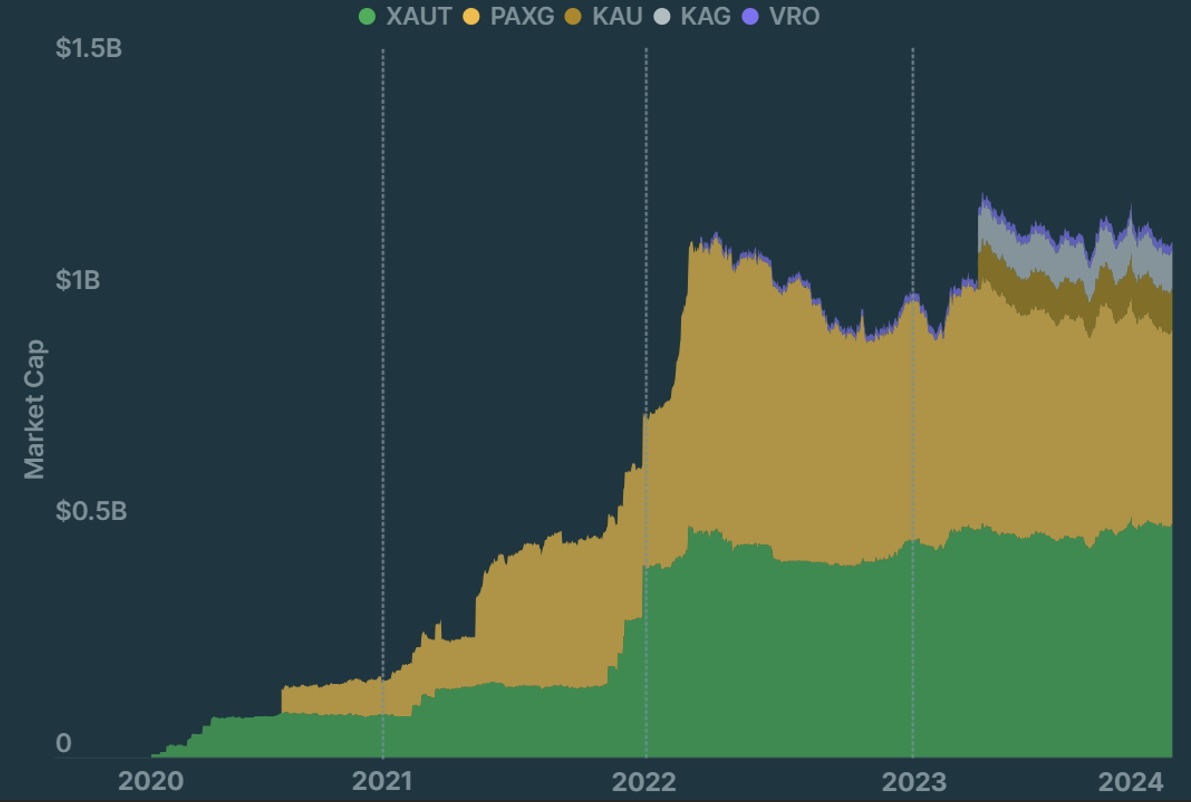
Over the last couple of years, the realm of real-world assets (RWAs) has witnessed a remarkable surge. Simply put, RWAs are a class of crypto tokens that represent tangible assets existing outside of the existing digital spectrum. In this regard, recent data suggests that since 2020, commodity-backed tokens alone have amassed a substantial market capitalization of $1.1 billion, with gold emerging as the most popular commodity.
Commodity-backed crypto tokens and their respective market caps (source: Coingecko)
Similarly, tokenized treasury products too have experienced an astonishing 800+% growth over the course of 2023, boasting a valuation that now exceeds $1.1 billion. Therefore, as the boundaries between traditional finance (trad-fi) and decentralized systems continue to blur, a new frontier has emerged, one where the trading of conventional instruments (such as forex, commodities, etc.) is increasingly being utilized within the context of Web3.
This paradigm shift offers unprecedented opportunities for investors to diversify their portfolios and gain exposure to a broader spectrum of assets, all while leveraging the inherent advantages of blockchain technology.
RWA trading in a Web3 environment
As highlighted earlier, the advent of Web3 has opened up new possibilities for trading traditional financial with ease. For instance, there are several platforms now that enable users to trade foreign currency pairs, precious metals, and even tokenized representations of real-world commodities like gold, silver, and uranium.
Moreover, the emergence of liquid staking derivatives allows investors to unlock the value of their staked crypto assets, effectively turning non-working assets into productive investment vehicles. By providing a fully collateralized and on-chain trading environment, these platforms ensure transparency, security, and global accessibility, empowering traders to tap into diverse markets without the limitations of traditional finance.
One offering at the helm of this revolution is Levana. As a fully collateralized perpetual swaps platform, Levana offers traders a unique opportunity to gain exposure to a diverse range of real-world assets, including forex pairs like the Chinese yuan and the British pound, as well as commodities such as gold and silver. This exclusive access to trading traditional asset classes sets Levana apart, catering to the evolving needs of traders seeking to diversify their portfolios beyond crypto alone.
One of Levana's standout features is its ability to allow users to profit from fees or trader losses. This unique offering flips the traditional trading paradigm on its head, enabling users to effectively become the "house" and earn from the platform's success. By providing this innovative revenue stream, Levana empowers its users to participate in the platform's growth and sustainability actively.
Moreover, Levana's support for liquid stake derivative markets further expands the possibilities traders have today, enhancing their capital efficiency while also opening up new avenues for value creation and portfolio optimization within the Web3 ecosystem.
A closer look at the pros and cons
While the integration of RWAs into the Web3 ecosystem presents a plethora of opportunities, it is important for individuals to recognize the potential challenges and risks associated with this emerging market segment. On the one hand, RWA trading offers investors unprecedented access to diverse asset classes, enabling them to hedge against market volatility and diversify their portfolios effectively. Furthermore, the transparency and immutability inherent in blockchain technology foster trust and accountability, crucial elements in the realm of financial transactions.
That said, the regulatory landscape surrounding RWA trading remains nascent and subject to constant evolution. As traditional finance intersects with decentralized systems, navigating the complexities of compliance and regulatory frameworks becomes paramount. Additionally, the reliance on third-party oracles, custodians, and credit assessors introduces potential vulnerabilities that need to be addressed so as to ensure the integrity and reliability of RWA trading platforms.
In this regard, Levana, with its innovative approach to risk management — thanks to features such as mandatory take-profit and stop-loss orders, capping the total amount of earnings per trade — alongside solvency assurance, helps mitigate the risks associated with market volatility and ensures the platform's resilience under any market conditions. Therefore, as the Web3 ecosystem continues to mature, it will be interesting to see how these two seemingly disparate frontiers continue to merge with one another.
Over the last couple of years, the realm of real-world assets (RWAs) has witnessed a remarkable surge. Simply put, RWAs are a class of crypto tokens that represent tangible assets existing outside of the existing digital spectrum. In this regard, recent data suggests that since 2020, commodity-backed tokens alone have amassed a substantial market capitalization of $1.1 billion, with gold emerging as the most popular commodity.
Commodity-backed crypto tokens and their respective market caps (source: Coingecko)
Similarly, tokenized treasury products too have experienced an astonishing 800+% growth over the course of 2023, boasting a valuation that now exceeds $1.1 billion. Therefore, as the boundaries between traditional finance (trad-fi) and decentralized systems continue to blur, a new frontier has emerged, one where the trading of conventional instruments (such as forex, commodities, etc.) is increasingly being utilized within the context of Web3.
This paradigm shift offers unprecedented opportunities for investors to diversify their portfolios and gain exposure to a broader spectrum of assets, all while leveraging the inherent advantages of blockchain technology.
RWA trading in a Web3 environment
As highlighted earlier, the advent of Web3 has opened up new possibilities for trading traditional financial with ease. For instance, there are several platforms now that enable users to trade foreign currency pairs, precious metals, and even tokenized representations of real-world commodities like gold, silver, and uranium.
Moreover, the emergence of liquid staking derivatives allows investors to unlock the value of their staked crypto assets, effectively turning non-working assets into productive investment vehicles. By providing a fully collateralized and on-chain trading environment, these platforms ensure transparency, security, and global accessibility, empowering traders to tap into diverse markets without the limitations of traditional finance.
One offering at the helm of this revolution is Levana. As a fully collateralized perpetual swaps platform, Levana offers traders a unique opportunity to gain exposure to a diverse range of real-world assets, including forex pairs like the Chinese yuan and the British pound, as well as commodities such as gold and silver. This exclusive access to trading traditional asset classes sets Levana apart, catering to the evolving needs of traders seeking to diversify their portfolios beyond crypto alone.
One of Levana's standout features is its ability to allow users to profit from fees or trader losses. This unique offering flips the traditional trading paradigm on its head, enabling users to effectively become the "house" and earn from the platform's success. By providing this innovative revenue stream, Levana empowers its users to participate in the platform's growth and sustainability actively.
Moreover, Levana's support for liquid stake derivative markets further expands the possibilities traders have today, enhancing their capital efficiency while also opening up new avenues for value creation and portfolio optimization within the Web3 ecosystem.
A closer look at the pros and cons
While the integration of RWAs into the Web3 ecosystem presents a plethora of opportunities, it is important for individuals to recognize the potential challenges and risks associated with this emerging market segment. On the one hand, RWA trading offers investors unprecedented access to diverse asset classes, enabling them to hedge against market volatility and diversify their portfolios effectively. Furthermore, the transparency and immutability inherent in blockchain technology foster trust and accountability, crucial elements in the realm of financial transactions.
That said, the regulatory landscape surrounding RWA trading remains nascent and subject to constant evolution. As traditional finance intersects with decentralized systems, navigating the complexities of compliance and regulatory frameworks becomes paramount. Additionally, the reliance on third-party oracles, custodians, and credit assessors introduces potential vulnerabilities that need to be addressed so as to ensure the integrity and reliability of RWA trading platforms.
In this regard, Levana, with its innovative approach to risk management — thanks to features such as mandatory take-profit and stop-loss orders, capping the total amount of earnings per trade — alongside solvency assurance, helps mitigate the risks associated with market volatility and ensures the platform's resilience under any market conditions. Therefore, as the Web3 ecosystem continues to mature, it will be interesting to see how these two seemingly disparate frontiers continue to merge with one another.
FP Markets Winner Spotlight 🏆 | Global Broker of the Year 2025 #Trading #Broker #Innovation #Shorts
FP Markets Winner Spotlight 🏆 | Global Broker of the Year 2025 #Trading #Broker #Innovation #Shorts
FP Markets takes the spotlight as Global Broker of the Year 2025 at the Finance Magnates Awards.
Martin Stoilov, Head of Client Experience, shares that trust, innovation, and people played a key role in the company’s success, supported by a strong foundation of integrity and client-centricity.
Following this milestone, FP Markets continues to focus on growth, technology investment, and its core values of transparency and excellence.
👉 Be part of FM Awards 2026: https://awards.financemagnates.com/#nominate
FP Markets takes the spotlight as Global Broker of the Year 2025 at the Finance Magnates Awards.
Martin Stoilov, Head of Client Experience, shares that trust, innovation, and people played a key role in the company’s success, supported by a strong foundation of integrity and client-centricity.
Following this milestone, FP Markets continues to focus on growth, technology investment, and its core values of transparency and excellence.
👉 Be part of FM Awards 2026: https://awards.financemagnates.com/#nominate
In this video, we review @HolaPrimeMarketsOfficial, a multi-asset forex and CFDs broker offering different account types, trading platforms, and flexible trading conditions.
We cover the broker’s overall offering, including account options, trading environment, platforms like MT4 and MT5, and additional services such as managed accounts and fast withdrawals.
Watch the full video to see if Hola Prime Markets fits your trading needs.
📣 Stay up to date with the latest in finance and trading. Follow Finance Magnates for industry news, insights, and global event coverage.
Connect with us:
🔗 LinkedIn: /financemagnates
👍 Facebook: /financemagnates
📸 Instagram: https://www.instagram.com/financemagnates
🐦 X: https://x.com/financemagnates
🎥 TikTok: https://www.tiktok.com/tag/financemagnates
▶️ YouTube: /@financemagnates_official
#HolaPrime #ForexBroker #CFDTrading #FinanceMagnates #Trading #Forex #BrokerReview
In this video, we review @HolaPrimeMarketsOfficial, a multi-asset forex and CFDs broker offering different account types, trading platforms, and flexible trading conditions.
We cover the broker’s overall offering, including account options, trading environment, platforms like MT4 and MT5, and additional services such as managed accounts and fast withdrawals.
Watch the full video to see if Hola Prime Markets fits your trading needs.
📣 Stay up to date with the latest in finance and trading. Follow Finance Magnates for industry news, insights, and global event coverage.
Connect with us:
🔗 LinkedIn: /financemagnates
👍 Facebook: /financemagnates
📸 Instagram: https://www.instagram.com/financemagnates
🐦 X: https://x.com/financemagnates
🎥 TikTok: https://www.tiktok.com/tag/financemagnates
▶️ YouTube: /@financemagnates_official
#HolaPrime #ForexBroker #CFDTrading #FinanceMagnates #Trading #Forex #BrokerReview
Hola Prime Review: What You Need to Know | Full Breakdown by Finance Magnates
Hola Prime Review: What You Need to Know | Full Breakdown by Finance Magnates
In this video, we review @HolaPrime_Global, a proprietary trading firm offering evaluation programs and performance-based payouts in simulated market environments.
We cover how the challenge model works, including account types, profit splits (up to 95%), trading rules, and what it takes to reach a funded account. You’ll also learn about available platforms like MT4, MT5, cTrader, and more, along with insights into payouts, support, and trading conditions.
Watch the full video to see if Hola Prime fits your trading style.
📣 Stay up to date with the latest in finance and trading. Follow Finance Magnates for industry news, insights, and global event coverage.
Connect with us:
🔗 LinkedIn: /financemagnates
👍 Facebook: /financemagnates
📸 Instagram: https://www.instagram.com/financemagnates
🐦 X: https://x.com/financemagnates
🎥 TikTok: https://www.tiktok.com/tag/financemagnates
▶️ YouTube: /@financemagnates_official
#HolaPrime #PropFirm #Trading #FinanceMagnates #Forex #FuturesTrading #TradingReview #PropFirmReview
In this video, we review @HolaPrime_Global, a proprietary trading firm offering evaluation programs and performance-based payouts in simulated market environments.
We cover how the challenge model works, including account types, profit splits (up to 95%), trading rules, and what it takes to reach a funded account. You’ll also learn about available platforms like MT4, MT5, cTrader, and more, along with insights into payouts, support, and trading conditions.
Watch the full video to see if Hola Prime fits your trading style.
📣 Stay up to date with the latest in finance and trading. Follow Finance Magnates for industry news, insights, and global event coverage.
Connect with us:
🔗 LinkedIn: /financemagnates
👍 Facebook: /financemagnates
📸 Instagram: https://www.instagram.com/financemagnates
🐦 X: https://x.com/financemagnates
🎥 TikTok: https://www.tiktok.com/tag/financemagnates
▶️ YouTube: /@financemagnates_official
#HolaPrime #PropFirm #Trading #FinanceMagnates #Forex #FuturesTrading #TradingReview #PropFirmReview
Axi Winner Spotlight 🏆 | Global Most Innovative Broker 2025 #Innovation #Trading #Fintech #Broker
Axi Winner Spotlight 🏆 | Global Most Innovative Broker 2025 #Innovation #Trading #Fintech #Broker
Axi takes the spotlight at the Finance Magnates Awards, winning Global Most Innovative Broker 2025.
Olivia Xenofontos and Ivanna Openko share how the team will feel: proud, motivated, and ready to keep delivering.
They also describe the night as well-organized, focused, and enjoyable for all.
👉 Be part of FM Awards 2026.
Axi takes the spotlight at the Finance Magnates Awards, winning Global Most Innovative Broker 2025.
Olivia Xenofontos and Ivanna Openko share how the team will feel: proud, motivated, and ready to keep delivering.
They also describe the night as well-organized, focused, and enjoyable for all.
👉 Be part of FM Awards 2026.
Recognition that matters.
Built on transparency.
Driven by the industry.
The Finance Magnates Awards 2026.
Nominations are now open.
🔗 https://awards.financemagnates.com/?utm_source=SM&utm_medium=social&utm_campaign=recognition-matters
Recognition that matters.
Built on transparency.
Driven by the industry.
The Finance Magnates Awards 2026.
Nominations are now open.
🔗 https://awards.financemagnates.com/?utm_source=SM&utm_medium=social&utm_campaign=recognition-matters