Financial and Business News

The Regulatory Playbook: Dubai Did It First, But Cyprus Can Still Do It Best

Monday, 05/05/2025 | 09:21 GMT by Nikolas Xenofontos
  • Cyprus can modernise its fintech rules by adapting Dubai's proven playbook—without breaking EU law or compromising investor protection.
  • Rolling reviews, real-time data, and risk-based licensing could cut delays and boost innovation in Cyprus without clashing with EU regulations.
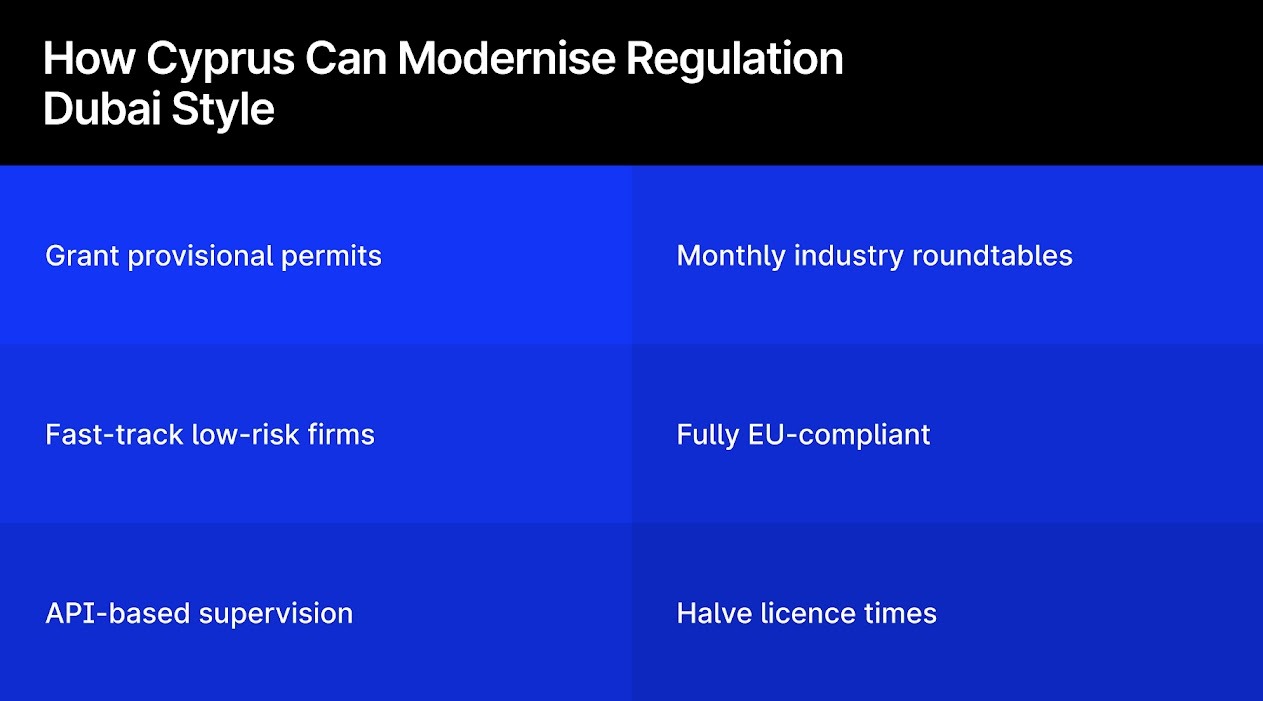
How Cyprus can modernise regulation - dubai style

Dubai’s regulators may have had the luxury of starting on a blank sheet of paper: it attracted and utilised talent and knowledge from experienced professionals that worked in more mature supervisory bodies and is also being able to take any direction it considers optimal for the jurisdictions short, medium and long-term. Cyprus, an EU member state, by contrast, must fit into the ever-thickening EU rulebook of PSD2, MiFID II, MiCA and the Anti-Money-Laundering Package.

Yet a different starting point is no longer an excuse for Cyprus, not to aim for the same destination of hyper-scale in hyper-responsible manner—even if not at the hyper-speed of the UAE.

The Cyprus Securities and Exchange Commission (CySEC) and the Central Bank of Cyprus (CBC) can still import the best UAE mechanics—without breaching EU discipline. In fact, the Abu Dhabi Global Market (ADGM) and the Dubai International Financial Centre (DIFC) have a proven playbook that Cyprus could implement immediately.

1. Rolling-Review Sandboxes

I call these “license while you build.”

The DIFC’s Innovation Testing Licence (ITL) grants a provisional permit, then reviews progress in 30- to 90-day bursts while the product is still being coded. If the firm meets pre-agreed KPIs—say, daily VaR below 0.5 %—the licence automatically graduates to full status. ADGM’s RegLab takes the same “test-and-learn” approach, giving supervisors live dashboards instead of static PDFs.

CySEC’s own sandbox , is the perfect canvas to adopt true rolling reviews rather than one-off “letters of comfort.” A phased licence aligned to EU proportionality principles would reduce time-to-market without relaxing investor protection.

2. Risk-Based Licence Paths

VARA and the DFSA calibrate capital, disclosure and audit depth to business-model risk: a low-volume advisory gets lighter scrutiny than a leveraged derivatives venue. Cyprus still funnels most applicants—CFD brokers, EMI start-ups, crypto custodians—through a single process that can exceed 12 months.

A better approach? Publish a CySEC and a CBC “risk matrix”: green channel (advisors, no leverage, no clients’ funds), amber (spot crypto, PISPs/AISPs), red (margin products, algorithmic venues). Such a risk matrix policy is entirely EU-compatible: for example, Article 7 of MiCA and Recital 15 of PSD2 already endorse proportionality.

3. Real-Time Supervisory Data

ADGM’s Digital Lab lets regulators pull API data—latency, order-book depth, margin calls—in almost real time, replacing quarterly spreadsheets with heat-maps.

Cyprus should mandate API-based risk streams into CySEC’s and CBC’s new RegTech back-ends. Nothing in EU law bars this; in fact, ESMA’s 2024 supervisory convergence report calls for “machine-readable” submissions. Faster anomaly detection protects retail traders and burns less supervisory manpower, that could be focused on initiatives such as those listed in here.

You may also like: Cyprus FX Exec Pay Drops, Compliance Salaries Soar; Dubai Stays Lucrative

The Need for an Ongoing Discussion

Further, the regulators in Cyprus should implement proper channels to remain in touch and connected to the industry and gather real insights for further improvement. Dubai’s regulators hold monthly, agenda-free roundtables where supervisors, founders and investors debate edge-case scenarios before they become headlines. The conversations de-risk policy drafts and reduce lobbying friction.

Cyprus could institute majlis focused on hot topics—AI trading signals, finfluencer marketing, DeFi staking. Minutes published in near real time would raise transparency and pull private-sector expertise into first-draft legislation.

The CySEC must be compliant with the requirements of the pan-European financial market regulator. However, the suggestions to mimic the UAE playbook would not violate any of the pan-European rules.

Read more: FCA Warns Tech Firms Not Doing Enough to Stop Illegal Forex Finfluencers

Brussels is not the barrier—inertia is:

  • Phased sandboxes are already embedded in ESMA’s 2023 FinTech Guidelines.
  • Risk-weighted reviews mirror the EBA’s SREP methodology for banks.
  • RegTech APIs align with the Digital Operational Resilience Act’s call for continuous monitoring.
  • Stakeholder forums echo the Commission’s new structured-dialogue approach used in the 2024 instant-payments package.

And there some obvious pay-offs on implementing these measures. It can even directly uimpact the efficiency of the licencing regime.

  1. Speed: Rolling reviews could halve the median licence timeline from 12 (or more) months to six without loosening prudential screws.
  2. Safety: Live risk data, and early-warning majlis sessions shrink the window for consumer harm and market abuse.
  3. Signal to founders: A publicly documented fast lane tells the next wave of PSPs, brokers and tokenisation platforms that Cyprus is serious about custodianship and innovation.

Dubai’s experience shows that hyper-scalable can be hyper-responsible, and that is not marketing fluff. It is operational design. Cyprus may have had a different starting point, but the desired destination is the same and borrowing the best practices—in this case the UAE’s mechanics—and embedding them inside the EU’s robust legal architecture, can still sprint the island to the front of Europe’s fintech pack.

Dubai’s regulators may have had the luxury of starting on a blank sheet of paper: it attracted and utilised talent and knowledge from experienced professionals that worked in more mature supervisory bodies and is also being able to take any direction it considers optimal for the jurisdictions short, medium and long-term. Cyprus, an EU member state, by contrast, must fit into the ever-thickening EU rulebook of PSD2, MiFID II, MiCA and the Anti-Money-Laundering Package.

Yet a different starting point is no longer an excuse for Cyprus, not to aim for the same destination of hyper-scale in hyper-responsible manner—even if not at the hyper-speed of the UAE.

The Cyprus Securities and Exchange Commission (CySEC) and the Central Bank of Cyprus (CBC) can still import the best UAE mechanics—without breaching EU discipline. In fact, the Abu Dhabi Global Market (ADGM) and the Dubai International Financial Centre (DIFC) have a proven playbook that Cyprus could implement immediately.

1. Rolling-Review Sandboxes

I call these “license while you build.”

The DIFC’s Innovation Testing Licence (ITL) grants a provisional permit, then reviews progress in 30- to 90-day bursts while the product is still being coded. If the firm meets pre-agreed KPIs—say, daily VaR below 0.5 %—the licence automatically graduates to full status. ADGM’s RegLab takes the same “test-and-learn” approach, giving supervisors live dashboards instead of static PDFs.

CySEC’s own sandbox , is the perfect canvas to adopt true rolling reviews rather than one-off “letters of comfort.” A phased licence aligned to EU proportionality principles would reduce time-to-market without relaxing investor protection.

2. Risk-Based Licence Paths

VARA and the DFSA calibrate capital, disclosure and audit depth to business-model risk: a low-volume advisory gets lighter scrutiny than a leveraged derivatives venue. Cyprus still funnels most applicants—CFD brokers, EMI start-ups, crypto custodians—through a single process that can exceed 12 months.

A better approach? Publish a CySEC and a CBC “risk matrix”: green channel (advisors, no leverage, no clients’ funds), amber (spot crypto, PISPs/AISPs), red (margin products, algorithmic venues). Such a risk matrix policy is entirely EU-compatible: for example, Article 7 of MiCA and Recital 15 of PSD2 already endorse proportionality.

3. Real-Time Supervisory Data

ADGM’s Digital Lab lets regulators pull API data—latency, order-book depth, margin calls—in almost real time, replacing quarterly spreadsheets with heat-maps.

Cyprus should mandate API-based risk streams into CySEC’s and CBC’s new RegTech back-ends. Nothing in EU law bars this; in fact, ESMA’s 2024 supervisory convergence report calls for “machine-readable” submissions. Faster anomaly detection protects retail traders and burns less supervisory manpower, that could be focused on initiatives such as those listed in here.

You may also like: Cyprus FX Exec Pay Drops, Compliance Salaries Soar; Dubai Stays Lucrative

The Need for an Ongoing Discussion

Further, the regulators in Cyprus should implement proper channels to remain in touch and connected to the industry and gather real insights for further improvement. Dubai’s regulators hold monthly, agenda-free roundtables where supervisors, founders and investors debate edge-case scenarios before they become headlines. The conversations de-risk policy drafts and reduce lobbying friction.

Cyprus could institute majlis focused on hot topics—AI trading signals, finfluencer marketing, DeFi staking. Minutes published in near real time would raise transparency and pull private-sector expertise into first-draft legislation.

The CySEC must be compliant with the requirements of the pan-European financial market regulator. However, the suggestions to mimic the UAE playbook would not violate any of the pan-European rules.

Read more: FCA Warns Tech Firms Not Doing Enough to Stop Illegal Forex Finfluencers

Brussels is not the barrier—inertia is:

  • Phased sandboxes are already embedded in ESMA’s 2023 FinTech Guidelines.
  • Risk-weighted reviews mirror the EBA’s SREP methodology for banks.
  • RegTech APIs align with the Digital Operational Resilience Act’s call for continuous monitoring.
  • Stakeholder forums echo the Commission’s new structured-dialogue approach used in the 2024 instant-payments package.

And there some obvious pay-offs on implementing these measures. It can even directly uimpact the efficiency of the licencing regime.

  1. Speed: Rolling reviews could halve the median licence timeline from 12 (or more) months to six without loosening prudential screws.
  2. Safety: Live risk data, and early-warning majlis sessions shrink the window for consumer harm and market abuse.
  3. Signal to founders: A publicly documented fast lane tells the next wave of PSPs, brokers and tokenisation platforms that Cyprus is serious about custodianship and innovation.

Dubai’s experience shows that hyper-scalable can be hyper-responsible, and that is not marketing fluff. It is operational design. Cyprus may have had a different starting point, but the desired destination is the same and borrowing the best practices—in this case the UAE’s mechanics—and embedding them inside the EU’s robust legal architecture, can still sprint the island to the front of Europe’s fintech pack.

About the Author: Nikolas Xenofontos
Nikolas Xenofontos
  • 1 Article
Nikolas Xenofontos is the Managing Director of SALVUS Funds, the Cyprus, Mauritius and UAE based boutique advisory for licensing, regulatory compliance and internal audit across investment firms, payment and electronic-money institutions, investment funds and Crypto-Asset Service Providers (CASPs). Under his leadership, SALVUS’ global team has delivered licences in multiple jurisdictions and steered landmark deals cementing the firm’s international footprint. Renowned for cutting through complexity, Nikolas draws on a career spanning market-risk management, brokerage marketing and CPD education to equip clients with pragmatic, forward-looking solutions that keep them ahead and in compliance of regulation.

Retail FX