The Q2 figure was 110 per cent higher than the first half of 2024 and 31 per cent higher than the second half.
Active accounts also increased by 22 per cent in the six months compared to H2 2024 and 84 per cent from H1 2024.
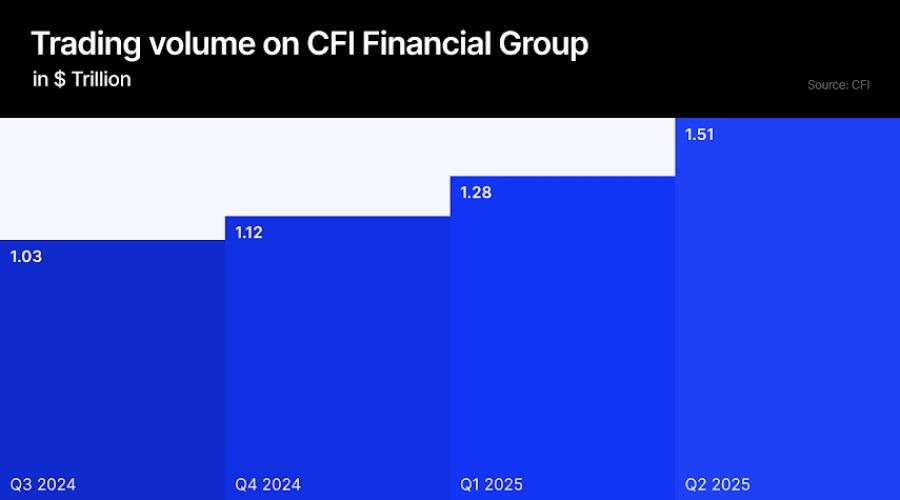
CFI Financial handled a record $1.51 trillion in trading volume during the second quarter of 2025. In comparison, the broker’s trading volume for the entire year of 2024 was $2.79 trillion, showing the growing interest in retail trading.
The record figure includes the period when US President Donald Trump’s tariff policies caused significant market volatility and lifted trading activity. Some retail trading market participants even said those were their “strongest days.”
Announced today (Monday), CFI’s latest quarterly figure was 18 per cent higher than Q1 2025 and nearly double—specifically a 97 per cent rise—compared to the same quarter last year.
Another noteworthy comparison is that the Q2 volume jumped 110 per cent over the first half of 2024 and 31 per cent over the second half.
As for the number of traders, the broker said that funded accounts on its platform increased by 2 per cent in the first half of 2025 compared to the previous six months, with a year-on-year rise of 60 per cent.
Active accounts also increased by 22 per cent compared to H2 2024 and 84 per cent over H1 2024.
Ziad Melhem, CEO at CFI Financial Group (Source: CFI)
“Q2 2025 was not only about numbers, it was about momentum,” said Ziad Melhem, who became CFI’s Group CEO during the record quarter. Meanwhile, the two co-founders, Hisham Mansour and Eduardo Fakhoury, stepped down from their Managing Director roles to become Chairman and Vice Chairman, respectively.
CFI also grew its geographical presence. The broker launched operations in South Africa last December and recently entered Bahrain with a licence from the country’s central bank.
However, CFI—already well-established in the Middle East—is not the only broker expanding in the region. Tickmill recently opened an office in Oman through a local partnership, just a couple of months after OneRoyal, another CFD broker, set up its presence in the country. XS.com was another broker to expand, choosing Kuwait.
The most popular Middle Eastern destination for international CFD brokers, however, remains the UAE. The country’s clear financial regulation and large talent pool have attracted many brokers to set up base in the desert city.
Increased trading activity among Middle Eastern clients has made the region a top priority for many firms. Capital.com previously reported that 53 per cent of its Q1 trading volume came from the Middle East, compared to 24 per cent from Europe. That broker handled $656 billion in trading volume during the quarter and has yet to release its Q2 figures.
CFI Financial handled a record $1.51 trillion in trading volume during the second quarter of 2025. In comparison, the broker’s trading volume for the entire year of 2024 was $2.79 trillion, showing the growing interest in retail trading.
The record figure includes the period when US President Donald Trump’s tariff policies caused significant market volatility and lifted trading activity. Some retail trading market participants even said those were their “strongest days.”
Announced today (Monday), CFI’s latest quarterly figure was 18 per cent higher than Q1 2025 and nearly double—specifically a 97 per cent rise—compared to the same quarter last year.
Another noteworthy comparison is that the Q2 volume jumped 110 per cent over the first half of 2024 and 31 per cent over the second half.
As for the number of traders, the broker said that funded accounts on its platform increased by 2 per cent in the first half of 2025 compared to the previous six months, with a year-on-year rise of 60 per cent.
Active accounts also increased by 22 per cent compared to H2 2024 and 84 per cent over H1 2024.
Ziad Melhem, CEO at CFI Financial Group (Source: CFI)
“Q2 2025 was not only about numbers, it was about momentum,” said Ziad Melhem, who became CFI’s Group CEO during the record quarter. Meanwhile, the two co-founders, Hisham Mansour and Eduardo Fakhoury, stepped down from their Managing Director roles to become Chairman and Vice Chairman, respectively.
CFI also grew its geographical presence. The broker launched operations in South Africa last December and recently entered Bahrain with a licence from the country’s central bank.
However, CFI—already well-established in the Middle East—is not the only broker expanding in the region. Tickmill recently opened an office in Oman through a local partnership, just a couple of months after OneRoyal, another CFD broker, set up its presence in the country. XS.com was another broker to expand, choosing Kuwait.
The most popular Middle Eastern destination for international CFD brokers, however, remains the UAE. The country’s clear financial regulation and large talent pool have attracted many brokers to set up base in the desert city.
Increased trading activity among Middle Eastern clients has made the region a top priority for many firms. Capital.com previously reported that 53 per cent of its Q1 trading volume came from the Middle East, compared to 24 per cent from Europe. That broker handled $656 billion in trading volume during the quarter and has yet to release its Q2 figures.
Arnab Shome is an electronics engineer-turned-financial editor. He holds a Bachelor of Technology from the National Institute of Technology, Agartala. He entered the retail trading industry about a decade ago, covering the cryptocurrency market for Finance Magnates, and later expanded his coverage to include forex and CFDs as well.
His work at Finance Magnates includes C-level interviews, data-driven analysis, opinion pieces, and scoops of industry exclusives. He also contributes to Finance Magnates’ quarterly industry report.
Area of coverage:
1. CFD broker-related news
2. Industry-related Regulatory updates and developments
3. New retail trading trends
4. Prop trading industry updates
5. Executive interviews
Education:
Bachelor of Technology - National Institute of Technology, Agartala (India)
Webull Spent Big to Hit Record Revenue, and the Bill Is in the Fine Print
FP Markets Winner Spotlight 🏆 | Global Broker of the Year 2025 #Trading #Broker #Innovation #Shorts
FP Markets Winner Spotlight 🏆 | Global Broker of the Year 2025 #Trading #Broker #Innovation #Shorts
FP Markets takes the spotlight as Global Broker of the Year 2025 at the Finance Magnates Awards.
Martin Stoilov, Head of Client Experience, shares that trust, innovation, and people played a key role in the company’s success, supported by a strong foundation of integrity and client-centricity.
Following this milestone, FP Markets continues to focus on growth, technology investment, and its core values of transparency and excellence.
👉 Be part of FM Awards 2026: https://awards.financemagnates.com/#nominate
FP Markets takes the spotlight as Global Broker of the Year 2025 at the Finance Magnates Awards.
Martin Stoilov, Head of Client Experience, shares that trust, innovation, and people played a key role in the company’s success, supported by a strong foundation of integrity and client-centricity.
Following this milestone, FP Markets continues to focus on growth, technology investment, and its core values of transparency and excellence.
👉 Be part of FM Awards 2026: https://awards.financemagnates.com/#nominate
In this video, we review @HolaPrimeMarketsOfficial, a multi-asset forex and CFDs broker offering different account types, trading platforms, and flexible trading conditions.
We cover the broker’s overall offering, including account options, trading environment, platforms like MT4 and MT5, and additional services such as managed accounts and fast withdrawals.
Watch the full video to see if Hola Prime Markets fits your trading needs.
📣 Stay up to date with the latest in finance and trading. Follow Finance Magnates for industry news, insights, and global event coverage.
Connect with us:
🔗 LinkedIn: /financemagnates
👍 Facebook: /financemagnates
📸 Instagram: https://www.instagram.com/financemagnates
🐦 X: https://x.com/financemagnates
🎥 TikTok: https://www.tiktok.com/tag/financemagnates
▶️ YouTube: /@financemagnates_official
#HolaPrime #ForexBroker #CFDTrading #FinanceMagnates #Trading #Forex #BrokerReview
In this video, we review @HolaPrimeMarketsOfficial, a multi-asset forex and CFDs broker offering different account types, trading platforms, and flexible trading conditions.
We cover the broker’s overall offering, including account options, trading environment, platforms like MT4 and MT5, and additional services such as managed accounts and fast withdrawals.
Watch the full video to see if Hola Prime Markets fits your trading needs.
📣 Stay up to date with the latest in finance and trading. Follow Finance Magnates for industry news, insights, and global event coverage.
Connect with us:
🔗 LinkedIn: /financemagnates
👍 Facebook: /financemagnates
📸 Instagram: https://www.instagram.com/financemagnates
🐦 X: https://x.com/financemagnates
🎥 TikTok: https://www.tiktok.com/tag/financemagnates
▶️ YouTube: /@financemagnates_official
#HolaPrime #ForexBroker #CFDTrading #FinanceMagnates #Trading #Forex #BrokerReview
Hola Prime Review: What You Need to Know | Full Breakdown by Finance Magnates
Hola Prime Review: What You Need to Know | Full Breakdown by Finance Magnates
In this video, we review @HolaPrime_Global, a proprietary trading firm offering evaluation programs and performance-based payouts in simulated market environments.
We cover how the challenge model works, including account types, profit splits (up to 95%), trading rules, and what it takes to reach a funded account. You’ll also learn about available platforms like MT4, MT5, cTrader, and more, along with insights into payouts, support, and trading conditions.
Watch the full video to see if Hola Prime fits your trading style.
📣 Stay up to date with the latest in finance and trading. Follow Finance Magnates for industry news, insights, and global event coverage.
Connect with us:
🔗 LinkedIn: /financemagnates
👍 Facebook: /financemagnates
📸 Instagram: https://www.instagram.com/financemagnates
🐦 X: https://x.com/financemagnates
🎥 TikTok: https://www.tiktok.com/tag/financemagnates
▶️ YouTube: /@financemagnates_official
#HolaPrime #PropFirm #Trading #FinanceMagnates #Forex #FuturesTrading #TradingReview #PropFirmReview
In this video, we review @HolaPrime_Global, a proprietary trading firm offering evaluation programs and performance-based payouts in simulated market environments.
We cover how the challenge model works, including account types, profit splits (up to 95%), trading rules, and what it takes to reach a funded account. You’ll also learn about available platforms like MT4, MT5, cTrader, and more, along with insights into payouts, support, and trading conditions.
Watch the full video to see if Hola Prime fits your trading style.
📣 Stay up to date with the latest in finance and trading. Follow Finance Magnates for industry news, insights, and global event coverage.
Connect with us:
🔗 LinkedIn: /financemagnates
👍 Facebook: /financemagnates
📸 Instagram: https://www.instagram.com/financemagnates
🐦 X: https://x.com/financemagnates
🎥 TikTok: https://www.tiktok.com/tag/financemagnates
▶️ YouTube: /@financemagnates_official
#HolaPrime #PropFirm #Trading #FinanceMagnates #Forex #FuturesTrading #TradingReview #PropFirmReview
Axi Winner Spotlight 🏆 | Global Most Innovative Broker 2025 #Innovation #Trading #Fintech #Broker
Axi Winner Spotlight 🏆 | Global Most Innovative Broker 2025 #Innovation #Trading #Fintech #Broker
Axi takes the spotlight at the Finance Magnates Awards, winning Global Most Innovative Broker 2025.
Olivia Xenofontos and Ivanna Openko share how the team will feel: proud, motivated, and ready to keep delivering.
They also describe the night as well-organized, focused, and enjoyable for all.
👉 Be part of FM Awards 2026.
Axi takes the spotlight at the Finance Magnates Awards, winning Global Most Innovative Broker 2025.
Olivia Xenofontos and Ivanna Openko share how the team will feel: proud, motivated, and ready to keep delivering.
They also describe the night as well-organized, focused, and enjoyable for all.
👉 Be part of FM Awards 2026.
Recognition that matters.
Built on transparency.
Driven by the industry.
The Finance Magnates Awards 2026.
Nominations are now open.
🔗 https://awards.financemagnates.com/?utm_source=SM&utm_medium=social&utm_campaign=recognition-matters
Recognition that matters.
Built on transparency.
Driven by the industry.
The Finance Magnates Awards 2026.
Nominations are now open.
🔗 https://awards.financemagnates.com/?utm_source=SM&utm_medium=social&utm_campaign=recognition-matters