Financial and Business News

Robinhood Tests Social Trading in the U.S., Trying Not to Upset Regulators

Thursday, 19/03/2026 | 13:17 GMT by Tanya Chepkova
  • Robinhood avoids auto-copying, keeping users in control to stay within U.S. regulatory boundaries.
  • The product mirrors eToro’s model—but strips out automation to reduce legal risk and test demand.
Robinhood Soical
Robinhood Soical

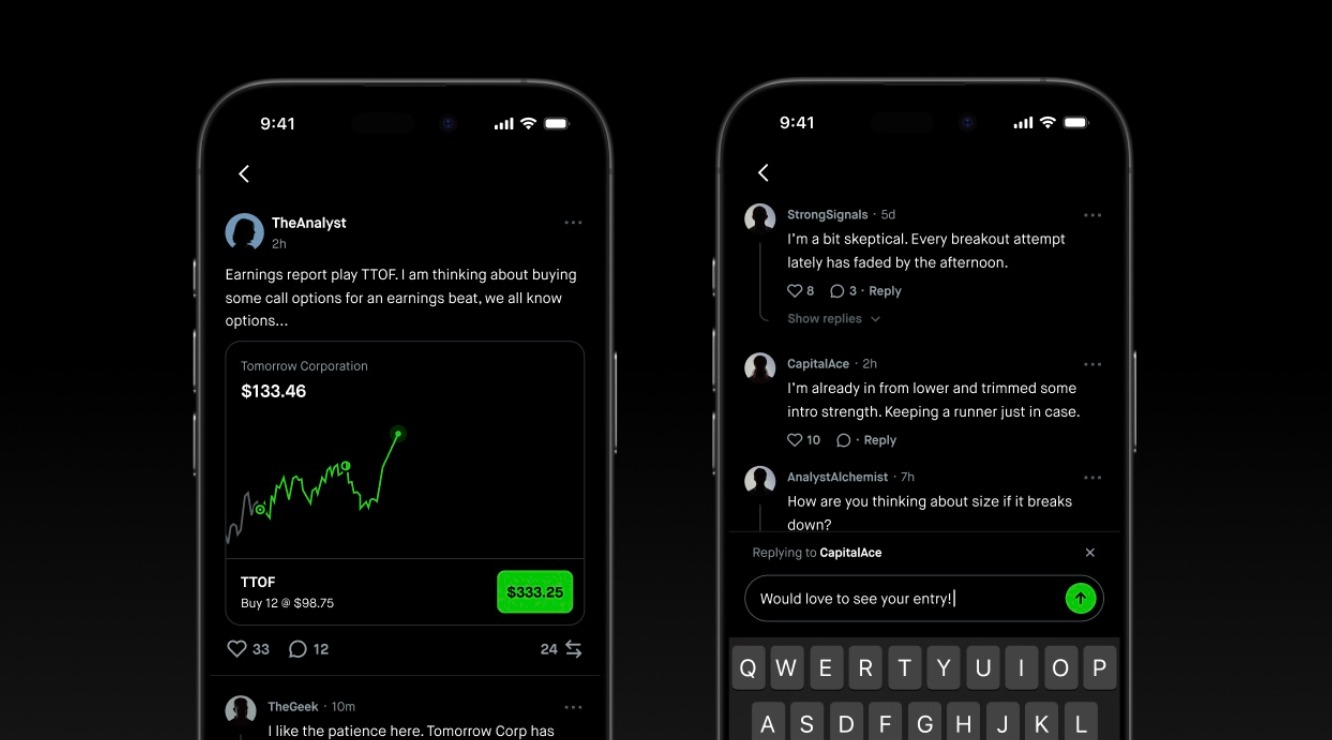
Robinhood is beta testing a new social feature that allows users to share and discuss trades, marking its first move toward social trading in the U.S. market.

Join the inaugural Finance Magnates Singapore Summit 2026, which will bring together brokers, fintechs, banks, EMIs, wealth managers, and hedge funds across APAC.

The product, called “Robinhood Social,” reflects a model already popular in Europe, where platforms such as eToro allow users to follow and automatically copy each other’s trades.

Robinhood first signaled its interest in social trading features in October 2025. In the U.S., however, that approach sits in a more uncertain regulatory environment

Manual Copying Instead of Automation

Robinhood’s version deliberately stops short of full copy trading. Users can see what others are trading and replicate those positions manually, but there is no automatic portfolio mirroring or rebalancing.

That distinction is central to the product’s design and reflects how the company is approaching regulatory risk. The concern is real. In the U.S., sharing trades at scale can be interpreted as a form of investment advice, particularly if it leads to systematic copying.

At the same time, anonymous social features raise concerns around coordinated trading and market manipulation. Robinhood’s approach addresses both issues.

Profiles are tied to verified users through existing onboarding processes, and trading decisions remain fully user-initiated. The company is effectively bringing the social layer that already exists on platforms like Reddit and X into its own app — but without automating decision-making.

Robinhood is also limiting early access. The feature is initially available to around 1,000 invited users, with plans to expand to another 10,000 in the near term. A broader rollout to all customers is expected later this year.

A Different Product Model from eToro

The rollout is also limited. Access is initially restricted to a small group of users, with broader expansion planned later this year. The product positioning differs from established copy trading platforms.

Services such as eToro are built around portfolio delegation, where users allocate capital to traders and have positions replicated automatically. Robinhood, by contrast, is adding a social layer on top of its existing multi-asset offering — including stocks, options, crypto, futures and prediction markets — without shifting control away from the user.

That difference has implications for both user experience and risk. Instead of “following” a trader in the background, users remain responsible for each trade, even if the idea originates from someone else’s portfolio.

Testing the Limits of U.S. Regulation

For the brokerage industry, the rollout highlights a key constraint in the U.S. market. Social trading is well established globally, but its development domestically has been limited by rules around investment advice and market conduct.

Robinhood’s model suggests one way forward: keep the social signal, remove the automation. Whether that balance holds as the product scales will depend on how regulators interpret the boundary between discussion and advice.


Robinhood is beta testing a new social feature that allows users to share and discuss trades, marking its first move toward social trading in the U.S. market.

Join the inaugural Finance Magnates Singapore Summit 2026, which will bring together brokers, fintechs, banks, EMIs, wealth managers, and hedge funds across APAC.

The product, called “Robinhood Social,” reflects a model already popular in Europe, where platforms such as eToro allow users to follow and automatically copy each other’s trades.

Robinhood first signaled its interest in social trading features in October 2025. In the U.S., however, that approach sits in a more uncertain regulatory environment

Manual Copying Instead of Automation

Robinhood’s version deliberately stops short of full copy trading. Users can see what others are trading and replicate those positions manually, but there is no automatic portfolio mirroring or rebalancing.

That distinction is central to the product’s design and reflects how the company is approaching regulatory risk. The concern is real. In the U.S., sharing trades at scale can be interpreted as a form of investment advice, particularly if it leads to systematic copying.

At the same time, anonymous social features raise concerns around coordinated trading and market manipulation. Robinhood’s approach addresses both issues.

Profiles are tied to verified users through existing onboarding processes, and trading decisions remain fully user-initiated. The company is effectively bringing the social layer that already exists on platforms like Reddit and X into its own app — but without automating decision-making.

Robinhood is also limiting early access. The feature is initially available to around 1,000 invited users, with plans to expand to another 10,000 in the near term. A broader rollout to all customers is expected later this year.

A Different Product Model from eToro

The rollout is also limited. Access is initially restricted to a small group of users, with broader expansion planned later this year. The product positioning differs from established copy trading platforms.

Services such as eToro are built around portfolio delegation, where users allocate capital to traders and have positions replicated automatically. Robinhood, by contrast, is adding a social layer on top of its existing multi-asset offering — including stocks, options, crypto, futures and prediction markets — without shifting control away from the user.

That difference has implications for both user experience and risk. Instead of “following” a trader in the background, users remain responsible for each trade, even if the idea originates from someone else’s portfolio.

Testing the Limits of U.S. Regulation

For the brokerage industry, the rollout highlights a key constraint in the U.S. market. Social trading is well established globally, but its development domestically has been limited by rules around investment advice and market conduct.

Robinhood’s model suggests one way forward: keep the social signal, remove the automation. Whether that balance holds as the product scales will depend on how regulators interpret the boundary between discussion and advice.

About the Author: Tanya Chepkova
Tanya Chepkova
  • 127 Articles
Tanya Chepkova is a News Editor at Finance Magnates with more than 16 years of experience in financial journalism, covering forex, crypto, and digital asset markets. Her work spans daily industry reporting and data-driven, long-form explainers focused on market structure, trading models, and regulatory shifts. Before joining Finance Magnates, she led the editorial team of a cryptocurrency-focused media outlet for six years. Her reporting combines analytical depth with clear storytelling, with particular attention to how structural changes in trading, stablecoin infrastructure, and emerging products such as prediction markets reshape the broader financial ecosystem. She covers global developments and provides additional insight into CIS markets. Areas of Coverage: Crypto and digital asset markets Prediction markets Stablecoins and cross-border payments Industry analysis and long-form explainers

More from the Author

Retail FX