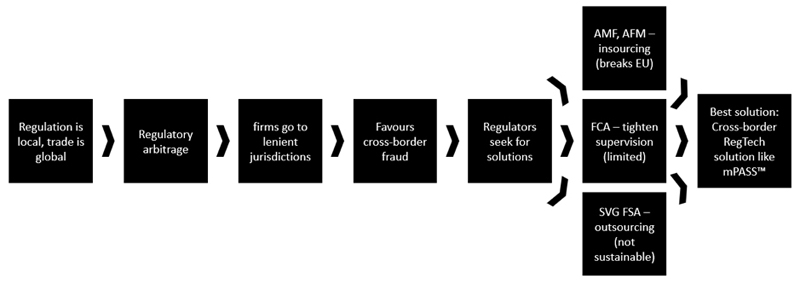
The FSA is effectively outsourcing its supervisory powers to overseas regulators.
RegTech has been cutting costs, streamlining processes and shortening times-to-market for decades.
Op-ed
The Bad Kind of Glocal
'Glocal' is a term mostly used positively to describe
something which enjoys both the advantages of a global mindset and the benefits
of a local community.
However, 'Glocal' has its dark side, too. For example, since
regulation is local, but trade is global, companies are incentivised to set shop
in a jurisdiction whose regulatory and supervisory regimes are relatively
lenient and provide services from there.
The combination of a jurisdiction with a lenient regulatory
and supervisory regime, as well as companies who choose to set shop in it for that
reason, make it very hard for those who see themselves deceived by said
companies to recover their funds from them.
Therefore, 'Glocal' doesn’t always mean enjoying the best
of the two; it can sometimes actually be suffering their worst.
The Regulatory Challenge and Process
Insourcing – the French and Dutch Approach to Regtech
The above-described phenomenon is nothing new, of course.
What is new is the way regulators are attempting to deal with it?
In December 2021 the AFM and AMF (French and Dutch
regulators) published a very unusual joint
statement, in which they stated they “increasingly observe practices of
financial firms obtaining a license and European passport in other EU member
states than that of their target audience,” and that these firms especially
are prominent when it comes to “offering high-risk products (such as CFDs)
as well as in terms of the complaints received from consumers on their
practices”.
Therefore, the AFM and AMF asked to transfer supervision
over those firms to them – a quite dramatic move, as it contradicts the
very notion of a unified European market.
Effectively, what the AFM and AMF were saying was that they
no longer wish to 'outsource' the supervision over French and Dutch residents
to other EU regulators; and wish to 'insource' the supervision back to them.
Apart from being contradictory to the very notion of the EU,
this type of 'reverse supervision' seems also quite impractical, as both the
criteria for its imposing are fluid and imprecise, at best; and as the actual
abilities of a regulatory authority to exercise effective supervision over a body
in a different jurisdiction is unclear.
Outsourcing – the Saint Vincent and Grenadine Approach
Just over a year later, on January 6, 2023, the Saint
Vincent and the Grenadines (SVG) Financial Services Authority (FSA) took the
exact opposite approach.
In a memorandum titled “Requirements for Business
Companies (BCs) and Limited Liability Companies (LLCs) Engaging in Forex
Business Activity,” the FSA stated the following:
“Owing to the sharp increase in the frequency and number
of complaints and allegations of fraud against SVG registered BCs and LLCs
which are engaged in FOREX trading or brokerage and the potential detrimental
effects on the reputation of St. Vincent and the Grenadines as an International
Financial Centre, the Financial Services Authority (FSA) has adopted the
following policy decision… Companies
wishing to engage in FOREX business must provide a certified copy of requisite
licences/approval from the jurisdiction(s)/authorities where their business
activities will be conducted…”
Remonda Kirketerp-Moller, Founder and CEO, Muinmos
Without such evidence, states the memorandum, applications
for new licenses will be rejected; and existing brokers have until 10.03.23 to
provide said evidence to the FSA, or risk being sanctioned.
This is a very unusual step taken by the FSA. Of course, strictly
speaking, in order to legally operate in a jurisdiction, one usually requires
to obtain a license there (there might also be other legal possibilities, though,
such as reverse solicitation or 'soft licensing' of various sorts).
However, here the FSA is effectively outsourcing its
supervisory powers to overseas regulators, saying it will only grant a license
(except for those who wish to operate only in SVG) to a firm that has been
previously licensed by a different regulatory authority.
This can be very effective, in the sense that the FSA
understands it cannot regulate the actions of financial institutions in their
operations elsewhere, and it is also aware firms are mis-using its license to
harm investors in those jurisdictions, and therefore wishes to remove from its
shores those specific firms who are interested in an unfair advantage.
However, this seems non-sustainable on a large scale, as it
is doubtful many regulators will follow suit. After all, this means that there
will be very little value to an offshore license. Also, not all regulators are able
to withstand the incentive to provide a lenient regulatory environment in order
to attract investments. And, this is before we even mention the paradox that
might be created, if ALL the regulators in the world (or at least many of them)
will implement a similar criterion…
Watch the recent FMLS22 panel discuss Regulation Roundup: Everything you need to know for 2023.
The Traditional Approach – Tightening Supervision
In December 2022, the FCA tackled the same issue of
cross-border trading. In a quite direct “Dear CEO” letter, the FCA highlighted
problems of bad practices in CFD trading, related among others to firms trading
in the UK via a temporary passporting regime, and made it clear it intends to
prioritise this issue, and expects firms to take clear action on this.
Contrary to the SVG FSA and the AMF, AFM approaches, the
FCA’s approach can be described as a “traditional” – tightening of supervision.
The advantages of this approach are clear; but so are its disadvantages. Among
other things, the FCA can only deal with the matter in its own “backyard”; and
that is, of course, only half the solution.
The Market Already Knows – Regulatory Challenges Are
Solved by Regulatory Technology
One regulator tightens its supervision; others ask to
insource it; another to outsource it. The variety of approaches is wide, and it
won’t come as too big of a surprise if a regulator would even choose to
ban electronic trading in their jurisdiction altogether (drastic as it may
sound). However, we would like to
suggest a better solution, harmonisation through technology.
As any market-maker or participant already knows, regulatory
challenges are solvable or at least are considerably eased by the use of
appropriate technology. Regulatory Technology solutions, or 'RegTech
solutions', have been cutting costs, streamlining processes and shortening
times-to-market for decades now, and are an essential and inseparable part of
the day-to-day practice of compliance, onboarding, reporting etc. teams in financial
institutions.
It makes perfect sense, then, to look for a RegTech solution
for this problem of cross-border trading as well. And, the solution exists, Muinmos’
mPASS™, an automated investor protection module, which automatically
categorises a client, assesses suitability and appropriateness, assigns it with
a risk profile etc., according to the legal systems of both the financial
institution’s domicile AND that of the client.
The implementation of such a system, of course, won’t solve
all the issues concerning cross-border trading. But, it will provide a much
better compliance starting point; can be implemented fast and at a relatively low cost; and is a lot more realistic than expecting all the regulators in the
world to ask for each other’s licenses before granting their own (something
that is also, as stated above, actually paradoxical).
Such is the power of RegTech: it can solve a regulatory
problem with relative ease and at a relatively fast pace, low cost, and to the
benefit of all regulators, firms and investors alike. In the context
discussed here, mPASS™ even presents a unique opportunity to create a unified
legal benchmark, thus eliminating regulatory arbitrage, proving that technology,
very much like trade, has the potential to transcend jurisdictional boundaries.
Remonda Kirketerp-Møller is the CEO/Founder of Muinmos
The Bad Kind of Glocal
'Glocal' is a term mostly used positively to describe
something which enjoys both the advantages of a global mindset and the benefits
of a local community.
However, 'Glocal' has its dark side, too. For example, since
regulation is local, but trade is global, companies are incentivised to set shop
in a jurisdiction whose regulatory and supervisory regimes are relatively
lenient and provide services from there.
The combination of a jurisdiction with a lenient regulatory
and supervisory regime, as well as companies who choose to set shop in it for that
reason, make it very hard for those who see themselves deceived by said
companies to recover their funds from them.
Therefore, 'Glocal' doesn’t always mean enjoying the best
of the two; it can sometimes actually be suffering their worst.
The Regulatory Challenge and Process
Insourcing – the French and Dutch Approach to Regtech
The above-described phenomenon is nothing new, of course.
What is new is the way regulators are attempting to deal with it?
In December 2021 the AFM and AMF (French and Dutch
regulators) published a very unusual joint
statement, in which they stated they “increasingly observe practices of
financial firms obtaining a license and European passport in other EU member
states than that of their target audience,” and that these firms especially
are prominent when it comes to “offering high-risk products (such as CFDs)
as well as in terms of the complaints received from consumers on their
practices”.
Therefore, the AFM and AMF asked to transfer supervision
over those firms to them – a quite dramatic move, as it contradicts the
very notion of a unified European market.
Effectively, what the AFM and AMF were saying was that they
no longer wish to 'outsource' the supervision over French and Dutch residents
to other EU regulators; and wish to 'insource' the supervision back to them.
Apart from being contradictory to the very notion of the EU,
this type of 'reverse supervision' seems also quite impractical, as both the
criteria for its imposing are fluid and imprecise, at best; and as the actual
abilities of a regulatory authority to exercise effective supervision over a body
in a different jurisdiction is unclear.
Outsourcing – the Saint Vincent and Grenadine Approach
Just over a year later, on January 6, 2023, the Saint
Vincent and the Grenadines (SVG) Financial Services Authority (FSA) took the
exact opposite approach.
In a memorandum titled “Requirements for Business
Companies (BCs) and Limited Liability Companies (LLCs) Engaging in Forex
Business Activity,” the FSA stated the following:
“Owing to the sharp increase in the frequency and number
of complaints and allegations of fraud against SVG registered BCs and LLCs
which are engaged in FOREX trading or brokerage and the potential detrimental
effects on the reputation of St. Vincent and the Grenadines as an International
Financial Centre, the Financial Services Authority (FSA) has adopted the
following policy decision… Companies
wishing to engage in FOREX business must provide a certified copy of requisite
licences/approval from the jurisdiction(s)/authorities where their business
activities will be conducted…”
Remonda Kirketerp-Moller, Founder and CEO, Muinmos
Without such evidence, states the memorandum, applications
for new licenses will be rejected; and existing brokers have until 10.03.23 to
provide said evidence to the FSA, or risk being sanctioned.
This is a very unusual step taken by the FSA. Of course, strictly
speaking, in order to legally operate in a jurisdiction, one usually requires
to obtain a license there (there might also be other legal possibilities, though,
such as reverse solicitation or 'soft licensing' of various sorts).
However, here the FSA is effectively outsourcing its
supervisory powers to overseas regulators, saying it will only grant a license
(except for those who wish to operate only in SVG) to a firm that has been
previously licensed by a different regulatory authority.
This can be very effective, in the sense that the FSA
understands it cannot regulate the actions of financial institutions in their
operations elsewhere, and it is also aware firms are mis-using its license to
harm investors in those jurisdictions, and therefore wishes to remove from its
shores those specific firms who are interested in an unfair advantage.
However, this seems non-sustainable on a large scale, as it
is doubtful many regulators will follow suit. After all, this means that there
will be very little value to an offshore license. Also, not all regulators are able
to withstand the incentive to provide a lenient regulatory environment in order
to attract investments. And, this is before we even mention the paradox that
might be created, if ALL the regulators in the world (or at least many of them)
will implement a similar criterion…
Watch the recent FMLS22 panel discuss Regulation Roundup: Everything you need to know for 2023.
The Traditional Approach – Tightening Supervision
In December 2022, the FCA tackled the same issue of
cross-border trading. In a quite direct “Dear CEO” letter, the FCA highlighted
problems of bad practices in CFD trading, related among others to firms trading
in the UK via a temporary passporting regime, and made it clear it intends to
prioritise this issue, and expects firms to take clear action on this.
Contrary to the SVG FSA and the AMF, AFM approaches, the
FCA’s approach can be described as a “traditional” – tightening of supervision.
The advantages of this approach are clear; but so are its disadvantages. Among
other things, the FCA can only deal with the matter in its own “backyard”; and
that is, of course, only half the solution.
The Market Already Knows – Regulatory Challenges Are
Solved by Regulatory Technology
One regulator tightens its supervision; others ask to
insource it; another to outsource it. The variety of approaches is wide, and it
won’t come as too big of a surprise if a regulator would even choose to
ban electronic trading in their jurisdiction altogether (drastic as it may
sound). However, we would like to
suggest a better solution, harmonisation through technology.
As any market-maker or participant already knows, regulatory
challenges are solvable or at least are considerably eased by the use of
appropriate technology. Regulatory Technology solutions, or 'RegTech
solutions', have been cutting costs, streamlining processes and shortening
times-to-market for decades now, and are an essential and inseparable part of
the day-to-day practice of compliance, onboarding, reporting etc. teams in financial
institutions.
It makes perfect sense, then, to look for a RegTech solution
for this problem of cross-border trading as well. And, the solution exists, Muinmos’
mPASS™, an automated investor protection module, which automatically
categorises a client, assesses suitability and appropriateness, assigns it with
a risk profile etc., according to the legal systems of both the financial
institution’s domicile AND that of the client.
The implementation of such a system, of course, won’t solve
all the issues concerning cross-border trading. But, it will provide a much
better compliance starting point; can be implemented fast and at a relatively low cost; and is a lot more realistic than expecting all the regulators in the
world to ask for each other’s licenses before granting their own (something
that is also, as stated above, actually paradoxical).
Such is the power of RegTech: it can solve a regulatory
problem with relative ease and at a relatively fast pace, low cost, and to the
benefit of all regulators, firms and investors alike. In the context
discussed here, mPASS™ even presents a unique opportunity to create a unified
legal benchmark, thus eliminating regulatory arbitrage, proving that technology,
very much like trade, has the potential to transcend jurisdictional boundaries.
Remonda Kirketerp-Møller is the CEO/Founder of Muinmos
Remonda Kirketerp-Møller, a qualified solicitor and a renowned expert in RegTech, Fintech and regulatory matters in financial services.
She has held senior executive positions at two highly successful, fast growth global firms, Saxo Bank and CFH Clearing, where she gained first hand experience about the complexities involved in compliance and onboarding.
Remonda founded Danish RegTech company, muinmos ApS in 2012 after spotting a gap in the market to use technology to automate highly complex legal and regulatory challenges in financial services, specifically in client onboarding.
With Remonda at the helm, Muinmos has won multiple awards for its innovative automated. AI-based onboarding solution and has been selected for the prestigious RegTech 100 for the last five consecutive years.
Remonda is also co-author of ‘The RegTech Book’ , published by Wiley in Summer 2019.
42% of Swiss Financial Firms Have No Digital Fraud Policy, FINMA Finds
FP Markets Winner Spotlight 🏆 | Global Broker of the Year 2025 #Trading #Broker #Innovation #Shorts
FP Markets Winner Spotlight 🏆 | Global Broker of the Year 2025 #Trading #Broker #Innovation #Shorts
FP Markets takes the spotlight as Global Broker of the Year 2025 at the Finance Magnates Awards.
Martin Stoilov, Head of Client Experience, shares that trust, innovation, and people played a key role in the company’s success, supported by a strong foundation of integrity and client-centricity.
Following this milestone, FP Markets continues to focus on growth, technology investment, and its core values of transparency and excellence.
👉 Be part of FM Awards 2026: https://awards.financemagnates.com/#nominate
FP Markets takes the spotlight as Global Broker of the Year 2025 at the Finance Magnates Awards.
Martin Stoilov, Head of Client Experience, shares that trust, innovation, and people played a key role in the company’s success, supported by a strong foundation of integrity and client-centricity.
Following this milestone, FP Markets continues to focus on growth, technology investment, and its core values of transparency and excellence.
👉 Be part of FM Awards 2026: https://awards.financemagnates.com/#nominate
In this video, we review @HolaPrimeMarketsOfficial, a multi-asset forex and CFDs broker offering different account types, trading platforms, and flexible trading conditions.
We cover the broker’s overall offering, including account options, trading environment, platforms like MT4 and MT5, and additional services such as managed accounts and fast withdrawals.
Watch the full video to see if Hola Prime Markets fits your trading needs.
📣 Stay up to date with the latest in finance and trading. Follow Finance Magnates for industry news, insights, and global event coverage.
Connect with us:
🔗 LinkedIn: /financemagnates
👍 Facebook: /financemagnates
📸 Instagram: https://www.instagram.com/financemagnates
🐦 X: https://x.com/financemagnates
🎥 TikTok: https://www.tiktok.com/tag/financemagnates
▶️ YouTube: /@financemagnates_official
#HolaPrime #ForexBroker #CFDTrading #FinanceMagnates #Trading #Forex #BrokerReview
In this video, we review @HolaPrimeMarketsOfficial, a multi-asset forex and CFDs broker offering different account types, trading platforms, and flexible trading conditions.
We cover the broker’s overall offering, including account options, trading environment, platforms like MT4 and MT5, and additional services such as managed accounts and fast withdrawals.
Watch the full video to see if Hola Prime Markets fits your trading needs.
📣 Stay up to date with the latest in finance and trading. Follow Finance Magnates for industry news, insights, and global event coverage.
Connect with us:
🔗 LinkedIn: /financemagnates
👍 Facebook: /financemagnates
📸 Instagram: https://www.instagram.com/financemagnates
🐦 X: https://x.com/financemagnates
🎥 TikTok: https://www.tiktok.com/tag/financemagnates
▶️ YouTube: /@financemagnates_official
#HolaPrime #ForexBroker #CFDTrading #FinanceMagnates #Trading #Forex #BrokerReview
Hola Prime Review: What You Need to Know | Full Breakdown by Finance Magnates
Hola Prime Review: What You Need to Know | Full Breakdown by Finance Magnates
In this video, we review @HolaPrime_Global, a proprietary trading firm offering evaluation programs and performance-based payouts in simulated market environments.
We cover how the challenge model works, including account types, profit splits (up to 95%), trading rules, and what it takes to reach a funded account. You’ll also learn about available platforms like MT4, MT5, cTrader, and more, along with insights into payouts, support, and trading conditions.
Watch the full video to see if Hola Prime fits your trading style.
📣 Stay up to date with the latest in finance and trading. Follow Finance Magnates for industry news, insights, and global event coverage.
Connect with us:
🔗 LinkedIn: /financemagnates
👍 Facebook: /financemagnates
📸 Instagram: https://www.instagram.com/financemagnates
🐦 X: https://x.com/financemagnates
🎥 TikTok: https://www.tiktok.com/tag/financemagnates
▶️ YouTube: /@financemagnates_official
#HolaPrime #PropFirm #Trading #FinanceMagnates #Forex #FuturesTrading #TradingReview #PropFirmReview
In this video, we review @HolaPrime_Global, a proprietary trading firm offering evaluation programs and performance-based payouts in simulated market environments.
We cover how the challenge model works, including account types, profit splits (up to 95%), trading rules, and what it takes to reach a funded account. You’ll also learn about available platforms like MT4, MT5, cTrader, and more, along with insights into payouts, support, and trading conditions.
Watch the full video to see if Hola Prime fits your trading style.
📣 Stay up to date with the latest in finance and trading. Follow Finance Magnates for industry news, insights, and global event coverage.
Connect with us:
🔗 LinkedIn: /financemagnates
👍 Facebook: /financemagnates
📸 Instagram: https://www.instagram.com/financemagnates
🐦 X: https://x.com/financemagnates
🎥 TikTok: https://www.tiktok.com/tag/financemagnates
▶️ YouTube: /@financemagnates_official
#HolaPrime #PropFirm #Trading #FinanceMagnates #Forex #FuturesTrading #TradingReview #PropFirmReview
Axi Winner Spotlight 🏆 | Global Most Innovative Broker 2025 #Innovation #Trading #Fintech #Broker
Axi Winner Spotlight 🏆 | Global Most Innovative Broker 2025 #Innovation #Trading #Fintech #Broker
Axi takes the spotlight at the Finance Magnates Awards, winning Global Most Innovative Broker 2025.
Olivia Xenofontos and Ivanna Openko share how the team will feel: proud, motivated, and ready to keep delivering.
They also describe the night as well-organized, focused, and enjoyable for all.
👉 Be part of FM Awards 2026.
Axi takes the spotlight at the Finance Magnates Awards, winning Global Most Innovative Broker 2025.
Olivia Xenofontos and Ivanna Openko share how the team will feel: proud, motivated, and ready to keep delivering.
They also describe the night as well-organized, focused, and enjoyable for all.
👉 Be part of FM Awards 2026.
Recognition that matters.
Built on transparency.
Driven by the industry.
The Finance Magnates Awards 2026.
Nominations are now open.
🔗 https://awards.financemagnates.com/?utm_source=SM&utm_medium=social&utm_campaign=recognition-matters
Recognition that matters.
Built on transparency.
Driven by the industry.
The Finance Magnates Awards 2026.
Nominations are now open.
🔗 https://awards.financemagnates.com/?utm_source=SM&utm_medium=social&utm_campaign=recognition-matters