Finance Magnates examined the zero-fee trading phenomenon, asking new market players for their opinion on the current changes.
FM
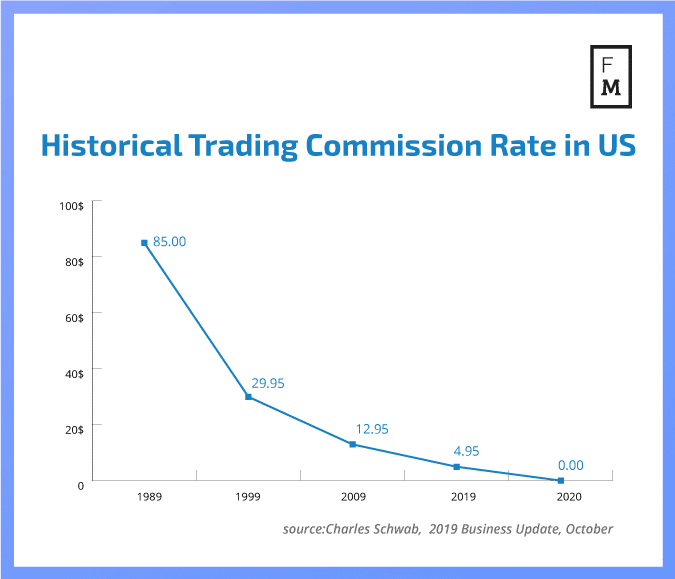
The zero-fee trading phenomena took the US industry and investors by storm in 2019. Is there anything that the CFD industry as a whole can learn from it?
We had to wait until the end of 2019 to fully understand what the term "disrupted" means. The last quarter of the year brought a real tsunami to the financial world, particularly the US trading market. The biggest names in the industry, such as Charles Schwab, TD Ameritrade, and Etrade, became involved. Recently, even FXCM presented its own zero-fee stock trading offer. Why did the firm suddenly make such a move? Mostly because of Robinhood, one of the newcomers on the market, that actually disrupted it after entering the scene only a few years earlier.
Who buys into zero-fee trading?
While more than a decade ago, retail Forex trading (and CFD outside the US) brought markets to smaller traders who were willing to trade and take a risk, Robinhood went even further. It managed to capture customers who previously were not interested in stock trading at all and did not want to take any risk.
From what is known, the average age of Robinhood's customers is around 32. Most often, they are first-time investors, drawn to the easy experience of the trading process and low prices. They don't even have to understand charting or operate advanced trading platforms. It is an entirely new category of customer, far less knowledgeable and demanding than FX/CFD traders. They are millennials, looking for simplicity, lack of risk, and low or no costs.
Obviously, young and inexperienced millennial stock investors can be a tasty bite for CFD or spread-betting providers. First of all, they can be onboarded by CFD brokers faster as they already have their most difficult decision on putting capital to risk behind them, especially since the CFD industry offers trading instruments based on shares, which should be already familiar to millennial investors.
Secondly, we can imagine that smaller fintech firms, which will not succeed to the extent they wished, could sell their clients to CFD or FX brokers. Either way, with the zero-fee model disruption, a new wave of potential clients emerged, and that is something traditional OTC brokers should not miss.
To get the full article and the bigger-picture perspective on the zero-fee phenomena, get our latest Quarterly Industry Report.
The zero-fee trading phenomena took the US industry and investors by storm in 2019. Is there anything that the CFD industry as a whole can learn from it?
We had to wait until the end of 2019 to fully understand what the term "disrupted" means. The last quarter of the year brought a real tsunami to the financial world, particularly the US trading market. The biggest names in the industry, such as Charles Schwab, TD Ameritrade, and Etrade, became involved. Recently, even FXCM presented its own zero-fee stock trading offer. Why did the firm suddenly make such a move? Mostly because of Robinhood, one of the newcomers on the market, that actually disrupted it after entering the scene only a few years earlier.
Who buys into zero-fee trading?
While more than a decade ago, retail Forex trading (and CFD outside the US) brought markets to smaller traders who were willing to trade and take a risk, Robinhood went even further. It managed to capture customers who previously were not interested in stock trading at all and did not want to take any risk.
From what is known, the average age of Robinhood's customers is around 32. Most often, they are first-time investors, drawn to the easy experience of the trading process and low prices. They don't even have to understand charting or operate advanced trading platforms. It is an entirely new category of customer, far less knowledgeable and demanding than FX/CFD traders. They are millennials, looking for simplicity, lack of risk, and low or no costs.
Obviously, young and inexperienced millennial stock investors can be a tasty bite for CFD or spread-betting providers. First of all, they can be onboarded by CFD brokers faster as they already have their most difficult decision on putting capital to risk behind them, especially since the CFD industry offers trading instruments based on shares, which should be already familiar to millennial investors.
Secondly, we can imagine that smaller fintech firms, which will not succeed to the extent they wished, could sell their clients to CFD or FX brokers. Either way, with the zero-fee model disruption, a new wave of potential clients emerged, and that is something traditional OTC brokers should not miss.
To get the full article and the bigger-picture perspective on the zero-fee phenomena, get our latest Quarterly Industry Report.
Sylwester is a graduate of the Warsaw School of Economics, holding an MA in Finance and Banking. He currently serves as Head of the Insights & Reporting Hub at Finance Magnates. He is also a former minority partner in an NFA-registered US forex broker and has been involved in numerous forex and trading industry projects since 2003.
Privately, Sylwester is a husband and father to a 7-year-old daughter, as well as an enthusiast of trading and Formula 1.
Italy’s Consob Tightens Net on AI-Fueled Scams With Fresh Website Bans
FP Markets Winner Spotlight 🏆 | Global Broker of the Year 2025 #Trading #Broker #Innovation #Shorts
FP Markets Winner Spotlight 🏆 | Global Broker of the Year 2025 #Trading #Broker #Innovation #Shorts
FP Markets takes the spotlight as Global Broker of the Year 2025 at the Finance Magnates Awards.
Martin Stoilov, Head of Client Experience, shares that trust, innovation, and people played a key role in the company’s success, supported by a strong foundation of integrity and client-centricity.
Following this milestone, FP Markets continues to focus on growth, technology investment, and its core values of transparency and excellence.
👉 Be part of FM Awards 2026: https://awards.financemagnates.com/#nominate
FP Markets takes the spotlight as Global Broker of the Year 2025 at the Finance Magnates Awards.
Martin Stoilov, Head of Client Experience, shares that trust, innovation, and people played a key role in the company’s success, supported by a strong foundation of integrity and client-centricity.
Following this milestone, FP Markets continues to focus on growth, technology investment, and its core values of transparency and excellence.
👉 Be part of FM Awards 2026: https://awards.financemagnates.com/#nominate
In this video, we review @HolaPrimeMarketsOfficial, a multi-asset forex and CFDs broker offering different account types, trading platforms, and flexible trading conditions.
We cover the broker’s overall offering, including account options, trading environment, platforms like MT4 and MT5, and additional services such as managed accounts and fast withdrawals.
Watch the full video to see if Hola Prime Markets fits your trading needs.
📣 Stay up to date with the latest in finance and trading. Follow Finance Magnates for industry news, insights, and global event coverage.
Connect with us:
🔗 LinkedIn: /financemagnates
👍 Facebook: /financemagnates
📸 Instagram: https://www.instagram.com/financemagnates
🐦 X: https://x.com/financemagnates
🎥 TikTok: https://www.tiktok.com/tag/financemagnates
▶️ YouTube: /@financemagnates_official
#HolaPrime #ForexBroker #CFDTrading #FinanceMagnates #Trading #Forex #BrokerReview
In this video, we review @HolaPrimeMarketsOfficial, a multi-asset forex and CFDs broker offering different account types, trading platforms, and flexible trading conditions.
We cover the broker’s overall offering, including account options, trading environment, platforms like MT4 and MT5, and additional services such as managed accounts and fast withdrawals.
Watch the full video to see if Hola Prime Markets fits your trading needs.
📣 Stay up to date with the latest in finance and trading. Follow Finance Magnates for industry news, insights, and global event coverage.
Connect with us:
🔗 LinkedIn: /financemagnates
👍 Facebook: /financemagnates
📸 Instagram: https://www.instagram.com/financemagnates
🐦 X: https://x.com/financemagnates
🎥 TikTok: https://www.tiktok.com/tag/financemagnates
▶️ YouTube: /@financemagnates_official
#HolaPrime #ForexBroker #CFDTrading #FinanceMagnates #Trading #Forex #BrokerReview
Hola Prime Review: What You Need to Know | Full Breakdown by Finance Magnates
Hola Prime Review: What You Need to Know | Full Breakdown by Finance Magnates
In this video, we review @HolaPrime_Global, a proprietary trading firm offering evaluation programs and performance-based payouts in simulated market environments.
We cover how the challenge model works, including account types, profit splits (up to 95%), trading rules, and what it takes to reach a funded account. You’ll also learn about available platforms like MT4, MT5, cTrader, and more, along with insights into payouts, support, and trading conditions.
Watch the full video to see if Hola Prime fits your trading style.
📣 Stay up to date with the latest in finance and trading. Follow Finance Magnates for industry news, insights, and global event coverage.
Connect with us:
🔗 LinkedIn: /financemagnates
👍 Facebook: /financemagnates
📸 Instagram: https://www.instagram.com/financemagnates
🐦 X: https://x.com/financemagnates
🎥 TikTok: https://www.tiktok.com/tag/financemagnates
▶️ YouTube: /@financemagnates_official
#HolaPrime #PropFirm #Trading #FinanceMagnates #Forex #FuturesTrading #TradingReview #PropFirmReview
In this video, we review @HolaPrime_Global, a proprietary trading firm offering evaluation programs and performance-based payouts in simulated market environments.
We cover how the challenge model works, including account types, profit splits (up to 95%), trading rules, and what it takes to reach a funded account. You’ll also learn about available platforms like MT4, MT5, cTrader, and more, along with insights into payouts, support, and trading conditions.
Watch the full video to see if Hola Prime fits your trading style.
📣 Stay up to date with the latest in finance and trading. Follow Finance Magnates for industry news, insights, and global event coverage.
Connect with us:
🔗 LinkedIn: /financemagnates
👍 Facebook: /financemagnates
📸 Instagram: https://www.instagram.com/financemagnates
🐦 X: https://x.com/financemagnates
🎥 TikTok: https://www.tiktok.com/tag/financemagnates
▶️ YouTube: /@financemagnates_official
#HolaPrime #PropFirm #Trading #FinanceMagnates #Forex #FuturesTrading #TradingReview #PropFirmReview
Axi Winner Spotlight 🏆 | Global Most Innovative Broker 2025 #Innovation #Trading #Fintech #Broker
Axi Winner Spotlight 🏆 | Global Most Innovative Broker 2025 #Innovation #Trading #Fintech #Broker
Axi takes the spotlight at the Finance Magnates Awards, winning Global Most Innovative Broker 2025.
Olivia Xenofontos and Ivanna Openko share how the team will feel: proud, motivated, and ready to keep delivering.
They also describe the night as well-organized, focused, and enjoyable for all.
👉 Be part of FM Awards 2026.
Axi takes the spotlight at the Finance Magnates Awards, winning Global Most Innovative Broker 2025.
Olivia Xenofontos and Ivanna Openko share how the team will feel: proud, motivated, and ready to keep delivering.
They also describe the night as well-organized, focused, and enjoyable for all.
👉 Be part of FM Awards 2026.
Recognition that matters.
Built on transparency.
Driven by the industry.
The Finance Magnates Awards 2026.
Nominations are now open.
🔗 https://awards.financemagnates.com/?utm_source=SM&utm_medium=social&utm_campaign=recognition-matters
Recognition that matters.
Built on transparency.
Driven by the industry.
The Finance Magnates Awards 2026.
Nominations are now open.
🔗 https://awards.financemagnates.com/?utm_source=SM&utm_medium=social&utm_campaign=recognition-matters