Crypto revenue on the platform peaked in Q4 2024, then dropped 30 per cent in the next quarter, and has now fallen again.
The broker, however, beat market estimates with its overall revenue and income.
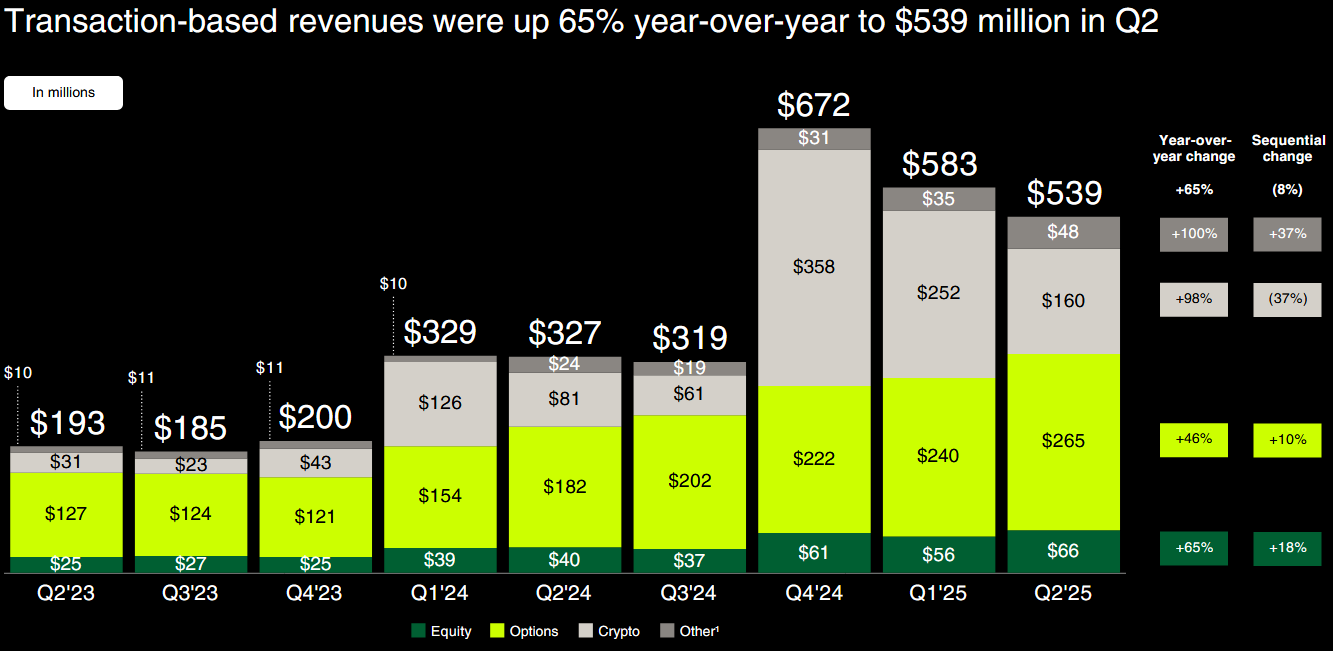
The crypto windfall for Robinhood (Nasdaq: HOOD) is disappearing, as Q2 2025 revenue from the asset class came in at $160 million – down from $252 million in the first three months of the year – a drop of 36.5 per cent. However, the company highlighted that its crypto revenue nearly doubled year-over-year.
Why Is Crypto Demand Dropping on Robinhood?
This marked Robinhood's second straight quarterly decline in crypto revenue. Revenue from digital assets peaked at $358 million in Q4 2024 but dropped 30 per cent in Q1 2025. CEO Vlad Tenev previously noted that the company is looking to diversify away from crypto, as trading volumes tend to go “up and down.”
Vlad Tenev, CEO at Robinhood; Photo: Wikimedia Commons
Despite the drop in crypto activity, the Nasdaq-listed broker’s total revenue rose to $989 million – up 45 per cent year-over-year and 6.6 per cent quarter-over-quarter. The figure also beat market expectations of $928.8 million.
Although transaction-based revenue reached $539 million (a 65 per cent rise year-over-year), it dropped 7.5 per cent compared to the previous quarter.
The rise in overall figures was driven by strong demand for options, which generated $265 million. In addition, revenue from net interest and subscriptions also increased.
Robinhood’s transaction-based revenue for crypto, equities, options and “other” (Source: Robinhood)
Robinhood ended the quarter with a net income of $386 million and earnings per share of $0.42 – well above analysts’ forecasts of $0.31.
“We delivered strong business results in Q2 driven by relentless product velocity, and we launched tokenisation – which I believe is the biggest innovation our industry has seen in the past decade,” said Tenev.
Jason Warnick, Chief Financial Officer of Robinhood (Photo: Robinhood)
Robinhood’s launch of tokenised stocks in European markets has contributed to its growing popularity. The company also expanded through acquisitions, including the closure of its Bitstamp deal.
Beyond financial performance, several customer-related metrics improved. The number of funded accounts on the platform increased by 10 per cent year-over-year to 27.4 million. Assets on the platform also doubled to $279 billion.
Average revenue per user (ARPU) stood at $151 – up 34 per cent year-over-year and 4 per cent from the previous quarter. This remains just below the Q4 2024 peak of $164.
“And Q3 is off to a great start in July, as customers accelerated their net deposits to around $6 billion and leaned in with strong trading across categories,” said Jason Warnick, Chief Financial Officer of Robinhood.
Meanwhile, eToro—positioning itself as a competitor to Robinhood – is expanding rapidly following its public listing. The company still earns most of its revenue from crypto but has also embraced tokenised stocks and overnight trading.
The crypto windfall for Robinhood (Nasdaq: HOOD) is disappearing, as Q2 2025 revenue from the asset class came in at $160 million – down from $252 million in the first three months of the year – a drop of 36.5 per cent. However, the company highlighted that its crypto revenue nearly doubled year-over-year.
Why Is Crypto Demand Dropping on Robinhood?
This marked Robinhood's second straight quarterly decline in crypto revenue. Revenue from digital assets peaked at $358 million in Q4 2024 but dropped 30 per cent in Q1 2025. CEO Vlad Tenev previously noted that the company is looking to diversify away from crypto, as trading volumes tend to go “up and down.”
Vlad Tenev, CEO at Robinhood; Photo: Wikimedia Commons
Despite the drop in crypto activity, the Nasdaq-listed broker’s total revenue rose to $989 million – up 45 per cent year-over-year and 6.6 per cent quarter-over-quarter. The figure also beat market expectations of $928.8 million.
Although transaction-based revenue reached $539 million (a 65 per cent rise year-over-year), it dropped 7.5 per cent compared to the previous quarter.
The rise in overall figures was driven by strong demand for options, which generated $265 million. In addition, revenue from net interest and subscriptions also increased.
Robinhood’s transaction-based revenue for crypto, equities, options and “other” (Source: Robinhood)
Robinhood ended the quarter with a net income of $386 million and earnings per share of $0.42 – well above analysts’ forecasts of $0.31.
“We delivered strong business results in Q2 driven by relentless product velocity, and we launched tokenisation – which I believe is the biggest innovation our industry has seen in the past decade,” said Tenev.
Jason Warnick, Chief Financial Officer of Robinhood (Photo: Robinhood)
Robinhood’s launch of tokenised stocks in European markets has contributed to its growing popularity. The company also expanded through acquisitions, including the closure of its Bitstamp deal.
Beyond financial performance, several customer-related metrics improved. The number of funded accounts on the platform increased by 10 per cent year-over-year to 27.4 million. Assets on the platform also doubled to $279 billion.
Average revenue per user (ARPU) stood at $151 – up 34 per cent year-over-year and 4 per cent from the previous quarter. This remains just below the Q4 2024 peak of $164.
“And Q3 is off to a great start in July, as customers accelerated their net deposits to around $6 billion and leaned in with strong trading across categories,” said Jason Warnick, Chief Financial Officer of Robinhood.
Meanwhile, eToro—positioning itself as a competitor to Robinhood – is expanding rapidly following its public listing. The company still earns most of its revenue from crypto but has also embraced tokenised stocks and overnight trading.
Arnab Shome is an electronics engineer-turned-financial editor. He holds a Bachelor of Technology from the National Institute of Technology, Agartala. He entered the retail trading industry about a decade ago, covering the cryptocurrency market for Finance Magnates, and later expanded his coverage to include forex and CFDs as well.
His work at Finance Magnates includes C-level interviews, data-driven analysis, opinion pieces, and scoops of industry exclusives. He also contributes to Finance Magnates’ quarterly industry report.
Area of coverage:
1. CFD broker-related news
2. Industry-related Regulatory updates and developments
3. New retail trading trends
4. Prop trading industry updates
5. Executive interviews
Education:
Bachelor of Technology - National Institute of Technology, Agartala (India)
Webull Spent Big to Hit Record Revenue, and the Bill Is in the Fine Print
FP Markets Winner Spotlight 🏆 | Global Broker of the Year 2025 #Trading #Broker #Innovation #Shorts
FP Markets Winner Spotlight 🏆 | Global Broker of the Year 2025 #Trading #Broker #Innovation #Shorts
FP Markets takes the spotlight as Global Broker of the Year 2025 at the Finance Magnates Awards.
Martin Stoilov, Head of Client Experience, shares that trust, innovation, and people played a key role in the company’s success, supported by a strong foundation of integrity and client-centricity.
Following this milestone, FP Markets continues to focus on growth, technology investment, and its core values of transparency and excellence.
👉 Be part of FM Awards 2026: https://awards.financemagnates.com/#nominate
FP Markets takes the spotlight as Global Broker of the Year 2025 at the Finance Magnates Awards.
Martin Stoilov, Head of Client Experience, shares that trust, innovation, and people played a key role in the company’s success, supported by a strong foundation of integrity and client-centricity.
Following this milestone, FP Markets continues to focus on growth, technology investment, and its core values of transparency and excellence.
👉 Be part of FM Awards 2026: https://awards.financemagnates.com/#nominate
In this video, we review @HolaPrimeMarketsOfficial, a multi-asset forex and CFDs broker offering different account types, trading platforms, and flexible trading conditions.
We cover the broker’s overall offering, including account options, trading environment, platforms like MT4 and MT5, and additional services such as managed accounts and fast withdrawals.
Watch the full video to see if Hola Prime Markets fits your trading needs.
📣 Stay up to date with the latest in finance and trading. Follow Finance Magnates for industry news, insights, and global event coverage.
Connect with us:
🔗 LinkedIn: /financemagnates
👍 Facebook: /financemagnates
📸 Instagram: https://www.instagram.com/financemagnates
🐦 X: https://x.com/financemagnates
🎥 TikTok: https://www.tiktok.com/tag/financemagnates
▶️ YouTube: /@financemagnates_official
#HolaPrime #ForexBroker #CFDTrading #FinanceMagnates #Trading #Forex #BrokerReview
In this video, we review @HolaPrimeMarketsOfficial, a multi-asset forex and CFDs broker offering different account types, trading platforms, and flexible trading conditions.
We cover the broker’s overall offering, including account options, trading environment, platforms like MT4 and MT5, and additional services such as managed accounts and fast withdrawals.
Watch the full video to see if Hola Prime Markets fits your trading needs.
📣 Stay up to date with the latest in finance and trading. Follow Finance Magnates for industry news, insights, and global event coverage.
Connect with us:
🔗 LinkedIn: /financemagnates
👍 Facebook: /financemagnates
📸 Instagram: https://www.instagram.com/financemagnates
🐦 X: https://x.com/financemagnates
🎥 TikTok: https://www.tiktok.com/tag/financemagnates
▶️ YouTube: /@financemagnates_official
#HolaPrime #ForexBroker #CFDTrading #FinanceMagnates #Trading #Forex #BrokerReview
Hola Prime Review: What You Need to Know | Full Breakdown by Finance Magnates
Hola Prime Review: What You Need to Know | Full Breakdown by Finance Magnates
In this video, we review @HolaPrime_Global, a proprietary trading firm offering evaluation programs and performance-based payouts in simulated market environments.
We cover how the challenge model works, including account types, profit splits (up to 95%), trading rules, and what it takes to reach a funded account. You’ll also learn about available platforms like MT4, MT5, cTrader, and more, along with insights into payouts, support, and trading conditions.
Watch the full video to see if Hola Prime fits your trading style.
📣 Stay up to date with the latest in finance and trading. Follow Finance Magnates for industry news, insights, and global event coverage.
Connect with us:
🔗 LinkedIn: /financemagnates
👍 Facebook: /financemagnates
📸 Instagram: https://www.instagram.com/financemagnates
🐦 X: https://x.com/financemagnates
🎥 TikTok: https://www.tiktok.com/tag/financemagnates
▶️ YouTube: /@financemagnates_official
#HolaPrime #PropFirm #Trading #FinanceMagnates #Forex #FuturesTrading #TradingReview #PropFirmReview
In this video, we review @HolaPrime_Global, a proprietary trading firm offering evaluation programs and performance-based payouts in simulated market environments.
We cover how the challenge model works, including account types, profit splits (up to 95%), trading rules, and what it takes to reach a funded account. You’ll also learn about available platforms like MT4, MT5, cTrader, and more, along with insights into payouts, support, and trading conditions.
Watch the full video to see if Hola Prime fits your trading style.
📣 Stay up to date with the latest in finance and trading. Follow Finance Magnates for industry news, insights, and global event coverage.
Connect with us:
🔗 LinkedIn: /financemagnates
👍 Facebook: /financemagnates
📸 Instagram: https://www.instagram.com/financemagnates
🐦 X: https://x.com/financemagnates
🎥 TikTok: https://www.tiktok.com/tag/financemagnates
▶️ YouTube: /@financemagnates_official
#HolaPrime #PropFirm #Trading #FinanceMagnates #Forex #FuturesTrading #TradingReview #PropFirmReview
Axi Winner Spotlight 🏆 | Global Most Innovative Broker 2025 #Innovation #Trading #Fintech #Broker
Axi Winner Spotlight 🏆 | Global Most Innovative Broker 2025 #Innovation #Trading #Fintech #Broker
Axi takes the spotlight at the Finance Magnates Awards, winning Global Most Innovative Broker 2025.
Olivia Xenofontos and Ivanna Openko share how the team will feel: proud, motivated, and ready to keep delivering.
They also describe the night as well-organized, focused, and enjoyable for all.
👉 Be part of FM Awards 2026.
Axi takes the spotlight at the Finance Magnates Awards, winning Global Most Innovative Broker 2025.
Olivia Xenofontos and Ivanna Openko share how the team will feel: proud, motivated, and ready to keep delivering.
They also describe the night as well-organized, focused, and enjoyable for all.
👉 Be part of FM Awards 2026.
Recognition that matters.
Built on transparency.
Driven by the industry.
The Finance Magnates Awards 2026.
Nominations are now open.
🔗 https://awards.financemagnates.com/?utm_source=SM&utm_medium=social&utm_campaign=recognition-matters
Recognition that matters.
Built on transparency.
Driven by the industry.
The Finance Magnates Awards 2026.
Nominations are now open.
🔗 https://awards.financemagnates.com/?utm_source=SM&utm_medium=social&utm_campaign=recognition-matters