DIFC hosts over 70 brokers, including Interactive Brokers’ newly established regional office.
It added over 1,000 companies in the first half this year; FinTech firms rose 28%.
DIFC
Dubai International Financial Centre reported its strongest
first-half performance to date. DIFC functions as a regulated financial hub
where the Dubai Financial Services Authority oversees and licenses Contract for
Difference brokers.
Brokers operating under DIFC must comply with local
regulations and investor protection standards, creating a regulated environment
for CFD trading services across the Middle East.
Company Registrations and Workforce Growth
In the first six months of 2025, DIFC registered 1,081 new
active companies, bringing the total number of active registered companies to
7,700. The Centre currently employs 47,901 professionals.
Financial Services Authorisations and Sector Expansion
Financial services authorisations increased by 28 percent
year-on-year, with 78 issued in the first half of 2025 compared to 61 in the
same period of 2024.
The banking and capital markets cluster expanded to 289
companies, up from 247 a year ago. The wealth and asset management sector grew
19 percent year-on-year to 440 firms, including 85 hedge funds, of which 69 are
valued at over one billion dollars. More than 10,000 funds are managed or
marketed from DIFC.
The number of FinTech and Innovation companies rose sharply
to 1,388 in H1 2025, a 28 percent increase from 1,081 in the same period last
year. Active non-financial entities also grew to 6,335 from 4,935 a year
earlier.
Brokerage Firms and Market Presence
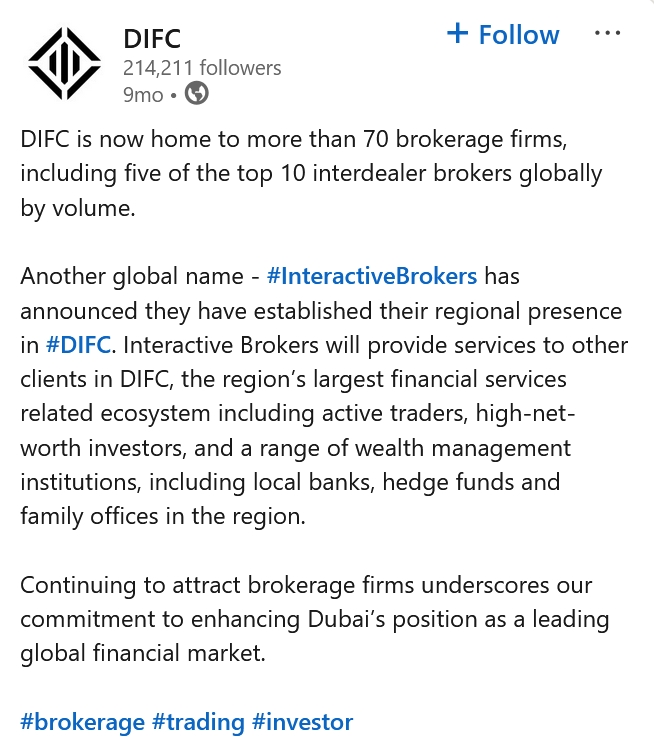
According to a LinkedIn post by DIFC several months ago, the
Centre is home to more than 70 brokerage firms, including five of the top 10
interdealer brokers globally by volume. Additionally, Interactive Brokers has
announced the establishment of its regional presence in DIFC. The firm provides
brokerage services to clients within the Centre.
Global Financial Centre Ranking
According to the Global Financial Centres Index, Dubai is
one of eight cities worldwide with broad and deep capabilities across all parts
of the finance industry. It is listed alongside London, New York, and Paris.
Dubai International Financial Centre reported its strongest
first-half performance to date. DIFC functions as a regulated financial hub
where the Dubai Financial Services Authority oversees and licenses Contract for
Difference brokers.
Brokers operating under DIFC must comply with local
regulations and investor protection standards, creating a regulated environment
for CFD trading services across the Middle East.
Company Registrations and Workforce Growth
In the first six months of 2025, DIFC registered 1,081 new
active companies, bringing the total number of active registered companies to
7,700. The Centre currently employs 47,901 professionals.
Financial Services Authorisations and Sector Expansion
Financial services authorisations increased by 28 percent
year-on-year, with 78 issued in the first half of 2025 compared to 61 in the
same period of 2024.
The banking and capital markets cluster expanded to 289
companies, up from 247 a year ago. The wealth and asset management sector grew
19 percent year-on-year to 440 firms, including 85 hedge funds, of which 69 are
valued at over one billion dollars. More than 10,000 funds are managed or
marketed from DIFC.
The number of FinTech and Innovation companies rose sharply
to 1,388 in H1 2025, a 28 percent increase from 1,081 in the same period last
year. Active non-financial entities also grew to 6,335 from 4,935 a year
earlier.
Brokerage Firms and Market Presence
According to a LinkedIn post by DIFC several months ago, the
Centre is home to more than 70 brokerage firms, including five of the top 10
interdealer brokers globally by volume. Additionally, Interactive Brokers has
announced the establishment of its regional presence in DIFC. The firm provides
brokerage services to clients within the Centre.
Global Financial Centre Ranking
According to the Global Financial Centres Index, Dubai is
one of eight cities worldwide with broad and deep capabilities across all parts
of the finance industry. It is listed alongside London, New York, and Paris.
Tareq is a financial writer with 15 years of experience covering global markets. His work spans technical analysis, forex broker reviews, and market sentiment, with a focus on topics relevant to retail traders. He joined Finance Magnates in 2023.
At Finance Magnates, he serves as News Editor, covering retail forex and CFD brokers, cryptocurrency exchanges, fintech firms, and regulatory developments shaping the trading industry. He holds an Honours degree in Information Technology from Anfell College, London.
Education:
Honours degree Information Technology, Anfell College, London
Webull Spent Big to Hit Record Revenue, and the Bill Is in the Fine Print
FP Markets Winner Spotlight 🏆 | Global Broker of the Year 2025 #Trading #Broker #Innovation #Shorts
FP Markets Winner Spotlight 🏆 | Global Broker of the Year 2025 #Trading #Broker #Innovation #Shorts
FP Markets takes the spotlight as Global Broker of the Year 2025 at the Finance Magnates Awards.
Martin Stoilov, Head of Client Experience, shares that trust, innovation, and people played a key role in the company’s success, supported by a strong foundation of integrity and client-centricity.
Following this milestone, FP Markets continues to focus on growth, technology investment, and its core values of transparency and excellence.
👉 Be part of FM Awards 2026: https://awards.financemagnates.com/#nominate
FP Markets takes the spotlight as Global Broker of the Year 2025 at the Finance Magnates Awards.
Martin Stoilov, Head of Client Experience, shares that trust, innovation, and people played a key role in the company’s success, supported by a strong foundation of integrity and client-centricity.
Following this milestone, FP Markets continues to focus on growth, technology investment, and its core values of transparency and excellence.
👉 Be part of FM Awards 2026: https://awards.financemagnates.com/#nominate
In this video, we review @HolaPrimeMarketsOfficial, a multi-asset forex and CFDs broker offering different account types, trading platforms, and flexible trading conditions.
We cover the broker’s overall offering, including account options, trading environment, platforms like MT4 and MT5, and additional services such as managed accounts and fast withdrawals.
Watch the full video to see if Hola Prime Markets fits your trading needs.
📣 Stay up to date with the latest in finance and trading. Follow Finance Magnates for industry news, insights, and global event coverage.
Connect with us:
🔗 LinkedIn: /financemagnates
👍 Facebook: /financemagnates
📸 Instagram: https://www.instagram.com/financemagnates
🐦 X: https://x.com/financemagnates
🎥 TikTok: https://www.tiktok.com/tag/financemagnates
▶️ YouTube: /@financemagnates_official
#HolaPrime #ForexBroker #CFDTrading #FinanceMagnates #Trading #Forex #BrokerReview
In this video, we review @HolaPrimeMarketsOfficial, a multi-asset forex and CFDs broker offering different account types, trading platforms, and flexible trading conditions.
We cover the broker’s overall offering, including account options, trading environment, platforms like MT4 and MT5, and additional services such as managed accounts and fast withdrawals.
Watch the full video to see if Hola Prime Markets fits your trading needs.
📣 Stay up to date with the latest in finance and trading. Follow Finance Magnates for industry news, insights, and global event coverage.
Connect with us:
🔗 LinkedIn: /financemagnates
👍 Facebook: /financemagnates
📸 Instagram: https://www.instagram.com/financemagnates
🐦 X: https://x.com/financemagnates
🎥 TikTok: https://www.tiktok.com/tag/financemagnates
▶️ YouTube: /@financemagnates_official
#HolaPrime #ForexBroker #CFDTrading #FinanceMagnates #Trading #Forex #BrokerReview
Hola Prime Review: What You Need to Know | Full Breakdown by Finance Magnates
Hola Prime Review: What You Need to Know | Full Breakdown by Finance Magnates
In this video, we review @HolaPrime_Global, a proprietary trading firm offering evaluation programs and performance-based payouts in simulated market environments.
We cover how the challenge model works, including account types, profit splits (up to 95%), trading rules, and what it takes to reach a funded account. You’ll also learn about available platforms like MT4, MT5, cTrader, and more, along with insights into payouts, support, and trading conditions.
Watch the full video to see if Hola Prime fits your trading style.
📣 Stay up to date with the latest in finance and trading. Follow Finance Magnates for industry news, insights, and global event coverage.
Connect with us:
🔗 LinkedIn: /financemagnates
👍 Facebook: /financemagnates
📸 Instagram: https://www.instagram.com/financemagnates
🐦 X: https://x.com/financemagnates
🎥 TikTok: https://www.tiktok.com/tag/financemagnates
▶️ YouTube: /@financemagnates_official
#HolaPrime #PropFirm #Trading #FinanceMagnates #Forex #FuturesTrading #TradingReview #PropFirmReview
In this video, we review @HolaPrime_Global, a proprietary trading firm offering evaluation programs and performance-based payouts in simulated market environments.
We cover how the challenge model works, including account types, profit splits (up to 95%), trading rules, and what it takes to reach a funded account. You’ll also learn about available platforms like MT4, MT5, cTrader, and more, along with insights into payouts, support, and trading conditions.
Watch the full video to see if Hola Prime fits your trading style.
📣 Stay up to date with the latest in finance and trading. Follow Finance Magnates for industry news, insights, and global event coverage.
Connect with us:
🔗 LinkedIn: /financemagnates
👍 Facebook: /financemagnates
📸 Instagram: https://www.instagram.com/financemagnates
🐦 X: https://x.com/financemagnates
🎥 TikTok: https://www.tiktok.com/tag/financemagnates
▶️ YouTube: /@financemagnates_official
#HolaPrime #PropFirm #Trading #FinanceMagnates #Forex #FuturesTrading #TradingReview #PropFirmReview
Axi Winner Spotlight 🏆 | Global Most Innovative Broker 2025 #Innovation #Trading #Fintech #Broker
Axi Winner Spotlight 🏆 | Global Most Innovative Broker 2025 #Innovation #Trading #Fintech #Broker
Axi takes the spotlight at the Finance Magnates Awards, winning Global Most Innovative Broker 2025.
Olivia Xenofontos and Ivanna Openko share how the team will feel: proud, motivated, and ready to keep delivering.
They also describe the night as well-organized, focused, and enjoyable for all.
👉 Be part of FM Awards 2026.
Axi takes the spotlight at the Finance Magnates Awards, winning Global Most Innovative Broker 2025.
Olivia Xenofontos and Ivanna Openko share how the team will feel: proud, motivated, and ready to keep delivering.
They also describe the night as well-organized, focused, and enjoyable for all.
👉 Be part of FM Awards 2026.
Recognition that matters.
Built on transparency.
Driven by the industry.
The Finance Magnates Awards 2026.
Nominations are now open.
🔗 https://awards.financemagnates.com/?utm_source=SM&utm_medium=social&utm_campaign=recognition-matters
Recognition that matters.
Built on transparency.
Driven by the industry.
The Finance Magnates Awards 2026.
Nominations are now open.
🔗 https://awards.financemagnates.com/?utm_source=SM&utm_medium=social&utm_campaign=recognition-matters