The decision came after BUX was acquired by Dutch lending giant ABN AMRO.
It offered CFD clients the option to migrate their accounts to AvaTrade.
A notice on the website of Stryk
BUX, the Dutch neobroker now fully owned by ABN AMRO, has quietly closed down its contracts for differences (CFDs) platform, Stryk, as it focuses “more on mid and long-term investing via the BUX app.” It has also allowed customers to migrate their accounts to AvaTrade, another CFDs broker.
Stryk Decommissioned
“We are reevaluating the position of speculative trading products within our group’s overall offering,” the FAQ section of the now-closed platform noted. “As part of this change in strategy, we are decommissioning Stryk, our CFD trading app.”
Elaborating on the decision to close the platform, BUX highlighted that it has been increasing its focus on “long-term wealth creation” and the “decommissioning of Stryk completes the strategic pivot.” It will also allow the company to “streamline [its] operations and allocate resources more efficiently.”
Further, the regulatory environment also played a role. “The landscape for CFDs has changed significantly since we entered the CFD market,” the website of the closed platform added. “In this environment, we believe that our resources are better directed towards the BUX mobile app, which focuses on mid and long-term investing and is poised for healthy growth in the coming years.”
Rebranding to the Strategic Path
BUX initially launched its CFDs offerings under the brand BUX X but rebranded it to Stryk in July 2022 to differentiate it from the company’s zero-fee trading app, which was also rebranded to BUX from BUX Zero in mid-2023.
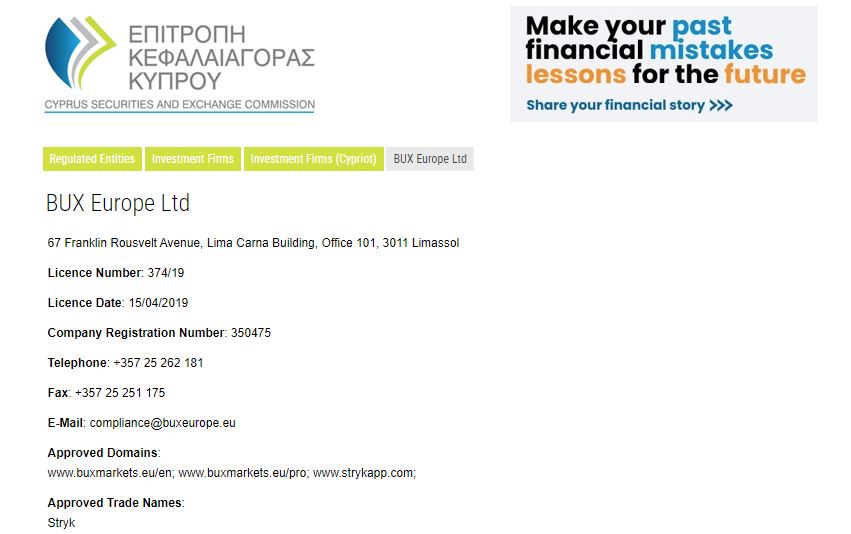
Also, the group operated the CFDs business under its UK-regulated entity. However, it shifted the CFDs business under the Cyprus-regulated BUX Europe to expand the services in the European markets. Although the Stryk brand has been decommissioned, according to the regulatory registry, BUX Europe still holds the Cyprus Investment Firm licence.
Details of the Cyprus Investment Firm license of BUX Europe on CySEC's registry
While it is unclear when exactly Stryk was closed down, Wayback Machine shows that the step was taken at the beginning of this year.
Meanwhile, the acquisition of the Netherlands-based BUX was recently completed by the local lending giant ABN AMRO, which will now mark its presence in the retail investment markets. However, the financials of the deal remain unknown.
BUX, the Dutch neobroker now fully owned by ABN AMRO, has quietly closed down its contracts for differences (CFDs) platform, Stryk, as it focuses “more on mid and long-term investing via the BUX app.” It has also allowed customers to migrate their accounts to AvaTrade, another CFDs broker.
Stryk Decommissioned
“We are reevaluating the position of speculative trading products within our group’s overall offering,” the FAQ section of the now-closed platform noted. “As part of this change in strategy, we are decommissioning Stryk, our CFD trading app.”
Elaborating on the decision to close the platform, BUX highlighted that it has been increasing its focus on “long-term wealth creation” and the “decommissioning of Stryk completes the strategic pivot.” It will also allow the company to “streamline [its] operations and allocate resources more efficiently.”
Further, the regulatory environment also played a role. “The landscape for CFDs has changed significantly since we entered the CFD market,” the website of the closed platform added. “In this environment, we believe that our resources are better directed towards the BUX mobile app, which focuses on mid and long-term investing and is poised for healthy growth in the coming years.”
Rebranding to the Strategic Path
BUX initially launched its CFDs offerings under the brand BUX X but rebranded it to Stryk in July 2022 to differentiate it from the company’s zero-fee trading app, which was also rebranded to BUX from BUX Zero in mid-2023.
Also, the group operated the CFDs business under its UK-regulated entity. However, it shifted the CFDs business under the Cyprus-regulated BUX Europe to expand the services in the European markets. Although the Stryk brand has been decommissioned, according to the regulatory registry, BUX Europe still holds the Cyprus Investment Firm licence.
Details of the Cyprus Investment Firm license of BUX Europe on CySEC's registry
While it is unclear when exactly Stryk was closed down, Wayback Machine shows that the step was taken at the beginning of this year.
Meanwhile, the acquisition of the Netherlands-based BUX was recently completed by the local lending giant ABN AMRO, which will now mark its presence in the retail investment markets. However, the financials of the deal remain unknown.
Arnab Shome is an electronics engineer-turned-financial editor. He holds a Bachelor of Technology from the National Institute of Technology, Agartala. He entered the retail trading industry about a decade ago, covering the cryptocurrency market for Finance Magnates, and later expanded his coverage to include forex and CFDs as well.
His work at Finance Magnates includes C-level interviews, data-driven analysis, opinion pieces, and scoops of industry exclusives. He also contributes to Finance Magnates’ quarterly industry report.
Area of coverage:
1. CFD broker-related news
2. Industry-related Regulatory updates and developments
3. New retail trading trends
4. Prop trading industry updates
5. Executive interviews
Education:
Bachelor of Technology - National Institute of Technology, Agartala (India)
In this video, we review @HolaPrimeMarketsOfficial, a multi-asset forex and CFDs broker offering different account types, trading platforms, and flexible trading conditions.
We cover the broker’s overall offering, including account options, trading environment, platforms like MT4 and MT5, and additional services such as managed accounts and fast withdrawals.
Watch the full video to see if Hola Prime Markets fits your trading needs.
📣 Stay up to date with the latest in finance and trading. Follow Finance Magnates for industry news, insights, and global event coverage.
Connect with us:
🔗 LinkedIn: /financemagnates
👍 Facebook: /financemagnates
📸 Instagram: https://www.instagram.com/financemagnates
🐦 X: https://x.com/financemagnates
🎥 TikTok: https://www.tiktok.com/tag/financemagnates
▶️ YouTube: /@financemagnates_official
#HolaPrime #ForexBroker #CFDTrading #FinanceMagnates #Trading #Forex #BrokerReview
In this video, we review @HolaPrimeMarketsOfficial, a multi-asset forex and CFDs broker offering different account types, trading platforms, and flexible trading conditions.
We cover the broker’s overall offering, including account options, trading environment, platforms like MT4 and MT5, and additional services such as managed accounts and fast withdrawals.
Watch the full video to see if Hola Prime Markets fits your trading needs.
📣 Stay up to date with the latest in finance and trading. Follow Finance Magnates for industry news, insights, and global event coverage.
Connect with us:
🔗 LinkedIn: /financemagnates
👍 Facebook: /financemagnates
📸 Instagram: https://www.instagram.com/financemagnates
🐦 X: https://x.com/financemagnates
🎥 TikTok: https://www.tiktok.com/tag/financemagnates
▶️ YouTube: /@financemagnates_official
#HolaPrime #ForexBroker #CFDTrading #FinanceMagnates #Trading #Forex #BrokerReview
Hola Prime Review: What You Need to Know | Full Breakdown by Finance Magnates
Hola Prime Review: What You Need to Know | Full Breakdown by Finance Magnates
In this video, we review @HolaPrime_Global, a proprietary trading firm offering evaluation programs and performance-based payouts in simulated market environments.
We cover how the challenge model works, including account types, profit splits (up to 95%), trading rules, and what it takes to reach a funded account. You’ll also learn about available platforms like MT4, MT5, cTrader, and more, along with insights into payouts, support, and trading conditions.
Watch the full video to see if Hola Prime fits your trading style.
📣 Stay up to date with the latest in finance and trading. Follow Finance Magnates for industry news, insights, and global event coverage.
Connect with us:
🔗 LinkedIn: /financemagnates
👍 Facebook: /financemagnates
📸 Instagram: https://www.instagram.com/financemagnates
🐦 X: https://x.com/financemagnates
🎥 TikTok: https://www.tiktok.com/tag/financemagnates
▶️ YouTube: /@financemagnates_official
#HolaPrime #PropFirm #Trading #FinanceMagnates #Forex #FuturesTrading #TradingReview #PropFirmReview
In this video, we review @HolaPrime_Global, a proprietary trading firm offering evaluation programs and performance-based payouts in simulated market environments.
We cover how the challenge model works, including account types, profit splits (up to 95%), trading rules, and what it takes to reach a funded account. You’ll also learn about available platforms like MT4, MT5, cTrader, and more, along with insights into payouts, support, and trading conditions.
Watch the full video to see if Hola Prime fits your trading style.
📣 Stay up to date with the latest in finance and trading. Follow Finance Magnates for industry news, insights, and global event coverage.
Connect with us:
🔗 LinkedIn: /financemagnates
👍 Facebook: /financemagnates
📸 Instagram: https://www.instagram.com/financemagnates
🐦 X: https://x.com/financemagnates
🎥 TikTok: https://www.tiktok.com/tag/financemagnates
▶️ YouTube: /@financemagnates_official
#HolaPrime #PropFirm #Trading #FinanceMagnates #Forex #FuturesTrading #TradingReview #PropFirmReview
Axi Winner Spotlight 🏆 | Global Most Innovative Broker 2025 #Innovation #Trading #Fintech #Broker
Axi Winner Spotlight 🏆 | Global Most Innovative Broker 2025 #Innovation #Trading #Fintech #Broker
Axi takes the spotlight at the Finance Magnates Awards, winning Global Most Innovative Broker 2025.
Olivia Xenofontos and Ivanna Openko share how the team will feel: proud, motivated, and ready to keep delivering.
They also describe the night as well-organized, focused, and enjoyable for all.
👉 Be part of FM Awards 2026.
Axi takes the spotlight at the Finance Magnates Awards, winning Global Most Innovative Broker 2025.
Olivia Xenofontos and Ivanna Openko share how the team will feel: proud, motivated, and ready to keep delivering.
They also describe the night as well-organized, focused, and enjoyable for all.
👉 Be part of FM Awards 2026.
Recognition that matters.
Built on transparency.
Driven by the industry.
The Finance Magnates Awards 2026.
Nominations are now open.
🔗 https://awards.financemagnates.com/?utm_source=SM&utm_medium=social&utm_campaign=recognition-matters
Recognition that matters.
Built on transparency.
Driven by the industry.
The Finance Magnates Awards 2026.
Nominations are now open.
🔗 https://awards.financemagnates.com/?utm_source=SM&utm_medium=social&utm_campaign=recognition-matters
Tickmill Winner Spotlight | Broker of the Year 2025 (LATAM) 🏆 | Finance Magnates Awards #Trading
Tickmill Winner Spotlight | Broker of the Year 2025 (LATAM) 🏆 | Finance Magnates Awards #Trading
What helped Tickmill stand out this year?
In this Winner Spotlight, Johnny Khalil, Executive Director at Tickmill Europe, shares how listening closely to clients and delivering strong trading conditions made the difference.
A big thank you to the community whose support continues to drive progress every day.
👉 Think your brand has what it takes? Nominate for the 2026 Finance Magnates Awards: https://awards.financemagnates.com/#nominate
What helped Tickmill stand out this year?
In this Winner Spotlight, Johnny Khalil, Executive Director at Tickmill Europe, shares how listening closely to clients and delivering strong trading conditions made the difference.
A big thank you to the community whose support continues to drive progress every day.
👉 Think your brand has what it takes? Nominate for the 2026 Finance Magnates Awards: https://awards.financemagnates.com/#nominate