Monex Publishes Final YTD Results,Upward Revisions Not Found
Thursday,30/10/2014|04:55GMTby
George Tchetvertakov
The Tokyo-based broker publishes final results which highlight difficulties in all business units overcast by lower market volatility and compressed fee structures across the industry. Despite growing client numbers and deposits, revenues are down.
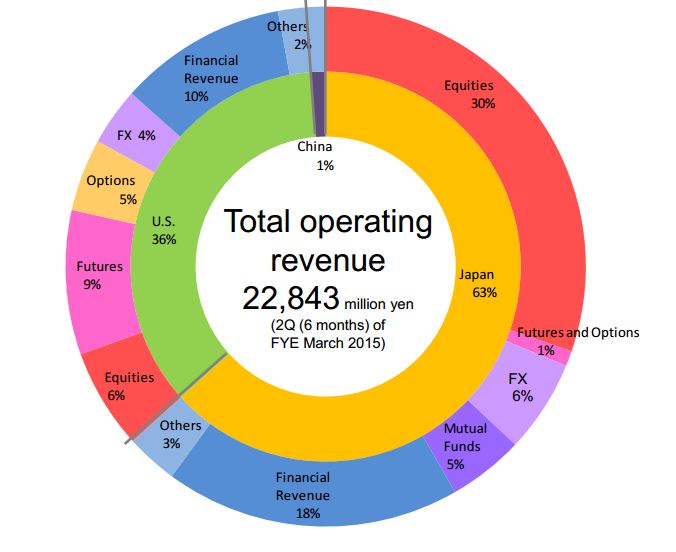
Monex revised its preliminary total operating revenue figure of ¥22,800 million up to ¥23,038 million (~$212 million). The company's costs and expenses were unchanged and the reported quarterly net loss of ¥304 million also remains unchanged.
Regional Operating Revenue & Business Diversification: Source: Monex Group Inc
The sharp fall in the Group’s overall performance is also reflected in the results of Monex Inc. – the Japanese-based subsidiary offering retail FX trading services. The comparatively better performance of Monex Inc. compared to Monex Group means that Monex Inc. now accounts for approximately 65% of the company’s total revenue.
On the flip side, Monex reports higher levels of client deposits, segregated capital and monies held in trust accounts. Client deposits rose from ¥53,193 million to ¥62,590 million and segregated capital rose from ¥192,897 million to ¥221,792 million.
TradeStation
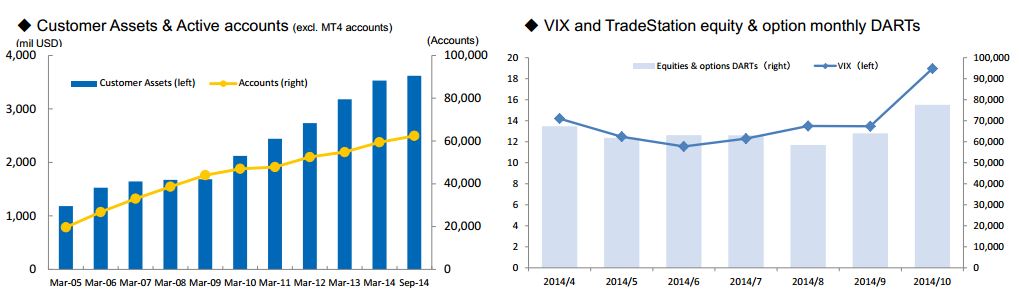
"With a steady increase in customer assets and the number of accounts, TradeStation
remains competitive," said Monex Inc in an investor presentation. Adding, "TradeStation regards its brokerage business primarily of Equities as its core revenue source, and plans to increase option trading, which has high profitability and strong potential for growth. Since October 2014 with the rise in market Volatility, TradeStation’s customer activity has
rapidly improved."
In an admission of tough retail FX times, Monex stated: "In the midst of lower currency volatility and excessive competition and concerns about future business profitability, we transferred MT4 retail accounts offered under the name of IBFX to FXCM Holdings, LLC and consolidated services onto TradeStation FX for greater competitiveness."
Global Vision
As part of the company's "Global Vision" initiative, Monex wants to "geographically expand business areas through Mergers and Acquisitions (M&A) in Hong Kong and the U.S." The initiative's broader goal is to deliver differentiated products and services among all Group companies to be offered to retail investors globally. Monex also hopes to diversify revenue sources by expanding its B2B business and offering white-label solutions to third party companies.
Assuming flat business conditions continue and a host of firms struggle with balancing costs with revenues, industry consolidation is a topic likely to be revisited many times in 2015.
Monex revised its preliminary total operating revenue figure of ¥22,800 million up to ¥23,038 million (~$212 million). The company's costs and expenses were unchanged and the reported quarterly net loss of ¥304 million also remains unchanged.
Regional Operating Revenue & Business Diversification: Source: Monex Group Inc
The sharp fall in the Group’s overall performance is also reflected in the results of Monex Inc. – the Japanese-based subsidiary offering retail FX trading services. The comparatively better performance of Monex Inc. compared to Monex Group means that Monex Inc. now accounts for approximately 65% of the company’s total revenue.
On the flip side, Monex reports higher levels of client deposits, segregated capital and monies held in trust accounts. Client deposits rose from ¥53,193 million to ¥62,590 million and segregated capital rose from ¥192,897 million to ¥221,792 million.
TradeStation
"With a steady increase in customer assets and the number of accounts, TradeStation
remains competitive," said Monex Inc in an investor presentation. Adding, "TradeStation regards its brokerage business primarily of Equities as its core revenue source, and plans to increase option trading, which has high profitability and strong potential for growth. Since October 2014 with the rise in market Volatility, TradeStation’s customer activity has
rapidly improved."
In an admission of tough retail FX times, Monex stated: "In the midst of lower currency volatility and excessive competition and concerns about future business profitability, we transferred MT4 retail accounts offered under the name of IBFX to FXCM Holdings, LLC and consolidated services onto TradeStation FX for greater competitiveness."
Global Vision
As part of the company's "Global Vision" initiative, Monex wants to "geographically expand business areas through Mergers and Acquisitions (M&A) in Hong Kong and the U.S." The initiative's broader goal is to deliver differentiated products and services among all Group companies to be offered to retail investors globally. Monex also hopes to diversify revenue sources by expanding its B2B business and offering white-label solutions to third party companies.
Assuming flat business conditions continue and a host of firms struggle with balancing costs with revenues, industry consolidation is a topic likely to be revisited many times in 2015.
TradeZero Europe Adds Four Markets After Netherlands Launch
CMC Markets’ Artur Delijergijevs on Metals Demand, Volatility, & Stable Execution
CMC Markets’ Artur Delijergijevs on Metals Demand, Volatility, & Stable Execution
In this exclusive Executive Interview, Finance Magnates speaks with Artur Delijergijevs, Head of Systematic Market Making at CMC Markets, about the current state of metals demand and market volatility.
Delijergijevs offers a desk-level view on:
- Metals Demand: Why metals are seeing the strongest demand from both retail and institutional clients right now.
- The Safe-Haven Debate: Questioning whether gold still fits the classic safe-haven definition given large daily price movements.
- Volatile Market Prep: How a market-making desk prepares its systems and pricing for stressed market conditions and high-impact economic events.
- Hybrid Execution: Why the best execution model combines electronic speed with human relationship support, especially during volatility.
- AI in Workflow: Where CMC Markets is integrating machine learning for risk management and pricing, and the limitations of AI during stressed markets.
- Dubai's Role: The strategic importance of Dubai’s location for covering global trading sessions across Asia, Europe, and the US.
Watch to understand how CMC Markets maintains stable pricing and reliable execution quality in high-volatility environments.
#CMCmarkets #forex #metals #gold #trading #volatility #MarketMaking #iFXDubai #FinanceMagnates #Finance #Fintech #Execution #AlgorithmicTrading #RiskManagement
In this exclusive Executive Interview, Finance Magnates speaks with Artur Delijergijevs, Head of Systematic Market Making at CMC Markets, about the current state of metals demand and market volatility.
Delijergijevs offers a desk-level view on:
- Metals Demand: Why metals are seeing the strongest demand from both retail and institutional clients right now.
- The Safe-Haven Debate: Questioning whether gold still fits the classic safe-haven definition given large daily price movements.
- Volatile Market Prep: How a market-making desk prepares its systems and pricing for stressed market conditions and high-impact economic events.
- Hybrid Execution: Why the best execution model combines electronic speed with human relationship support, especially during volatility.
- AI in Workflow: Where CMC Markets is integrating machine learning for risk management and pricing, and the limitations of AI during stressed markets.
- Dubai's Role: The strategic importance of Dubai’s location for covering global trading sessions across Asia, Europe, and the US.
Watch to understand how CMC Markets maintains stable pricing and reliable execution quality in high-volatility environments.
#CMCmarkets #forex #metals #gold #trading #volatility #MarketMaking #iFXDubai #FinanceMagnates #Finance #Fintech #Execution #AlgorithmicTrading #RiskManagement
Finance Magnates Awards 2026 – Nominations Now Open
Finance Magnates Awards 2026 – Nominations Now Open
The Finance Magnates Awards 2026 nominations are now open. 🏆
From fintech innovators to leading brokers, this is where the finance industry celebrates its biggest achievements.
Winners will be announced at the Cyprus Gala Dinner on November 6, 2026.
Nominate your brand now.
https://awards.financemagnates.com/?utm_source=linkedin&utm_medium=video&utm_campaign=nominations-open
#FMAwards #FinanceMagnates #FintechAwards #Fintech #FinanceIndustry
The Finance Magnates Awards 2026 nominations are now open. 🏆
From fintech innovators to leading brokers, this is where the finance industry celebrates its biggest achievements.
Winners will be announced at the Cyprus Gala Dinner on November 6, 2026.
Nominate your brand now.
https://awards.financemagnates.com/?utm_source=linkedin&utm_medium=video&utm_campaign=nominations-open
#FMAwards #FinanceMagnates #FintechAwards #Fintech #FinanceIndustry
Finance Magnates Awards 2026 | Nominations Now Open 🏆#Fintech #FMAwards #TradingIndustry
Finance Magnates Awards 2026 | Nominations Now Open 🏆#Fintech #FMAwards #TradingIndustry
Lights on. Cameras ready. 🎬
Finance Magnates Awards 2026 nominations are now open. 🏆
#FMAwards #FinanceMagnates #FintechAwards #Fintech
Lights on. Cameras ready. 🎬
Finance Magnates Awards 2026 nominations are now open. 🏆
#FMAwards #FinanceMagnates #FintechAwards #Fintech
Exness sees trust as the key theme for growth in MENA Trading Growth for 2026
Exness sees trust as the key theme for growth in MENA Trading Growth for 2026
Mohammad Amer, Regional Commercial Director at Exness, sits down to discuss the booming MENA financial trading market. Find out why Dubai is key to the company's growth strategy, how a mobile-first generation is changing expectations, and why trust will be the defining theme for traders in 2026.
In this interview, you'll learn:
* Why Dubai and the MENA region are critical growth markets for fintech and online trading.
* How Exness is addressing the demands of mobile-first, younger traders through engineering, platform stability, and transparent conditions.
* The essential role local talent plays in providing a culturally relevant and compliant user experience.
* Mohammad Amer's outlook on the future of the online trading industry and why stronger controls and systems are necessary.
* Why "trust" isn't just a brand value, but has commercial value—and why he predicts 2026 will be the "Year of Trust."
Key Takeaways:
➡️ The MENA region is rapidly shaping global financial markets.
➡️ New traders expect stability, precise execution, and transparency.
➡️ Local expertise is key to regulatory compliance and user experience.
➡️ Future success belongs to firms capable of meeting rising standards across regulation and platform consistency.
Read the full article at: https://www.financemagnates.com/thought-leadership/exness-sees-trust-as-the-key-theme-for-growth-in-mena-trading-growth-for-2026/
#Exness #MENA #Trading #FinTech #Dubai #OnlineTrading #FinanceMagnates #MohammadAmer #Trust #MobileTrading
Mohammad Amer, Regional Commercial Director at Exness, sits down to discuss the booming MENA financial trading market. Find out why Dubai is key to the company's growth strategy, how a mobile-first generation is changing expectations, and why trust will be the defining theme for traders in 2026.
In this interview, you'll learn:
* Why Dubai and the MENA region are critical growth markets for fintech and online trading.
* How Exness is addressing the demands of mobile-first, younger traders through engineering, platform stability, and transparent conditions.
* The essential role local talent plays in providing a culturally relevant and compliant user experience.
* Mohammad Amer's outlook on the future of the online trading industry and why stronger controls and systems are necessary.
* Why "trust" isn't just a brand value, but has commercial value—and why he predicts 2026 will be the "Year of Trust."
Key Takeaways:
➡️ The MENA region is rapidly shaping global financial markets.
➡️ New traders expect stability, precise execution, and transparency.
➡️ Local expertise is key to regulatory compliance and user experience.
➡️ Future success belongs to firms capable of meeting rising standards across regulation and platform consistency.
Read the full article at: https://www.financemagnates.com/thought-leadership/exness-sees-trust-as-the-key-theme-for-growth-in-mena-trading-growth-for-2026/
#Exness #MENA #Trading #FinTech #Dubai #OnlineTrading #FinanceMagnates #MohammadAmer #Trust #MobileTrading
Paytiko CEO Razi Salih on Why Payment Orchestration is a MUST-HAVE for Brokers in 2026
Paytiko CEO Razi Salih on Why Payment Orchestration is a MUST-HAVE for Brokers in 2026
At iFX Expo Dubai, Finance Magnates spoke with Razi Salih, CEO at Paytiko, about the evolution of the payments ecosystem and why payment orchestration has shifted from an option to a necessity for brokers, prop firms, and exchanges.
Mr. Salih explains how global expansion, the need for deep localisation, and the sheer number of new payment methods, from instant banking to stablecoins, are driving this critical infrastructure shift.
#PaymentOrchestration #Fintech #Brokerage #TradingPayments #RaziSalih #Paytiko #iFXExpoDubai #Stablecoins #AIinFintech
At iFX Expo Dubai, Finance Magnates spoke with Razi Salih, CEO at Paytiko, about the evolution of the payments ecosystem and why payment orchestration has shifted from an option to a necessity for brokers, prop firms, and exchanges.
Mr. Salih explains how global expansion, the need for deep localisation, and the sheer number of new payment methods, from instant banking to stablecoins, are driving this critical infrastructure shift.
#PaymentOrchestration #Fintech #Brokerage #TradingPayments #RaziSalih #Paytiko #iFXExpoDubai #Stablecoins #AIinFintech