The Commodity Futures Trading Commission (CFTC) has released its monthly composite of key figures and data for Futures Commission Merchants (FCMs), this time for the month ending in July 31, 2017. According to the CFTC dataset, three of the four FX firms listed saw declines in Retail Forex Obligations compared with the month prior.
The statistics didn’t show notable changes in terms of retail FX funds held at registered brokerages operating in the United States – a drop of 2.0 percent month-over-month was seen in July 2017 with a result of $518.9 million, compared with $530.9 million reported in June.
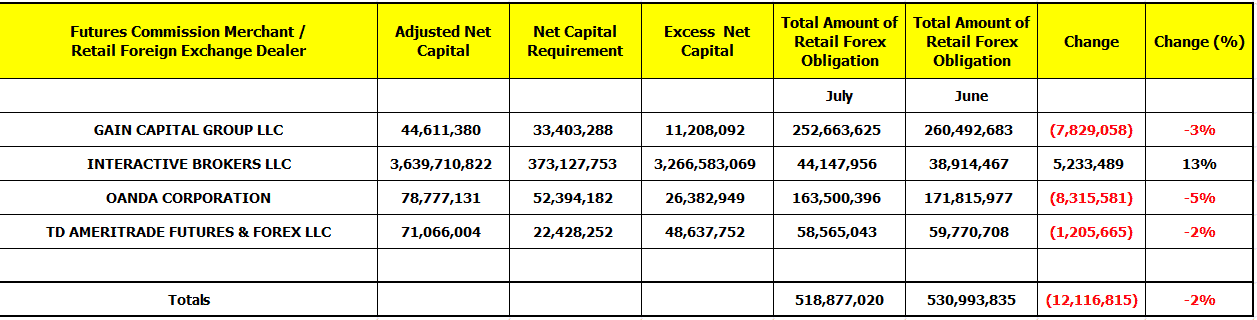
Out of the four reporting FCMs that hold Retail Forex Obligations, three of them reported lower figures in July – GAIN Capital, OANDA Corporation and TD AMERITRADE. The largest single loss was made by OANDA, which saw a drop of $8.3 million, or more than 5.0 percent month-over-month. In addition, GAIN Capital saw an overall drop to $252.7 million at the end of July 2017, compared to $260.5 million at the end of June, or a decrease by -3 percent MoM.
Interactive Brokers was the notable exception, as the broker dealer saw substantial growth month-over-month across its Retail Forex Obligations. The company notched an increase over last month’s figure by $5.23 million, gaining 13.0 percent compared to June’s metrics.
The report covers data for FCMs that are registered as Retail Foreign Exchange Dealers (RFEDs) and those also included as broker dealers that hold retail forex obligations in the United States.
The chart listed below outlines the full list of all FCMs that held Retail Forex Obligations in the month ending in July 31, 2017 – for purposes of comparison, the figures have been included against their June 2017 counterparts to illustrate disparities.
Total Amount of Retail Forex Obligations for July 2017, Source: CFTC
The Commodity Futures Trading Commission (CFTC) has released its monthly composite of key figures and data for Futures Commission Merchants (FCMs), this time for the month ending in July 31, 2017. According to the CFTC dataset, three of the four FX firms listed saw declines in Retail Forex Obligations compared with the month prior.
The statistics didn’t show notable changes in terms of retail FX funds held at registered brokerages operating in the United States – a drop of 2.0 percent month-over-month was seen in July 2017 with a result of $518.9 million, compared with $530.9 million reported in June.
Out of the four reporting FCMs that hold Retail Forex Obligations, three of them reported lower figures in July – GAIN Capital, OANDA Corporation and TD AMERITRADE. The largest single loss was made by OANDA, which saw a drop of $8.3 million, or more than 5.0 percent month-over-month. In addition, GAIN Capital saw an overall drop to $252.7 million at the end of July 2017, compared to $260.5 million at the end of June, or a decrease by -3 percent MoM.
Interactive Brokers was the notable exception, as the broker dealer saw substantial growth month-over-month across its Retail Forex Obligations. The company notched an increase over last month’s figure by $5.23 million, gaining 13.0 percent compared to June’s metrics.
The report covers data for FCMs that are registered as Retail Foreign Exchange Dealers (RFEDs) and those also included as broker dealers that hold retail forex obligations in the United States.
The chart listed below outlines the full list of all FCMs that held Retail Forex Obligations in the month ending in July 31, 2017 – for purposes of comparison, the figures have been included against their June 2017 counterparts to illustrate disparities.
Total Amount of Retail Forex Obligations for July 2017, Source: CFTC
Italy’s Consob Tightens Net on AI-Fueled Scams With Fresh Website Bans
FP Markets Winner Spotlight 🏆 | Global Broker of the Year 2025 #Trading #Broker #Innovation #Shorts
FP Markets Winner Spotlight 🏆 | Global Broker of the Year 2025 #Trading #Broker #Innovation #Shorts
FP Markets takes the spotlight as Global Broker of the Year 2025 at the Finance Magnates Awards.
Martin Stoilov, Head of Client Experience, shares that trust, innovation, and people played a key role in the company’s success, supported by a strong foundation of integrity and client-centricity.
Following this milestone, FP Markets continues to focus on growth, technology investment, and its core values of transparency and excellence.
👉 Be part of FM Awards 2026: https://awards.financemagnates.com/#nominate
FP Markets takes the spotlight as Global Broker of the Year 2025 at the Finance Magnates Awards.
Martin Stoilov, Head of Client Experience, shares that trust, innovation, and people played a key role in the company’s success, supported by a strong foundation of integrity and client-centricity.
Following this milestone, FP Markets continues to focus on growth, technology investment, and its core values of transparency and excellence.
👉 Be part of FM Awards 2026: https://awards.financemagnates.com/#nominate
In this video, we review @HolaPrimeMarketsOfficial, a multi-asset forex and CFDs broker offering different account types, trading platforms, and flexible trading conditions.
We cover the broker’s overall offering, including account options, trading environment, platforms like MT4 and MT5, and additional services such as managed accounts and fast withdrawals.
Watch the full video to see if Hola Prime Markets fits your trading needs.
📣 Stay up to date with the latest in finance and trading. Follow Finance Magnates for industry news, insights, and global event coverage.
Connect with us:
🔗 LinkedIn: /financemagnates
👍 Facebook: /financemagnates
📸 Instagram: https://www.instagram.com/financemagnates
🐦 X: https://x.com/financemagnates
🎥 TikTok: https://www.tiktok.com/tag/financemagnates
▶️ YouTube: /@financemagnates_official
#HolaPrime #ForexBroker #CFDTrading #FinanceMagnates #Trading #Forex #BrokerReview
In this video, we review @HolaPrimeMarketsOfficial, a multi-asset forex and CFDs broker offering different account types, trading platforms, and flexible trading conditions.
We cover the broker’s overall offering, including account options, trading environment, platforms like MT4 and MT5, and additional services such as managed accounts and fast withdrawals.
Watch the full video to see if Hola Prime Markets fits your trading needs.
📣 Stay up to date with the latest in finance and trading. Follow Finance Magnates for industry news, insights, and global event coverage.
Connect with us:
🔗 LinkedIn: /financemagnates
👍 Facebook: /financemagnates
📸 Instagram: https://www.instagram.com/financemagnates
🐦 X: https://x.com/financemagnates
🎥 TikTok: https://www.tiktok.com/tag/financemagnates
▶️ YouTube: /@financemagnates_official
#HolaPrime #ForexBroker #CFDTrading #FinanceMagnates #Trading #Forex #BrokerReview
Hola Prime Review: What You Need to Know | Full Breakdown by Finance Magnates
Hola Prime Review: What You Need to Know | Full Breakdown by Finance Magnates
In this video, we review @HolaPrime_Global, a proprietary trading firm offering evaluation programs and performance-based payouts in simulated market environments.
We cover how the challenge model works, including account types, profit splits (up to 95%), trading rules, and what it takes to reach a funded account. You’ll also learn about available platforms like MT4, MT5, cTrader, and more, along with insights into payouts, support, and trading conditions.
Watch the full video to see if Hola Prime fits your trading style.
📣 Stay up to date with the latest in finance and trading. Follow Finance Magnates for industry news, insights, and global event coverage.
Connect with us:
🔗 LinkedIn: /financemagnates
👍 Facebook: /financemagnates
📸 Instagram: https://www.instagram.com/financemagnates
🐦 X: https://x.com/financemagnates
🎥 TikTok: https://www.tiktok.com/tag/financemagnates
▶️ YouTube: /@financemagnates_official
#HolaPrime #PropFirm #Trading #FinanceMagnates #Forex #FuturesTrading #TradingReview #PropFirmReview
In this video, we review @HolaPrime_Global, a proprietary trading firm offering evaluation programs and performance-based payouts in simulated market environments.
We cover how the challenge model works, including account types, profit splits (up to 95%), trading rules, and what it takes to reach a funded account. You’ll also learn about available platforms like MT4, MT5, cTrader, and more, along with insights into payouts, support, and trading conditions.
Watch the full video to see if Hola Prime fits your trading style.
📣 Stay up to date with the latest in finance and trading. Follow Finance Magnates for industry news, insights, and global event coverage.
Connect with us:
🔗 LinkedIn: /financemagnates
👍 Facebook: /financemagnates
📸 Instagram: https://www.instagram.com/financemagnates
🐦 X: https://x.com/financemagnates
🎥 TikTok: https://www.tiktok.com/tag/financemagnates
▶️ YouTube: /@financemagnates_official
#HolaPrime #PropFirm #Trading #FinanceMagnates #Forex #FuturesTrading #TradingReview #PropFirmReview
Axi Winner Spotlight 🏆 | Global Most Innovative Broker 2025 #Innovation #Trading #Fintech #Broker
Axi Winner Spotlight 🏆 | Global Most Innovative Broker 2025 #Innovation #Trading #Fintech #Broker
Axi takes the spotlight at the Finance Magnates Awards, winning Global Most Innovative Broker 2025.
Olivia Xenofontos and Ivanna Openko share how the team will feel: proud, motivated, and ready to keep delivering.
They also describe the night as well-organized, focused, and enjoyable for all.
👉 Be part of FM Awards 2026.
Axi takes the spotlight at the Finance Magnates Awards, winning Global Most Innovative Broker 2025.
Olivia Xenofontos and Ivanna Openko share how the team will feel: proud, motivated, and ready to keep delivering.
They also describe the night as well-organized, focused, and enjoyable for all.
👉 Be part of FM Awards 2026.
Recognition that matters.
Built on transparency.
Driven by the industry.
The Finance Magnates Awards 2026.
Nominations are now open.
🔗 https://awards.financemagnates.com/?utm_source=SM&utm_medium=social&utm_campaign=recognition-matters
Recognition that matters.
Built on transparency.
Driven by the industry.
The Finance Magnates Awards 2026.
Nominations are now open.
🔗 https://awards.financemagnates.com/?utm_source=SM&utm_medium=social&utm_campaign=recognition-matters