Last week’s oil-price collapse received a temporary reprieve on Friday after Russian President Vladimir Putin reaffirmed his country’s commitment to rebalancing the market with OPEC.
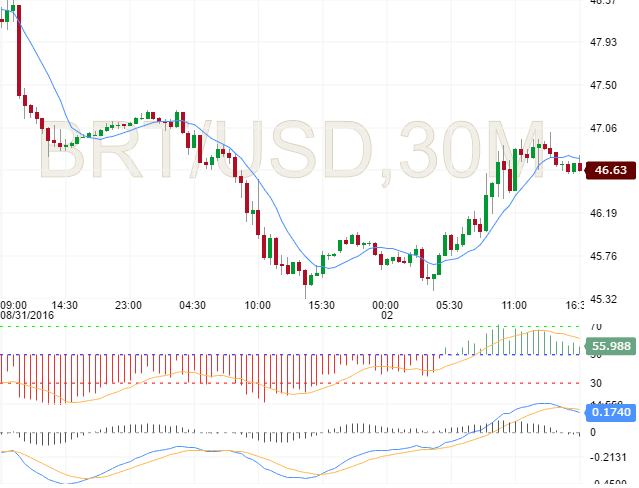
Brent crude for November delivery advanced $1.38 or 3% to close at $46.83 a barrel Friday. The futures price briefly traded above $47 a barrel before returning lower. For the week, Brent plunged 6.2% after a four-day losing streak sent prices to three-week lows.
The West Texas Intermediate (WTI) benchmark for US crude futures advanced $1.28 or 3% on Friday to close at $44.44 a barrel, paring its weekly loss down to 6.7%.
Oil prices ran into Volatility last week, as the combination of rising US crude inventories and a strong dollar weighed on investor sentiment. Markets also digested remarks from Saudi Arabian energy minister Khalid al-Falih that the kingdom was not planning to intervene in the oil market, casting doubts about the upcoming production talks in Algeria.
Markets began to stabilize on Friday after Russian President Vladimir Putin called on the Organization of the Petroleum Exporting Countries (OPEC) to agree to limit output when they meet at the International Energy Forum September 26-28. The Russian leader said he would even favour a deal that offers leeway for Iran to continue ramping up production to pre-sanctions levels.
“Iran is starting from a very low position, connected with the well-known sanctions in relation to this country,” Putin said in an interview with Bloomberg on Friday. “It would be unfair to leave it on this sanctioned level.”
Experts remain skeptical that major producers will come to terms on a production freeze later this month. Even if a deal were reached, compliance would be a major issue, especially at a time when OPEC was continuing to defend market share. Saudi Arabia recently reported record oil output, while Iraq continues to ramp up exports from its southern ports.
In the United States, drillers have added active oil rigs in nine of the past ten weeks. The number of oil rigs operating in US fields rose by one to a total of 407 in the latest week, according to data from energy services provider Baker Hughes. Compared to the same time last year, drillers are operating 255 fewer rigs.
Increasing rig counts suggest US drillers are looking to expand production, and are highly responsive to rising prices.
Commodity traders also monitored a disappointing US jobs report, which virtually erased the possibility that the Federal Reserve will raise interest rates at its policy meeting later this month. US employers added 151,000 workers to payrolls in August, falling short of expectations calling for 180,000, the Labor Department reported Friday.
Continued low-rate stimulus by the Fed will help keep the US dollar in check, which could provide temporary relief for greenback-denominated commodities, such as oil. The US dollar declined sharply following the jobs report, but quickly rebounded to finish 0.2% higher against a basket of currencies Friday.
Last week’s oil-price collapse received a temporary reprieve on Friday after Russian President Vladimir Putin reaffirmed his country’s commitment to rebalancing the market with OPEC.
Brent crude for November delivery advanced $1.38 or 3% to close at $46.83 a barrel Friday. The futures price briefly traded above $47 a barrel before returning lower. For the week, Brent plunged 6.2% after a four-day losing streak sent prices to three-week lows.
The West Texas Intermediate (WTI) benchmark for US crude futures advanced $1.28 or 3% on Friday to close at $44.44 a barrel, paring its weekly loss down to 6.7%.
Oil prices ran into Volatility last week, as the combination of rising US crude inventories and a strong dollar weighed on investor sentiment. Markets also digested remarks from Saudi Arabian energy minister Khalid al-Falih that the kingdom was not planning to intervene in the oil market, casting doubts about the upcoming production talks in Algeria.
Markets began to stabilize on Friday after Russian President Vladimir Putin called on the Organization of the Petroleum Exporting Countries (OPEC) to agree to limit output when they meet at the International Energy Forum September 26-28. The Russian leader said he would even favour a deal that offers leeway for Iran to continue ramping up production to pre-sanctions levels.
“Iran is starting from a very low position, connected with the well-known sanctions in relation to this country,” Putin said in an interview with Bloomberg on Friday. “It would be unfair to leave it on this sanctioned level.”
Experts remain skeptical that major producers will come to terms on a production freeze later this month. Even if a deal were reached, compliance would be a major issue, especially at a time when OPEC was continuing to defend market share. Saudi Arabia recently reported record oil output, while Iraq continues to ramp up exports from its southern ports.
In the United States, drillers have added active oil rigs in nine of the past ten weeks. The number of oil rigs operating in US fields rose by one to a total of 407 in the latest week, according to data from energy services provider Baker Hughes. Compared to the same time last year, drillers are operating 255 fewer rigs.
Increasing rig counts suggest US drillers are looking to expand production, and are highly responsive to rising prices.
Commodity traders also monitored a disappointing US jobs report, which virtually erased the possibility that the Federal Reserve will raise interest rates at its policy meeting later this month. US employers added 151,000 workers to payrolls in August, falling short of expectations calling for 180,000, the Labor Department reported Friday.
Continued low-rate stimulus by the Fed will help keep the US dollar in check, which could provide temporary relief for greenback-denominated commodities, such as oil. The US dollar declined sharply following the jobs report, but quickly rebounded to finish 0.2% higher against a basket of currencies Friday.
Italy’s Consob Tightens Net on AI-Fueled Scams With Fresh Website Bans
FP Markets Winner Spotlight 🏆 | Global Broker of the Year 2025 #Trading #Broker #Innovation #Shorts
FP Markets Winner Spotlight 🏆 | Global Broker of the Year 2025 #Trading #Broker #Innovation #Shorts
FP Markets takes the spotlight as Global Broker of the Year 2025 at the Finance Magnates Awards.
Martin Stoilov, Head of Client Experience, shares that trust, innovation, and people played a key role in the company’s success, supported by a strong foundation of integrity and client-centricity.
Following this milestone, FP Markets continues to focus on growth, technology investment, and its core values of transparency and excellence.
👉 Be part of FM Awards 2026: https://awards.financemagnates.com/#nominate
FP Markets takes the spotlight as Global Broker of the Year 2025 at the Finance Magnates Awards.
Martin Stoilov, Head of Client Experience, shares that trust, innovation, and people played a key role in the company’s success, supported by a strong foundation of integrity and client-centricity.
Following this milestone, FP Markets continues to focus on growth, technology investment, and its core values of transparency and excellence.
👉 Be part of FM Awards 2026: https://awards.financemagnates.com/#nominate
In this video, we review @HolaPrimeMarketsOfficial, a multi-asset forex and CFDs broker offering different account types, trading platforms, and flexible trading conditions.
We cover the broker’s overall offering, including account options, trading environment, platforms like MT4 and MT5, and additional services such as managed accounts and fast withdrawals.
Watch the full video to see if Hola Prime Markets fits your trading needs.
📣 Stay up to date with the latest in finance and trading. Follow Finance Magnates for industry news, insights, and global event coverage.
Connect with us:
🔗 LinkedIn: /financemagnates
👍 Facebook: /financemagnates
📸 Instagram: https://www.instagram.com/financemagnates
🐦 X: https://x.com/financemagnates
🎥 TikTok: https://www.tiktok.com/tag/financemagnates
▶️ YouTube: /@financemagnates_official
#HolaPrime #ForexBroker #CFDTrading #FinanceMagnates #Trading #Forex #BrokerReview
In this video, we review @HolaPrimeMarketsOfficial, a multi-asset forex and CFDs broker offering different account types, trading platforms, and flexible trading conditions.
We cover the broker’s overall offering, including account options, trading environment, platforms like MT4 and MT5, and additional services such as managed accounts and fast withdrawals.
Watch the full video to see if Hola Prime Markets fits your trading needs.
📣 Stay up to date with the latest in finance and trading. Follow Finance Magnates for industry news, insights, and global event coverage.
Connect with us:
🔗 LinkedIn: /financemagnates
👍 Facebook: /financemagnates
📸 Instagram: https://www.instagram.com/financemagnates
🐦 X: https://x.com/financemagnates
🎥 TikTok: https://www.tiktok.com/tag/financemagnates
▶️ YouTube: /@financemagnates_official
#HolaPrime #ForexBroker #CFDTrading #FinanceMagnates #Trading #Forex #BrokerReview
Hola Prime Review: What You Need to Know | Full Breakdown by Finance Magnates
Hola Prime Review: What You Need to Know | Full Breakdown by Finance Magnates
In this video, we review @HolaPrime_Global, a proprietary trading firm offering evaluation programs and performance-based payouts in simulated market environments.
We cover how the challenge model works, including account types, profit splits (up to 95%), trading rules, and what it takes to reach a funded account. You’ll also learn about available platforms like MT4, MT5, cTrader, and more, along with insights into payouts, support, and trading conditions.
Watch the full video to see if Hola Prime fits your trading style.
📣 Stay up to date with the latest in finance and trading. Follow Finance Magnates for industry news, insights, and global event coverage.
Connect with us:
🔗 LinkedIn: /financemagnates
👍 Facebook: /financemagnates
📸 Instagram: https://www.instagram.com/financemagnates
🐦 X: https://x.com/financemagnates
🎥 TikTok: https://www.tiktok.com/tag/financemagnates
▶️ YouTube: /@financemagnates_official
#HolaPrime #PropFirm #Trading #FinanceMagnates #Forex #FuturesTrading #TradingReview #PropFirmReview
In this video, we review @HolaPrime_Global, a proprietary trading firm offering evaluation programs and performance-based payouts in simulated market environments.
We cover how the challenge model works, including account types, profit splits (up to 95%), trading rules, and what it takes to reach a funded account. You’ll also learn about available platforms like MT4, MT5, cTrader, and more, along with insights into payouts, support, and trading conditions.
Watch the full video to see if Hola Prime fits your trading style.
📣 Stay up to date with the latest in finance and trading. Follow Finance Magnates for industry news, insights, and global event coverage.
Connect with us:
🔗 LinkedIn: /financemagnates
👍 Facebook: /financemagnates
📸 Instagram: https://www.instagram.com/financemagnates
🐦 X: https://x.com/financemagnates
🎥 TikTok: https://www.tiktok.com/tag/financemagnates
▶️ YouTube: /@financemagnates_official
#HolaPrime #PropFirm #Trading #FinanceMagnates #Forex #FuturesTrading #TradingReview #PropFirmReview
Axi Winner Spotlight 🏆 | Global Most Innovative Broker 2025 #Innovation #Trading #Fintech #Broker
Axi Winner Spotlight 🏆 | Global Most Innovative Broker 2025 #Innovation #Trading #Fintech #Broker
Axi takes the spotlight at the Finance Magnates Awards, winning Global Most Innovative Broker 2025.
Olivia Xenofontos and Ivanna Openko share how the team will feel: proud, motivated, and ready to keep delivering.
They also describe the night as well-organized, focused, and enjoyable for all.
👉 Be part of FM Awards 2026.
Axi takes the spotlight at the Finance Magnates Awards, winning Global Most Innovative Broker 2025.
Olivia Xenofontos and Ivanna Openko share how the team will feel: proud, motivated, and ready to keep delivering.
They also describe the night as well-organized, focused, and enjoyable for all.
👉 Be part of FM Awards 2026.
Recognition that matters.
Built on transparency.
Driven by the industry.
The Finance Magnates Awards 2026.
Nominations are now open.
🔗 https://awards.financemagnates.com/?utm_source=SM&utm_medium=social&utm_campaign=recognition-matters
Recognition that matters.
Built on transparency.
Driven by the industry.
The Finance Magnates Awards 2026.
Nominations are now open.
🔗 https://awards.financemagnates.com/?utm_source=SM&utm_medium=social&utm_campaign=recognition-matters