The following article from ORE, describes an option’s moneyness and why choosing a strike rate to match your market outlook is important.
Bloomberg
An option can be described as being in one of three states depending on the position of the market price with respect to the option's strike rate. If the market rate equals the strike, the option is at-the-money (ATM). If the market is better than the strike, the option is out-of-the-money (OTM). Finally, if the market is worse than the strike, the option is in-the-money (ITM).
Why does it matter? A key factor in determining an option's value is the market rate versus the strike. In-the-money (ITM) options are the most expensive and out-the-money (OTM) options are the cheapest. The more bullish you are when speculating the markets, the further out-of-the-money you can buy an option (and the cheaper it will be), which creates a highly-leveraged trade.
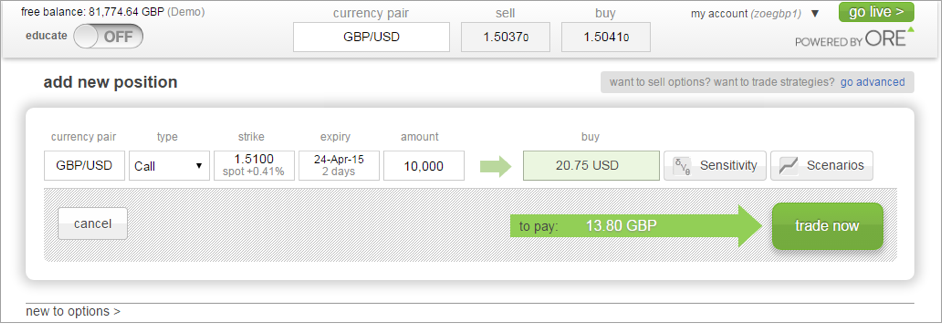
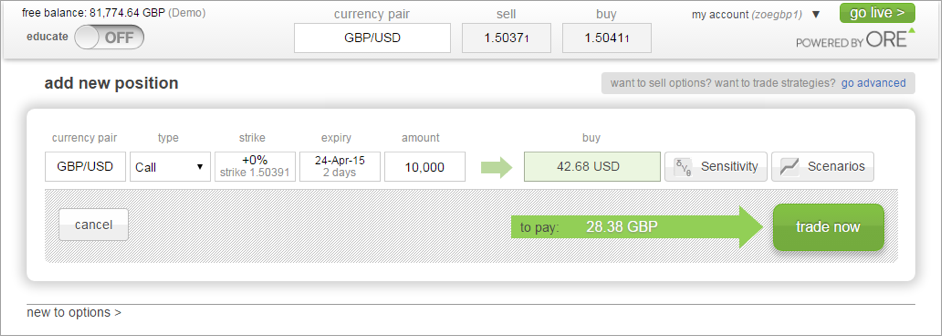
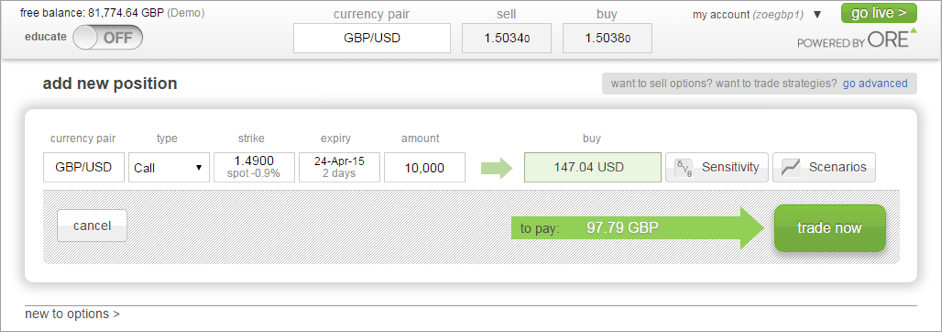
For example, below is a GBP/USD, 2-day call option in the amount of GBP 10,000 shown with three different strike rates. The underlying GBP/USD mid-rate was around 1.5040. Notice how the out-the-money (OTM) call with a 1.5100 strike is the cheapest option to buy at USD 20.75. However, for this option to payout by expiry, the GBP/USD market rate will need to rise more comparatively with the ATM and ITM options. The further away your strike, the further away your break-even point. However, you are risking less money in the trade.
OTM Option with strike rate = 1.5100 costs USD 20.75:
ATM Option with strike rate = 1.5039 (0% from market) costs USD 42.68:
ITM Option with strike rate = 1.4900 costs USD 147.04:
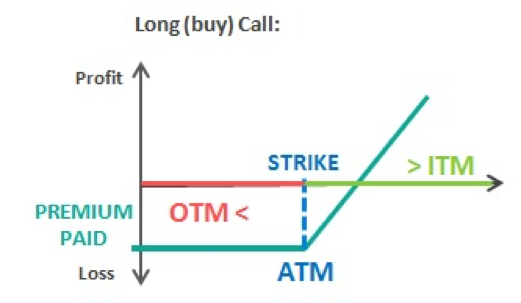
The state of an open option trade may change as the underlying market rate moves around. If you buy an at-the-money (ATM) call option and the market rises, then the call becomes in-the-money (ITM). Alternatively, if the market falls below the strike the call becomes out-the-money (OTM). The long call option payout graph below indicates the state of an option at different market rates.
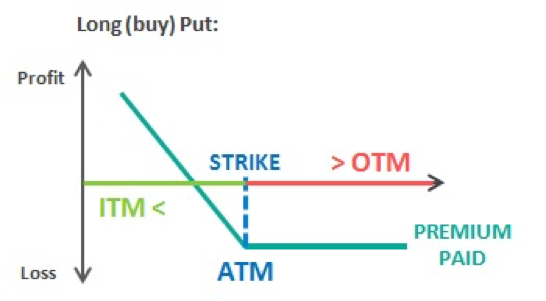
The state of Put options may also change as the market moves, but when you buy a Put you are positioned in the opposite direction compared with buying a call, i.e. if you hold a Put you want the market to fall. If you buy an at-the-money (ATM) Put and the market rises then the Put becomes out-the-money (OTM). But, if the market falls below the strike, the Put becomes in-the-money (ITM). The long Put option payout graph below indicates the state of an option at different market rates.
What happens at expiry? In the last article, Part 3 of the Options Game, we explained an option will only have value at expiry if its strike rate can 'beat' the market rate. If the strike is worse than or equal to the market, the option expires worthless. Hence, only ITM options will have value at expiry.
In Part 5 of The Options Game, Zoe Fiddes explains “The Time Value of an Option."
An option can be described as being in one of three states depending on the position of the market price with respect to the option's strike rate. If the market rate equals the strike, the option is at-the-money (ATM). If the market is better than the strike, the option is out-of-the-money (OTM). Finally, if the market is worse than the strike, the option is in-the-money (ITM).
Why does it matter? A key factor in determining an option's value is the market rate versus the strike. In-the-money (ITM) options are the most expensive and out-the-money (OTM) options are the cheapest. The more bullish you are when speculating the markets, the further out-of-the-money you can buy an option (and the cheaper it will be), which creates a highly-leveraged trade.
For example, below is a GBP/USD, 2-day call option in the amount of GBP 10,000 shown with three different strike rates. The underlying GBP/USD mid-rate was around 1.5040. Notice how the out-the-money (OTM) call with a 1.5100 strike is the cheapest option to buy at USD 20.75. However, for this option to payout by expiry, the GBP/USD market rate will need to rise more comparatively with the ATM and ITM options. The further away your strike, the further away your break-even point. However, you are risking less money in the trade.
OTM Option with strike rate = 1.5100 costs USD 20.75:
ATM Option with strike rate = 1.5039 (0% from market) costs USD 42.68:
ITM Option with strike rate = 1.4900 costs USD 147.04:
The state of an open option trade may change as the underlying market rate moves around. If you buy an at-the-money (ATM) call option and the market rises, then the call becomes in-the-money (ITM). Alternatively, if the market falls below the strike the call becomes out-the-money (OTM). The long call option payout graph below indicates the state of an option at different market rates.
The state of Put options may also change as the market moves, but when you buy a Put you are positioned in the opposite direction compared with buying a call, i.e. if you hold a Put you want the market to fall. If you buy an at-the-money (ATM) Put and the market rises then the Put becomes out-the-money (OTM). But, if the market falls below the strike, the Put becomes in-the-money (ITM). The long Put option payout graph below indicates the state of an option at different market rates.
What happens at expiry? In the last article, Part 3 of the Options Game, we explained an option will only have value at expiry if its strike rate can 'beat' the market rate. If the strike is worse than or equal to the market, the option expires worthless. Hence, only ITM options will have value at expiry.
In Part 5 of The Options Game, Zoe Fiddes explains “The Time Value of an Option."
CMC Markets’ Artur Delijergijevs on Metals Demand, Volatility, & Stable Execution
CMC Markets’ Artur Delijergijevs on Metals Demand, Volatility, & Stable Execution
In this exclusive Executive Interview, Finance Magnates speaks with Artur Delijergijevs, Head of Systematic Market Making at CMC Markets, about the current state of metals demand and market volatility.
Delijergijevs offers a desk-level view on:
- Metals Demand: Why metals are seeing the strongest demand from both retail and institutional clients right now.
- The Safe-Haven Debate: Questioning whether gold still fits the classic safe-haven definition given large daily price movements.
- Volatile Market Prep: How a market-making desk prepares its systems and pricing for stressed market conditions and high-impact economic events.
- Hybrid Execution: Why the best execution model combines electronic speed with human relationship support, especially during volatility.
- AI in Workflow: Where CMC Markets is integrating machine learning for risk management and pricing, and the limitations of AI during stressed markets.
- Dubai's Role: The strategic importance of Dubai’s location for covering global trading sessions across Asia, Europe, and the US.
Watch to understand how CMC Markets maintains stable pricing and reliable execution quality in high-volatility environments.
#CMCmarkets #forex #metals #gold #trading #volatility #MarketMaking #iFXDubai #FinanceMagnates #Finance #Fintech #Execution #AlgorithmicTrading #RiskManagement
In this exclusive Executive Interview, Finance Magnates speaks with Artur Delijergijevs, Head of Systematic Market Making at CMC Markets, about the current state of metals demand and market volatility.
Delijergijevs offers a desk-level view on:
- Metals Demand: Why metals are seeing the strongest demand from both retail and institutional clients right now.
- The Safe-Haven Debate: Questioning whether gold still fits the classic safe-haven definition given large daily price movements.
- Volatile Market Prep: How a market-making desk prepares its systems and pricing for stressed market conditions and high-impact economic events.
- Hybrid Execution: Why the best execution model combines electronic speed with human relationship support, especially during volatility.
- AI in Workflow: Where CMC Markets is integrating machine learning for risk management and pricing, and the limitations of AI during stressed markets.
- Dubai's Role: The strategic importance of Dubai’s location for covering global trading sessions across Asia, Europe, and the US.
Watch to understand how CMC Markets maintains stable pricing and reliable execution quality in high-volatility environments.
#CMCmarkets #forex #metals #gold #trading #volatility #MarketMaking #iFXDubai #FinanceMagnates #Finance #Fintech #Execution #AlgorithmicTrading #RiskManagement
Finance Magnates Awards 2026 – Nominations Now Open
Finance Magnates Awards 2026 – Nominations Now Open
The Finance Magnates Awards 2026 nominations are now open. 🏆
From fintech innovators to leading brokers, this is where the finance industry celebrates its biggest achievements.
Winners will be announced at the Cyprus Gala Dinner on November 6, 2026.
Nominate your brand now.
https://awards.financemagnates.com/?utm_source=linkedin&utm_medium=video&utm_campaign=nominations-open
#FMAwards #FinanceMagnates #FintechAwards #Fintech #FinanceIndustry
The Finance Magnates Awards 2026 nominations are now open. 🏆
From fintech innovators to leading brokers, this is where the finance industry celebrates its biggest achievements.
Winners will be announced at the Cyprus Gala Dinner on November 6, 2026.
Nominate your brand now.
https://awards.financemagnates.com/?utm_source=linkedin&utm_medium=video&utm_campaign=nominations-open
#FMAwards #FinanceMagnates #FintechAwards #Fintech #FinanceIndustry
Finance Magnates Awards 2026 | Nominations Now Open 🏆#Fintech #FMAwards #TradingIndustry
Finance Magnates Awards 2026 | Nominations Now Open 🏆#Fintech #FMAwards #TradingIndustry
Lights on. Cameras ready. 🎬
Finance Magnates Awards 2026 nominations are now open. 🏆
#FMAwards #FinanceMagnates #FintechAwards #Fintech
Lights on. Cameras ready. 🎬
Finance Magnates Awards 2026 nominations are now open. 🏆
#FMAwards #FinanceMagnates #FintechAwards #Fintech
Exness sees trust as the key theme for growth in MENA Trading Growth for 2026
Exness sees trust as the key theme for growth in MENA Trading Growth for 2026
Mohammad Amer, Regional Commercial Director at Exness, sits down to discuss the booming MENA financial trading market. Find out why Dubai is key to the company's growth strategy, how a mobile-first generation is changing expectations, and why trust will be the defining theme for traders in 2026.
In this interview, you'll learn:
* Why Dubai and the MENA region are critical growth markets for fintech and online trading.
* How Exness is addressing the demands of mobile-first, younger traders through engineering, platform stability, and transparent conditions.
* The essential role local talent plays in providing a culturally relevant and compliant user experience.
* Mohammad Amer's outlook on the future of the online trading industry and why stronger controls and systems are necessary.
* Why "trust" isn't just a brand value, but has commercial value—and why he predicts 2026 will be the "Year of Trust."
Key Takeaways:
➡️ The MENA region is rapidly shaping global financial markets.
➡️ New traders expect stability, precise execution, and transparency.
➡️ Local expertise is key to regulatory compliance and user experience.
➡️ Future success belongs to firms capable of meeting rising standards across regulation and platform consistency.
Read the full article at: https://www.financemagnates.com/thought-leadership/exness-sees-trust-as-the-key-theme-for-growth-in-mena-trading-growth-for-2026/
#Exness #MENA #Trading #FinTech #Dubai #OnlineTrading #FinanceMagnates #MohammadAmer #Trust #MobileTrading
Mohammad Amer, Regional Commercial Director at Exness, sits down to discuss the booming MENA financial trading market. Find out why Dubai is key to the company's growth strategy, how a mobile-first generation is changing expectations, and why trust will be the defining theme for traders in 2026.
In this interview, you'll learn:
* Why Dubai and the MENA region are critical growth markets for fintech and online trading.
* How Exness is addressing the demands of mobile-first, younger traders through engineering, platform stability, and transparent conditions.
* The essential role local talent plays in providing a culturally relevant and compliant user experience.
* Mohammad Amer's outlook on the future of the online trading industry and why stronger controls and systems are necessary.
* Why "trust" isn't just a brand value, but has commercial value—and why he predicts 2026 will be the "Year of Trust."
Key Takeaways:
➡️ The MENA region is rapidly shaping global financial markets.
➡️ New traders expect stability, precise execution, and transparency.
➡️ Local expertise is key to regulatory compliance and user experience.
➡️ Future success belongs to firms capable of meeting rising standards across regulation and platform consistency.
Read the full article at: https://www.financemagnates.com/thought-leadership/exness-sees-trust-as-the-key-theme-for-growth-in-mena-trading-growth-for-2026/
#Exness #MENA #Trading #FinTech #Dubai #OnlineTrading #FinanceMagnates #MohammadAmer #Trust #MobileTrading
Paytiko CEO Razi Salih on Why Payment Orchestration is a MUST-HAVE for Brokers in 2026
Paytiko CEO Razi Salih on Why Payment Orchestration is a MUST-HAVE for Brokers in 2026
At iFX Expo Dubai, Finance Magnates spoke with Razi Salih, CEO at Paytiko, about the evolution of the payments ecosystem and why payment orchestration has shifted from an option to a necessity for brokers, prop firms, and exchanges.
Mr. Salih explains how global expansion, the need for deep localisation, and the sheer number of new payment methods, from instant banking to stablecoins, are driving this critical infrastructure shift.
#PaymentOrchestration #Fintech #Brokerage #TradingPayments #RaziSalih #Paytiko #iFXExpoDubai #Stablecoins #AIinFintech
At iFX Expo Dubai, Finance Magnates spoke with Razi Salih, CEO at Paytiko, about the evolution of the payments ecosystem and why payment orchestration has shifted from an option to a necessity for brokers, prop firms, and exchanges.
Mr. Salih explains how global expansion, the need for deep localisation, and the sheer number of new payment methods, from instant banking to stablecoins, are driving this critical infrastructure shift.
#PaymentOrchestration #Fintech #Brokerage #TradingPayments #RaziSalih #Paytiko #iFXExpoDubai #Stablecoins #AIinFintech