When all have access to custom EAs and robo-advisors, the price of these will naturally drop.
Few can be in doubt that financial trading is every year moving increasingly towards automated and robotic trading.
The majority of the users in the retail segment have no other choice today than to follow other traders, or to follow ready-made signals. It is common to the present robotic trading that the user typically has no influence on the trader he follows, or the signal he uses.
Today
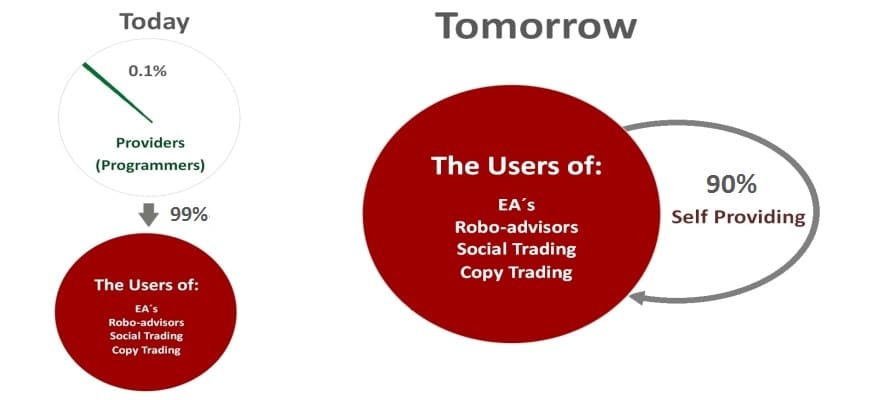
Today, an estimated 0.1% of the traders develop and provide the signals/EAs to the non-programmers in the market, which are close to 100% of the retail users. Despite visual development tools for EAs becoming available over the past years, it still takes time to develop new EAs. Many of the EAs in the market are circulating for years, and are reused. There is a high demand for EAs and signals developed and tested using recent data.
Tomorrow
There is a clear trend towards an increasing use of visual methods for custom development of strategies, EAs, signals and robo-advisors. Tomorrow we can expect that it will be possible for the unskilled user to provide these signals and EAs himself.
This trend will have a major impact on the future of financial trading, the providers, the programmers, the brokers – all participants in the sector will be influenced.
Approaching a price of zero
When any user can develop his own robotic trading, the amount of strategies in the market will increase. The move from 0.1% of the traders providing EAs, towards a magnitude of 90% of the traders expected to self-provide without programming, will multiply the strategies in the market by an estimated factor of 10,000. The exact number we do not know at this stage, but we know the figure is exponential.
When all have access to custom signals/EAs/robo-advisors, the price of these will naturally drop, approaching a price of zero.
The influence on the market for EAs
A price drop approaching zero for an EA, combined with an oversupply of custom developed strategies, will dilute and flood the market with the provided EAs, and will make EA development for selling or for other users close to unprofitable.
The influence on social and copy trading
Several surveys have concluded that traders prefer to have an influence and be more in control. These surveys did not include the scenarios where the trader could develop his own signals. But it would be expected that the majority of users, and previous users of social trading, will start providing these signal for themselves, or pick signals from the oversupplied market.
Many users will probably eventually choose to do it themselves, as navigating the very high count of free signals would be confusing and time consuming.
Another major influence we can expect is when the user can provide his own signals/robo-advisors/EAs, implying that there is no additional spread added by the signal provider! Where the typical added value to the spread today is from 1 pips up to in many cases 2-3.
The lower spread will have a major influence on the trade frequency, as removing 1-2 pips from the spread will mean strategies in the lower time frames can be used, for example in the 1 minute time frame - strategies which did not perform before may start to perform with the lower spread.
The influence on robo-advisors
'Robo-advisors' is a relatively new term and phenomenon in the market, a spin-off of wealth management, where retail users now can use a robot to advise, rather than an investment advisor. Today focused on the investment time frame of stocks and derived long-only instruments, large amounts of venture capitalist money is injected in this segment.
A survey from E*TRADE recently concluded that users prefer an influence on the robo-advisor. There is not a big gap between today´s robotic advisors, to solutions where the user can self-provide his advice, which would imply also automating the advice. When this happens, part of this trading will be expected to move towards offline trading, and even move to other markets traded 24 hours a day, such as FX.
The influence on the programmers
When signals, robo-advisors and EAs can be developed by any trader, the programmer will no longer be needed. The 1,000+ programmers at Goldman Sachs will not be out of work from one day to another, but the attractive business of developing custom financial trading will for sure shrink dramatically. However, the programmer will still be needed, as no visual development environment is complete - there will always be traders who have special requirements, especially in the institutional segment.
The influence on the market
Today only a minority of traders in the financial market can develop their own custom trading. Nobody can predict what will happen when traders tomorrow have the ability to develop their own custom signals, but we can imagine the influence on the market.
Few can be in doubt that financial trading is every year moving increasingly towards automated and robotic trading.
The majority of the users in the retail segment have no other choice today than to follow other traders, or to follow ready-made signals. It is common to the present robotic trading that the user typically has no influence on the trader he follows, or the signal he uses.
Today
Today, an estimated 0.1% of the traders develop and provide the signals/EAs to the non-programmers in the market, which are close to 100% of the retail users. Despite visual development tools for EAs becoming available over the past years, it still takes time to develop new EAs. Many of the EAs in the market are circulating for years, and are reused. There is a high demand for EAs and signals developed and tested using recent data.
Tomorrow
There is a clear trend towards an increasing use of visual methods for custom development of strategies, EAs, signals and robo-advisors. Tomorrow we can expect that it will be possible for the unskilled user to provide these signals and EAs himself.
This trend will have a major impact on the future of financial trading, the providers, the programmers, the brokers – all participants in the sector will be influenced.
Approaching a price of zero
When any user can develop his own robotic trading, the amount of strategies in the market will increase. The move from 0.1% of the traders providing EAs, towards a magnitude of 90% of the traders expected to self-provide without programming, will multiply the strategies in the market by an estimated factor of 10,000. The exact number we do not know at this stage, but we know the figure is exponential.
When all have access to custom signals/EAs/robo-advisors, the price of these will naturally drop, approaching a price of zero.
The influence on the market for EAs
A price drop approaching zero for an EA, combined with an oversupply of custom developed strategies, will dilute and flood the market with the provided EAs, and will make EA development for selling or for other users close to unprofitable.
The influence on social and copy trading
Several surveys have concluded that traders prefer to have an influence and be more in control. These surveys did not include the scenarios where the trader could develop his own signals. But it would be expected that the majority of users, and previous users of social trading, will start providing these signal for themselves, or pick signals from the oversupplied market.
Many users will probably eventually choose to do it themselves, as navigating the very high count of free signals would be confusing and time consuming.
Another major influence we can expect is when the user can provide his own signals/robo-advisors/EAs, implying that there is no additional spread added by the signal provider! Where the typical added value to the spread today is from 1 pips up to in many cases 2-3.
The lower spread will have a major influence on the trade frequency, as removing 1-2 pips from the spread will mean strategies in the lower time frames can be used, for example in the 1 minute time frame - strategies which did not perform before may start to perform with the lower spread.
The influence on robo-advisors
'Robo-advisors' is a relatively new term and phenomenon in the market, a spin-off of wealth management, where retail users now can use a robot to advise, rather than an investment advisor. Today focused on the investment time frame of stocks and derived long-only instruments, large amounts of venture capitalist money is injected in this segment.
A survey from E*TRADE recently concluded that users prefer an influence on the robo-advisor. There is not a big gap between today´s robotic advisors, to solutions where the user can self-provide his advice, which would imply also automating the advice. When this happens, part of this trading will be expected to move towards offline trading, and even move to other markets traded 24 hours a day, such as FX.
The influence on the programmers
When signals, robo-advisors and EAs can be developed by any trader, the programmer will no longer be needed. The 1,000+ programmers at Goldman Sachs will not be out of work from one day to another, but the attractive business of developing custom financial trading will for sure shrink dramatically. However, the programmer will still be needed, as no visual development environment is complete - there will always be traders who have special requirements, especially in the institutional segment.
The influence on the market
Today only a minority of traders in the financial market can develop their own custom trading. Nobody can predict what will happen when traders tomorrow have the ability to develop their own custom signals, but we can imagine the influence on the market.
FTMO Says Monthly Rewards Near $15 Million in September
Featured Videos
AvaTrade to Acquire Most of FXCM; NAGA Raises $8M
AvaTrade to Acquire Most of FXCM; NAGA Raises $8M
AvaTrade to Acquire Most of FXCM; NAGA Raises $8M
AvaTrade to Acquire Most of FXCM; NAGA Raises $8M
Today’s financial news recap covers AvaTrade agrees to acquire most of FXCM, NAGA secures eight million dollars in new financing, and Wise seeks a tax settlement in the UK.
Finance Magnates Daily Recap brings you the latest news from forex and CFD brokers, fintech, payments, cryptocurrency, digital assets, trading platforms, financial regulation and global markets.
Get the key company news, executive moves, deals, regulatory updates and market developments of the day, in just a few minutes. New episodes published every weekday.
Read more: https://www.financemagnates.com
#FinanceMagnates #ForexNews #FintechNews
Today’s financial news recap covers AvaTrade agrees to acquire most of FXCM, NAGA secures eight million dollars in new financing, and Wise seeks a tax settlement in the UK.
Finance Magnates Daily Recap brings you the latest news from forex and CFD brokers, fintech, payments, cryptocurrency, digital assets, trading platforms, financial regulation and global markets.
Get the key company news, executive moves, deals, regulatory updates and market developments of the day, in just a few minutes. New episodes published every weekday.
Read more: https://www.financemagnates.com
#FinanceMagnates #ForexNews #FintechNews
Today’s financial news recap covers AvaTrade agrees to acquire most of FXCM, NAGA secures eight million dollars in new financing, and Wise seeks a tax settlement in the UK.
Finance Magnates Daily Recap brings you the latest news from forex and CFD brokers, fintech, payments, cryptocurrency, digital assets, trading platforms, financial regulation and global markets.
Get the key company news, executive moves, deals, regulatory updates and market developments of the day, in just a few minutes. New episodes published every weekday.
Read more: https://www.financemagnates.com
#FinanceMagnates #ForexNews #FintechNews
Today’s financial news recap covers AvaTrade agrees to acquire most of FXCM, NAGA secures eight million dollars in new financing, and Wise seeks a tax settlement in the UK.
Finance Magnates Daily Recap brings you the latest news from forex and CFD brokers, fintech, payments, cryptocurrency, digital assets, trading platforms, financial regulation and global markets.
Get the key company news, executive moves, deals, regulatory updates and market developments of the day, in just a few minutes. New episodes published every weekday.
Read more: https://www.financemagnates.com
#FinanceMagnates #ForexNews #FintechNews
XTB Adds Overnight US Stock Trading; Nasdaq Ventures Invests in One Trading
XTB Adds Overnight US Stock Trading; Nasdaq Ventures Invests in One Trading
XTB Adds Overnight US Stock Trading; Nasdaq Ventures Invests in One Trading
XTB Adds Overnight US Stock Trading; Nasdaq Ventures Invests in One Trading
XTB Adds Overnight US Stock Trading; Nasdaq Ventures Invests in One Trading
XTB Adds Overnight US Stock Trading; Nasdaq Ventures Invests in One Trading
Today’s financial news recap covers XTB expands overnight US stock trading, Fortrade reports higher revenue, Nasdaq backs One Trading, and Vest Labs raises 13 million dollars.
Finance Magnates Daily Recap brings you the latest news from forex and CFD brokers, fintech, payments, cryptocurrency, digital assets, trading platforms, financial regulation and global markets.
Get the key company news, executive moves, deals, regulatory updates and market developments of the day, in just a few minutes. New episodes published every weekday.
Read more: https://www.financemagnates.com
#FinanceMagnates #ForexNews #FintechNews
Today’s financial news recap covers XTB expands overnight US stock trading, Fortrade reports higher revenue, Nasdaq backs One Trading, and Vest Labs raises 13 million dollars.
Finance Magnates Daily Recap brings you the latest news from forex and CFD brokers, fintech, payments, cryptocurrency, digital assets, trading platforms, financial regulation and global markets.
Get the key company news, executive moves, deals, regulatory updates and market developments of the day, in just a few minutes. New episodes published every weekday.
Read more: https://www.financemagnates.com
#FinanceMagnates #ForexNews #FintechNews
Today’s financial news recap covers XTB expands overnight US stock trading, Fortrade reports higher revenue, Nasdaq backs One Trading, and Vest Labs raises 13 million dollars.
Finance Magnates Daily Recap brings you the latest news from forex and CFD brokers, fintech, payments, cryptocurrency, digital assets, trading platforms, financial regulation and global markets.
Get the key company news, executive moves, deals, regulatory updates and market developments of the day, in just a few minutes. New episodes published every weekday.
Read more: https://www.financemagnates.com
#FinanceMagnates #ForexNews #FintechNews
Today’s financial news recap covers XTB expands overnight US stock trading, Fortrade reports higher revenue, Nasdaq backs One Trading, and Vest Labs raises 13 million dollars.
Finance Magnates Daily Recap brings you the latest news from forex and CFD brokers, fintech, payments, cryptocurrency, digital assets, trading platforms, financial regulation and global markets.
Get the key company news, executive moves, deals, regulatory updates and market developments of the day, in just a few minutes. New episodes published every weekday.
Read more: https://www.financemagnates.com
#FinanceMagnates #ForexNews #FintechNews
Today’s financial news recap covers XTB expands overnight US stock trading, Fortrade reports higher revenue, Nasdaq backs One Trading, and Vest Labs raises 13 million dollars.
Finance Magnates Daily Recap brings you the latest news from forex and CFD brokers, fintech, payments, cryptocurrency, digital assets, trading platforms, financial regulation and global markets.
Get the key company news, executive moves, deals, regulatory updates and market developments of the day, in just a few minutes. New episodes published every weekday.
Read more: https://www.financemagnates.com
#FinanceMagnates #ForexNews #FintechNews
Today’s financial news recap covers XTB expands overnight US stock trading, Fortrade reports higher revenue, Nasdaq backs One Trading, and Vest Labs raises 13 million dollars.
Finance Magnates Daily Recap brings you the latest news from forex and CFD brokers, fintech, payments, cryptocurrency, digital assets, trading platforms, financial regulation and global markets.
Get the key company news, executive moves, deals, regulatory updates and market developments of the day, in just a few minutes. New episodes published every weekday.
Read more: https://www.financemagnates.com
#FinanceMagnates #ForexNews #FintechNews
CMC Founder Downplays Volatility Hit; Devexperts Names CEO
CMC Founder Downplays Volatility Hit; Devexperts Names CEO
CMC Founder Downplays Volatility Hit; Devexperts Names CEO
CMC Founder Downplays Volatility Hit; Devexperts Names CEO
CMC Founder Downplays Volatility Hit; Devexperts Names CEO
CMC Founder Downplays Volatility Hit; Devexperts Names CEO
Today’s financial news recap covers low volatility pressures brokers, Devexperts names a new CEO, Saxo cuts onboarding time, and OKX reaches a 25 billion dollar valuation.
Finance Magnates Daily Recap brings you the latest news from forex and CFD brokers, fintech, payments, cryptocurrency, digital assets, trading platforms, financial regulation and global markets.
Get the key company news, executive moves, deals, regulatory updates and market developments of the day, in just a few minutes. New episodes published every weekday.
Read more: https://www.financemagnates.com
#FinanceMagnates #ForexNews #FintechNews
Today’s financial news recap covers low volatility pressures brokers, Devexperts names a new CEO, Saxo cuts onboarding time, and OKX reaches a 25 billion dollar valuation.
Finance Magnates Daily Recap brings you the latest news from forex and CFD brokers, fintech, payments, cryptocurrency, digital assets, trading platforms, financial regulation and global markets.
Get the key company news, executive moves, deals, regulatory updates and market developments of the day, in just a few minutes. New episodes published every weekday.
Read more: https://www.financemagnates.com
#FinanceMagnates #ForexNews #FintechNews
Today’s financial news recap covers low volatility pressures brokers, Devexperts names a new CEO, Saxo cuts onboarding time, and OKX reaches a 25 billion dollar valuation.
Finance Magnates Daily Recap brings you the latest news from forex and CFD brokers, fintech, payments, cryptocurrency, digital assets, trading platforms, financial regulation and global markets.
Get the key company news, executive moves, deals, regulatory updates and market developments of the day, in just a few minutes. New episodes published every weekday.
Read more: https://www.financemagnates.com
#FinanceMagnates #ForexNews #FintechNews
Today’s financial news recap covers low volatility pressures brokers, Devexperts names a new CEO, Saxo cuts onboarding time, and OKX reaches a 25 billion dollar valuation.
Finance Magnates Daily Recap brings you the latest news from forex and CFD brokers, fintech, payments, cryptocurrency, digital assets, trading platforms, financial regulation and global markets.
Get the key company news, executive moves, deals, regulatory updates and market developments of the day, in just a few minutes. New episodes published every weekday.
Read more: https://www.financemagnates.com
#FinanceMagnates #ForexNews #FintechNews
Today’s financial news recap covers low volatility pressures brokers, Devexperts names a new CEO, Saxo cuts onboarding time, and OKX reaches a 25 billion dollar valuation.
Finance Magnates Daily Recap brings you the latest news from forex and CFD brokers, fintech, payments, cryptocurrency, digital assets, trading platforms, financial regulation and global markets.
Get the key company news, executive moves, deals, regulatory updates and market developments of the day, in just a few minutes. New episodes published every weekday.
Read more: https://www.financemagnates.com
#FinanceMagnates #ForexNews #FintechNews
Today’s financial news recap covers low volatility pressures brokers, Devexperts names a new CEO, Saxo cuts onboarding time, and OKX reaches a 25 billion dollar valuation.
Finance Magnates Daily Recap brings you the latest news from forex and CFD brokers, fintech, payments, cryptocurrency, digital assets, trading platforms, financial regulation and global markets.
Get the key company news, executive moves, deals, regulatory updates and market developments of the day, in just a few minutes. New episodes published every weekday.
Read more: https://www.financemagnates.com
#FinanceMagnates #ForexNews #FintechNews
Today’s financial news recap covers Trade Nation buys FXCM's UK client book, Trading 212 reports higher revenue, the CFTC's move to allow perpetual index futures.
Finance Magnates Daily Recap brings you the latest news from forex and CFD brokers, fintech, payments, cryptocurrency, digital assets, trading platforms, financial regulation and global markets.
Get the key company news, executive moves, deals, regulatory updates and market developments of the day, in just a few minutes. New episodes published every weekday.
Read more: https://www.financemagnates.com
#FinanceMagnates #ForexNews #FintechNews
Today’s financial news recap covers Trade Nation buys FXCM's UK client book, Trading 212 reports higher revenue, the CFTC's move to allow perpetual index futures.
Finance Magnates Daily Recap brings you the latest news from forex and CFD brokers, fintech, payments, cryptocurrency, digital assets, trading platforms, financial regulation and global markets.
Get the key company news, executive moves, deals, regulatory updates and market developments of the day, in just a few minutes. New episodes published every weekday.
Read more: https://www.financemagnates.com
#FinanceMagnates #ForexNews #FintechNews
Today’s financial news recap covers Trade Nation buys FXCM's UK client book, Trading 212 reports higher revenue, the CFTC's move to allow perpetual index futures.
Finance Magnates Daily Recap brings you the latest news from forex and CFD brokers, fintech, payments, cryptocurrency, digital assets, trading platforms, financial regulation and global markets.
Get the key company news, executive moves, deals, regulatory updates and market developments of the day, in just a few minutes. New episodes published every weekday.
Read more: https://www.financemagnates.com
#FinanceMagnates #ForexNews #FintechNews
Today’s financial news recap covers Trade Nation buys FXCM's UK client book, Trading 212 reports higher revenue, the CFTC's move to allow perpetual index futures.
Finance Magnates Daily Recap brings you the latest news from forex and CFD brokers, fintech, payments, cryptocurrency, digital assets, trading platforms, financial regulation and global markets.
Get the key company news, executive moves, deals, regulatory updates and market developments of the day, in just a few minutes. New episodes published every weekday.
Read more: https://www.financemagnates.com
#FinanceMagnates #ForexNews #FintechNews
Today’s financial news recap covers Trade Nation buys FXCM's UK client book, Trading 212 reports higher revenue, the CFTC's move to allow perpetual index futures.
Finance Magnates Daily Recap brings you the latest news from forex and CFD brokers, fintech, payments, cryptocurrency, digital assets, trading platforms, financial regulation and global markets.
Get the key company news, executive moves, deals, regulatory updates and market developments of the day, in just a few minutes. New episodes published every weekday.
Read more: https://www.financemagnates.com
#FinanceMagnates #ForexNews #FintechNews
Today’s financial news recap covers Trade Nation buys FXCM's UK client book, Trading 212 reports higher revenue, the CFTC's move to allow perpetual index futures.
Finance Magnates Daily Recap brings you the latest news from forex and CFD brokers, fintech, payments, cryptocurrency, digital assets, trading platforms, financial regulation and global markets.
Get the key company news, executive moves, deals, regulatory updates and market developments of the day, in just a few minutes. New episodes published every weekday.
Read more: https://www.financemagnates.com
#FinanceMagnates #ForexNews #FintechNews
Your career isn’t a linear path.
Your career isn’t a linear path.
Your career isn’t a linear path.
Your career isn’t a linear path.
Your career isn’t a linear path.
Your career isn’t a linear path.
Roles change. Career goals change. Sometimes you want a completely new challenge.
But the skills and knowledge you build along the way can stay with you and give you something to build on.
For Jeff Patterson, that continued growth is key to long-term career development.
You bring the skills. FM Academy helps you build the knowledge.
#FMAcademy #FinanceMagnates #FinanceCareers #ProfessionalDevelopment #Fintech
Roles change. Career goals change. Sometimes you want a completely new challenge.
But the skills and knowledge you build along the way can stay with you and give you something to build on.
For Jeff Patterson, that continued growth is key to long-term career development.
You bring the skills. FM Academy helps you build the knowledge.
#FMAcademy #FinanceMagnates #FinanceCareers #ProfessionalDevelopment #Fintech
Roles change. Career goals change. Sometimes you want a completely new challenge.
But the skills and knowledge you build along the way can stay with you and give you something to build on.
For Jeff Patterson, that continued growth is key to long-term career development.
You bring the skills. FM Academy helps you build the knowledge.
#FMAcademy #FinanceMagnates #FinanceCareers #ProfessionalDevelopment #Fintech
Roles change. Career goals change. Sometimes you want a completely new challenge.
But the skills and knowledge you build along the way can stay with you and give you something to build on.
For Jeff Patterson, that continued growth is key to long-term career development.
You bring the skills. FM Academy helps you build the knowledge.
#FMAcademy #FinanceMagnates #FinanceCareers #ProfessionalDevelopment #Fintech
Roles change. Career goals change. Sometimes you want a completely new challenge.
But the skills and knowledge you build along the way can stay with you and give you something to build on.
For Jeff Patterson, that continued growth is key to long-term career development.
You bring the skills. FM Academy helps you build the knowledge.
#FMAcademy #FinanceMagnates #FinanceCareers #ProfessionalDevelopment #Fintech
Roles change. Career goals change. Sometimes you want a completely new challenge.
But the skills and knowledge you build along the way can stay with you and give you something to build on.
For Jeff Patterson, that continued growth is key to long-term career development.
You bring the skills. FM Academy helps you build the knowledge.
#FMAcademy #FinanceMagnates #FinanceCareers #ProfessionalDevelopment #Fintech