Despite all sorts of policies introduced by central banks, we have not seen any significant improvement in the global economy.
Bloomberg
This article was written by Michael Oyebamiji, an FX analyst with major focus on G-10 currencies.
A couple of days ago, the Reserve Bank of Australia cut interest rates to a record low of 1.50%, which was more than the 60% priced in by the market. According to the RBA, the low interest rate is an important factor which can be used to drive economic growth, enhance demand and eventually achieve some level of inflation.
It should be recalled that the RBA’s inflation target is 2%-3%. At the moment, the inflation rate in Australia is relatively low at 1.0% for Q2. Cutting interest rates is a policy tool used by many central banks to devalue their currency so as to boost exports and encourage spending.
The RBA cut interest rates in order to weaken the AUD, but we saw a strong rally on AUD shortly after this announcement, which was quite unbelievable. I was a bit surprised to see a strong rally on AUD/USD despite the rate cut and a dovish comment from the RBA.
Last night, the Royal Bank of New Zealand followed its counterpart in Australia in cutting rates to an all-time low of 2.0%. Just like the AUD, the kiwi rallied to reach a new 2016 high at 0.7340. This was also pretty much priced in by the market, which was anticipating a surprise cut of 50bps but the RBNZ disappointed and kept it moderate at 25bps. The bank's governor said that there is no need to cut lower than 25bps for now.
Markets have so far disappointed the RBA and RBNZ with how their currencies have reacted to their decisions. They wanted weak currencies to boost trade export and demand. Unfortunately the market is on another mission.
This is a strong indication that central bank policies have reached a level of diminishing marginal return. Monetary policies are no longer effective; this is similar to all major economies where interest rates have been cut to a record low.
Let us take a look at Japan; the Bank of Japan introduced the negative interest policy earlier in 2016 in an attempt to weaken the yen. So far, the yen is one of the strongest currencies in 2016.
Despite all sorts of policies introduced by central banks, we have not seen any significant improvement in the global economy. In fact, a recession seems to be around the corner.
In the last quarter, the US economy grew by 1.2%, missing the estimate of 2.6%. Considering the massive ongoing quantitative and qualitative easing going on in major economies right now, the real sector is not improving. It's stagnating, corporate profits are falling, and trade balance remains at a massive deficit in relative to GDP.
The only thing I can say that QE has done is that it has pushed up asset prices through continuous buy backs!
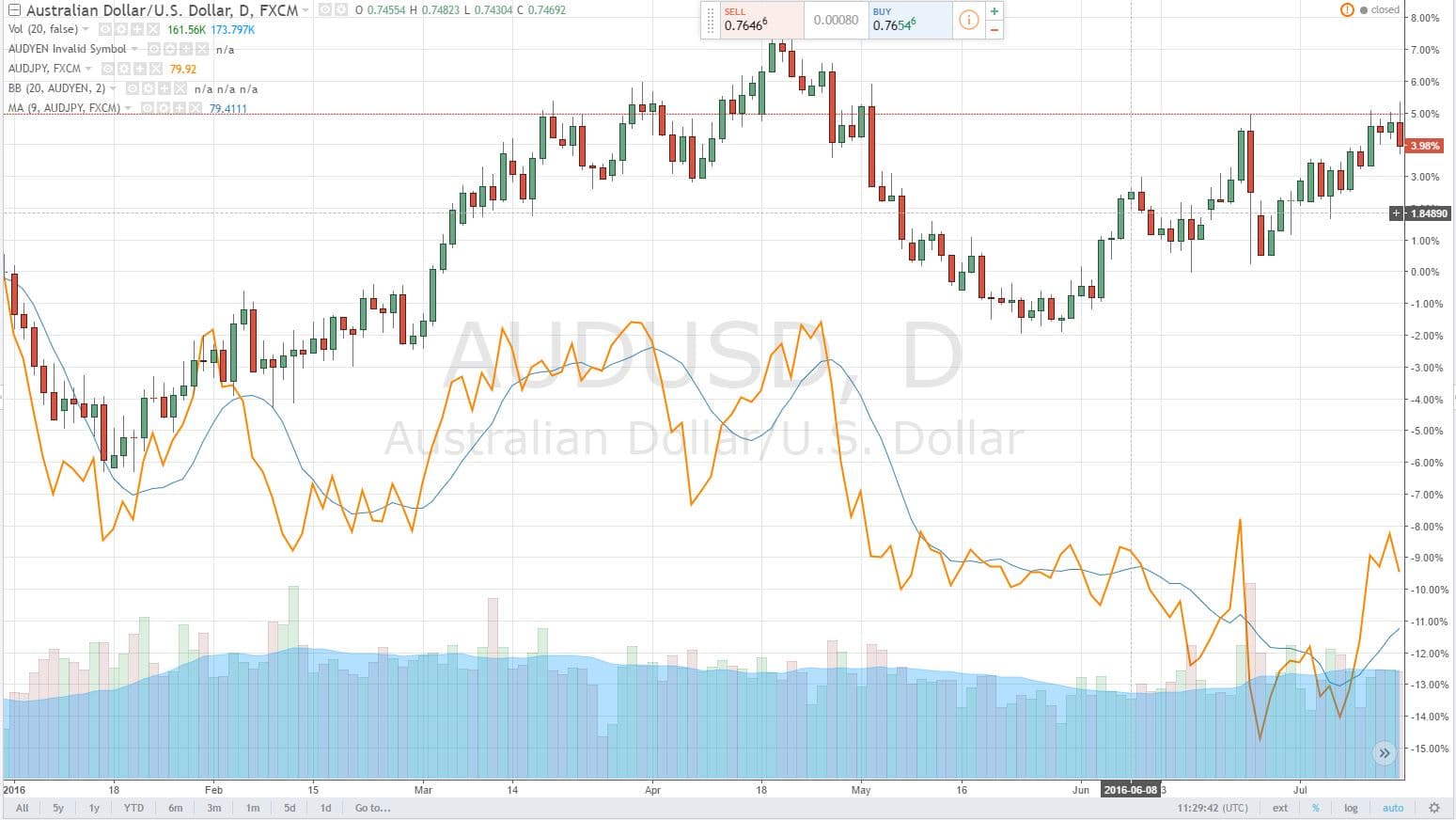
Tradingview; Chart 2016 of AUDUSD in comparison to AUDJPY
This article was written by Michael Oyebamiji, an FX analyst with major focus on G-10 currencies.
A couple of days ago, the Reserve Bank of Australia cut interest rates to a record low of 1.50%, which was more than the 60% priced in by the market. According to the RBA, the low interest rate is an important factor which can be used to drive economic growth, enhance demand and eventually achieve some level of inflation.
It should be recalled that the RBA’s inflation target is 2%-3%. At the moment, the inflation rate in Australia is relatively low at 1.0% for Q2. Cutting interest rates is a policy tool used by many central banks to devalue their currency so as to boost exports and encourage spending.
The RBA cut interest rates in order to weaken the AUD, but we saw a strong rally on AUD shortly after this announcement, which was quite unbelievable. I was a bit surprised to see a strong rally on AUD/USD despite the rate cut and a dovish comment from the RBA.
Last night, the Royal Bank of New Zealand followed its counterpart in Australia in cutting rates to an all-time low of 2.0%. Just like the AUD, the kiwi rallied to reach a new 2016 high at 0.7340. This was also pretty much priced in by the market, which was anticipating a surprise cut of 50bps but the RBNZ disappointed and kept it moderate at 25bps. The bank's governor said that there is no need to cut lower than 25bps for now.
Markets have so far disappointed the RBA and RBNZ with how their currencies have reacted to their decisions. They wanted weak currencies to boost trade export and demand. Unfortunately the market is on another mission.
This is a strong indication that central bank policies have reached a level of diminishing marginal return. Monetary policies are no longer effective; this is similar to all major economies where interest rates have been cut to a record low.
Let us take a look at Japan; the Bank of Japan introduced the negative interest policy earlier in 2016 in an attempt to weaken the yen. So far, the yen is one of the strongest currencies in 2016.
Despite all sorts of policies introduced by central banks, we have not seen any significant improvement in the global economy. In fact, a recession seems to be around the corner.
In the last quarter, the US economy grew by 1.2%, missing the estimate of 2.6%. Considering the massive ongoing quantitative and qualitative easing going on in major economies right now, the real sector is not improving. It's stagnating, corporate profits are falling, and trade balance remains at a massive deficit in relative to GDP.
The only thing I can say that QE has done is that it has pushed up asset prices through continuous buy backs!
Tradingview; Chart 2016 of AUDUSD in comparison to AUDJPY
Michael Oyebamiji is an FX Analyst with major focus on G-10 currencies. I write about the Financial market from a Traders perspective and macro view. An economist by profession, Fx trader by training
Italy’s Consob Tightens Net on AI-Fueled Scams With Fresh Website Bans
FP Markets Winner Spotlight 🏆 | Global Broker of the Year 2025 #Trading #Broker #Innovation #Shorts
FP Markets Winner Spotlight 🏆 | Global Broker of the Year 2025 #Trading #Broker #Innovation #Shorts
FP Markets takes the spotlight as Global Broker of the Year 2025 at the Finance Magnates Awards.
Martin Stoilov, Head of Client Experience, shares that trust, innovation, and people played a key role in the company’s success, supported by a strong foundation of integrity and client-centricity.
Following this milestone, FP Markets continues to focus on growth, technology investment, and its core values of transparency and excellence.
👉 Be part of FM Awards 2026: https://awards.financemagnates.com/#nominate
FP Markets takes the spotlight as Global Broker of the Year 2025 at the Finance Magnates Awards.
Martin Stoilov, Head of Client Experience, shares that trust, innovation, and people played a key role in the company’s success, supported by a strong foundation of integrity and client-centricity.
Following this milestone, FP Markets continues to focus on growth, technology investment, and its core values of transparency and excellence.
👉 Be part of FM Awards 2026: https://awards.financemagnates.com/#nominate
In this video, we review @HolaPrimeMarketsOfficial, a multi-asset forex and CFDs broker offering different account types, trading platforms, and flexible trading conditions.
We cover the broker’s overall offering, including account options, trading environment, platforms like MT4 and MT5, and additional services such as managed accounts and fast withdrawals.
Watch the full video to see if Hola Prime Markets fits your trading needs.
📣 Stay up to date with the latest in finance and trading. Follow Finance Magnates for industry news, insights, and global event coverage.
Connect with us:
🔗 LinkedIn: /financemagnates
👍 Facebook: /financemagnates
📸 Instagram: https://www.instagram.com/financemagnates
🐦 X: https://x.com/financemagnates
🎥 TikTok: https://www.tiktok.com/tag/financemagnates
▶️ YouTube: /@financemagnates_official
#HolaPrime #ForexBroker #CFDTrading #FinanceMagnates #Trading #Forex #BrokerReview
In this video, we review @HolaPrimeMarketsOfficial, a multi-asset forex and CFDs broker offering different account types, trading platforms, and flexible trading conditions.
We cover the broker’s overall offering, including account options, trading environment, platforms like MT4 and MT5, and additional services such as managed accounts and fast withdrawals.
Watch the full video to see if Hola Prime Markets fits your trading needs.
📣 Stay up to date with the latest in finance and trading. Follow Finance Magnates for industry news, insights, and global event coverage.
Connect with us:
🔗 LinkedIn: /financemagnates
👍 Facebook: /financemagnates
📸 Instagram: https://www.instagram.com/financemagnates
🐦 X: https://x.com/financemagnates
🎥 TikTok: https://www.tiktok.com/tag/financemagnates
▶️ YouTube: /@financemagnates_official
#HolaPrime #ForexBroker #CFDTrading #FinanceMagnates #Trading #Forex #BrokerReview
Hola Prime Review: What You Need to Know | Full Breakdown by Finance Magnates
Hola Prime Review: What You Need to Know | Full Breakdown by Finance Magnates
In this video, we review @HolaPrime_Global, a proprietary trading firm offering evaluation programs and performance-based payouts in simulated market environments.
We cover how the challenge model works, including account types, profit splits (up to 95%), trading rules, and what it takes to reach a funded account. You’ll also learn about available platforms like MT4, MT5, cTrader, and more, along with insights into payouts, support, and trading conditions.
Watch the full video to see if Hola Prime fits your trading style.
📣 Stay up to date with the latest in finance and trading. Follow Finance Magnates for industry news, insights, and global event coverage.
Connect with us:
🔗 LinkedIn: /financemagnates
👍 Facebook: /financemagnates
📸 Instagram: https://www.instagram.com/financemagnates
🐦 X: https://x.com/financemagnates
🎥 TikTok: https://www.tiktok.com/tag/financemagnates
▶️ YouTube: /@financemagnates_official
#HolaPrime #PropFirm #Trading #FinanceMagnates #Forex #FuturesTrading #TradingReview #PropFirmReview
In this video, we review @HolaPrime_Global, a proprietary trading firm offering evaluation programs and performance-based payouts in simulated market environments.
We cover how the challenge model works, including account types, profit splits (up to 95%), trading rules, and what it takes to reach a funded account. You’ll also learn about available platforms like MT4, MT5, cTrader, and more, along with insights into payouts, support, and trading conditions.
Watch the full video to see if Hola Prime fits your trading style.
📣 Stay up to date with the latest in finance and trading. Follow Finance Magnates for industry news, insights, and global event coverage.
Connect with us:
🔗 LinkedIn: /financemagnates
👍 Facebook: /financemagnates
📸 Instagram: https://www.instagram.com/financemagnates
🐦 X: https://x.com/financemagnates
🎥 TikTok: https://www.tiktok.com/tag/financemagnates
▶️ YouTube: /@financemagnates_official
#HolaPrime #PropFirm #Trading #FinanceMagnates #Forex #FuturesTrading #TradingReview #PropFirmReview
Axi Winner Spotlight 🏆 | Global Most Innovative Broker 2025 #Innovation #Trading #Fintech #Broker
Axi Winner Spotlight 🏆 | Global Most Innovative Broker 2025 #Innovation #Trading #Fintech #Broker
Axi takes the spotlight at the Finance Magnates Awards, winning Global Most Innovative Broker 2025.
Olivia Xenofontos and Ivanna Openko share how the team will feel: proud, motivated, and ready to keep delivering.
They also describe the night as well-organized, focused, and enjoyable for all.
👉 Be part of FM Awards 2026.
Axi takes the spotlight at the Finance Magnates Awards, winning Global Most Innovative Broker 2025.
Olivia Xenofontos and Ivanna Openko share how the team will feel: proud, motivated, and ready to keep delivering.
They also describe the night as well-organized, focused, and enjoyable for all.
👉 Be part of FM Awards 2026.
Recognition that matters.
Built on transparency.
Driven by the industry.
The Finance Magnates Awards 2026.
Nominations are now open.
🔗 https://awards.financemagnates.com/?utm_source=SM&utm_medium=social&utm_campaign=recognition-matters
Recognition that matters.
Built on transparency.
Driven by the industry.
The Finance Magnates Awards 2026.
Nominations are now open.
🔗 https://awards.financemagnates.com/?utm_source=SM&utm_medium=social&utm_campaign=recognition-matters