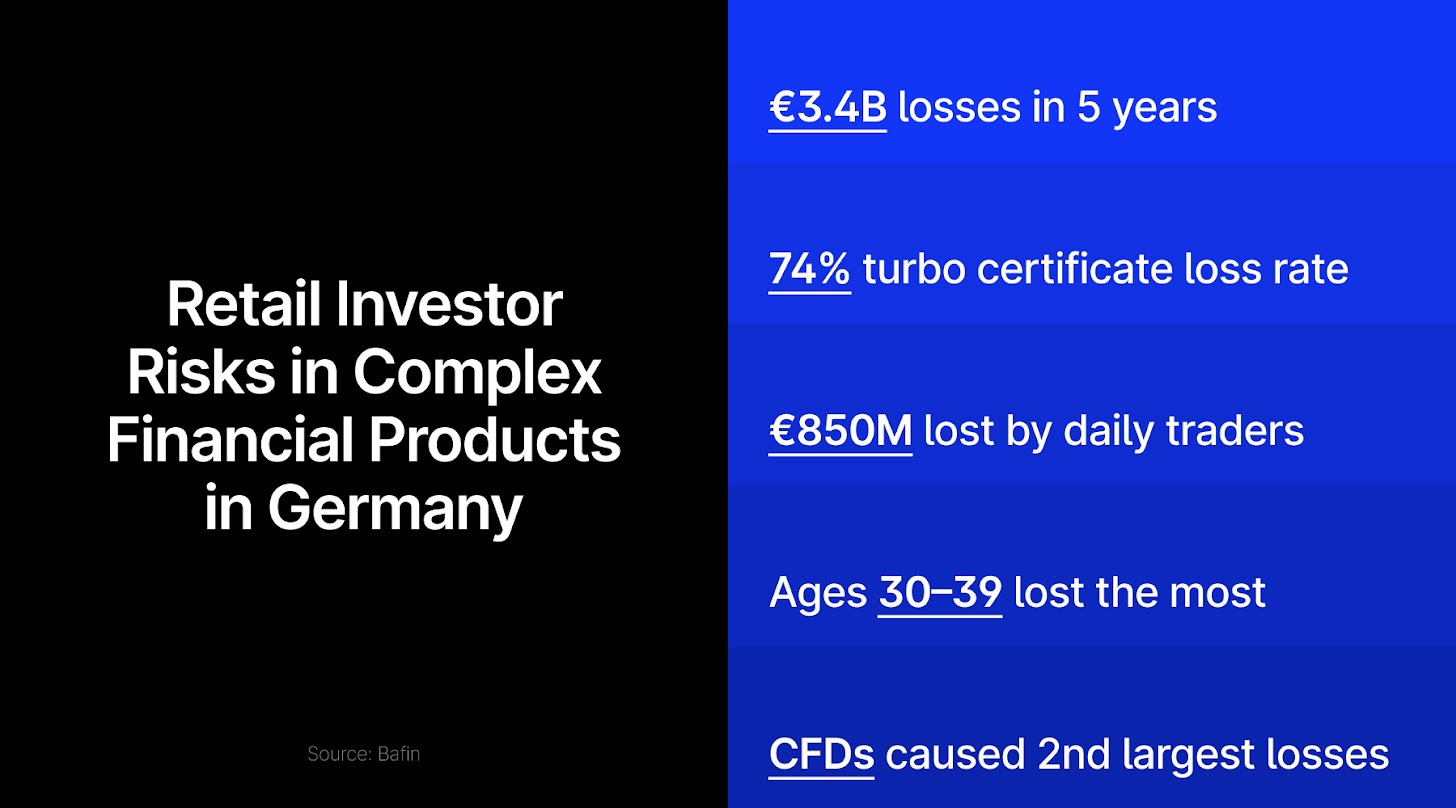
91% loss rate occurred among frequent turbo certificate traders.
Investors aged 30–50 in southern Germany traded turbos most actively, often with heavy losses.
A recent market investigation by Germany’s financial
regulator, BaFin, revealed that a significant majority of retail investors
trading turbo certificates incurred substantial losses. Covering January 2019
to December 2023, the study found that 74.2% of these investors lost money,
with average losses of €6,358 per losing investor. Total losses exceeded €3.4
billion during this five-year period.
Turbo certificates are leveraged derivative products similar
to contracts for difference (CFDs), another popular but high-risk instrument
among retail investors. Both allow for leveraged exposure to underlying assets
but can lead to rapid and total capital loss.
Due to their complexity and risks, CFDs have faced EU
regulatory restrictions. BaFin’s findings may prompt renewed scrutiny of turbo
certificates, which are also marketed under various names such as “Knock-Out
Options,” “Mini-Futures,” or “Wave XXL Certificates,” potentially obscuring the
associated risks.
High-Risk Trading Hits German Retail Investors
These certificates enable investors to amplify exposure to
price movements of assets like stocks, indices, or currencies. They include a
knock-out threshold: if the asset price reaches this level, the certificate
expires immediately and becomes worthless. While gains can be magnified, losses
can quickly wipe out the entire investment.
The BaFin analysis examined approximately 113 million
transactions by 543,000 retail investors, based on data reported under Article
26 of the EU’s Markets in Financial Instruments Regulation (MiFIR). It focused
on small investors with German citizenship, excluding trades via intermediaries
outside the EU or by non-German residents.
4. Number of retail investors who traded Turbo Certificates, Source: Bafin
Over five years, the number of investors and transactions
more than doubled. In 2023, about 231,000 small investors traded turbo
certificates in Germany, an increase of around 110% since 2019 despite being
slightly below the 2021 peak. Investors placed over 62 million purchase orders
averaging €3,003 each, with a combined purchase volume near €195 billion.
Distribution of trading success per retail investor, Source: Bafin
The market is highly concentrated. Among 20 active issuers,
the top five accounted for over 75% of transactions. Similarly, the top five of
1,294 intermediaries handled more than three-quarters of the volume. Most
intermediaries 1,147 were based in Germany.
Frequent Turbo Traders Suffer Higher Losses
BaFin’s evaluation also highlighted a correlation between
trading frequency and losses. Investors with 1–10 trades had a 70% loss rate,
rising to 76% for 10–100 trades, 83% for 100–500 trades, and 91% for over 1,000
trades. Around 12% of investors lost more than €10,000, while only 2% earned
profits of similar size.
A recent market investigation by Germany’s financial
regulator, BaFin, revealed that a significant majority of retail investors
trading turbo certificates incurred substantial losses. Covering January 2019
to December 2023, the study found that 74.2% of these investors lost money,
with average losses of €6,358 per losing investor. Total losses exceeded €3.4
billion during this five-year period.
Turbo certificates are leveraged derivative products similar
to contracts for difference (CFDs), another popular but high-risk instrument
among retail investors. Both allow for leveraged exposure to underlying assets
but can lead to rapid and total capital loss.
Due to their complexity and risks, CFDs have faced EU
regulatory restrictions. BaFin’s findings may prompt renewed scrutiny of turbo
certificates, which are also marketed under various names such as “Knock-Out
Options,” “Mini-Futures,” or “Wave XXL Certificates,” potentially obscuring the
associated risks.
High-Risk Trading Hits German Retail Investors
These certificates enable investors to amplify exposure to
price movements of assets like stocks, indices, or currencies. They include a
knock-out threshold: if the asset price reaches this level, the certificate
expires immediately and becomes worthless. While gains can be magnified, losses
can quickly wipe out the entire investment.
The BaFin analysis examined approximately 113 million
transactions by 543,000 retail investors, based on data reported under Article
26 of the EU’s Markets in Financial Instruments Regulation (MiFIR). It focused
on small investors with German citizenship, excluding trades via intermediaries
outside the EU or by non-German residents.
4. Number of retail investors who traded Turbo Certificates, Source: Bafin
Over five years, the number of investors and transactions
more than doubled. In 2023, about 231,000 small investors traded turbo
certificates in Germany, an increase of around 110% since 2019 despite being
slightly below the 2021 peak. Investors placed over 62 million purchase orders
averaging €3,003 each, with a combined purchase volume near €195 billion.
Distribution of trading success per retail investor, Source: Bafin
The market is highly concentrated. Among 20 active issuers,
the top five accounted for over 75% of transactions. Similarly, the top five of
1,294 intermediaries handled more than three-quarters of the volume. Most
intermediaries 1,147 were based in Germany.
Frequent Turbo Traders Suffer Higher Losses
BaFin’s evaluation also highlighted a correlation between
trading frequency and losses. Investors with 1–10 trades had a 70% loss rate,
rising to 76% for 10–100 trades, 83% for 100–500 trades, and 91% for over 1,000
trades. Around 12% of investors lost more than €10,000, while only 2% earned
profits of similar size.
Tareq is a financial writer with 15 years of experience covering global markets. His work spans technical analysis, forex broker reviews, and market sentiment, with a focus on topics relevant to retail traders. He joined Finance Magnates in 2023.
At Finance Magnates, he serves as News Editor, covering retail forex and CFD brokers, cryptocurrency exchanges, fintech firms, and regulatory developments shaping the trading industry. He holds an Honours degree in Information Technology from Anfell College, London.
Education:
Honours degree Information Technology, Anfell College, London
42% of Swiss Financial Firms Have No Digital Fraud Policy, FINMA Finds
FP Markets Winner Spotlight 🏆 | Global Broker of the Year 2025 #Trading #Broker #Innovation #Shorts
FP Markets Winner Spotlight 🏆 | Global Broker of the Year 2025 #Trading #Broker #Innovation #Shorts
FP Markets takes the spotlight as Global Broker of the Year 2025 at the Finance Magnates Awards.
Martin Stoilov, Head of Client Experience, shares that trust, innovation, and people played a key role in the company’s success, supported by a strong foundation of integrity and client-centricity.
Following this milestone, FP Markets continues to focus on growth, technology investment, and its core values of transparency and excellence.
👉 Be part of FM Awards 2026: https://awards.financemagnates.com/#nominate
FP Markets takes the spotlight as Global Broker of the Year 2025 at the Finance Magnates Awards.
Martin Stoilov, Head of Client Experience, shares that trust, innovation, and people played a key role in the company’s success, supported by a strong foundation of integrity and client-centricity.
Following this milestone, FP Markets continues to focus on growth, technology investment, and its core values of transparency and excellence.
👉 Be part of FM Awards 2026: https://awards.financemagnates.com/#nominate
In this video, we review @HolaPrimeMarketsOfficial, a multi-asset forex and CFDs broker offering different account types, trading platforms, and flexible trading conditions.
We cover the broker’s overall offering, including account options, trading environment, platforms like MT4 and MT5, and additional services such as managed accounts and fast withdrawals.
Watch the full video to see if Hola Prime Markets fits your trading needs.
📣 Stay up to date with the latest in finance and trading. Follow Finance Magnates for industry news, insights, and global event coverage.
Connect with us:
🔗 LinkedIn: /financemagnates
👍 Facebook: /financemagnates
📸 Instagram: https://www.instagram.com/financemagnates
🐦 X: https://x.com/financemagnates
🎥 TikTok: https://www.tiktok.com/tag/financemagnates
▶️ YouTube: /@financemagnates_official
#HolaPrime #ForexBroker #CFDTrading #FinanceMagnates #Trading #Forex #BrokerReview
In this video, we review @HolaPrimeMarketsOfficial, a multi-asset forex and CFDs broker offering different account types, trading platforms, and flexible trading conditions.
We cover the broker’s overall offering, including account options, trading environment, platforms like MT4 and MT5, and additional services such as managed accounts and fast withdrawals.
Watch the full video to see if Hola Prime Markets fits your trading needs.
📣 Stay up to date with the latest in finance and trading. Follow Finance Magnates for industry news, insights, and global event coverage.
Connect with us:
🔗 LinkedIn: /financemagnates
👍 Facebook: /financemagnates
📸 Instagram: https://www.instagram.com/financemagnates
🐦 X: https://x.com/financemagnates
🎥 TikTok: https://www.tiktok.com/tag/financemagnates
▶️ YouTube: /@financemagnates_official
#HolaPrime #ForexBroker #CFDTrading #FinanceMagnates #Trading #Forex #BrokerReview
Hola Prime Review: What You Need to Know | Full Breakdown by Finance Magnates
Hola Prime Review: What You Need to Know | Full Breakdown by Finance Magnates
In this video, we review @HolaPrime_Global, a proprietary trading firm offering evaluation programs and performance-based payouts in simulated market environments.
We cover how the challenge model works, including account types, profit splits (up to 95%), trading rules, and what it takes to reach a funded account. You’ll also learn about available platforms like MT4, MT5, cTrader, and more, along with insights into payouts, support, and trading conditions.
Watch the full video to see if Hola Prime fits your trading style.
📣 Stay up to date with the latest in finance and trading. Follow Finance Magnates for industry news, insights, and global event coverage.
Connect with us:
🔗 LinkedIn: /financemagnates
👍 Facebook: /financemagnates
📸 Instagram: https://www.instagram.com/financemagnates
🐦 X: https://x.com/financemagnates
🎥 TikTok: https://www.tiktok.com/tag/financemagnates
▶️ YouTube: /@financemagnates_official
#HolaPrime #PropFirm #Trading #FinanceMagnates #Forex #FuturesTrading #TradingReview #PropFirmReview
In this video, we review @HolaPrime_Global, a proprietary trading firm offering evaluation programs and performance-based payouts in simulated market environments.
We cover how the challenge model works, including account types, profit splits (up to 95%), trading rules, and what it takes to reach a funded account. You’ll also learn about available platforms like MT4, MT5, cTrader, and more, along with insights into payouts, support, and trading conditions.
Watch the full video to see if Hola Prime fits your trading style.
📣 Stay up to date with the latest in finance and trading. Follow Finance Magnates for industry news, insights, and global event coverage.
Connect with us:
🔗 LinkedIn: /financemagnates
👍 Facebook: /financemagnates
📸 Instagram: https://www.instagram.com/financemagnates
🐦 X: https://x.com/financemagnates
🎥 TikTok: https://www.tiktok.com/tag/financemagnates
▶️ YouTube: /@financemagnates_official
#HolaPrime #PropFirm #Trading #FinanceMagnates #Forex #FuturesTrading #TradingReview #PropFirmReview
Axi Winner Spotlight 🏆 | Global Most Innovative Broker 2025 #Innovation #Trading #Fintech #Broker
Axi Winner Spotlight 🏆 | Global Most Innovative Broker 2025 #Innovation #Trading #Fintech #Broker
Axi takes the spotlight at the Finance Magnates Awards, winning Global Most Innovative Broker 2025.
Olivia Xenofontos and Ivanna Openko share how the team will feel: proud, motivated, and ready to keep delivering.
They also describe the night as well-organized, focused, and enjoyable for all.
👉 Be part of FM Awards 2026.
Axi takes the spotlight at the Finance Magnates Awards, winning Global Most Innovative Broker 2025.
Olivia Xenofontos and Ivanna Openko share how the team will feel: proud, motivated, and ready to keep delivering.
They also describe the night as well-organized, focused, and enjoyable for all.
👉 Be part of FM Awards 2026.
Recognition that matters.
Built on transparency.
Driven by the industry.
The Finance Magnates Awards 2026.
Nominations are now open.
🔗 https://awards.financemagnates.com/?utm_source=SM&utm_medium=social&utm_campaign=recognition-matters
Recognition that matters.
Built on transparency.
Driven by the industry.
The Finance Magnates Awards 2026.
Nominations are now open.
🔗 https://awards.financemagnates.com/?utm_source=SM&utm_medium=social&utm_campaign=recognition-matters