World Bank Expects Asian Growth to Slow; China Remains the Major Catalyst For the APAC Region
Wednesday,08/10/2014|08:32GMTby
George Tchetvertakov
As China implements much needed structural reforms, the World Bank publishes a report forecasting macroeconomic trends in the APAC region. With growth now coming at a premium, the bank sees "regional integration" as the future.
The World Bank has cut China's growth forecast for the next three years as the country is expected to implement tough structural reforms. Growth in the world's second-largest economy will fall to 7.4% from a previous estimate of 7.6%, according to the World Bank. The bank added that "Growth in 2015 will go down to 7.2% and then 7.1% in 2016 from a previous forecast of 7.5% for both years".
“East Asia Pacific will continue to have the potential to grow at a higher rate—and faster than other developing regions—if policy makers implement an ambitious domestic reform agenda, which includes removing barriers to domestic investment, improving export competitiveness and rationalizing public spending,” said Axel van Trotsenburg, World Bank East Asia and Pacific Regional Vice President.
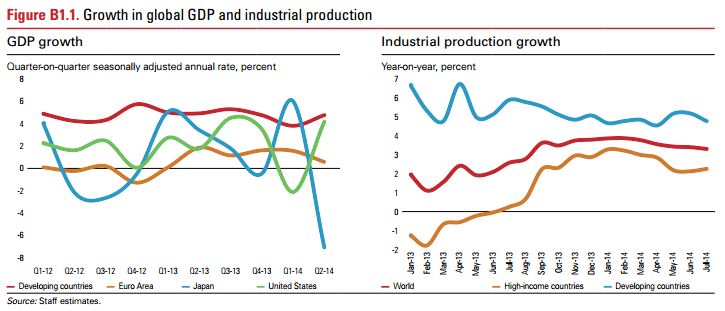
Growth rates around the globe are uneven as different economies recover at varying rates and with varying macroeconomic goals. Highly developed countries showed significant expansion in Q2 but performance varied sharply across countries. Global growth is expected to reach 2.6% in 2014 and average 3.3% in 2015-17.
United States
In the United States, output rebounded strongly, supported by still accommodative monetary policy, easing fiscal consolidation, and rising employment, investment growth, and confidence. Growth is projected at about 2% in 2014, rising to 3% in 2015.
Euro-area
In the Euro Area, the recovery continues to be impaired by weak domestic demand and credit growth, and subdued investment prospects. Growth is projected at about 1% in 2014, rising slowly thereafter.
Japan
In Japan, monetary policy accommodation and reform commitments are providing ongoing support, but fiscal consolidation is expected to keep domestic demand subdued throughout 2015, with exports recovering only slowly. As in Europe, growth is projected at about 1% in 2014, rising slowly thereafter.
Asia
The gradual strengthening of activity in high-income economies will boost demand for exports from developing East Asia and Pacific (EAP), helping the region sustain its growth performance.
In China, growth rose from 6.1% in Q1 to 8.2% in Q2, supported by both investment stimulus measures and the global recovery; more recent weakness reflects renewed efforts to rebalance the economy. The World Bank expects "growth will gradually moderate to 7.4% in 2014 and 7.1% in 2016, reflecting intensified policy efforts to address financial vulnerabilities and structural constraints, and place the economy on a more sustainable growth path". Measures to contain local government debt; curb shadow banking; and tackle excess capacity, high energy demand, and high pollution will reduce investment and manufacturing output.
Recommendations
The report recommends various initiatives that the bank would like to see implemented. In China, the World Bank urges authorities to "strike a balance between containing the growing risks from rising Leverage and meeting the indicative growth targets".
Over the longer term, the World Bank expects most countries "to focus on implementing structural reforms needed to enhance their export competitiveness" with key reform areas including "infrastructure investment, logistics, and the liberalization of services and FDI, including in the context of regional integration".
Centralising policy-making and removing sovereign barriers has been a common theme in many of the World Bank's communications and echoes other agencies such as the European Commission, European Central Bank (ECB), the International Monetary Fund (IMF) and United Nations (UN). Such intra-national agencies are trying to rectify the ills and problems in financial markets by "integrating" national statutes into a more global framework that supersedes national governments. The European Banking Union is a prime example.
How these types of changes will impact national economies, their growth rates and the very fabric of financial markets is ambiguous and rather unfortunately, cannot be forecast in an annual report.
The full report report: 'Enhancing Competitiveness in an Uncertain World' can be viewed here
The World Bank has cut China's growth forecast for the next three years as the country is expected to implement tough structural reforms. Growth in the world's second-largest economy will fall to 7.4% from a previous estimate of 7.6%, according to the World Bank. The bank added that "Growth in 2015 will go down to 7.2% and then 7.1% in 2016 from a previous forecast of 7.5% for both years".
“East Asia Pacific will continue to have the potential to grow at a higher rate—and faster than other developing regions—if policy makers implement an ambitious domestic reform agenda, which includes removing barriers to domestic investment, improving export competitiveness and rationalizing public spending,” said Axel van Trotsenburg, World Bank East Asia and Pacific Regional Vice President.
Growth rates around the globe are uneven as different economies recover at varying rates and with varying macroeconomic goals. Highly developed countries showed significant expansion in Q2 but performance varied sharply across countries. Global growth is expected to reach 2.6% in 2014 and average 3.3% in 2015-17.
United States
In the United States, output rebounded strongly, supported by still accommodative monetary policy, easing fiscal consolidation, and rising employment, investment growth, and confidence. Growth is projected at about 2% in 2014, rising to 3% in 2015.
Euro-area
In the Euro Area, the recovery continues to be impaired by weak domestic demand and credit growth, and subdued investment prospects. Growth is projected at about 1% in 2014, rising slowly thereafter.
Japan
In Japan, monetary policy accommodation and reform commitments are providing ongoing support, but fiscal consolidation is expected to keep domestic demand subdued throughout 2015, with exports recovering only slowly. As in Europe, growth is projected at about 1% in 2014, rising slowly thereafter.
Asia
The gradual strengthening of activity in high-income economies will boost demand for exports from developing East Asia and Pacific (EAP), helping the region sustain its growth performance.
In China, growth rose from 6.1% in Q1 to 8.2% in Q2, supported by both investment stimulus measures and the global recovery; more recent weakness reflects renewed efforts to rebalance the economy. The World Bank expects "growth will gradually moderate to 7.4% in 2014 and 7.1% in 2016, reflecting intensified policy efforts to address financial vulnerabilities and structural constraints, and place the economy on a more sustainable growth path". Measures to contain local government debt; curb shadow banking; and tackle excess capacity, high energy demand, and high pollution will reduce investment and manufacturing output.
Recommendations
The report recommends various initiatives that the bank would like to see implemented. In China, the World Bank urges authorities to "strike a balance between containing the growing risks from rising Leverage and meeting the indicative growth targets".
Over the longer term, the World Bank expects most countries "to focus on implementing structural reforms needed to enhance their export competitiveness" with key reform areas including "infrastructure investment, logistics, and the liberalization of services and FDI, including in the context of regional integration".
Centralising policy-making and removing sovereign barriers has been a common theme in many of the World Bank's communications and echoes other agencies such as the European Commission, European Central Bank (ECB), the International Monetary Fund (IMF) and United Nations (UN). Such intra-national agencies are trying to rectify the ills and problems in financial markets by "integrating" national statutes into a more global framework that supersedes national governments. The European Banking Union is a prime example.
How these types of changes will impact national economies, their growth rates and the very fabric of financial markets is ambiguous and rather unfortunately, cannot be forecast in an annual report.
The full report report: 'Enhancing Competitiveness in an Uncertain World' can be viewed here
Italy’s Consob Tightens Net on AI-Fueled Scams With Fresh Website Bans
FP Markets Winner Spotlight 🏆 | Global Broker of the Year 2025 #Trading #Broker #Innovation #Shorts
FP Markets Winner Spotlight 🏆 | Global Broker of the Year 2025 #Trading #Broker #Innovation #Shorts
FP Markets takes the spotlight as Global Broker of the Year 2025 at the Finance Magnates Awards.
Martin Stoilov, Head of Client Experience, shares that trust, innovation, and people played a key role in the company’s success, supported by a strong foundation of integrity and client-centricity.
Following this milestone, FP Markets continues to focus on growth, technology investment, and its core values of transparency and excellence.
👉 Be part of FM Awards 2026: https://awards.financemagnates.com/#nominate
FP Markets takes the spotlight as Global Broker of the Year 2025 at the Finance Magnates Awards.
Martin Stoilov, Head of Client Experience, shares that trust, innovation, and people played a key role in the company’s success, supported by a strong foundation of integrity and client-centricity.
Following this milestone, FP Markets continues to focus on growth, technology investment, and its core values of transparency and excellence.
👉 Be part of FM Awards 2026: https://awards.financemagnates.com/#nominate
In this video, we review @HolaPrimeMarketsOfficial, a multi-asset forex and CFDs broker offering different account types, trading platforms, and flexible trading conditions.
We cover the broker’s overall offering, including account options, trading environment, platforms like MT4 and MT5, and additional services such as managed accounts and fast withdrawals.
Watch the full video to see if Hola Prime Markets fits your trading needs.
📣 Stay up to date with the latest in finance and trading. Follow Finance Magnates for industry news, insights, and global event coverage.
Connect with us:
🔗 LinkedIn: /financemagnates
👍 Facebook: /financemagnates
📸 Instagram: https://www.instagram.com/financemagnates
🐦 X: https://x.com/financemagnates
🎥 TikTok: https://www.tiktok.com/tag/financemagnates
▶️ YouTube: /@financemagnates_official
#HolaPrime #ForexBroker #CFDTrading #FinanceMagnates #Trading #Forex #BrokerReview
In this video, we review @HolaPrimeMarketsOfficial, a multi-asset forex and CFDs broker offering different account types, trading platforms, and flexible trading conditions.
We cover the broker’s overall offering, including account options, trading environment, platforms like MT4 and MT5, and additional services such as managed accounts and fast withdrawals.
Watch the full video to see if Hola Prime Markets fits your trading needs.
📣 Stay up to date with the latest in finance and trading. Follow Finance Magnates for industry news, insights, and global event coverage.
Connect with us:
🔗 LinkedIn: /financemagnates
👍 Facebook: /financemagnates
📸 Instagram: https://www.instagram.com/financemagnates
🐦 X: https://x.com/financemagnates
🎥 TikTok: https://www.tiktok.com/tag/financemagnates
▶️ YouTube: /@financemagnates_official
#HolaPrime #ForexBroker #CFDTrading #FinanceMagnates #Trading #Forex #BrokerReview
Hola Prime Review: What You Need to Know | Full Breakdown by Finance Magnates
Hola Prime Review: What You Need to Know | Full Breakdown by Finance Magnates
In this video, we review @HolaPrime_Global, a proprietary trading firm offering evaluation programs and performance-based payouts in simulated market environments.
We cover how the challenge model works, including account types, profit splits (up to 95%), trading rules, and what it takes to reach a funded account. You’ll also learn about available platforms like MT4, MT5, cTrader, and more, along with insights into payouts, support, and trading conditions.
Watch the full video to see if Hola Prime fits your trading style.
📣 Stay up to date with the latest in finance and trading. Follow Finance Magnates for industry news, insights, and global event coverage.
Connect with us:
🔗 LinkedIn: /financemagnates
👍 Facebook: /financemagnates
📸 Instagram: https://www.instagram.com/financemagnates
🐦 X: https://x.com/financemagnates
🎥 TikTok: https://www.tiktok.com/tag/financemagnates
▶️ YouTube: /@financemagnates_official
#HolaPrime #PropFirm #Trading #FinanceMagnates #Forex #FuturesTrading #TradingReview #PropFirmReview
In this video, we review @HolaPrime_Global, a proprietary trading firm offering evaluation programs and performance-based payouts in simulated market environments.
We cover how the challenge model works, including account types, profit splits (up to 95%), trading rules, and what it takes to reach a funded account. You’ll also learn about available platforms like MT4, MT5, cTrader, and more, along with insights into payouts, support, and trading conditions.
Watch the full video to see if Hola Prime fits your trading style.
📣 Stay up to date with the latest in finance and trading. Follow Finance Magnates for industry news, insights, and global event coverage.
Connect with us:
🔗 LinkedIn: /financemagnates
👍 Facebook: /financemagnates
📸 Instagram: https://www.instagram.com/financemagnates
🐦 X: https://x.com/financemagnates
🎥 TikTok: https://www.tiktok.com/tag/financemagnates
▶️ YouTube: /@financemagnates_official
#HolaPrime #PropFirm #Trading #FinanceMagnates #Forex #FuturesTrading #TradingReview #PropFirmReview
Axi Winner Spotlight 🏆 | Global Most Innovative Broker 2025 #Innovation #Trading #Fintech #Broker
Axi Winner Spotlight 🏆 | Global Most Innovative Broker 2025 #Innovation #Trading #Fintech #Broker
Axi takes the spotlight at the Finance Magnates Awards, winning Global Most Innovative Broker 2025.
Olivia Xenofontos and Ivanna Openko share how the team will feel: proud, motivated, and ready to keep delivering.
They also describe the night as well-organized, focused, and enjoyable for all.
👉 Be part of FM Awards 2026.
Axi takes the spotlight at the Finance Magnates Awards, winning Global Most Innovative Broker 2025.
Olivia Xenofontos and Ivanna Openko share how the team will feel: proud, motivated, and ready to keep delivering.
They also describe the night as well-organized, focused, and enjoyable for all.
👉 Be part of FM Awards 2026.
Recognition that matters.
Built on transparency.
Driven by the industry.
The Finance Magnates Awards 2026.
Nominations are now open.
🔗 https://awards.financemagnates.com/?utm_source=SM&utm_medium=social&utm_campaign=recognition-matters
Recognition that matters.
Built on transparency.
Driven by the industry.
The Finance Magnates Awards 2026.
Nominations are now open.
🔗 https://awards.financemagnates.com/?utm_source=SM&utm_medium=social&utm_campaign=recognition-matters