South Korea's Financial Regulator Intensifies Monitoring of Forex Trading
Thursday,16/10/2014|07:41GMTby
George Tchetvertakov
In yet another example of the FX market coming under more scrutiny from regulators globally, Forex Magnates reports on South Korea's plans to make Forex brokers more transparent and traders more accountable.
The South Korean financial watchdog, the Financial Supervisory Service (FSS), has announced the agency “will work with the state customs office to intensify monitoring of illegal foreign Exchange trading in order to maintain order in the financial community”.
"The Financial Supervisory Service (FSS) will focus on protecting consumers and supporting the financially weak in order to secure stability of the financial system and establish order" FSS Governor Choi Soo-hyun said in a parliamentary audit session. Adding, “The FSS will also intensify supervision of financial scams and insurance frauds in order to strengthen consumer protection”.
Tthe FSS intends to conduct “special inspections” on illegal foreign exchange trading, such as buying ooverseas real estate without declaring to national authorities and evading taxes via offshore tax havens.
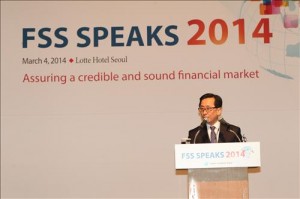
Financial Supervisory Service Gov. Choi Soo-Hyun addresses an annual forum with foreign financial companies in March 2014
According to data, authorities uncovered 1,015 cases of illegal foreign currency transactions last year, compared to 320 in the previous year. They discovered 563 cases in the first nine months of this year.
The amount of damages incurred from financial frauds, including voice Phishing, in South Korea came to 224.1 billion won last year (~$211 million) and is expected to reach 270 billion won (~$254 million) in 2014 as 182.5 billion won (~$172 million) has already been reported between January and August this year. Insurance fraud damage has also been on the rise, with the amount totalling 453.3 billion won (~$426 million) in 2012 and 520 billion won (~$490 million) in 2013. The figure is anticipated to reach 570 billion won (~$536 million) this year.
The FSS said it is considering employing “pre-emptive measures” such as “delaying withdrawals of financial transactions between suspicious accounts” and tighter monitoring of unauthorized private lenders.
The South Korean financial watchdog, the Financial Supervisory Service (FSS), has announced the agency “will work with the state customs office to intensify monitoring of illegal foreign Exchange trading in order to maintain order in the financial community”.
"The Financial Supervisory Service (FSS) will focus on protecting consumers and supporting the financially weak in order to secure stability of the financial system and establish order" FSS Governor Choi Soo-hyun said in a parliamentary audit session. Adding, “The FSS will also intensify supervision of financial scams and insurance frauds in order to strengthen consumer protection”.
Tthe FSS intends to conduct “special inspections” on illegal foreign exchange trading, such as buying ooverseas real estate without declaring to national authorities and evading taxes via offshore tax havens.
Financial Supervisory Service Gov. Choi Soo-Hyun addresses an annual forum with foreign financial companies in March 2014
According to data, authorities uncovered 1,015 cases of illegal foreign currency transactions last year, compared to 320 in the previous year. They discovered 563 cases in the first nine months of this year.
The amount of damages incurred from financial frauds, including voice Phishing, in South Korea came to 224.1 billion won last year (~$211 million) and is expected to reach 270 billion won (~$254 million) in 2014 as 182.5 billion won (~$172 million) has already been reported between January and August this year. Insurance fraud damage has also been on the rise, with the amount totalling 453.3 billion won (~$426 million) in 2012 and 520 billion won (~$490 million) in 2013. The figure is anticipated to reach 570 billion won (~$536 million) this year.
The FSS said it is considering employing “pre-emptive measures” such as “delaying withdrawals of financial transactions between suspicious accounts” and tighter monitoring of unauthorized private lenders.
OANDA Japan Pushes Clients to MT5 as It Sets MT4 Shutdown
CMC Markets’ Artur Delijergijevs on Metals Demand, Volatility, & Stable Execution
CMC Markets’ Artur Delijergijevs on Metals Demand, Volatility, & Stable Execution
In this exclusive Executive Interview, Finance Magnates speaks with Artur Delijergijevs, Head of Systematic Market Making at CMC Markets, about the current state of metals demand and market volatility.
Delijergijevs offers a desk-level view on:
- Metals Demand: Why metals are seeing the strongest demand from both retail and institutional clients right now.
- The Safe-Haven Debate: Questioning whether gold still fits the classic safe-haven definition given large daily price movements.
- Volatile Market Prep: How a market-making desk prepares its systems and pricing for stressed market conditions and high-impact economic events.
- Hybrid Execution: Why the best execution model combines electronic speed with human relationship support, especially during volatility.
- AI in Workflow: Where CMC Markets is integrating machine learning for risk management and pricing, and the limitations of AI during stressed markets.
- Dubai's Role: The strategic importance of Dubai’s location for covering global trading sessions across Asia, Europe, and the US.
Watch to understand how CMC Markets maintains stable pricing and reliable execution quality in high-volatility environments.
#CMCmarkets #forex #metals #gold #trading #volatility #MarketMaking #iFXDubai #FinanceMagnates #Finance #Fintech #Execution #AlgorithmicTrading #RiskManagement
In this exclusive Executive Interview, Finance Magnates speaks with Artur Delijergijevs, Head of Systematic Market Making at CMC Markets, about the current state of metals demand and market volatility.
Delijergijevs offers a desk-level view on:
- Metals Demand: Why metals are seeing the strongest demand from both retail and institutional clients right now.
- The Safe-Haven Debate: Questioning whether gold still fits the classic safe-haven definition given large daily price movements.
- Volatile Market Prep: How a market-making desk prepares its systems and pricing for stressed market conditions and high-impact economic events.
- Hybrid Execution: Why the best execution model combines electronic speed with human relationship support, especially during volatility.
- AI in Workflow: Where CMC Markets is integrating machine learning for risk management and pricing, and the limitations of AI during stressed markets.
- Dubai's Role: The strategic importance of Dubai’s location for covering global trading sessions across Asia, Europe, and the US.
Watch to understand how CMC Markets maintains stable pricing and reliable execution quality in high-volatility environments.
#CMCmarkets #forex #metals #gold #trading #volatility #MarketMaking #iFXDubai #FinanceMagnates #Finance #Fintech #Execution #AlgorithmicTrading #RiskManagement
Finance Magnates Awards 2026 – Nominations Now Open
Finance Magnates Awards 2026 – Nominations Now Open
The Finance Magnates Awards 2026 nominations are now open. 🏆
From fintech innovators to leading brokers, this is where the finance industry celebrates its biggest achievements.
Winners will be announced at the Cyprus Gala Dinner on November 6, 2026.
Nominate your brand now.
https://awards.financemagnates.com/?utm_source=linkedin&utm_medium=video&utm_campaign=nominations-open
#FMAwards #FinanceMagnates #FintechAwards #Fintech #FinanceIndustry
The Finance Magnates Awards 2026 nominations are now open. 🏆
From fintech innovators to leading brokers, this is where the finance industry celebrates its biggest achievements.
Winners will be announced at the Cyprus Gala Dinner on November 6, 2026.
Nominate your brand now.
https://awards.financemagnates.com/?utm_source=linkedin&utm_medium=video&utm_campaign=nominations-open
#FMAwards #FinanceMagnates #FintechAwards #Fintech #FinanceIndustry
Finance Magnates Awards 2026 | Nominations Now Open 🏆#Fintech #FMAwards #TradingIndustry
Finance Magnates Awards 2026 | Nominations Now Open 🏆#Fintech #FMAwards #TradingIndustry
Lights on. Cameras ready. 🎬
Finance Magnates Awards 2026 nominations are now open. 🏆
#FMAwards #FinanceMagnates #FintechAwards #Fintech
Lights on. Cameras ready. 🎬
Finance Magnates Awards 2026 nominations are now open. 🏆
#FMAwards #FinanceMagnates #FintechAwards #Fintech
Exness sees trust as the key theme for growth in MENA Trading Growth for 2026
Exness sees trust as the key theme for growth in MENA Trading Growth for 2026
Mohammad Amer, Regional Commercial Director at Exness, sits down to discuss the booming MENA financial trading market. Find out why Dubai is key to the company's growth strategy, how a mobile-first generation is changing expectations, and why trust will be the defining theme for traders in 2026.
In this interview, you'll learn:
* Why Dubai and the MENA region are critical growth markets for fintech and online trading.
* How Exness is addressing the demands of mobile-first, younger traders through engineering, platform stability, and transparent conditions.
* The essential role local talent plays in providing a culturally relevant and compliant user experience.
* Mohammad Amer's outlook on the future of the online trading industry and why stronger controls and systems are necessary.
* Why "trust" isn't just a brand value, but has commercial value—and why he predicts 2026 will be the "Year of Trust."
Key Takeaways:
➡️ The MENA region is rapidly shaping global financial markets.
➡️ New traders expect stability, precise execution, and transparency.
➡️ Local expertise is key to regulatory compliance and user experience.
➡️ Future success belongs to firms capable of meeting rising standards across regulation and platform consistency.
Read the full article at: https://www.financemagnates.com/thought-leadership/exness-sees-trust-as-the-key-theme-for-growth-in-mena-trading-growth-for-2026/
#Exness #MENA #Trading #FinTech #Dubai #OnlineTrading #FinanceMagnates #MohammadAmer #Trust #MobileTrading
Mohammad Amer, Regional Commercial Director at Exness, sits down to discuss the booming MENA financial trading market. Find out why Dubai is key to the company's growth strategy, how a mobile-first generation is changing expectations, and why trust will be the defining theme for traders in 2026.
In this interview, you'll learn:
* Why Dubai and the MENA region are critical growth markets for fintech and online trading.
* How Exness is addressing the demands of mobile-first, younger traders through engineering, platform stability, and transparent conditions.
* The essential role local talent plays in providing a culturally relevant and compliant user experience.
* Mohammad Amer's outlook on the future of the online trading industry and why stronger controls and systems are necessary.
* Why "trust" isn't just a brand value, but has commercial value—and why he predicts 2026 will be the "Year of Trust."
Key Takeaways:
➡️ The MENA region is rapidly shaping global financial markets.
➡️ New traders expect stability, precise execution, and transparency.
➡️ Local expertise is key to regulatory compliance and user experience.
➡️ Future success belongs to firms capable of meeting rising standards across regulation and platform consistency.
Read the full article at: https://www.financemagnates.com/thought-leadership/exness-sees-trust-as-the-key-theme-for-growth-in-mena-trading-growth-for-2026/
#Exness #MENA #Trading #FinTech #Dubai #OnlineTrading #FinanceMagnates #MohammadAmer #Trust #MobileTrading
Paytiko CEO Razi Salih on Why Payment Orchestration is a MUST-HAVE for Brokers in 2026
Paytiko CEO Razi Salih on Why Payment Orchestration is a MUST-HAVE for Brokers in 2026
At iFX Expo Dubai, Finance Magnates spoke with Razi Salih, CEO at Paytiko, about the evolution of the payments ecosystem and why payment orchestration has shifted from an option to a necessity for brokers, prop firms, and exchanges.
Mr. Salih explains how global expansion, the need for deep localisation, and the sheer number of new payment methods, from instant banking to stablecoins, are driving this critical infrastructure shift.
#PaymentOrchestration #Fintech #Brokerage #TradingPayments #RaziSalih #Paytiko #iFXExpoDubai #Stablecoins #AIinFintech
At iFX Expo Dubai, Finance Magnates spoke with Razi Salih, CEO at Paytiko, about the evolution of the payments ecosystem and why payment orchestration has shifted from an option to a necessity for brokers, prop firms, and exchanges.
Mr. Salih explains how global expansion, the need for deep localisation, and the sheer number of new payment methods, from instant banking to stablecoins, are driving this critical infrastructure shift.
#PaymentOrchestration #Fintech #Brokerage #TradingPayments #RaziSalih #Paytiko #iFXExpoDubai #Stablecoins #AIinFintech