Retail investors have dialed back their expectations for AI stocks and the so-called Magnificent 7 technology companies, while their exposure to commodities has reached its highest level in nearly three years, according to a quarterly survey published today (Wednesday) by eToro.
Singapore Summit: Meet the largest APAC brokers you know (and those you still don't!)
The poll of 11,000 retail investors across 13 countries, conducted between February 12 and 27, found that 43% expect AI-related stocks to rise in 2026, down from 52% the prior quarter. The share expecting the Magnificent 7 to beat the broader market fell to 40%, from 47% in the previous survey.
Both figures represent the lowest readings since eToro first posed the question in Q4 2024, the company said. The survey closed before the recent escalation involving Iran, meaning the numbers capture investor positioning ahead of that conflict.
AI Optimism Cools After Earnings Scrutiny
eToro's global market strategist Lale Akoner attributed the shift to a more considered stance on mega-cap tech rather than a wholesale departure from AI.

"The shift in expectations suggests retail investors are becoming more measured about mega-cap tech rather than turning away from the AI theme altogether," she said. "Recent earnings volatility and increasing scrutiny around capital expenditure appear to be encouraging a more selective approach."
- Why Is Gold Falling? XAU/USD Price Is Going Down for the 9th Session as Gold Price Predictions Remain Bearish
- Why Is Gold Crashing? How Low Can XAU/USD Chart Go and Gold Price Prediction 2026
- Why Gold Is Falling? XAU/USD Price Tests $5,000 After Strongest Drop in a Month
Akoner also pointed to what she described as a structural change in how investors think about portfolio concentration. "After a prolonged period where a small group of companies accounted for a significant share of market gains, investors are becoming more conscious of concentration risk," she said.
The data suggests some retail participants may now be looking to broaden exposure beyond AI leaders, including toward cyclical stocks and other asset classes, the firm added.
The cooling sentiment tracks with a broader pattern of record retail trading activity observed in early 2026, when Citadel Securities reported individual investor demand hitting all-time highs, with capital flows broadening well beyond technology into materials, real estate, and industrials.
Commodities Ownership Climbs to Highest Since 2023
Retail exposure to commodities reached 32% of investors surveyed, up from 30% the previous quarter and the highest recorded since eToro introduced the question in Q3 2023, the company said. Among those with commodity holdings, gold is the most widely owned asset, with 69% reporting exposure. Silver follows at 35%, oil at 29%, natural gas at 20%, and copper at 18%.
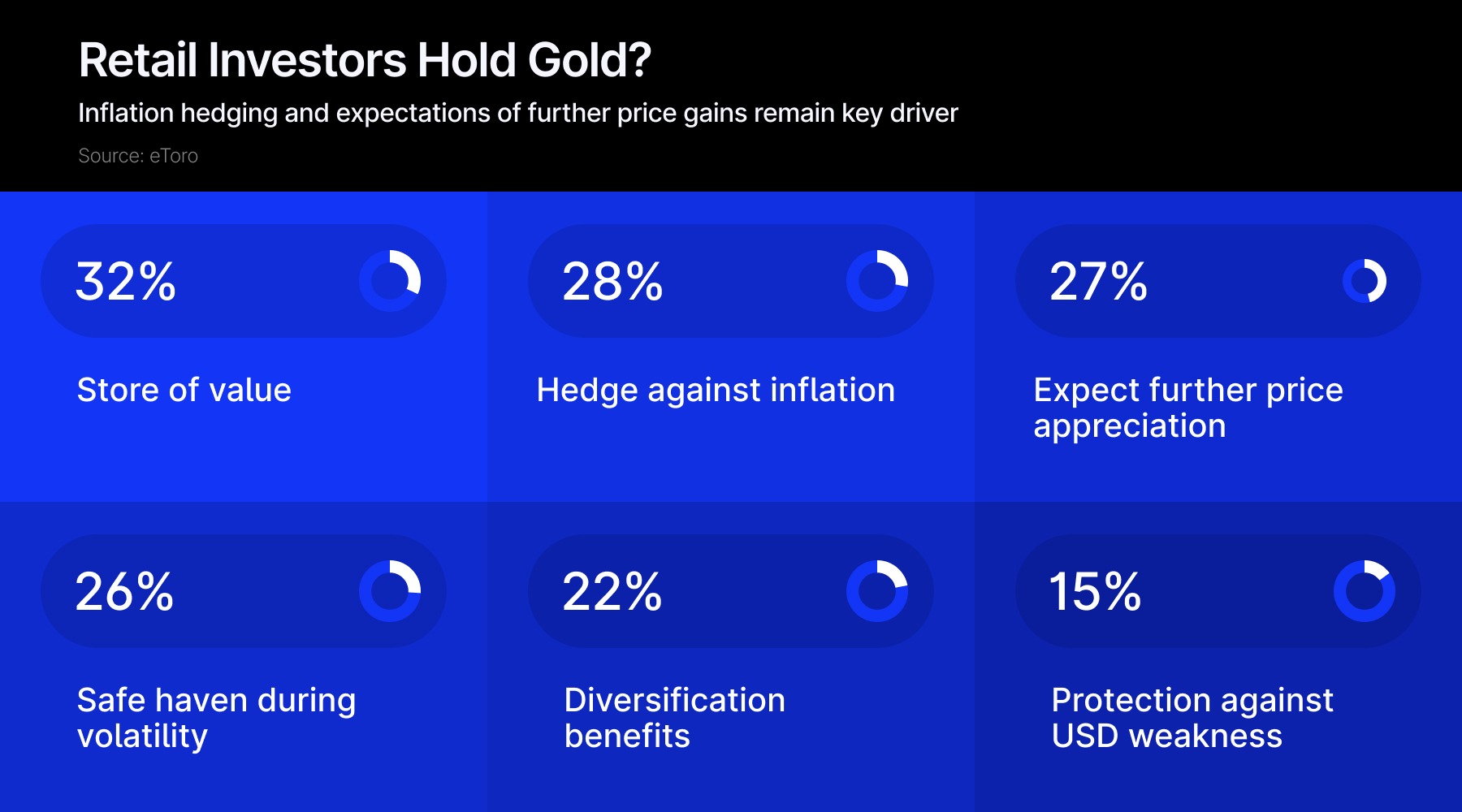
Investors offered a range of reasons for their gold positions. The top motivations cited were its role as a store of value (32%), a hedge against inflation (28%), and expectations of further price appreciation (27%). Safe-haven demand during volatility was cited by 26%, diversification benefits by 22%, and protection against US dollar weakness by 15%.
Reason for holding gold | Share of investors |
Store of value | 32% |
Hedge against inflation | 28% |
Expect further price appreciation | 27% |
Safe haven during volatility | 26% |
Diversification benefits | 22% |
Protection against USD weakness | 15% |
The survey data arrives alongside a sustained rally in precious metals. Goldman Sachs raised its end-2026 gold price forecast to $5,400 per ounce in January, citing private-sector diversification as the key driver, while the World Gold Council has separately flagged downside risk scenarios of up to 20%, illustrating the degree of uncertainty around the metal's path in 2026.
That volatility has drawn increased retail trading flows into gold and silver-linked instruments at online brokers globally.
"Even before the latest geopolitical developments, retail investors were increasing their exposure to tangible assets," Akoner said. "Gold in particular appears to be viewed less as a short-term trade and more as a strategic hedge and diversifier, especially as the momentum-driven rally begins to moderate."
Conflict Ties Recession as Investors' Top Fear
For the first time in the survey series, international conflict ranked level with the global economy and recession risk as the leading concern among retail investors. Some 22% cited geopolitical conflict as the biggest threat to their portfolios, up from 17% the prior quarter, matching the share who pointed to a global economic downturn.
A year ago, the rankings looked quite different: the global economy was first at 23%, inflation second at 21%, and international conflict third at 18%.
Akoner noted the elevation of geopolitical risk had been building before the latest Middle East developments.
"In recent years, markets have had to navigate a series of global flashpoints, making investors far more attuned to the potential impact of geopolitical events," she said. "The fact that international conflict now ranks alongside recession fears as the biggest perceived threat highlights how closely retail investors are watching global developments and recognising their potential implications for markets and portfolios."
That heightened attentiveness fits with broader research suggesting retail investors have grown more sophisticated in their macro awareness, with some industry analysis showing they increasingly behave as rational economic actors rather than reactive participants.
A new generation of Gen Z traders entering the market in early 2026 appears to be reinforcing that trend, bringing with it a stronger appetite for diversification and risk management.
eToro's Own Metrics Show Steady Expansion
The survey comes as eToro continues to grow its client base. The company reported record net contribution of $868 million for full-year 2025, up 10% year-on-year, with funded accounts reaching 3.81 million.
Despite the record results, the stock faced selling pressure in the weeks following the earnings release, reflecting a market environment in which investor expectations have become harder to satisfy even with strong underlying numbers.
The Retail Investor Beat survey is conducted quarterly. The Q1 2026 edition polled 11,000 participants across 13 countries between February 12 and 27, 2026.