Understanding how Gold is deeply rooted in Chinese culture and looking at the gold trading industry closer than ever before.
FM
Not long ago, China launched a yuan-denominated gold benchmark. Since the beginning of 2016 Chinese citizens can trade gold on the Shanghai Gold Exchange (SGE) with the “Yijintong” mobile app. Meanwhile, in Hong Kong there are more than 120 brokers offering bullion trading.
In China gold is rooted deeply into culture. It equates with power, purity and beauty. Finance Magnates inspects this phenomenon and brings the gold trading industry closer than ever. There is a lot to be told about China, their love for gold and its future. Will gold shine over the China for longer?
To anyone familiar with Chinese culture it is obvious that gold enjoys a very high status there. There are different theories explaining this phenomenon, sometimes linking it to Taoism or Buddhism. Buddhist temples across Asia share the same passion for gold, just to name the Grand Palace located in Thailand or The Potala Palace located in Lhasa.
The same can be witnessed in The Palace Museum located in Beijing, China. The complex used to serve as the home of emperors and their households for almost 500 years. Today it is a museum where its exhibitions showcase Chinese history and arts. One can see how golden elements were important throughout the past. It is worth to note that when the complex was being build (the process started in 1406) the floors of major halls were paved with "golden bricks" baked with clay.
"China has a savings culture and there are still relatively few options open to many Chinese savers with regards to safe and trusted stores of value - gold and property are the two assets that most Chinese savers immediately turn to. Over the long term, income and wealth growth should support greater spending capacity which should, in turn, be supportive of the jewellery market.” - John Mulligan, Head of Member and Market Relations at WGC (World Gold Council).
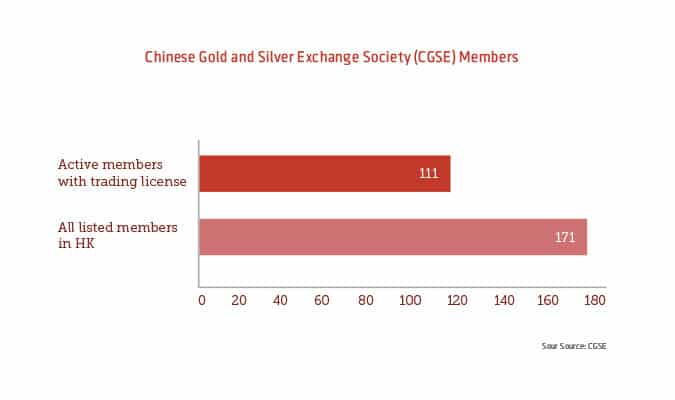
Chinese citizens do not only physically trade gold or trade futures contracts at SHE, they also use via the internet widely available bullion brokers which are located in Hong Kong and abroad. Finance Magnates conducted last year a research on bullion trading in HK. At that time there were at least 122 different brokers offering bullion trading to retails customers. These were Securities and Futures Commission (SFC) regulated firms as well as not regulated – both futures trading providers and OTC. The Chinese Gold and Silver Exchange Society (CGSE) alone lists 171 members.
CGSE was founded in 1910, and is is the sole exchange in Hong Kong which trades physical gold and silver. While only 111 of them have license for trading and not all of them offer electronic trading, this number still seems very large for Hong Kong alone. There is more than 7.1 million people in HK and it is difficult to imagine that all of the brokers who offer bullion trading target local traders only.
In normal circumstances it could be debated how long demand for gold would remain strong. Analysis of fundamental factors could give more or less concrete vision of how much of gold the economy needs in the coming years. For example, in the case that the economy of China is slowing down but the pace of growth is still above levels known from developed western economies.
However, the situation in the Chinese gold market is very different to what we know from other regions of the globe. Fundamental factors are backed by cultural ones resulting in an interesting blend. If anyone thinks that everything in the case of the gold market in China has already been seen he is wrong. We have only seen a prelude to something even bigger.
Want know more about the gold trade in China? Get the brand new FM Intelligence Report
Not long ago, China launched a yuan-denominated gold benchmark. Since the beginning of 2016 Chinese citizens can trade gold on the Shanghai Gold Exchange (SGE) with the “Yijintong” mobile app. Meanwhile, in Hong Kong there are more than 120 brokers offering bullion trading.
In China gold is rooted deeply into culture. It equates with power, purity and beauty. Finance Magnates inspects this phenomenon and brings the gold trading industry closer than ever. There is a lot to be told about China, their love for gold and its future. Will gold shine over the China for longer?
To anyone familiar with Chinese culture it is obvious that gold enjoys a very high status there. There are different theories explaining this phenomenon, sometimes linking it to Taoism or Buddhism. Buddhist temples across Asia share the same passion for gold, just to name the Grand Palace located in Thailand or The Potala Palace located in Lhasa.
The same can be witnessed in The Palace Museum located in Beijing, China. The complex used to serve as the home of emperors and their households for almost 500 years. Today it is a museum where its exhibitions showcase Chinese history and arts. One can see how golden elements were important throughout the past. It is worth to note that when the complex was being build (the process started in 1406) the floors of major halls were paved with "golden bricks" baked with clay.
"China has a savings culture and there are still relatively few options open to many Chinese savers with regards to safe and trusted stores of value - gold and property are the two assets that most Chinese savers immediately turn to. Over the long term, income and wealth growth should support greater spending capacity which should, in turn, be supportive of the jewellery market.” - John Mulligan, Head of Member and Market Relations at WGC (World Gold Council).
Chinese citizens do not only physically trade gold or trade futures contracts at SHE, they also use via the internet widely available bullion brokers which are located in Hong Kong and abroad. Finance Magnates conducted last year a research on bullion trading in HK. At that time there were at least 122 different brokers offering bullion trading to retails customers. These were Securities and Futures Commission (SFC) regulated firms as well as not regulated – both futures trading providers and OTC. The Chinese Gold and Silver Exchange Society (CGSE) alone lists 171 members.
CGSE was founded in 1910, and is is the sole exchange in Hong Kong which trades physical gold and silver. While only 111 of them have license for trading and not all of them offer electronic trading, this number still seems very large for Hong Kong alone. There is more than 7.1 million people in HK and it is difficult to imagine that all of the brokers who offer bullion trading target local traders only.
In normal circumstances it could be debated how long demand for gold would remain strong. Analysis of fundamental factors could give more or less concrete vision of how much of gold the economy needs in the coming years. For example, in the case that the economy of China is slowing down but the pace of growth is still above levels known from developed western economies.
However, the situation in the Chinese gold market is very different to what we know from other regions of the globe. Fundamental factors are backed by cultural ones resulting in an interesting blend. If anyone thinks that everything in the case of the gold market in China has already been seen he is wrong. We have only seen a prelude to something even bigger.
Want know more about the gold trade in China? Get the brand new FM Intelligence Report
Sylwester is a graduate of the Warsaw School of Economics, holding an MA in Finance and Banking. He currently serves as Head of the Insights & Reporting Hub at Finance Magnates. He is also a former minority partner in an NFA-registered US forex broker and has been involved in numerous forex and trading industry projects since 2003.
Privately, Sylwester is a husband and father to a 7-year-old daughter, as well as an enthusiast of trading and Formula 1.
Italy’s Consob Tightens Net on AI-Fueled Scams With Fresh Website Bans
FP Markets Winner Spotlight 🏆 | Global Broker of the Year 2025 #Trading #Broker #Innovation #Shorts
FP Markets Winner Spotlight 🏆 | Global Broker of the Year 2025 #Trading #Broker #Innovation #Shorts
FP Markets takes the spotlight as Global Broker of the Year 2025 at the Finance Magnates Awards.
Martin Stoilov, Head of Client Experience, shares that trust, innovation, and people played a key role in the company’s success, supported by a strong foundation of integrity and client-centricity.
Following this milestone, FP Markets continues to focus on growth, technology investment, and its core values of transparency and excellence.
👉 Be part of FM Awards 2026: https://awards.financemagnates.com/#nominate
FP Markets takes the spotlight as Global Broker of the Year 2025 at the Finance Magnates Awards.
Martin Stoilov, Head of Client Experience, shares that trust, innovation, and people played a key role in the company’s success, supported by a strong foundation of integrity and client-centricity.
Following this milestone, FP Markets continues to focus on growth, technology investment, and its core values of transparency and excellence.
👉 Be part of FM Awards 2026: https://awards.financemagnates.com/#nominate
In this video, we review @HolaPrimeMarketsOfficial, a multi-asset forex and CFDs broker offering different account types, trading platforms, and flexible trading conditions.
We cover the broker’s overall offering, including account options, trading environment, platforms like MT4 and MT5, and additional services such as managed accounts and fast withdrawals.
Watch the full video to see if Hola Prime Markets fits your trading needs.
📣 Stay up to date with the latest in finance and trading. Follow Finance Magnates for industry news, insights, and global event coverage.
Connect with us:
🔗 LinkedIn: /financemagnates
👍 Facebook: /financemagnates
📸 Instagram: https://www.instagram.com/financemagnates
🐦 X: https://x.com/financemagnates
🎥 TikTok: https://www.tiktok.com/tag/financemagnates
▶️ YouTube: /@financemagnates_official
#HolaPrime #ForexBroker #CFDTrading #FinanceMagnates #Trading #Forex #BrokerReview
In this video, we review @HolaPrimeMarketsOfficial, a multi-asset forex and CFDs broker offering different account types, trading platforms, and flexible trading conditions.
We cover the broker’s overall offering, including account options, trading environment, platforms like MT4 and MT5, and additional services such as managed accounts and fast withdrawals.
Watch the full video to see if Hola Prime Markets fits your trading needs.
📣 Stay up to date with the latest in finance and trading. Follow Finance Magnates for industry news, insights, and global event coverage.
Connect with us:
🔗 LinkedIn: /financemagnates
👍 Facebook: /financemagnates
📸 Instagram: https://www.instagram.com/financemagnates
🐦 X: https://x.com/financemagnates
🎥 TikTok: https://www.tiktok.com/tag/financemagnates
▶️ YouTube: /@financemagnates_official
#HolaPrime #ForexBroker #CFDTrading #FinanceMagnates #Trading #Forex #BrokerReview
Hola Prime Review: What You Need to Know | Full Breakdown by Finance Magnates
Hola Prime Review: What You Need to Know | Full Breakdown by Finance Magnates
In this video, we review @HolaPrime_Global, a proprietary trading firm offering evaluation programs and performance-based payouts in simulated market environments.
We cover how the challenge model works, including account types, profit splits (up to 95%), trading rules, and what it takes to reach a funded account. You’ll also learn about available platforms like MT4, MT5, cTrader, and more, along with insights into payouts, support, and trading conditions.
Watch the full video to see if Hola Prime fits your trading style.
📣 Stay up to date with the latest in finance and trading. Follow Finance Magnates for industry news, insights, and global event coverage.
Connect with us:
🔗 LinkedIn: /financemagnates
👍 Facebook: /financemagnates
📸 Instagram: https://www.instagram.com/financemagnates
🐦 X: https://x.com/financemagnates
🎥 TikTok: https://www.tiktok.com/tag/financemagnates
▶️ YouTube: /@financemagnates_official
#HolaPrime #PropFirm #Trading #FinanceMagnates #Forex #FuturesTrading #TradingReview #PropFirmReview
In this video, we review @HolaPrime_Global, a proprietary trading firm offering evaluation programs and performance-based payouts in simulated market environments.
We cover how the challenge model works, including account types, profit splits (up to 95%), trading rules, and what it takes to reach a funded account. You’ll also learn about available platforms like MT4, MT5, cTrader, and more, along with insights into payouts, support, and trading conditions.
Watch the full video to see if Hola Prime fits your trading style.
📣 Stay up to date with the latest in finance and trading. Follow Finance Magnates for industry news, insights, and global event coverage.
Connect with us:
🔗 LinkedIn: /financemagnates
👍 Facebook: /financemagnates
📸 Instagram: https://www.instagram.com/financemagnates
🐦 X: https://x.com/financemagnates
🎥 TikTok: https://www.tiktok.com/tag/financemagnates
▶️ YouTube: /@financemagnates_official
#HolaPrime #PropFirm #Trading #FinanceMagnates #Forex #FuturesTrading #TradingReview #PropFirmReview
Axi Winner Spotlight 🏆 | Global Most Innovative Broker 2025 #Innovation #Trading #Fintech #Broker
Axi Winner Spotlight 🏆 | Global Most Innovative Broker 2025 #Innovation #Trading #Fintech #Broker
Axi takes the spotlight at the Finance Magnates Awards, winning Global Most Innovative Broker 2025.
Olivia Xenofontos and Ivanna Openko share how the team will feel: proud, motivated, and ready to keep delivering.
They also describe the night as well-organized, focused, and enjoyable for all.
👉 Be part of FM Awards 2026.
Axi takes the spotlight at the Finance Magnates Awards, winning Global Most Innovative Broker 2025.
Olivia Xenofontos and Ivanna Openko share how the team will feel: proud, motivated, and ready to keep delivering.
They also describe the night as well-organized, focused, and enjoyable for all.
👉 Be part of FM Awards 2026.
Recognition that matters.
Built on transparency.
Driven by the industry.
The Finance Magnates Awards 2026.
Nominations are now open.
🔗 https://awards.financemagnates.com/?utm_source=SM&utm_medium=social&utm_campaign=recognition-matters
Recognition that matters.
Built on transparency.
Driven by the industry.
The Finance Magnates Awards 2026.
Nominations are now open.
🔗 https://awards.financemagnates.com/?utm_source=SM&utm_medium=social&utm_campaign=recognition-matters