75% of fraudulent credit transfers reportedly involved scams that manipulated victims into sending money.
Cross-border payments carried a significantly higher risk, with card fraud abroad being 25 times more likely than domestic cases.
A flag of Cyprus; Photo: Unsplash
Payment fraud in Cyprus is on the rise, but the latest
data suggest the country still records lower levels of fraud than the euro area
average. The Central Bank of Cyprus released its first statistical report on
payment fraud covering the second half of 2024, highlighting how criminals
exploit different types of non-cash transactions.
Card Fraud Dominates by Volume
According to the report, card fraud made up 94% of all
fraudulent transactions by volume. However, when measured by value, the largest
losses came from credit transfers, which accounted for 60% of fraudulent
activity. Card payments followed with 39% of the total fraud value.
The findings highlight a clear difference in fraud
patterns: while cards are most frequently misused, high-value fraud tends to
involve tricking account holders into transferring money directly to
fraudsters.
The Central Bank’s analysis shows that 75% of
fraudulent credit transfers involved scams where victims were manipulated into
making payments. In contrast, 99% of card fraud cases stemmed from criminals
using stolen or unauthorized customer information.
The report also found that fraud linked to card use
was almost entirely concentrated in online transactions, despite most
legitimate card payments still taking place at physical points of sale.
Cross-Border Transactions Carry Higher Risk
Fraudulent activity was far more common in
cross-border transactions compared with domestic payments. For card
transactions, the risk of fraud occurring outside Cyprus was about 25 times
higher. This stark difference underscores the challenges
regulators and payment providers face in securing international transactions.
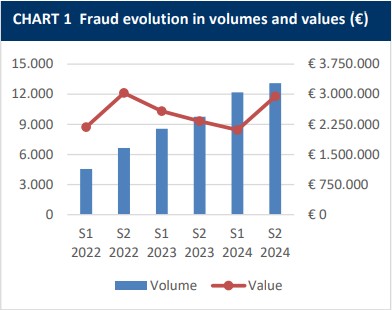
Official figures show that 94% of all fraudulent payment
transactions were card-related, amounting to around 13,000 cases over the
six-month period.
By comparison, all other payment services combined recorded
just about 1,000 fraudulent transactions, underscoring the concentration of
crime in card payments.
Credit transfers accounted for the largest share, €1.8
million, or 60% of total losses, while card fraud followed closely at €1.2
million, or 39%. Fraud across other payment services was negligible, amounting
to less than €50,000.
Source: the Central Bank of Cyprus
The euro area showed a similar breakdown in value terms,
though with different proportions. Fraudulent credit transfers accounted for
58% of total losses, while card fraud contributed 30%.
The Central Bank of Cyprus emphasized that monitoring
and publishing payment fraud data plays a key role in improving transparency
and guiding further regulatory action. The new statistical releases will serve
as a benchmark for assessing trends in future reporting periods.
Meanwhile, a recent report shows that although the
number of fund management entities in Cyprus declined slightly in early 2025,
overall assets under management expanded significantly.
AUM Rises Despite Fewer Fund Managers
According to
the Cyprus Securities and Exchange Commission, the collective investments
sector recorded €10.7 billion in total assets under management in the first
quarter of 2025, reflecting a 6.64% increase from the previous quarter.
This growth came even as the number of supervised
Management Companies and Undertakings of Collective Investments slipped by 1.8%
year-on-year, leaving the total at 322.
Payment fraud in Cyprus is on the rise, but the latest
data suggest the country still records lower levels of fraud than the euro area
average. The Central Bank of Cyprus released its first statistical report on
payment fraud covering the second half of 2024, highlighting how criminals
exploit different types of non-cash transactions.
Card Fraud Dominates by Volume
According to the report, card fraud made up 94% of all
fraudulent transactions by volume. However, when measured by value, the largest
losses came from credit transfers, which accounted for 60% of fraudulent
activity. Card payments followed with 39% of the total fraud value.
The findings highlight a clear difference in fraud
patterns: while cards are most frequently misused, high-value fraud tends to
involve tricking account holders into transferring money directly to
fraudsters.
The Central Bank’s analysis shows that 75% of
fraudulent credit transfers involved scams where victims were manipulated into
making payments. In contrast, 99% of card fraud cases stemmed from criminals
using stolen or unauthorized customer information.
The report also found that fraud linked to card use
was almost entirely concentrated in online transactions, despite most
legitimate card payments still taking place at physical points of sale.
Cross-Border Transactions Carry Higher Risk
Fraudulent activity was far more common in
cross-border transactions compared with domestic payments. For card
transactions, the risk of fraud occurring outside Cyprus was about 25 times
higher. This stark difference underscores the challenges
regulators and payment providers face in securing international transactions.
Official figures show that 94% of all fraudulent payment
transactions were card-related, amounting to around 13,000 cases over the
six-month period.
By comparison, all other payment services combined recorded
just about 1,000 fraudulent transactions, underscoring the concentration of
crime in card payments.
Credit transfers accounted for the largest share, €1.8
million, or 60% of total losses, while card fraud followed closely at €1.2
million, or 39%. Fraud across other payment services was negligible, amounting
to less than €50,000.
Source: the Central Bank of Cyprus
The euro area showed a similar breakdown in value terms,
though with different proportions. Fraudulent credit transfers accounted for
58% of total losses, while card fraud contributed 30%.
The Central Bank of Cyprus emphasized that monitoring
and publishing payment fraud data plays a key role in improving transparency
and guiding further regulatory action. The new statistical releases will serve
as a benchmark for assessing trends in future reporting periods.
Meanwhile, a recent report shows that although the
number of fund management entities in Cyprus declined slightly in early 2025,
overall assets under management expanded significantly.
AUM Rises Despite Fewer Fund Managers
According to
the Cyprus Securities and Exchange Commission, the collective investments
sector recorded €10.7 billion in total assets under management in the first
quarter of 2025, reflecting a 6.64% increase from the previous quarter.
This growth came even as the number of supervised
Management Companies and Undertakings of Collective Investments slipped by 1.8%
year-on-year, leaving the total at 322.
Jared Kirui is an Editor at Finance Magnates with more than five years of experience in financial journalism. He covers online trading, fintech, payments, and crypto industries with a focus on companies, regulation and compliance, executive moves, trading technology, and market analysis.
His work has been featured in other media outlets, including Benzinga, ZyCrypto, The Distributed, and The Daily Hodl.
Education:
Bachelor of Commerce degree (Finance option), University of Nairobi
Retail Investors Shift to Energy, Rare Earths, and AI Amid Tensions, eToro Finds
FP Markets Winner Spotlight 🏆 | Global Broker of the Year 2025 #Trading #Broker #Innovation #Shorts
FP Markets Winner Spotlight 🏆 | Global Broker of the Year 2025 #Trading #Broker #Innovation #Shorts
FP Markets takes the spotlight as Global Broker of the Year 2025 at the Finance Magnates Awards.
Martin Stoilov, Head of Client Experience, shares that trust, innovation, and people played a key role in the company’s success, supported by a strong foundation of integrity and client-centricity.
Following this milestone, FP Markets continues to focus on growth, technology investment, and its core values of transparency and excellence.
👉 Be part of FM Awards 2026: https://awards.financemagnates.com/#nominate
FP Markets takes the spotlight as Global Broker of the Year 2025 at the Finance Magnates Awards.
Martin Stoilov, Head of Client Experience, shares that trust, innovation, and people played a key role in the company’s success, supported by a strong foundation of integrity and client-centricity.
Following this milestone, FP Markets continues to focus on growth, technology investment, and its core values of transparency and excellence.
👉 Be part of FM Awards 2026: https://awards.financemagnates.com/#nominate
In this video, we review @HolaPrimeMarketsOfficial, a multi-asset forex and CFDs broker offering different account types, trading platforms, and flexible trading conditions.
We cover the broker’s overall offering, including account options, trading environment, platforms like MT4 and MT5, and additional services such as managed accounts and fast withdrawals.
Watch the full video to see if Hola Prime Markets fits your trading needs.
📣 Stay up to date with the latest in finance and trading. Follow Finance Magnates for industry news, insights, and global event coverage.
Connect with us:
🔗 LinkedIn: /financemagnates
👍 Facebook: /financemagnates
📸 Instagram: https://www.instagram.com/financemagnates
🐦 X: https://x.com/financemagnates
🎥 TikTok: https://www.tiktok.com/tag/financemagnates
▶️ YouTube: /@financemagnates_official
#HolaPrime #ForexBroker #CFDTrading #FinanceMagnates #Trading #Forex #BrokerReview
In this video, we review @HolaPrimeMarketsOfficial, a multi-asset forex and CFDs broker offering different account types, trading platforms, and flexible trading conditions.
We cover the broker’s overall offering, including account options, trading environment, platforms like MT4 and MT5, and additional services such as managed accounts and fast withdrawals.
Watch the full video to see if Hola Prime Markets fits your trading needs.
📣 Stay up to date with the latest in finance and trading. Follow Finance Magnates for industry news, insights, and global event coverage.
Connect with us:
🔗 LinkedIn: /financemagnates
👍 Facebook: /financemagnates
📸 Instagram: https://www.instagram.com/financemagnates
🐦 X: https://x.com/financemagnates
🎥 TikTok: https://www.tiktok.com/tag/financemagnates
▶️ YouTube: /@financemagnates_official
#HolaPrime #ForexBroker #CFDTrading #FinanceMagnates #Trading #Forex #BrokerReview
Hola Prime Review: What You Need to Know | Full Breakdown by Finance Magnates
Hola Prime Review: What You Need to Know | Full Breakdown by Finance Magnates
In this video, we review @HolaPrime_Global, a proprietary trading firm offering evaluation programs and performance-based payouts in simulated market environments.
We cover how the challenge model works, including account types, profit splits (up to 95%), trading rules, and what it takes to reach a funded account. You’ll also learn about available platforms like MT4, MT5, cTrader, and more, along with insights into payouts, support, and trading conditions.
Watch the full video to see if Hola Prime fits your trading style.
📣 Stay up to date with the latest in finance and trading. Follow Finance Magnates for industry news, insights, and global event coverage.
Connect with us:
🔗 LinkedIn: /financemagnates
👍 Facebook: /financemagnates
📸 Instagram: https://www.instagram.com/financemagnates
🐦 X: https://x.com/financemagnates
🎥 TikTok: https://www.tiktok.com/tag/financemagnates
▶️ YouTube: /@financemagnates_official
#HolaPrime #PropFirm #Trading #FinanceMagnates #Forex #FuturesTrading #TradingReview #PropFirmReview
In this video, we review @HolaPrime_Global, a proprietary trading firm offering evaluation programs and performance-based payouts in simulated market environments.
We cover how the challenge model works, including account types, profit splits (up to 95%), trading rules, and what it takes to reach a funded account. You’ll also learn about available platforms like MT4, MT5, cTrader, and more, along with insights into payouts, support, and trading conditions.
Watch the full video to see if Hola Prime fits your trading style.
📣 Stay up to date with the latest in finance and trading. Follow Finance Magnates for industry news, insights, and global event coverage.
Connect with us:
🔗 LinkedIn: /financemagnates
👍 Facebook: /financemagnates
📸 Instagram: https://www.instagram.com/financemagnates
🐦 X: https://x.com/financemagnates
🎥 TikTok: https://www.tiktok.com/tag/financemagnates
▶️ YouTube: /@financemagnates_official
#HolaPrime #PropFirm #Trading #FinanceMagnates #Forex #FuturesTrading #TradingReview #PropFirmReview
Axi Winner Spotlight 🏆 | Global Most Innovative Broker 2025 #Innovation #Trading #Fintech #Broker
Axi Winner Spotlight 🏆 | Global Most Innovative Broker 2025 #Innovation #Trading #Fintech #Broker
Axi takes the spotlight at the Finance Magnates Awards, winning Global Most Innovative Broker 2025.
Olivia Xenofontos and Ivanna Openko share how the team will feel: proud, motivated, and ready to keep delivering.
They also describe the night as well-organized, focused, and enjoyable for all.
👉 Be part of FM Awards 2026.
Axi takes the spotlight at the Finance Magnates Awards, winning Global Most Innovative Broker 2025.
Olivia Xenofontos and Ivanna Openko share how the team will feel: proud, motivated, and ready to keep delivering.
They also describe the night as well-organized, focused, and enjoyable for all.
👉 Be part of FM Awards 2026.
Recognition that matters.
Built on transparency.
Driven by the industry.
The Finance Magnates Awards 2026.
Nominations are now open.
🔗 https://awards.financemagnates.com/?utm_source=SM&utm_medium=social&utm_campaign=recognition-matters
Recognition that matters.
Built on transparency.
Driven by the industry.
The Finance Magnates Awards 2026.
Nominations are now open.
🔗 https://awards.financemagnates.com/?utm_source=SM&utm_medium=social&utm_campaign=recognition-matters