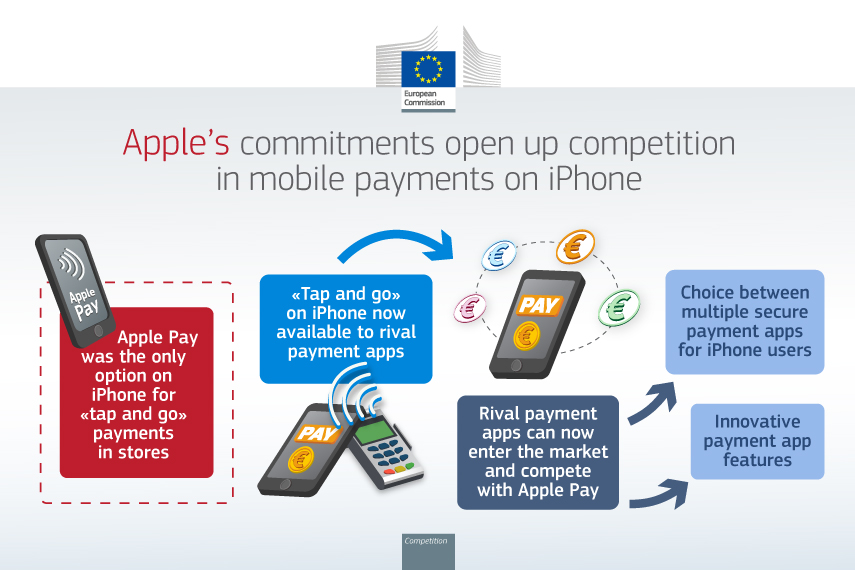
EU mandates Apple to provide Apple Pay access to rival payment systems.
Apple Pay under EU pressure.
In a significant development, Apple has reached an
agreement with the European Union to open its mobile payment system, Apple Pay,
to rival payment platforms. This
move marks a pivotal shift in the tech giant's approach to its highly
proprietary ecosystem and could have far-reaching implications for the mobile
payments landscape.
What Prompted the Deal?
The deal comes after prolonged scrutiny by EU regulators
who have raised concerns about anti-competitive practices. Apple has been under
investigation for allegedly restricting access to the Near Field Communication
(NFC) chip on its devices, which is essential for contactless payments. By
limiting this access to Apple Pay, the company has faced accusations of
stifling competition and innovation in the mobile payments market.
How Will This Affect Consumers?
For consumers, this agreement promises greater choice and
flexibility. Users of Apple devices will soon be able to use alternative
payment platforms that can now leverage the NFC technology. This could lead to
more competitive pricing and innovative features as other companies strive to
attract users who were previously locked into Apple Pay.
Source: European Commission
What Does This Mean for Rivals?
Rival payment platforms stand to benefit significantly from
this deal. Companies like Google Pay and Samsung Pay will now have the
opportunity to tap into Apple's vast user base. This could drive increased
adoption and usage of these alternative platforms, fostering a more competitive
and dynamic market environment.
How Might This Impact Apple?
While opening up its payment system could dilute Apple
Pay's exclusivity, it may also present new opportunities for Apple. By
complying with regulatory requirements and fostering a more open ecosystem, the
company could benefit from increased overall usage of its devices as consumers
appreciate the added flexibility.
What Are the Broader Implications for the Tech
Industry?
This development could set a precedent for other tech
giants with similarly closed ecosystems. Regulators around the world are
increasingly scrutinizing major technology companies for anti-competitive
behavior. The outcome of Apple's deal with the EU might encourage other firms
to proactively open up their platforms to avoid regulatory backlash.
Challenges and Considerations
Despite the potential benefits, there are challenges to
consider. Ensuring the security and privacy of transactions across multiple
payment platforms will be paramount. Apple will need to work closely with these
platforms to maintain the high security standards its users expect.
Additionally, the integration process for rival platforms could be complex,
requiring significant technical collaboration and testing.
A Step Towards a More Open Digital
Economy
Apple’s agreement with the EU to open up its mobile payment
system is a landmark decision that underscores the importance of competition in
the digital economy. For consumers, it means more choices and potentially
better services. For competitors, it offers a chance to innovate and expand
their reach. As the mobile payments market continues to evolve, this move could
herald a new era of openness and collaboration, setting the stage for a more
dynamic and inclusive digital ecosystem.
In a significant development, Apple has reached an
agreement with the European Union to open its mobile payment system, Apple Pay,
to rival payment platforms. This
move marks a pivotal shift in the tech giant's approach to its highly
proprietary ecosystem and could have far-reaching implications for the mobile
payments landscape.
What Prompted the Deal?
The deal comes after prolonged scrutiny by EU regulators
who have raised concerns about anti-competitive practices. Apple has been under
investigation for allegedly restricting access to the Near Field Communication
(NFC) chip on its devices, which is essential for contactless payments. By
limiting this access to Apple Pay, the company has faced accusations of
stifling competition and innovation in the mobile payments market.
How Will This Affect Consumers?
For consumers, this agreement promises greater choice and
flexibility. Users of Apple devices will soon be able to use alternative
payment platforms that can now leverage the NFC technology. This could lead to
more competitive pricing and innovative features as other companies strive to
attract users who were previously locked into Apple Pay.
Source: European Commission
What Does This Mean for Rivals?
Rival payment platforms stand to benefit significantly from
this deal. Companies like Google Pay and Samsung Pay will now have the
opportunity to tap into Apple's vast user base. This could drive increased
adoption and usage of these alternative platforms, fostering a more competitive
and dynamic market environment.
How Might This Impact Apple?
While opening up its payment system could dilute Apple
Pay's exclusivity, it may also present new opportunities for Apple. By
complying with regulatory requirements and fostering a more open ecosystem, the
company could benefit from increased overall usage of its devices as consumers
appreciate the added flexibility.
What Are the Broader Implications for the Tech
Industry?
This development could set a precedent for other tech
giants with similarly closed ecosystems. Regulators around the world are
increasingly scrutinizing major technology companies for anti-competitive
behavior. The outcome of Apple's deal with the EU might encourage other firms
to proactively open up their platforms to avoid regulatory backlash.
Challenges and Considerations
Despite the potential benefits, there are challenges to
consider. Ensuring the security and privacy of transactions across multiple
payment platforms will be paramount. Apple will need to work closely with these
platforms to maintain the high security standards its users expect.
Additionally, the integration process for rival platforms could be complex,
requiring significant technical collaboration and testing.
A Step Towards a More Open Digital
Economy
Apple’s agreement with the EU to open up its mobile payment
system is a landmark decision that underscores the importance of competition in
the digital economy. For consumers, it means more choices and potentially
better services. For competitors, it offers a chance to innovate and expand
their reach. As the mobile payments market continues to evolve, this move could
herald a new era of openness and collaboration, setting the stage for a more
dynamic and inclusive digital ecosystem.
Retail Investors Shift to Energy, Rare Earths, and AI Amid Tensions, eToro Finds
FP Markets Winner Spotlight 🏆 | Global Broker of the Year 2025 #Trading #Broker #Innovation #Shorts
FP Markets Winner Spotlight 🏆 | Global Broker of the Year 2025 #Trading #Broker #Innovation #Shorts
FP Markets takes the spotlight as Global Broker of the Year 2025 at the Finance Magnates Awards.
Martin Stoilov, Head of Client Experience, shares that trust, innovation, and people played a key role in the company’s success, supported by a strong foundation of integrity and client-centricity.
Following this milestone, FP Markets continues to focus on growth, technology investment, and its core values of transparency and excellence.
👉 Be part of FM Awards 2026: https://awards.financemagnates.com/#nominate
FP Markets takes the spotlight as Global Broker of the Year 2025 at the Finance Magnates Awards.
Martin Stoilov, Head of Client Experience, shares that trust, innovation, and people played a key role in the company’s success, supported by a strong foundation of integrity and client-centricity.
Following this milestone, FP Markets continues to focus on growth, technology investment, and its core values of transparency and excellence.
👉 Be part of FM Awards 2026: https://awards.financemagnates.com/#nominate
In this video, we review @HolaPrimeMarketsOfficial, a multi-asset forex and CFDs broker offering different account types, trading platforms, and flexible trading conditions.
We cover the broker’s overall offering, including account options, trading environment, platforms like MT4 and MT5, and additional services such as managed accounts and fast withdrawals.
Watch the full video to see if Hola Prime Markets fits your trading needs.
📣 Stay up to date with the latest in finance and trading. Follow Finance Magnates for industry news, insights, and global event coverage.
Connect with us:
🔗 LinkedIn: /financemagnates
👍 Facebook: /financemagnates
📸 Instagram: https://www.instagram.com/financemagnates
🐦 X: https://x.com/financemagnates
🎥 TikTok: https://www.tiktok.com/tag/financemagnates
▶️ YouTube: /@financemagnates_official
#HolaPrime #ForexBroker #CFDTrading #FinanceMagnates #Trading #Forex #BrokerReview
In this video, we review @HolaPrimeMarketsOfficial, a multi-asset forex and CFDs broker offering different account types, trading platforms, and flexible trading conditions.
We cover the broker’s overall offering, including account options, trading environment, platforms like MT4 and MT5, and additional services such as managed accounts and fast withdrawals.
Watch the full video to see if Hola Prime Markets fits your trading needs.
📣 Stay up to date with the latest in finance and trading. Follow Finance Magnates for industry news, insights, and global event coverage.
Connect with us:
🔗 LinkedIn: /financemagnates
👍 Facebook: /financemagnates
📸 Instagram: https://www.instagram.com/financemagnates
🐦 X: https://x.com/financemagnates
🎥 TikTok: https://www.tiktok.com/tag/financemagnates
▶️ YouTube: /@financemagnates_official
#HolaPrime #ForexBroker #CFDTrading #FinanceMagnates #Trading #Forex #BrokerReview
Hola Prime Review: What You Need to Know | Full Breakdown by Finance Magnates
Hola Prime Review: What You Need to Know | Full Breakdown by Finance Magnates
In this video, we review @HolaPrime_Global, a proprietary trading firm offering evaluation programs and performance-based payouts in simulated market environments.
We cover how the challenge model works, including account types, profit splits (up to 95%), trading rules, and what it takes to reach a funded account. You’ll also learn about available platforms like MT4, MT5, cTrader, and more, along with insights into payouts, support, and trading conditions.
Watch the full video to see if Hola Prime fits your trading style.
📣 Stay up to date with the latest in finance and trading. Follow Finance Magnates for industry news, insights, and global event coverage.
Connect with us:
🔗 LinkedIn: /financemagnates
👍 Facebook: /financemagnates
📸 Instagram: https://www.instagram.com/financemagnates
🐦 X: https://x.com/financemagnates
🎥 TikTok: https://www.tiktok.com/tag/financemagnates
▶️ YouTube: /@financemagnates_official
#HolaPrime #PropFirm #Trading #FinanceMagnates #Forex #FuturesTrading #TradingReview #PropFirmReview
In this video, we review @HolaPrime_Global, a proprietary trading firm offering evaluation programs and performance-based payouts in simulated market environments.
We cover how the challenge model works, including account types, profit splits (up to 95%), trading rules, and what it takes to reach a funded account. You’ll also learn about available platforms like MT4, MT5, cTrader, and more, along with insights into payouts, support, and trading conditions.
Watch the full video to see if Hola Prime fits your trading style.
📣 Stay up to date with the latest in finance and trading. Follow Finance Magnates for industry news, insights, and global event coverage.
Connect with us:
🔗 LinkedIn: /financemagnates
👍 Facebook: /financemagnates
📸 Instagram: https://www.instagram.com/financemagnates
🐦 X: https://x.com/financemagnates
🎥 TikTok: https://www.tiktok.com/tag/financemagnates
▶️ YouTube: /@financemagnates_official
#HolaPrime #PropFirm #Trading #FinanceMagnates #Forex #FuturesTrading #TradingReview #PropFirmReview
Axi Winner Spotlight 🏆 | Global Most Innovative Broker 2025 #Innovation #Trading #Fintech #Broker
Axi Winner Spotlight 🏆 | Global Most Innovative Broker 2025 #Innovation #Trading #Fintech #Broker
Axi takes the spotlight at the Finance Magnates Awards, winning Global Most Innovative Broker 2025.
Olivia Xenofontos and Ivanna Openko share how the team will feel: proud, motivated, and ready to keep delivering.
They also describe the night as well-organized, focused, and enjoyable for all.
👉 Be part of FM Awards 2026.
Axi takes the spotlight at the Finance Magnates Awards, winning Global Most Innovative Broker 2025.
Olivia Xenofontos and Ivanna Openko share how the team will feel: proud, motivated, and ready to keep delivering.
They also describe the night as well-organized, focused, and enjoyable for all.
👉 Be part of FM Awards 2026.
Recognition that matters.
Built on transparency.
Driven by the industry.
The Finance Magnates Awards 2026.
Nominations are now open.
🔗 https://awards.financemagnates.com/?utm_source=SM&utm_medium=social&utm_campaign=recognition-matters
Recognition that matters.
Built on transparency.
Driven by the industry.
The Finance Magnates Awards 2026.
Nominations are now open.
🔗 https://awards.financemagnates.com/?utm_source=SM&utm_medium=social&utm_campaign=recognition-matters