In the latest edition of the FM Intelligence Report, readers can find a thorough case study of the Chinese payments industry.
Finance Magnates Studio
This article was written by Brian Tom, co-founder of WeCollect.
In recent years, China has come to be regarded as the world center of e-commerce, where every single day companies are exporting huge quantities of packages to almost every possible continent or country. Today, the Middle Kingdom is also one of the most important consumers of e-commerce services.
Currently, the e-commerce market in the Middle Kingdom is the largest in the world and according to the latest data its valuation should equal US$1.57 trillion by 2018. This is all through the dynamic adaptation of web services and joint action taken by important services such as small and medium-sized enterprises (SMEs), the retail industry and multinational corporations.
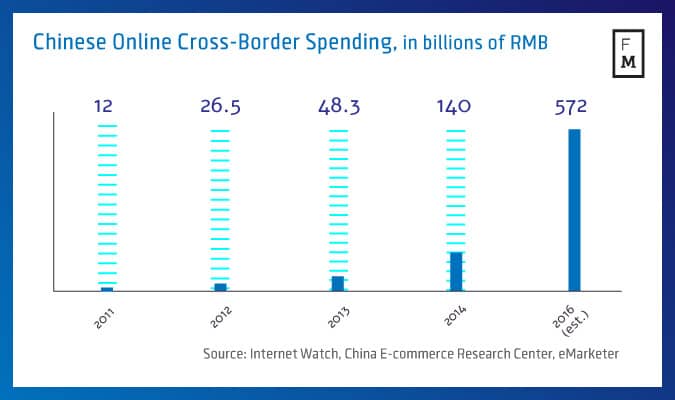
Currently the development rate of e-commerce moves around 30% per year, providing 20% of the total value of imports and exports.
Want know more about the Payments industry in China? Get the brand new FM Intelligence Report:
In the latest edition of the Finance Magnates Quarterly Industry Report, readers can find a thorough case study that x-rays the Chinese payments industry. At a time when the Western world uses mainly Visa, MasterCard and PayPal solutions, Asians are highly satisfied with services provided by UnionPay, AliPay and currently also WeChat Pay.
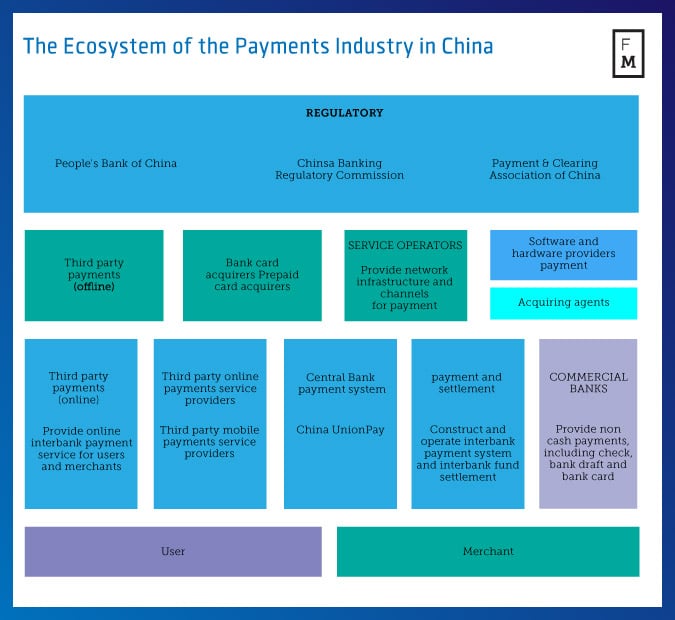
Andy Cheung, COO of WeCollect, says: “China UnionPay emerged from the offline payment space and has recently developed products for the online world. On the other hand, other major Chinese payment solutions such as Alipay and WeChat Pay evolved from the online world and has recently tried to enter the offline payment space. The next battleground will be the O2O sector where the offline and online worlds come together. As payments in China becomes more fintech focused, the major challenge of China UnionPay and banks is to leapfrog their old legacy systems in favor of new innovation and technologies.”
The first legal guidelines regarding the domestic third party payment providers in China emerged in 2010. Very quickly however, the dynamic growth of the e-commerce sector and heightened user demand forced the introduction of additional Regulation and licensing. These were issued in 2013 by the State Administration of Foreign Exchange (SAFE).
It has to be noted that the Chinese market has quite specific characteristics, and unlike most developed economics, it does not provide free cross border money transfers, adjusting the conversion of foreign currency to RMB and vice versa.
That is why the RMB and the future path of Chinese payments management policy will have an enormous impact on the future development of the local e-commerce market. It may also influence payment providers, which could force them to modify the existing infrastructure in order to allow undisturbed transaction flow.
Further globalization and transformation?
The dynamic development of the Chinese payments industry would not have been possible without the appropriate reforms introduced by the local government over decades. Foreign market participants still expect however that the Middle Kingdom through subsequent regulations will open up to foreign entities and integrate with the global community.
This would not only further push growth levels in the e-commerce industry, but also bring tangible benefits in a number of other market branches – including the financial services industry.
Want to know more about the payments industry in China? Get the brand new FM Intelligence Report:
This article was written by Brian Tom, co-founder of WeCollect.
In recent years, China has come to be regarded as the world center of e-commerce, where every single day companies are exporting huge quantities of packages to almost every possible continent or country. Today, the Middle Kingdom is also one of the most important consumers of e-commerce services.
Currently, the e-commerce market in the Middle Kingdom is the largest in the world and according to the latest data its valuation should equal US$1.57 trillion by 2018. This is all through the dynamic adaptation of web services and joint action taken by important services such as small and medium-sized enterprises (SMEs), the retail industry and multinational corporations.
Currently the development rate of e-commerce moves around 30% per year, providing 20% of the total value of imports and exports.
Want know more about the Payments industry in China? Get the brand new FM Intelligence Report:
In the latest edition of the Finance Magnates Quarterly Industry Report, readers can find a thorough case study that x-rays the Chinese payments industry. At a time when the Western world uses mainly Visa, MasterCard and PayPal solutions, Asians are highly satisfied with services provided by UnionPay, AliPay and currently also WeChat Pay.
Andy Cheung, COO of WeCollect, says: “China UnionPay emerged from the offline payment space and has recently developed products for the online world. On the other hand, other major Chinese payment solutions such as Alipay and WeChat Pay evolved from the online world and has recently tried to enter the offline payment space. The next battleground will be the O2O sector where the offline and online worlds come together. As payments in China becomes more fintech focused, the major challenge of China UnionPay and banks is to leapfrog their old legacy systems in favor of new innovation and technologies.”
The first legal guidelines regarding the domestic third party payment providers in China emerged in 2010. Very quickly however, the dynamic growth of the e-commerce sector and heightened user demand forced the introduction of additional Regulation and licensing. These were issued in 2013 by the State Administration of Foreign Exchange (SAFE).
It has to be noted that the Chinese market has quite specific characteristics, and unlike most developed economics, it does not provide free cross border money transfers, adjusting the conversion of foreign currency to RMB and vice versa.
That is why the RMB and the future path of Chinese payments management policy will have an enormous impact on the future development of the local e-commerce market. It may also influence payment providers, which could force them to modify the existing infrastructure in order to allow undisturbed transaction flow.
Further globalization and transformation?
The dynamic development of the Chinese payments industry would not have been possible without the appropriate reforms introduced by the local government over decades. Foreign market participants still expect however that the Middle Kingdom through subsequent regulations will open up to foreign entities and integrate with the global community.
This would not only further push growth levels in the e-commerce industry, but also bring tangible benefits in a number of other market branches – including the financial services industry.
Want to know more about the payments industry in China? Get the brand new FM Intelligence Report:
Retail Investors Shift to Energy, Rare Earths, and AI Amid Tensions, eToro Finds
FP Markets Winner Spotlight 🏆 | Global Broker of the Year 2025 #Trading #Broker #Innovation #Shorts
FP Markets Winner Spotlight 🏆 | Global Broker of the Year 2025 #Trading #Broker #Innovation #Shorts
FP Markets takes the spotlight as Global Broker of the Year 2025 at the Finance Magnates Awards.
Martin Stoilov, Head of Client Experience, shares that trust, innovation, and people played a key role in the company’s success, supported by a strong foundation of integrity and client-centricity.
Following this milestone, FP Markets continues to focus on growth, technology investment, and its core values of transparency and excellence.
👉 Be part of FM Awards 2026: https://awards.financemagnates.com/#nominate
FP Markets takes the spotlight as Global Broker of the Year 2025 at the Finance Magnates Awards.
Martin Stoilov, Head of Client Experience, shares that trust, innovation, and people played a key role in the company’s success, supported by a strong foundation of integrity and client-centricity.
Following this milestone, FP Markets continues to focus on growth, technology investment, and its core values of transparency and excellence.
👉 Be part of FM Awards 2026: https://awards.financemagnates.com/#nominate
In this video, we review @HolaPrimeMarketsOfficial, a multi-asset forex and CFDs broker offering different account types, trading platforms, and flexible trading conditions.
We cover the broker’s overall offering, including account options, trading environment, platforms like MT4 and MT5, and additional services such as managed accounts and fast withdrawals.
Watch the full video to see if Hola Prime Markets fits your trading needs.
📣 Stay up to date with the latest in finance and trading. Follow Finance Magnates for industry news, insights, and global event coverage.
Connect with us:
🔗 LinkedIn: /financemagnates
👍 Facebook: /financemagnates
📸 Instagram: https://www.instagram.com/financemagnates
🐦 X: https://x.com/financemagnates
🎥 TikTok: https://www.tiktok.com/tag/financemagnates
▶️ YouTube: /@financemagnates_official
#HolaPrime #ForexBroker #CFDTrading #FinanceMagnates #Trading #Forex #BrokerReview
In this video, we review @HolaPrimeMarketsOfficial, a multi-asset forex and CFDs broker offering different account types, trading platforms, and flexible trading conditions.
We cover the broker’s overall offering, including account options, trading environment, platforms like MT4 and MT5, and additional services such as managed accounts and fast withdrawals.
Watch the full video to see if Hola Prime Markets fits your trading needs.
📣 Stay up to date with the latest in finance and trading. Follow Finance Magnates for industry news, insights, and global event coverage.
Connect with us:
🔗 LinkedIn: /financemagnates
👍 Facebook: /financemagnates
📸 Instagram: https://www.instagram.com/financemagnates
🐦 X: https://x.com/financemagnates
🎥 TikTok: https://www.tiktok.com/tag/financemagnates
▶️ YouTube: /@financemagnates_official
#HolaPrime #ForexBroker #CFDTrading #FinanceMagnates #Trading #Forex #BrokerReview
Hola Prime Review: What You Need to Know | Full Breakdown by Finance Magnates
Hola Prime Review: What You Need to Know | Full Breakdown by Finance Magnates
In this video, we review @HolaPrime_Global, a proprietary trading firm offering evaluation programs and performance-based payouts in simulated market environments.
We cover how the challenge model works, including account types, profit splits (up to 95%), trading rules, and what it takes to reach a funded account. You’ll also learn about available platforms like MT4, MT5, cTrader, and more, along with insights into payouts, support, and trading conditions.
Watch the full video to see if Hola Prime fits your trading style.
📣 Stay up to date with the latest in finance and trading. Follow Finance Magnates for industry news, insights, and global event coverage.
Connect with us:
🔗 LinkedIn: /financemagnates
👍 Facebook: /financemagnates
📸 Instagram: https://www.instagram.com/financemagnates
🐦 X: https://x.com/financemagnates
🎥 TikTok: https://www.tiktok.com/tag/financemagnates
▶️ YouTube: /@financemagnates_official
#HolaPrime #PropFirm #Trading #FinanceMagnates #Forex #FuturesTrading #TradingReview #PropFirmReview
In this video, we review @HolaPrime_Global, a proprietary trading firm offering evaluation programs and performance-based payouts in simulated market environments.
We cover how the challenge model works, including account types, profit splits (up to 95%), trading rules, and what it takes to reach a funded account. You’ll also learn about available platforms like MT4, MT5, cTrader, and more, along with insights into payouts, support, and trading conditions.
Watch the full video to see if Hola Prime fits your trading style.
📣 Stay up to date with the latest in finance and trading. Follow Finance Magnates for industry news, insights, and global event coverage.
Connect with us:
🔗 LinkedIn: /financemagnates
👍 Facebook: /financemagnates
📸 Instagram: https://www.instagram.com/financemagnates
🐦 X: https://x.com/financemagnates
🎥 TikTok: https://www.tiktok.com/tag/financemagnates
▶️ YouTube: /@financemagnates_official
#HolaPrime #PropFirm #Trading #FinanceMagnates #Forex #FuturesTrading #TradingReview #PropFirmReview
Axi Winner Spotlight 🏆 | Global Most Innovative Broker 2025 #Innovation #Trading #Fintech #Broker
Axi Winner Spotlight 🏆 | Global Most Innovative Broker 2025 #Innovation #Trading #Fintech #Broker
Axi takes the spotlight at the Finance Magnates Awards, winning Global Most Innovative Broker 2025.
Olivia Xenofontos and Ivanna Openko share how the team will feel: proud, motivated, and ready to keep delivering.
They also describe the night as well-organized, focused, and enjoyable for all.
👉 Be part of FM Awards 2026.
Axi takes the spotlight at the Finance Magnates Awards, winning Global Most Innovative Broker 2025.
Olivia Xenofontos and Ivanna Openko share how the team will feel: proud, motivated, and ready to keep delivering.
They also describe the night as well-organized, focused, and enjoyable for all.
👉 Be part of FM Awards 2026.
Recognition that matters.
Built on transparency.
Driven by the industry.
The Finance Magnates Awards 2026.
Nominations are now open.
🔗 https://awards.financemagnates.com/?utm_source=SM&utm_medium=social&utm_campaign=recognition-matters
Recognition that matters.
Built on transparency.
Driven by the industry.
The Finance Magnates Awards 2026.
Nominations are now open.
🔗 https://awards.financemagnates.com/?utm_source=SM&utm_medium=social&utm_campaign=recognition-matters