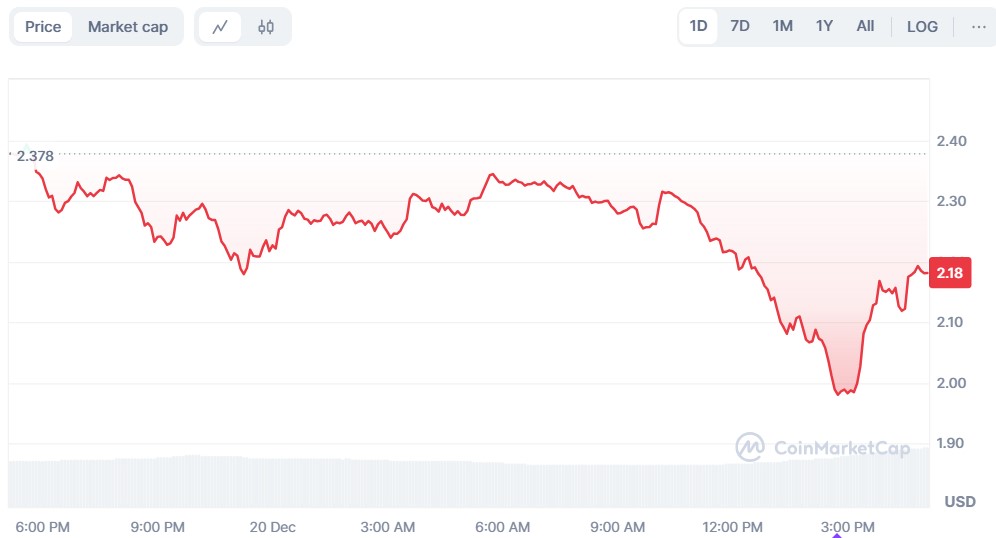
After reaching a multi-year high of $2.80 earlier this month, XRP has dropped more than 20% over the week.
XRP’s price decline reflects broader market challenges rather than Ripple-specific issues.
Ripple’s XRP dropped nearly 10% in the past day as the crypto market
faced downward pressure. This downtrend, which has wiped 7% off the global market cap, followed a federal reserve rate cut and a significant outflow
from Bitcoin-focused ETFs.
The Federal Reserve's announcement of a 0.25% rate
cut, coupled with Jerome Powell’s cautious outlook for 2024, triggered a wave
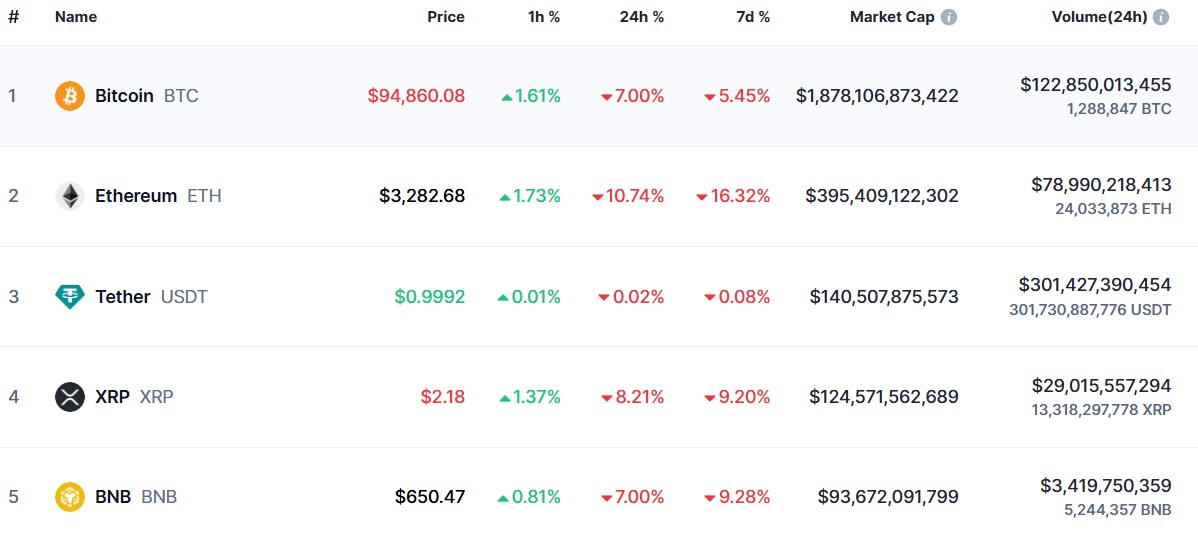
of selling in crypto markets. Data from CoinMarketCap shows that the overall crypto market capitalization is down 7% to $3.28 trillion.
Federal Reserve Sparks Market Selloff
While the rate reduction was widely anticipated,
Powell’s suggestion of a pause in monetary easing caught investors off guard.
Inflation concerns and uncertainty around fiscal policies added further
pressure.
Adding to the turmoil, spot Bitcoin ETFs reportedly recorded
massive outflows, with more than $600 million withdrawn in just 24 hours. High-profile
ETFs like Fidelity’s FBTC and Grayscale’s BTC accounted for the biggest share, CryptoPotato reported, unsettling sentiment across the broader market.
Top 5 Cryptos by Market Cap, Source: CoinMarketCap
After reaching a multi-year high of $2.80, XRP has dropped more than 20% in the weekly chart. The price drop highlights a broader market
condition rather than Ripple-specific developments. The broader crypto market
saw similar declines, with Bitcoin dropping toward $93,000 and altcoins like
Dogecoin plummeting over 25%.
Optimism amid Uncertainty
While XRP’s recent performance might alarm short-term
traders, many analysts remain optimistic about its long-term prospects. XRP’s
challenges reflect the volatile nature of cryptocurrency markets, influenced by
macroeconomic trends and investor sentiment.
As Ripple expands its ecosystem, particularly with
initiatives like its Ripple USD (RLUSD) stablecoin, the company could have
positioned itself for growth in the next bull cycle.
Market analysts have cited monetary and fiscal
policies as catalysts for future crypto adoption. Despite short-term
volatility, XRP’s fundamentals and market position remain robust.
Its use case as a bridge currency and its growing
adoption among financial institutions could propel it toward new heights. Whether
the token achieves the ambitious $5 or $10 targets depends largely on broader
market conditions and Ripple’s continued innovation in the space.
Meanwhile, the SEC granted approval to two major Bitcoin and
Ether exchange-traded funds (ETFs) today (Friday). The approved funds are the Hashdex Nasdaq Crypto Index US ETF and the Franklin Crypto Index ETF.
According to the regulator’s statement, the Hashdex ETF will
track Bitcoin and Ether, while the Franklin ETF will reportedly focus on the
Institutional Digital Asset Index, a benchmark covering both Bitcoin and Ether.
Ripple’s XRP dropped nearly 10% in the past day as the crypto market
faced downward pressure. This downtrend, which has wiped 7% off the global market cap, followed a federal reserve rate cut and a significant outflow
from Bitcoin-focused ETFs.
The Federal Reserve's announcement of a 0.25% rate
cut, coupled with Jerome Powell’s cautious outlook for 2024, triggered a wave
of selling in crypto markets. Data from CoinMarketCap shows that the overall crypto market capitalization is down 7% to $3.28 trillion.
Federal Reserve Sparks Market Selloff
While the rate reduction was widely anticipated,
Powell’s suggestion of a pause in monetary easing caught investors off guard.
Inflation concerns and uncertainty around fiscal policies added further
pressure.
Adding to the turmoil, spot Bitcoin ETFs reportedly recorded
massive outflows, with more than $600 million withdrawn in just 24 hours. High-profile
ETFs like Fidelity’s FBTC and Grayscale’s BTC accounted for the biggest share, CryptoPotato reported, unsettling sentiment across the broader market.
Top 5 Cryptos by Market Cap, Source: CoinMarketCap
After reaching a multi-year high of $2.80, XRP has dropped more than 20% in the weekly chart. The price drop highlights a broader market
condition rather than Ripple-specific developments. The broader crypto market
saw similar declines, with Bitcoin dropping toward $93,000 and altcoins like
Dogecoin plummeting over 25%.
Optimism amid Uncertainty
While XRP’s recent performance might alarm short-term
traders, many analysts remain optimistic about its long-term prospects. XRP’s
challenges reflect the volatile nature of cryptocurrency markets, influenced by
macroeconomic trends and investor sentiment.
As Ripple expands its ecosystem, particularly with
initiatives like its Ripple USD (RLUSD) stablecoin, the company could have
positioned itself for growth in the next bull cycle.
Market analysts have cited monetary and fiscal
policies as catalysts for future crypto adoption. Despite short-term
volatility, XRP’s fundamentals and market position remain robust.
Its use case as a bridge currency and its growing
adoption among financial institutions could propel it toward new heights. Whether
the token achieves the ambitious $5 or $10 targets depends largely on broader
market conditions and Ripple’s continued innovation in the space.
Meanwhile, the SEC granted approval to two major Bitcoin and
Ether exchange-traded funds (ETFs) today (Friday). The approved funds are the Hashdex Nasdaq Crypto Index US ETF and the Franklin Crypto Index ETF.
According to the regulator’s statement, the Hashdex ETF will
track Bitcoin and Ether, while the Franklin ETF will reportedly focus on the
Institutional Digital Asset Index, a benchmark covering both Bitcoin and Ether.
Jared Kirui is an Editor at Finance Magnates with more than five years of experience in financial journalism. He covers online trading, fintech, payments, and crypto industries with a focus on companies, regulation and compliance, executive moves, trading technology, and market analysis.
His work has been featured in other media outlets, including Benzinga, ZyCrypto, The Distributed, and The Daily Hodl.
Education:
Bachelor of Commerce degree (Finance option), University of Nairobi
WhiteBIT secures brokerage license in Georgia to launch regulated crypto derivatives
FP Markets Winner Spotlight 🏆 | Global Broker of the Year 2025 #Trading #Broker #Innovation #Shorts
FP Markets Winner Spotlight 🏆 | Global Broker of the Year 2025 #Trading #Broker #Innovation #Shorts
FP Markets takes the spotlight as Global Broker of the Year 2025 at the Finance Magnates Awards.
Martin Stoilov, Head of Client Experience, shares that trust, innovation, and people played a key role in the company’s success, supported by a strong foundation of integrity and client-centricity.
Following this milestone, FP Markets continues to focus on growth, technology investment, and its core values of transparency and excellence.
👉 Be part of FM Awards 2026: https://awards.financemagnates.com/#nominate
FP Markets takes the spotlight as Global Broker of the Year 2025 at the Finance Magnates Awards.
Martin Stoilov, Head of Client Experience, shares that trust, innovation, and people played a key role in the company’s success, supported by a strong foundation of integrity and client-centricity.
Following this milestone, FP Markets continues to focus on growth, technology investment, and its core values of transparency and excellence.
👉 Be part of FM Awards 2026: https://awards.financemagnates.com/#nominate
In this video, we review @HolaPrimeMarketsOfficial, a multi-asset forex and CFDs broker offering different account types, trading platforms, and flexible trading conditions.
We cover the broker’s overall offering, including account options, trading environment, platforms like MT4 and MT5, and additional services such as managed accounts and fast withdrawals.
Watch the full video to see if Hola Prime Markets fits your trading needs.
📣 Stay up to date with the latest in finance and trading. Follow Finance Magnates for industry news, insights, and global event coverage.
Connect with us:
🔗 LinkedIn: /financemagnates
👍 Facebook: /financemagnates
📸 Instagram: https://www.instagram.com/financemagnates
🐦 X: https://x.com/financemagnates
🎥 TikTok: https://www.tiktok.com/tag/financemagnates
▶️ YouTube: /@financemagnates_official
#HolaPrime #ForexBroker #CFDTrading #FinanceMagnates #Trading #Forex #BrokerReview
In this video, we review @HolaPrimeMarketsOfficial, a multi-asset forex and CFDs broker offering different account types, trading platforms, and flexible trading conditions.
We cover the broker’s overall offering, including account options, trading environment, platforms like MT4 and MT5, and additional services such as managed accounts and fast withdrawals.
Watch the full video to see if Hola Prime Markets fits your trading needs.
📣 Stay up to date with the latest in finance and trading. Follow Finance Magnates for industry news, insights, and global event coverage.
Connect with us:
🔗 LinkedIn: /financemagnates
👍 Facebook: /financemagnates
📸 Instagram: https://www.instagram.com/financemagnates
🐦 X: https://x.com/financemagnates
🎥 TikTok: https://www.tiktok.com/tag/financemagnates
▶️ YouTube: /@financemagnates_official
#HolaPrime #ForexBroker #CFDTrading #FinanceMagnates #Trading #Forex #BrokerReview
Hola Prime Review: What You Need to Know | Full Breakdown by Finance Magnates
Hola Prime Review: What You Need to Know | Full Breakdown by Finance Magnates
In this video, we review @HolaPrime_Global, a proprietary trading firm offering evaluation programs and performance-based payouts in simulated market environments.
We cover how the challenge model works, including account types, profit splits (up to 95%), trading rules, and what it takes to reach a funded account. You’ll also learn about available platforms like MT4, MT5, cTrader, and more, along with insights into payouts, support, and trading conditions.
Watch the full video to see if Hola Prime fits your trading style.
📣 Stay up to date with the latest in finance and trading. Follow Finance Magnates for industry news, insights, and global event coverage.
Connect with us:
🔗 LinkedIn: /financemagnates
👍 Facebook: /financemagnates
📸 Instagram: https://www.instagram.com/financemagnates
🐦 X: https://x.com/financemagnates
🎥 TikTok: https://www.tiktok.com/tag/financemagnates
▶️ YouTube: /@financemagnates_official
#HolaPrime #PropFirm #Trading #FinanceMagnates #Forex #FuturesTrading #TradingReview #PropFirmReview
In this video, we review @HolaPrime_Global, a proprietary trading firm offering evaluation programs and performance-based payouts in simulated market environments.
We cover how the challenge model works, including account types, profit splits (up to 95%), trading rules, and what it takes to reach a funded account. You’ll also learn about available platforms like MT4, MT5, cTrader, and more, along with insights into payouts, support, and trading conditions.
Watch the full video to see if Hola Prime fits your trading style.
📣 Stay up to date with the latest in finance and trading. Follow Finance Magnates for industry news, insights, and global event coverage.
Connect with us:
🔗 LinkedIn: /financemagnates
👍 Facebook: /financemagnates
📸 Instagram: https://www.instagram.com/financemagnates
🐦 X: https://x.com/financemagnates
🎥 TikTok: https://www.tiktok.com/tag/financemagnates
▶️ YouTube: /@financemagnates_official
#HolaPrime #PropFirm #Trading #FinanceMagnates #Forex #FuturesTrading #TradingReview #PropFirmReview
Axi Winner Spotlight 🏆 | Global Most Innovative Broker 2025 #Innovation #Trading #Fintech #Broker
Axi Winner Spotlight 🏆 | Global Most Innovative Broker 2025 #Innovation #Trading #Fintech #Broker
Axi takes the spotlight at the Finance Magnates Awards, winning Global Most Innovative Broker 2025.
Olivia Xenofontos and Ivanna Openko share how the team will feel: proud, motivated, and ready to keep delivering.
They also describe the night as well-organized, focused, and enjoyable for all.
👉 Be part of FM Awards 2026.
Axi takes the spotlight at the Finance Magnates Awards, winning Global Most Innovative Broker 2025.
Olivia Xenofontos and Ivanna Openko share how the team will feel: proud, motivated, and ready to keep delivering.
They also describe the night as well-organized, focused, and enjoyable for all.
👉 Be part of FM Awards 2026.
Recognition that matters.
Built on transparency.
Driven by the industry.
The Finance Magnates Awards 2026.
Nominations are now open.
🔗 https://awards.financemagnates.com/?utm_source=SM&utm_medium=social&utm_campaign=recognition-matters
Recognition that matters.
Built on transparency.
Driven by the industry.
The Finance Magnates Awards 2026.
Nominations are now open.
🔗 https://awards.financemagnates.com/?utm_source=SM&utm_medium=social&utm_campaign=recognition-matters