The recent downturn is attributed to an increase in Ethereum's supply, reversing the deflationary environment.
Ethereum has fallen below the $3,087 support level, reflecting the bearish sentiment in the crypto space.
Ethereum's price has been in a slump recently, slipping more than 15% in the past week amid bearish momentum in the overall crypto space. Ethereum's current struggles are mainly driven by a return to inflationary supply levels. Since April 2024, the network's supply has been increasing, which is the opposite of the deflationary environment it experienced after the Merger.
Ethereum's Price Outlook
The total supply has risen by 0.37% in the past nine
months, reaching 120.4 million ETH, according to data from Ultrasound.money This increased supply, coupled with lower
demand, has fueled concerns about the asset's price trajectory.
On the 4-hour chart on TradingView, Ethereum has dropped below the
$3,087 support level in a clear downtrend. The critical question for investors
now is whether Ethereum can maintain this support level, with failure to hold
above the support could lead to further declines.
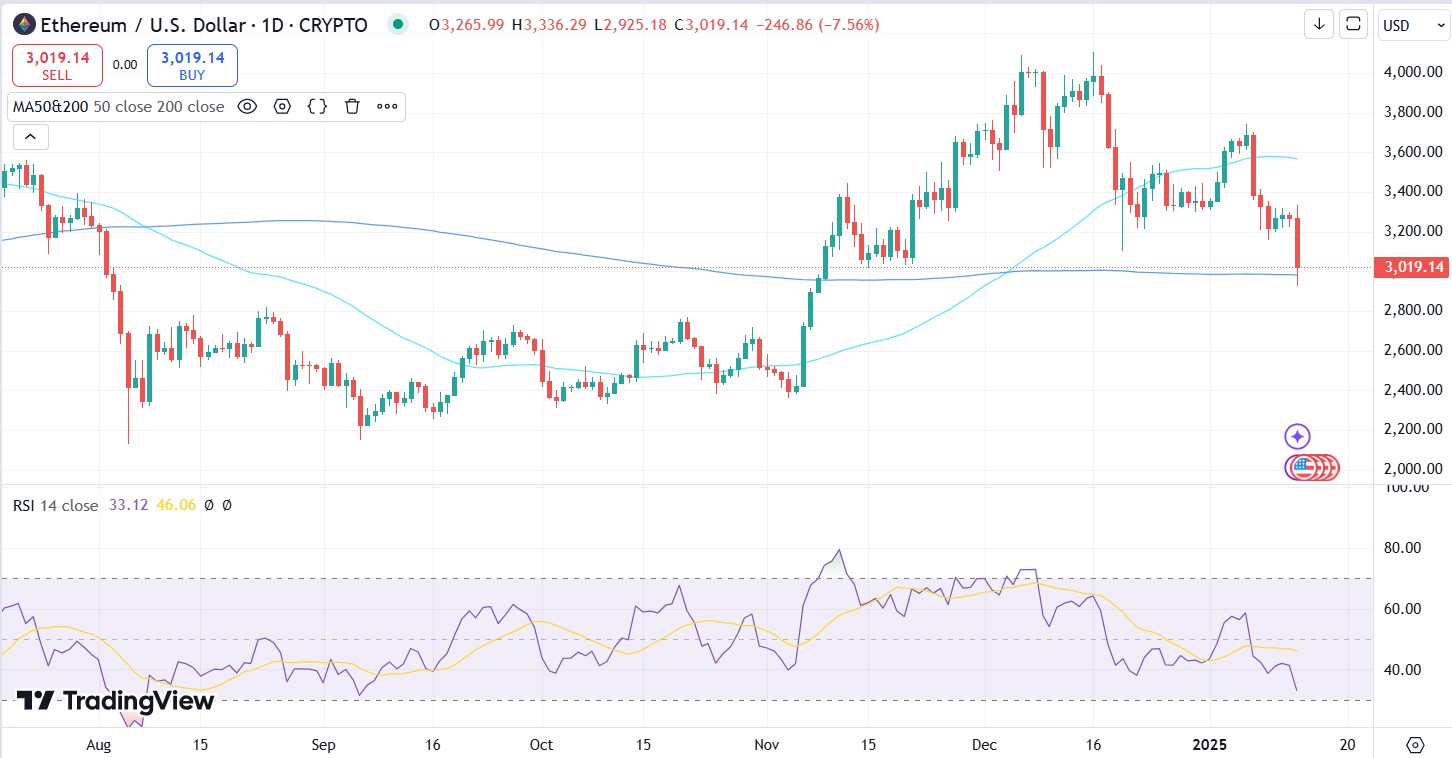
ETH Daily Price Chart, Source: TradingView
Additionally, the price is below the 50 and moving
averages. However, ETH's Relative Strength Index (RSI) is at the oversold
territory of 22, meaning there is a possibility of price reversing before a
further downward momentum can be seen.
Ether's price had remained in a consolidation, trading
between a low of $3,189 and a high of $3,330 before the price dipped to the current
level. On the daily chart, RSI is close to the oversold zone at 32, with the price
currently above the 50-moving average.
On the longer time chart, price had been on a downward
trend on the weekly chart since touching a high of $4,010 in December 2. A
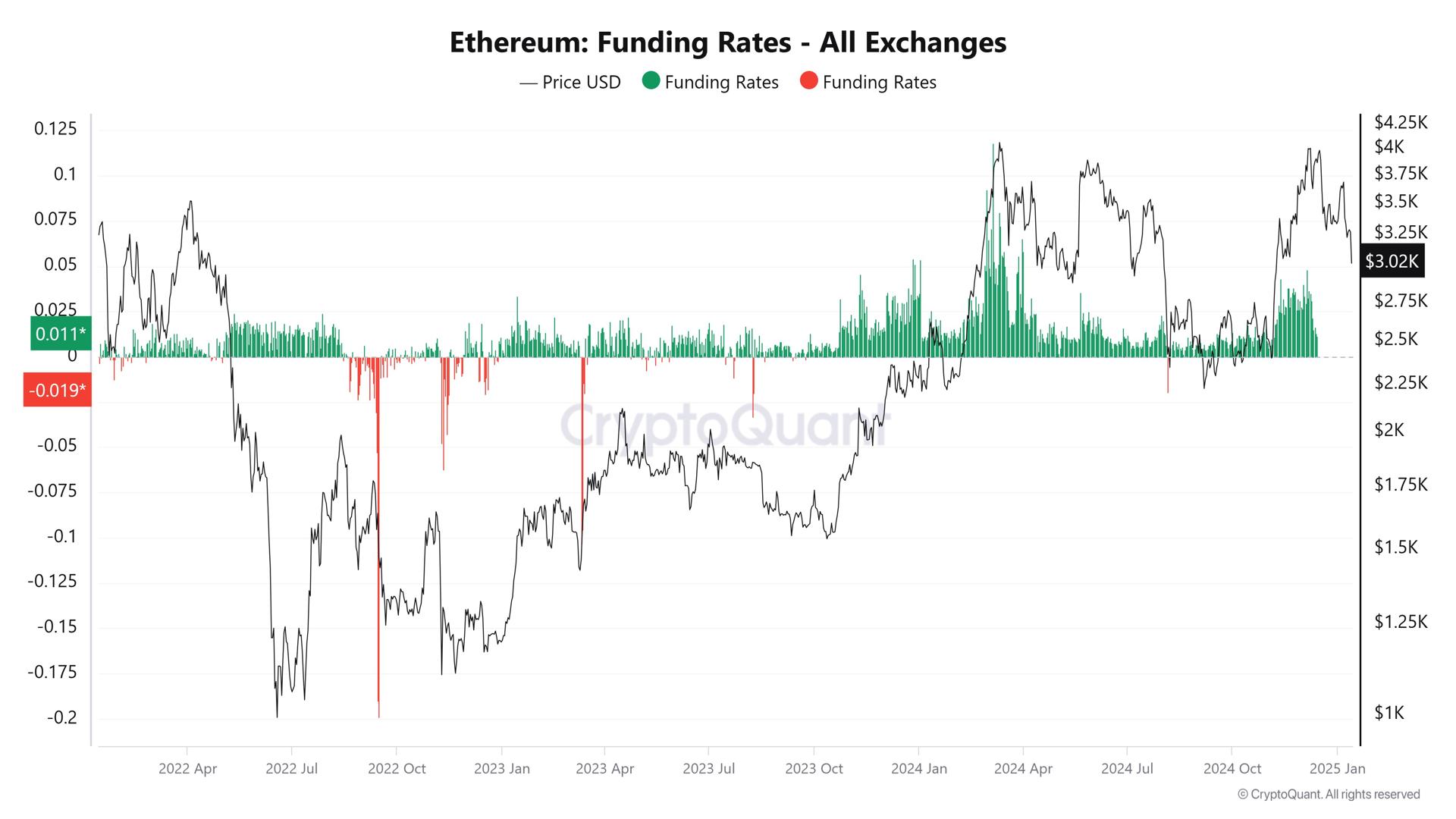
notable development is the recent drop in funding rates, which suggests
increasing bearish sentiment among traders.
Ethereum Funding Rates, Source: CryptoQuant
On-Chain Metrics
However, as Ethereum nears the $3,000 support zone,
funding rates have begun to show signs of recovery, indicating that some
traders are opening long positions in anticipation of a rebound, data from
CryptoQuant shows.
If these funding rates continue to recover, it could
signal the start of a bullish phase for Ethereum. However, if the recovery
falters and the bearish sentiment intensifies, further downside risks remain. Ethereum's price is at a crossroads, with its fate
likely tied to whether it can regain momentum.
Ethereum's price has been in a slump recently, slipping more than 15% in the past week amid bearish momentum in the overall crypto space. Ethereum's current struggles are mainly driven by a return to inflationary supply levels. Since April 2024, the network's supply has been increasing, which is the opposite of the deflationary environment it experienced after the Merger.
Ethereum's Price Outlook
The total supply has risen by 0.37% in the past nine
months, reaching 120.4 million ETH, according to data from Ultrasound.money This increased supply, coupled with lower
demand, has fueled concerns about the asset's price trajectory.
On the 4-hour chart on TradingView, Ethereum has dropped below the
$3,087 support level in a clear downtrend. The critical question for investors
now is whether Ethereum can maintain this support level, with failure to hold
above the support could lead to further declines.
ETH Daily Price Chart, Source: TradingView
Additionally, the price is below the 50 and moving
averages. However, ETH's Relative Strength Index (RSI) is at the oversold
territory of 22, meaning there is a possibility of price reversing before a
further downward momentum can be seen.
Ether's price had remained in a consolidation, trading
between a low of $3,189 and a high of $3,330 before the price dipped to the current
level. On the daily chart, RSI is close to the oversold zone at 32, with the price
currently above the 50-moving average.
On the longer time chart, price had been on a downward
trend on the weekly chart since touching a high of $4,010 in December 2. A
notable development is the recent drop in funding rates, which suggests
increasing bearish sentiment among traders.
Ethereum Funding Rates, Source: CryptoQuant
On-Chain Metrics
However, as Ethereum nears the $3,000 support zone,
funding rates have begun to show signs of recovery, indicating that some
traders are opening long positions in anticipation of a rebound, data from
CryptoQuant shows.
If these funding rates continue to recover, it could
signal the start of a bullish phase for Ethereum. However, if the recovery
falters and the bearish sentiment intensifies, further downside risks remain. Ethereum's price is at a crossroads, with its fate
likely tied to whether it can regain momentum.
Jared Kirui is an Editor at Finance Magnates with more than five years of experience in financial journalism. He covers online trading, fintech, payments, and crypto industries with a focus on companies, regulation and compliance, executive moves, trading technology, and market analysis.
His work has been featured in other media outlets, including Benzinga, ZyCrypto, The Distributed, and The Daily Hodl.
Education:
Bachelor of Commerce degree (Finance option), University of Nairobi
WhiteBIT secures brokerage license in Georgia to launch regulated crypto derivatives
FP Markets Winner Spotlight 🏆 | Global Broker of the Year 2025 #Trading #Broker #Innovation #Shorts
FP Markets Winner Spotlight 🏆 | Global Broker of the Year 2025 #Trading #Broker #Innovation #Shorts
FP Markets takes the spotlight as Global Broker of the Year 2025 at the Finance Magnates Awards.
Martin Stoilov, Head of Client Experience, shares that trust, innovation, and people played a key role in the company’s success, supported by a strong foundation of integrity and client-centricity.
Following this milestone, FP Markets continues to focus on growth, technology investment, and its core values of transparency and excellence.
👉 Be part of FM Awards 2026: https://awards.financemagnates.com/#nominate
FP Markets takes the spotlight as Global Broker of the Year 2025 at the Finance Magnates Awards.
Martin Stoilov, Head of Client Experience, shares that trust, innovation, and people played a key role in the company’s success, supported by a strong foundation of integrity and client-centricity.
Following this milestone, FP Markets continues to focus on growth, technology investment, and its core values of transparency and excellence.
👉 Be part of FM Awards 2026: https://awards.financemagnates.com/#nominate
In this video, we review @HolaPrimeMarketsOfficial, a multi-asset forex and CFDs broker offering different account types, trading platforms, and flexible trading conditions.
We cover the broker’s overall offering, including account options, trading environment, platforms like MT4 and MT5, and additional services such as managed accounts and fast withdrawals.
Watch the full video to see if Hola Prime Markets fits your trading needs.
📣 Stay up to date with the latest in finance and trading. Follow Finance Magnates for industry news, insights, and global event coverage.
Connect with us:
🔗 LinkedIn: /financemagnates
👍 Facebook: /financemagnates
📸 Instagram: https://www.instagram.com/financemagnates
🐦 X: https://x.com/financemagnates
🎥 TikTok: https://www.tiktok.com/tag/financemagnates
▶️ YouTube: /@financemagnates_official
#HolaPrime #ForexBroker #CFDTrading #FinanceMagnates #Trading #Forex #BrokerReview
In this video, we review @HolaPrimeMarketsOfficial, a multi-asset forex and CFDs broker offering different account types, trading platforms, and flexible trading conditions.
We cover the broker’s overall offering, including account options, trading environment, platforms like MT4 and MT5, and additional services such as managed accounts and fast withdrawals.
Watch the full video to see if Hola Prime Markets fits your trading needs.
📣 Stay up to date with the latest in finance and trading. Follow Finance Magnates for industry news, insights, and global event coverage.
Connect with us:
🔗 LinkedIn: /financemagnates
👍 Facebook: /financemagnates
📸 Instagram: https://www.instagram.com/financemagnates
🐦 X: https://x.com/financemagnates
🎥 TikTok: https://www.tiktok.com/tag/financemagnates
▶️ YouTube: /@financemagnates_official
#HolaPrime #ForexBroker #CFDTrading #FinanceMagnates #Trading #Forex #BrokerReview
Hola Prime Review: What You Need to Know | Full Breakdown by Finance Magnates
Hola Prime Review: What You Need to Know | Full Breakdown by Finance Magnates
In this video, we review @HolaPrime_Global, a proprietary trading firm offering evaluation programs and performance-based payouts in simulated market environments.
We cover how the challenge model works, including account types, profit splits (up to 95%), trading rules, and what it takes to reach a funded account. You’ll also learn about available platforms like MT4, MT5, cTrader, and more, along with insights into payouts, support, and trading conditions.
Watch the full video to see if Hola Prime fits your trading style.
📣 Stay up to date with the latest in finance and trading. Follow Finance Magnates for industry news, insights, and global event coverage.
Connect with us:
🔗 LinkedIn: /financemagnates
👍 Facebook: /financemagnates
📸 Instagram: https://www.instagram.com/financemagnates
🐦 X: https://x.com/financemagnates
🎥 TikTok: https://www.tiktok.com/tag/financemagnates
▶️ YouTube: /@financemagnates_official
#HolaPrime #PropFirm #Trading #FinanceMagnates #Forex #FuturesTrading #TradingReview #PropFirmReview
In this video, we review @HolaPrime_Global, a proprietary trading firm offering evaluation programs and performance-based payouts in simulated market environments.
We cover how the challenge model works, including account types, profit splits (up to 95%), trading rules, and what it takes to reach a funded account. You’ll also learn about available platforms like MT4, MT5, cTrader, and more, along with insights into payouts, support, and trading conditions.
Watch the full video to see if Hola Prime fits your trading style.
📣 Stay up to date with the latest in finance and trading. Follow Finance Magnates for industry news, insights, and global event coverage.
Connect with us:
🔗 LinkedIn: /financemagnates
👍 Facebook: /financemagnates
📸 Instagram: https://www.instagram.com/financemagnates
🐦 X: https://x.com/financemagnates
🎥 TikTok: https://www.tiktok.com/tag/financemagnates
▶️ YouTube: /@financemagnates_official
#HolaPrime #PropFirm #Trading #FinanceMagnates #Forex #FuturesTrading #TradingReview #PropFirmReview
Axi Winner Spotlight 🏆 | Global Most Innovative Broker 2025 #Innovation #Trading #Fintech #Broker
Axi Winner Spotlight 🏆 | Global Most Innovative Broker 2025 #Innovation #Trading #Fintech #Broker
Axi takes the spotlight at the Finance Magnates Awards, winning Global Most Innovative Broker 2025.
Olivia Xenofontos and Ivanna Openko share how the team will feel: proud, motivated, and ready to keep delivering.
They also describe the night as well-organized, focused, and enjoyable for all.
👉 Be part of FM Awards 2026.
Axi takes the spotlight at the Finance Magnates Awards, winning Global Most Innovative Broker 2025.
Olivia Xenofontos and Ivanna Openko share how the team will feel: proud, motivated, and ready to keep delivering.
They also describe the night as well-organized, focused, and enjoyable for all.
👉 Be part of FM Awards 2026.
Recognition that matters.
Built on transparency.
Driven by the industry.
The Finance Magnates Awards 2026.
Nominations are now open.
🔗 https://awards.financemagnates.com/?utm_source=SM&utm_medium=social&utm_campaign=recognition-matters
Recognition that matters.
Built on transparency.
Driven by the industry.
The Finance Magnates Awards 2026.
Nominations are now open.
🔗 https://awards.financemagnates.com/?utm_source=SM&utm_medium=social&utm_campaign=recognition-matters