The country’s financial regulator is concerned about the outflow of domestic funds overseas.
If everything is aligned, the rule is aimed to be in place by the end of H1 2024.
The South Korean Financial Services Commission (FSC) today (Thursday) published a legislative notice proposing a ban on cryptocurrency purchases using credit cards. If approved, the prohibitory rule will be imposed on the local citizens.
No Crypto on Credit
The highest financial regulator in South Korea proposed the restriction as it is concerned about the illegal outflows of domestic funds out of the country.
“Concerns have been raised about the illegal outflow of domestic funds overseas due to card payments on overseas virtual asset exchanges, money laundering, speculation, and encouragement of speculative activities,” the notice stated. “Accordingly, virtual assets [...] are stipulated as prohibited for payment.”
“In the future, it is expected that a basis for cooperation with international brands will be established and prevention of foreign currency outflow and money laundering will be strengthened.”
The FSC's proposal is now seeking feedback from the public and will be open until 13 February. It has to go through a review and resolution process, and if everything is in place, it will be effective in the first half of the year.
High Crypto Adoption Rate
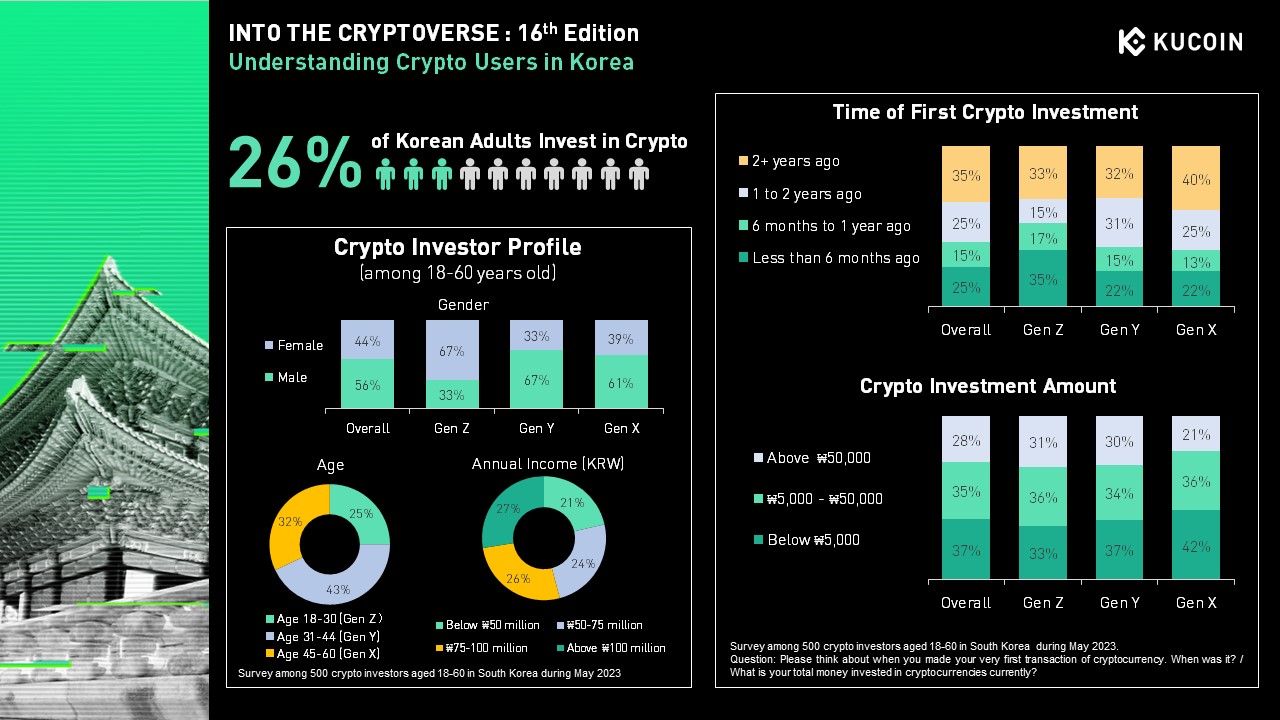
South Korea is one of the lucrative markets when it comes to cryptocurrencies. The country has a high crypto adoption rate. According to a KuCoin survey, 26 percent of South Korean adults are holding cryptocurrencies.
Crypto in South Korea, Source: KuCoin
The country already mandated the identification verification of all users for deposits and withdrawals from local cryptocurrency exchanges. However, these rules do not apply to overseas crypto exchanges targeting the local South Korean population.
South Korea is not the first to explore the restrictions of purchasing cryptocurrencies using credit cards. Earlier, Taiwan already banned the use of credit cards for crypto purchases and even asked banks and credit card companies not to partner with cryptocurrency service providers as merchants.
Meanwhile, several banks occasionally barred their customers holding credit cards from purchasing cryptocurrencies, mainly citing the volatility and risks associated with the asset class.
The South Korean Financial Services Commission (FSC) today (Thursday) published a legislative notice proposing a ban on cryptocurrency purchases using credit cards. If approved, the prohibitory rule will be imposed on the local citizens.
No Crypto on Credit
The highest financial regulator in South Korea proposed the restriction as it is concerned about the illegal outflows of domestic funds out of the country.
“Concerns have been raised about the illegal outflow of domestic funds overseas due to card payments on overseas virtual asset exchanges, money laundering, speculation, and encouragement of speculative activities,” the notice stated. “Accordingly, virtual assets [...] are stipulated as prohibited for payment.”
“In the future, it is expected that a basis for cooperation with international brands will be established and prevention of foreign currency outflow and money laundering will be strengthened.”
The FSC's proposal is now seeking feedback from the public and will be open until 13 February. It has to go through a review and resolution process, and if everything is in place, it will be effective in the first half of the year.
High Crypto Adoption Rate
South Korea is one of the lucrative markets when it comes to cryptocurrencies. The country has a high crypto adoption rate. According to a KuCoin survey, 26 percent of South Korean adults are holding cryptocurrencies.
Crypto in South Korea, Source: KuCoin
The country already mandated the identification verification of all users for deposits and withdrawals from local cryptocurrency exchanges. However, these rules do not apply to overseas crypto exchanges targeting the local South Korean population.
South Korea is not the first to explore the restrictions of purchasing cryptocurrencies using credit cards. Earlier, Taiwan already banned the use of credit cards for crypto purchases and even asked banks and credit card companies not to partner with cryptocurrency service providers as merchants.
Meanwhile, several banks occasionally barred their customers holding credit cards from purchasing cryptocurrencies, mainly citing the volatility and risks associated with the asset class.
Arnab Shome is an electronics engineer-turned-financial editor. He holds a Bachelor of Technology from the National Institute of Technology, Agartala. He entered the retail trading industry about a decade ago, covering the cryptocurrency market for Finance Magnates, and later expanded his coverage to include forex and CFDs as well.
His work at Finance Magnates includes C-level interviews, data-driven analysis, opinion pieces, and scoops of industry exclusives. He also contributes to Finance Magnates’ quarterly industry report.
Area of coverage:
1. CFD broker-related news
2. Industry-related Regulatory updates and developments
3. New retail trading trends
4. Prop trading industry updates
5. Executive interviews
Education:
Bachelor of Technology - National Institute of Technology, Agartala (India)
WhiteBIT secures brokerage license in Georgia to launch regulated crypto derivatives
FP Markets Winner Spotlight 🏆 | Global Broker of the Year 2025 #Trading #Broker #Innovation #Shorts
FP Markets Winner Spotlight 🏆 | Global Broker of the Year 2025 #Trading #Broker #Innovation #Shorts
FP Markets takes the spotlight as Global Broker of the Year 2025 at the Finance Magnates Awards.
Martin Stoilov, Head of Client Experience, shares that trust, innovation, and people played a key role in the company’s success, supported by a strong foundation of integrity and client-centricity.
Following this milestone, FP Markets continues to focus on growth, technology investment, and its core values of transparency and excellence.
👉 Be part of FM Awards 2026: https://awards.financemagnates.com/#nominate
FP Markets takes the spotlight as Global Broker of the Year 2025 at the Finance Magnates Awards.
Martin Stoilov, Head of Client Experience, shares that trust, innovation, and people played a key role in the company’s success, supported by a strong foundation of integrity and client-centricity.
Following this milestone, FP Markets continues to focus on growth, technology investment, and its core values of transparency and excellence.
👉 Be part of FM Awards 2026: https://awards.financemagnates.com/#nominate
In this video, we review @HolaPrimeMarketsOfficial, a multi-asset forex and CFDs broker offering different account types, trading platforms, and flexible trading conditions.
We cover the broker’s overall offering, including account options, trading environment, platforms like MT4 and MT5, and additional services such as managed accounts and fast withdrawals.
Watch the full video to see if Hola Prime Markets fits your trading needs.
📣 Stay up to date with the latest in finance and trading. Follow Finance Magnates for industry news, insights, and global event coverage.
Connect with us:
🔗 LinkedIn: /financemagnates
👍 Facebook: /financemagnates
📸 Instagram: https://www.instagram.com/financemagnates
🐦 X: https://x.com/financemagnates
🎥 TikTok: https://www.tiktok.com/tag/financemagnates
▶️ YouTube: /@financemagnates_official
#HolaPrime #ForexBroker #CFDTrading #FinanceMagnates #Trading #Forex #BrokerReview
In this video, we review @HolaPrimeMarketsOfficial, a multi-asset forex and CFDs broker offering different account types, trading platforms, and flexible trading conditions.
We cover the broker’s overall offering, including account options, trading environment, platforms like MT4 and MT5, and additional services such as managed accounts and fast withdrawals.
Watch the full video to see if Hola Prime Markets fits your trading needs.
📣 Stay up to date with the latest in finance and trading. Follow Finance Magnates for industry news, insights, and global event coverage.
Connect with us:
🔗 LinkedIn: /financemagnates
👍 Facebook: /financemagnates
📸 Instagram: https://www.instagram.com/financemagnates
🐦 X: https://x.com/financemagnates
🎥 TikTok: https://www.tiktok.com/tag/financemagnates
▶️ YouTube: /@financemagnates_official
#HolaPrime #ForexBroker #CFDTrading #FinanceMagnates #Trading #Forex #BrokerReview
Hola Prime Review: What You Need to Know | Full Breakdown by Finance Magnates
Hola Prime Review: What You Need to Know | Full Breakdown by Finance Magnates
In this video, we review @HolaPrime_Global, a proprietary trading firm offering evaluation programs and performance-based payouts in simulated market environments.
We cover how the challenge model works, including account types, profit splits (up to 95%), trading rules, and what it takes to reach a funded account. You’ll also learn about available platforms like MT4, MT5, cTrader, and more, along with insights into payouts, support, and trading conditions.
Watch the full video to see if Hola Prime fits your trading style.
📣 Stay up to date with the latest in finance and trading. Follow Finance Magnates for industry news, insights, and global event coverage.
Connect with us:
🔗 LinkedIn: /financemagnates
👍 Facebook: /financemagnates
📸 Instagram: https://www.instagram.com/financemagnates
🐦 X: https://x.com/financemagnates
🎥 TikTok: https://www.tiktok.com/tag/financemagnates
▶️ YouTube: /@financemagnates_official
#HolaPrime #PropFirm #Trading #FinanceMagnates #Forex #FuturesTrading #TradingReview #PropFirmReview
In this video, we review @HolaPrime_Global, a proprietary trading firm offering evaluation programs and performance-based payouts in simulated market environments.
We cover how the challenge model works, including account types, profit splits (up to 95%), trading rules, and what it takes to reach a funded account. You’ll also learn about available platforms like MT4, MT5, cTrader, and more, along with insights into payouts, support, and trading conditions.
Watch the full video to see if Hola Prime fits your trading style.
📣 Stay up to date with the latest in finance and trading. Follow Finance Magnates for industry news, insights, and global event coverage.
Connect with us:
🔗 LinkedIn: /financemagnates
👍 Facebook: /financemagnates
📸 Instagram: https://www.instagram.com/financemagnates
🐦 X: https://x.com/financemagnates
🎥 TikTok: https://www.tiktok.com/tag/financemagnates
▶️ YouTube: /@financemagnates_official
#HolaPrime #PropFirm #Trading #FinanceMagnates #Forex #FuturesTrading #TradingReview #PropFirmReview
Axi Winner Spotlight 🏆 | Global Most Innovative Broker 2025 #Innovation #Trading #Fintech #Broker
Axi Winner Spotlight 🏆 | Global Most Innovative Broker 2025 #Innovation #Trading #Fintech #Broker
Axi takes the spotlight at the Finance Magnates Awards, winning Global Most Innovative Broker 2025.
Olivia Xenofontos and Ivanna Openko share how the team will feel: proud, motivated, and ready to keep delivering.
They also describe the night as well-organized, focused, and enjoyable for all.
👉 Be part of FM Awards 2026.
Axi takes the spotlight at the Finance Magnates Awards, winning Global Most Innovative Broker 2025.
Olivia Xenofontos and Ivanna Openko share how the team will feel: proud, motivated, and ready to keep delivering.
They also describe the night as well-organized, focused, and enjoyable for all.
👉 Be part of FM Awards 2026.
Recognition that matters.
Built on transparency.
Driven by the industry.
The Finance Magnates Awards 2026.
Nominations are now open.
🔗 https://awards.financemagnates.com/?utm_source=SM&utm_medium=social&utm_campaign=recognition-matters
Recognition that matters.
Built on transparency.
Driven by the industry.
The Finance Magnates Awards 2026.
Nominations are now open.
🔗 https://awards.financemagnates.com/?utm_source=SM&utm_medium=social&utm_campaign=recognition-matters