South Korean exchanges like Upbit and Bithumb experienced temporary trading volume spikes and performance delays.
Bitcoin and XRP faced significant price volatility on South Korean exchanges, with temporary declines of up to 30%.
Bloomberg
Recent political developments in the US pushed crypto
market to unprecedent levels with Bitcoin recently reaching an all-time-high of
$99K. However, the developing political chaos in South Korea is reversing some of these gains.
The country plunged into political chaos today (Tuesday)
when President Yoon Suk Yeol declared emergency martial law. The Head of state
accused the opposition Democratic Party of Korea (DPK) of plotting rebellion
and undermining the nation's government, the Korea Times reported.
Bitcoin and XRP Prices Affected
This extraordinary decision has escalated tensions in
the country’s already polarized political landscape while triggering shockwaves
in cryptocurrency prices, especially among the region's exchanges.
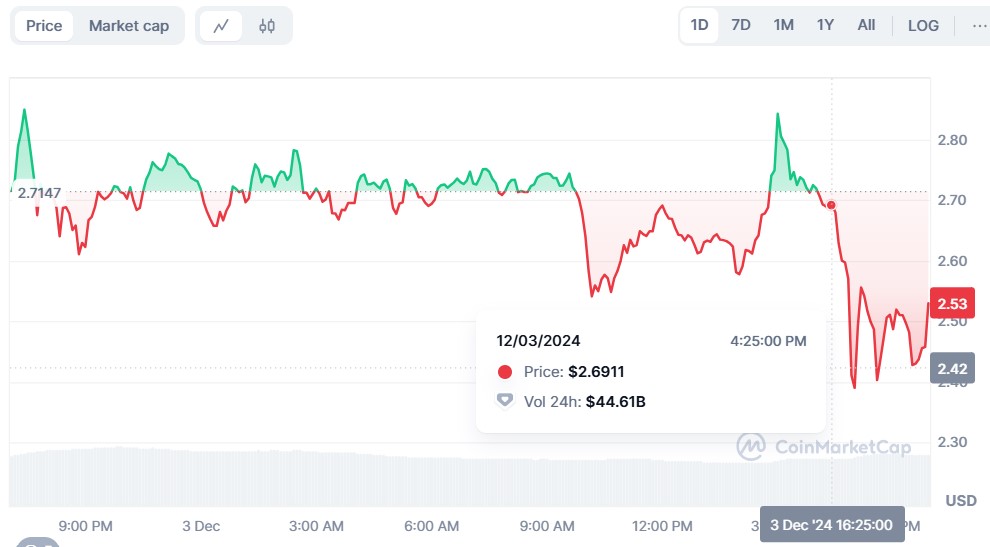
At the time of publication, XRP was down 12% in the
past day to trade at $2.45, according to CoinMarketCap. This is despite the
crypto, now ranked 3rd with a market cap of $139 billion, soaring
100% in the weekly chart.
XRP Price Chart, Source: CoinMarketCap
The political developments have also affected the leading
cryptocurrencies with most tokens now flashing red lights. Bitcoin is down 1.555
in the past day to $95k, while Ethereum has also dropped nearly 3%.
In a televised address, Yoon accused the opposition of
paralyzing the government through anti-state activities and described the
declaration of martial law as essential to safeguarding the nation’s democratic
foundations.
According to Yoon, this initiative is aimed at
eradicating pro-North Korean forces and protecting the constitutional order of
freedom. Bitcoin and XRP saw sharp, two of the recent top performers in the sector,
temporarily declined up to 30% on South Korean exchanges like Upbit, Coindesk
reported.
Trading volumes on local platforms, which often rival
global giants such as Binance and Coinbase, surged as traders reacted to the
news. Upbit and Bithumb, two of South Korea's largest
cryptocurrency exchanges, issued notices warning users about delayed site
performance due to the spike in activity.
Political Uncertainty in South Korea
The tipping point reportedly came when the DPK pushed
through a downsized budget bill and initiated impeachment motions against
senior government officials, including the state auditor and the chief
prosecutor.
Yoon further reportedly accused the DPK of shielding
its leader, Lee Jae-myung, from ongoing criminal trials. Under South Korea's constitution, martial law reportedly
grants the president sweeping powers, including the ability to restrict
freedoms such as press, assembly, and judicial independence.
The DPK, which holds a majority in the 300-seat
National Assembly, could technically terminate martial law through a vote.
However, access to the assembly was reportedly blocked shortly after Yoon's
declaration, preventing immediate action.
Recent political developments in the US pushed crypto
market to unprecedent levels with Bitcoin recently reaching an all-time-high of
$99K. However, the developing political chaos in South Korea is reversing some of these gains.
The country plunged into political chaos today (Tuesday)
when President Yoon Suk Yeol declared emergency martial law. The Head of state
accused the opposition Democratic Party of Korea (DPK) of plotting rebellion
and undermining the nation's government, the Korea Times reported.
Bitcoin and XRP Prices Affected
This extraordinary decision has escalated tensions in
the country’s already polarized political landscape while triggering shockwaves
in cryptocurrency prices, especially among the region's exchanges.
At the time of publication, XRP was down 12% in the
past day to trade at $2.45, according to CoinMarketCap. This is despite the
crypto, now ranked 3rd with a market cap of $139 billion, soaring
100% in the weekly chart.
XRP Price Chart, Source: CoinMarketCap
The political developments have also affected the leading
cryptocurrencies with most tokens now flashing red lights. Bitcoin is down 1.555
in the past day to $95k, while Ethereum has also dropped nearly 3%.
In a televised address, Yoon accused the opposition of
paralyzing the government through anti-state activities and described the
declaration of martial law as essential to safeguarding the nation’s democratic
foundations.
According to Yoon, this initiative is aimed at
eradicating pro-North Korean forces and protecting the constitutional order of
freedom. Bitcoin and XRP saw sharp, two of the recent top performers in the sector,
temporarily declined up to 30% on South Korean exchanges like Upbit, Coindesk
reported.
Trading volumes on local platforms, which often rival
global giants such as Binance and Coinbase, surged as traders reacted to the
news. Upbit and Bithumb, two of South Korea's largest
cryptocurrency exchanges, issued notices warning users about delayed site
performance due to the spike in activity.
Political Uncertainty in South Korea
The tipping point reportedly came when the DPK pushed
through a downsized budget bill and initiated impeachment motions against
senior government officials, including the state auditor and the chief
prosecutor.
Yoon further reportedly accused the DPK of shielding
its leader, Lee Jae-myung, from ongoing criminal trials. Under South Korea's constitution, martial law reportedly
grants the president sweeping powers, including the ability to restrict
freedoms such as press, assembly, and judicial independence.
The DPK, which holds a majority in the 300-seat
National Assembly, could technically terminate martial law through a vote.
However, access to the assembly was reportedly blocked shortly after Yoon's
declaration, preventing immediate action.
Jared Kirui is an Editor at Finance Magnates with more than five years of experience in financial journalism. He covers online trading, fintech, payments, and crypto industries with a focus on companies, regulation and compliance, executive moves, trading technology, and market analysis.
His work has been featured in other media outlets, including Benzinga, ZyCrypto, The Distributed, and The Daily Hodl.
Education:
Bachelor of Commerce degree (Finance option), University of Nairobi
WhiteBIT secures brokerage license in Georgia to launch regulated crypto derivatives
FP Markets Winner Spotlight 🏆 | Global Broker of the Year 2025 #Trading #Broker #Innovation #Shorts
FP Markets Winner Spotlight 🏆 | Global Broker of the Year 2025 #Trading #Broker #Innovation #Shorts
FP Markets takes the spotlight as Global Broker of the Year 2025 at the Finance Magnates Awards.
Martin Stoilov, Head of Client Experience, shares that trust, innovation, and people played a key role in the company’s success, supported by a strong foundation of integrity and client-centricity.
Following this milestone, FP Markets continues to focus on growth, technology investment, and its core values of transparency and excellence.
👉 Be part of FM Awards 2026: https://awards.financemagnates.com/#nominate
FP Markets takes the spotlight as Global Broker of the Year 2025 at the Finance Magnates Awards.
Martin Stoilov, Head of Client Experience, shares that trust, innovation, and people played a key role in the company’s success, supported by a strong foundation of integrity and client-centricity.
Following this milestone, FP Markets continues to focus on growth, technology investment, and its core values of transparency and excellence.
👉 Be part of FM Awards 2026: https://awards.financemagnates.com/#nominate
In this video, we review @HolaPrimeMarketsOfficial, a multi-asset forex and CFDs broker offering different account types, trading platforms, and flexible trading conditions.
We cover the broker’s overall offering, including account options, trading environment, platforms like MT4 and MT5, and additional services such as managed accounts and fast withdrawals.
Watch the full video to see if Hola Prime Markets fits your trading needs.
📣 Stay up to date with the latest in finance and trading. Follow Finance Magnates for industry news, insights, and global event coverage.
Connect with us:
🔗 LinkedIn: /financemagnates
👍 Facebook: /financemagnates
📸 Instagram: https://www.instagram.com/financemagnates
🐦 X: https://x.com/financemagnates
🎥 TikTok: https://www.tiktok.com/tag/financemagnates
▶️ YouTube: /@financemagnates_official
#HolaPrime #ForexBroker #CFDTrading #FinanceMagnates #Trading #Forex #BrokerReview
In this video, we review @HolaPrimeMarketsOfficial, a multi-asset forex and CFDs broker offering different account types, trading platforms, and flexible trading conditions.
We cover the broker’s overall offering, including account options, trading environment, platforms like MT4 and MT5, and additional services such as managed accounts and fast withdrawals.
Watch the full video to see if Hola Prime Markets fits your trading needs.
📣 Stay up to date with the latest in finance and trading. Follow Finance Magnates for industry news, insights, and global event coverage.
Connect with us:
🔗 LinkedIn: /financemagnates
👍 Facebook: /financemagnates
📸 Instagram: https://www.instagram.com/financemagnates
🐦 X: https://x.com/financemagnates
🎥 TikTok: https://www.tiktok.com/tag/financemagnates
▶️ YouTube: /@financemagnates_official
#HolaPrime #ForexBroker #CFDTrading #FinanceMagnates #Trading #Forex #BrokerReview
Hola Prime Review: What You Need to Know | Full Breakdown by Finance Magnates
Hola Prime Review: What You Need to Know | Full Breakdown by Finance Magnates
In this video, we review @HolaPrime_Global, a proprietary trading firm offering evaluation programs and performance-based payouts in simulated market environments.
We cover how the challenge model works, including account types, profit splits (up to 95%), trading rules, and what it takes to reach a funded account. You’ll also learn about available platforms like MT4, MT5, cTrader, and more, along with insights into payouts, support, and trading conditions.
Watch the full video to see if Hola Prime fits your trading style.
📣 Stay up to date with the latest in finance and trading. Follow Finance Magnates for industry news, insights, and global event coverage.
Connect with us:
🔗 LinkedIn: /financemagnates
👍 Facebook: /financemagnates
📸 Instagram: https://www.instagram.com/financemagnates
🐦 X: https://x.com/financemagnates
🎥 TikTok: https://www.tiktok.com/tag/financemagnates
▶️ YouTube: /@financemagnates_official
#HolaPrime #PropFirm #Trading #FinanceMagnates #Forex #FuturesTrading #TradingReview #PropFirmReview
In this video, we review @HolaPrime_Global, a proprietary trading firm offering evaluation programs and performance-based payouts in simulated market environments.
We cover how the challenge model works, including account types, profit splits (up to 95%), trading rules, and what it takes to reach a funded account. You’ll also learn about available platforms like MT4, MT5, cTrader, and more, along with insights into payouts, support, and trading conditions.
Watch the full video to see if Hola Prime fits your trading style.
📣 Stay up to date with the latest in finance and trading. Follow Finance Magnates for industry news, insights, and global event coverage.
Connect with us:
🔗 LinkedIn: /financemagnates
👍 Facebook: /financemagnates
📸 Instagram: https://www.instagram.com/financemagnates
🐦 X: https://x.com/financemagnates
🎥 TikTok: https://www.tiktok.com/tag/financemagnates
▶️ YouTube: /@financemagnates_official
#HolaPrime #PropFirm #Trading #FinanceMagnates #Forex #FuturesTrading #TradingReview #PropFirmReview
Axi Winner Spotlight 🏆 | Global Most Innovative Broker 2025 #Innovation #Trading #Fintech #Broker
Axi Winner Spotlight 🏆 | Global Most Innovative Broker 2025 #Innovation #Trading #Fintech #Broker
Axi takes the spotlight at the Finance Magnates Awards, winning Global Most Innovative Broker 2025.
Olivia Xenofontos and Ivanna Openko share how the team will feel: proud, motivated, and ready to keep delivering.
They also describe the night as well-organized, focused, and enjoyable for all.
👉 Be part of FM Awards 2026.
Axi takes the spotlight at the Finance Magnates Awards, winning Global Most Innovative Broker 2025.
Olivia Xenofontos and Ivanna Openko share how the team will feel: proud, motivated, and ready to keep delivering.
They also describe the night as well-organized, focused, and enjoyable for all.
👉 Be part of FM Awards 2026.
Recognition that matters.
Built on transparency.
Driven by the industry.
The Finance Magnates Awards 2026.
Nominations are now open.
🔗 https://awards.financemagnates.com/?utm_source=SM&utm_medium=social&utm_campaign=recognition-matters
Recognition that matters.
Built on transparency.
Driven by the industry.
The Finance Magnates Awards 2026.
Nominations are now open.
🔗 https://awards.financemagnates.com/?utm_source=SM&utm_medium=social&utm_campaign=recognition-matters