Pi Network's Open Mainnet launch sparks debate: innovation or overhyped speculation?
Pi Coin faces liquidity concerns and questions about its true value.
Critics highlight Pi Network's opaque operations and unconventional mining methods.
Pi Network's launch results in both excitement and claims of a scam (image via. Pi Network).
Pi Network's Open Mainnet is live, allowing external trading of Pi
Coin; major exchanges are listing it, but skepticism persists due to
transparency issues.
Major players like OKX and Bitget have already jumped on the bandwagon,
listing Pi Coin and offering enticing promotions to woo traders. Bitget, for
instance, has unveiled a $60,000 Pi airdrop pool running until March 3, aiming
to reward active users and stimulate trading activity. Meanwhile, Binance, the
behemoth of crypto exchanges, is taking a more democratic approach by holding a
community vote to decide on Pi Coin's listing, with results expected on
February 27.
This launch marks a significant milestone for Pi Network, a project
that has spent years in development, amassing a dedicated community of users.
However, with the excitement also comes scrutiny, as skeptics question the
project's fundamentals and long-term viability.
Pi Coin's Rollercoaster Debut
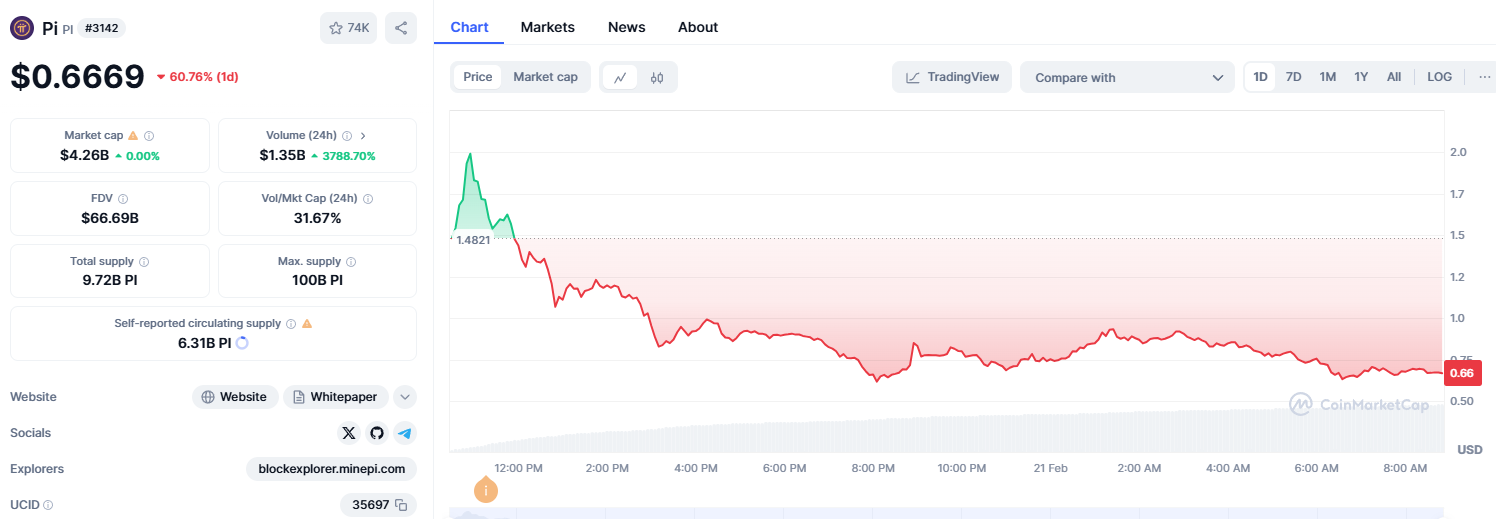
The launch wasn't without its theatrics. Pi Coin made a dramatic
entrance, debuting at $1.70 and soaring to $2.00 before taking a nosedive,
shedding 50% of its value within hours. This wild ride pegged its fully diluted
valuation at a staggering $195 billion, rivaling established giants in the
crypto space.
Screenshot from CoinMarketCap.com at 8.58 am GMT+2
However, liquidity—or the glaring lack thereof—has been a sticking
point. On OKX, the 2% market depth didn't even breach the $100,000 mark,
raising eyebrows and questions about the coin's real-world utility and demand.
Despite the high valuation on paper, actual trading volume and accessibility
remain low, leading some to speculate that the market price may not reflect genuine
demand.
Moreover, the Pi Network community has been vocal about maintaining a
"closed economy" model to avoid speculation. However, with the Open
Mainnet now active, the true test lies in how the market reacts to freely
tradable Pi Coins, especially given the cautious stance of some major
exchanges.
Mining for Pi: A New Frontier or Fool's Gold?
Pi Network's claim to fame is its novel approach to mining. Gone are
the days of power-hungry rigs and complex algorithms. Instead, Pi offers a
mobile app where users “mine” by simply tapping a button daily. This
gamified experience has attracted a massive user base, with the network
boasting 60 million users, 10.14 million Mainnet migrations, and 19 million
completing the KYC process.
But not everyone is sold. Critics argue that this tap-to-mine model is
more about habitual conditioning than genuine blockchain innovation. The lack
of transparency regarding the core team's operations and the absence of smart
contracts even after six years have only added fuel to the fire of skepticism.
The Pi Network model has been compared to past mobile-based mining
projects that promised decentralized wealth but struggled to maintain value
when faced with real-world market forces. Without a clear mechanism for
sustainable adoption beyond speculative trading, many remain cautious about its
long-term prospects.
Bybit CEO Ben Zhou has firmly rejected the listing of Pi Coin, labeling it a “big scam.” Zhou, who previously dismissed an invitation to join Pi Network as “ridiculous,” emphasized that Bybit does not list scams, pointing to a 2023 Chinese police warning classifying Pi Network as fraudulent. The backlash from Pi supporters included claims that Bybit had applied for a listing and was rejected, but Zhou denied these allegations, urging the Pi team to address scam concerns rather than attack critics.
Skeptic's Corner: Unanswered Questions Loom
While the Pi community is buzzing with excitement, a chorus of critics
remains unconvinced. The opaque nature of Pi Network's operations,
discrepancies in user statistics, and an unconventional mining process have all
been points of contention. The project's reluctance to fully disclose its
blockchain technology and the control retained by the core team over active
mainnet nodes have led some to question the project's decentralization claims.
Additionally, concerns about the real utility of Pi Coin persist. Many
projects have launched with great fanfare, only to struggle to deliver real-world applications beyond speculative trading. The fact that Pi Coin has
such a high theoretical valuation without corresponding liquidity raises
concerns that its price may not be sustainable in the long run.
As Pi Coin steps into the limelight, potential investors are urged to
tread carefully, armed with a healthy dose of skepticism and due diligence.
While the project has certainly captured the imagination of millions, only time
will tell whether it can transition from an ambitious experiment to a
legitimate force in the crypto world.
Pi Network's Open Mainnet is live, allowing external trading of Pi
Coin; major exchanges are listing it, but skepticism persists due to
transparency issues.
Major players like OKX and Bitget have already jumped on the bandwagon,
listing Pi Coin and offering enticing promotions to woo traders. Bitget, for
instance, has unveiled a $60,000 Pi airdrop pool running until March 3, aiming
to reward active users and stimulate trading activity. Meanwhile, Binance, the
behemoth of crypto exchanges, is taking a more democratic approach by holding a
community vote to decide on Pi Coin's listing, with results expected on
February 27.
This launch marks a significant milestone for Pi Network, a project
that has spent years in development, amassing a dedicated community of users.
However, with the excitement also comes scrutiny, as skeptics question the
project's fundamentals and long-term viability.
Pi Coin's Rollercoaster Debut
The launch wasn't without its theatrics. Pi Coin made a dramatic
entrance, debuting at $1.70 and soaring to $2.00 before taking a nosedive,
shedding 50% of its value within hours. This wild ride pegged its fully diluted
valuation at a staggering $195 billion, rivaling established giants in the
crypto space.
Screenshot from CoinMarketCap.com at 8.58 am GMT+2
However, liquidity—or the glaring lack thereof—has been a sticking
point. On OKX, the 2% market depth didn't even breach the $100,000 mark,
raising eyebrows and questions about the coin's real-world utility and demand.
Despite the high valuation on paper, actual trading volume and accessibility
remain low, leading some to speculate that the market price may not reflect genuine
demand.
Moreover, the Pi Network community has been vocal about maintaining a
"closed economy" model to avoid speculation. However, with the Open
Mainnet now active, the true test lies in how the market reacts to freely
tradable Pi Coins, especially given the cautious stance of some major
exchanges.
Mining for Pi: A New Frontier or Fool's Gold?
Pi Network's claim to fame is its novel approach to mining. Gone are
the days of power-hungry rigs and complex algorithms. Instead, Pi offers a
mobile app where users “mine” by simply tapping a button daily. This
gamified experience has attracted a massive user base, with the network
boasting 60 million users, 10.14 million Mainnet migrations, and 19 million
completing the KYC process.
But not everyone is sold. Critics argue that this tap-to-mine model is
more about habitual conditioning than genuine blockchain innovation. The lack
of transparency regarding the core team's operations and the absence of smart
contracts even after six years have only added fuel to the fire of skepticism.
The Pi Network model has been compared to past mobile-based mining
projects that promised decentralized wealth but struggled to maintain value
when faced with real-world market forces. Without a clear mechanism for
sustainable adoption beyond speculative trading, many remain cautious about its
long-term prospects.
Bybit CEO Ben Zhou has firmly rejected the listing of Pi Coin, labeling it a “big scam.” Zhou, who previously dismissed an invitation to join Pi Network as “ridiculous,” emphasized that Bybit does not list scams, pointing to a 2023 Chinese police warning classifying Pi Network as fraudulent. The backlash from Pi supporters included claims that Bybit had applied for a listing and was rejected, but Zhou denied these allegations, urging the Pi team to address scam concerns rather than attack critics.
Skeptic's Corner: Unanswered Questions Loom
While the Pi community is buzzing with excitement, a chorus of critics
remains unconvinced. The opaque nature of Pi Network's operations,
discrepancies in user statistics, and an unconventional mining process have all
been points of contention. The project's reluctance to fully disclose its
blockchain technology and the control retained by the core team over active
mainnet nodes have led some to question the project's decentralization claims.
Additionally, concerns about the real utility of Pi Coin persist. Many
projects have launched with great fanfare, only to struggle to deliver real-world applications beyond speculative trading. The fact that Pi Coin has
such a high theoretical valuation without corresponding liquidity raises
concerns that its price may not be sustainable in the long run.
As Pi Coin steps into the limelight, potential investors are urged to
tread carefully, armed with a healthy dose of skepticism and due diligence.
While the project has certainly captured the imagination of millions, only time
will tell whether it can transition from an ambitious experiment to a
legitimate force in the crypto world.
Louis Parks has lived and worked in and around the Middle East for much of his professional career. He writes about the meeting of the tech and finance worlds.
Kraken Steps Up Speed Race with New Equinix Colocation Service for Crypto Traders
FP Markets Winner Spotlight 🏆 | Global Broker of the Year 2025 #Trading #Broker #Innovation #Shorts
FP Markets Winner Spotlight 🏆 | Global Broker of the Year 2025 #Trading #Broker #Innovation #Shorts
FP Markets takes the spotlight as Global Broker of the Year 2025 at the Finance Magnates Awards.
Martin Stoilov, Head of Client Experience, shares that trust, innovation, and people played a key role in the company’s success, supported by a strong foundation of integrity and client-centricity.
Following this milestone, FP Markets continues to focus on growth, technology investment, and its core values of transparency and excellence.
👉 Be part of FM Awards 2026: https://awards.financemagnates.com/#nominate
FP Markets takes the spotlight as Global Broker of the Year 2025 at the Finance Magnates Awards.
Martin Stoilov, Head of Client Experience, shares that trust, innovation, and people played a key role in the company’s success, supported by a strong foundation of integrity and client-centricity.
Following this milestone, FP Markets continues to focus on growth, technology investment, and its core values of transparency and excellence.
👉 Be part of FM Awards 2026: https://awards.financemagnates.com/#nominate
In this video, we review @HolaPrimeMarketsOfficial, a multi-asset forex and CFDs broker offering different account types, trading platforms, and flexible trading conditions.
We cover the broker’s overall offering, including account options, trading environment, platforms like MT4 and MT5, and additional services such as managed accounts and fast withdrawals.
Watch the full video to see if Hola Prime Markets fits your trading needs.
📣 Stay up to date with the latest in finance and trading. Follow Finance Magnates for industry news, insights, and global event coverage.
Connect with us:
🔗 LinkedIn: /financemagnates
👍 Facebook: /financemagnates
📸 Instagram: https://www.instagram.com/financemagnates
🐦 X: https://x.com/financemagnates
🎥 TikTok: https://www.tiktok.com/tag/financemagnates
▶️ YouTube: /@financemagnates_official
#HolaPrime #ForexBroker #CFDTrading #FinanceMagnates #Trading #Forex #BrokerReview
In this video, we review @HolaPrimeMarketsOfficial, a multi-asset forex and CFDs broker offering different account types, trading platforms, and flexible trading conditions.
We cover the broker’s overall offering, including account options, trading environment, platforms like MT4 and MT5, and additional services such as managed accounts and fast withdrawals.
Watch the full video to see if Hola Prime Markets fits your trading needs.
📣 Stay up to date with the latest in finance and trading. Follow Finance Magnates for industry news, insights, and global event coverage.
Connect with us:
🔗 LinkedIn: /financemagnates
👍 Facebook: /financemagnates
📸 Instagram: https://www.instagram.com/financemagnates
🐦 X: https://x.com/financemagnates
🎥 TikTok: https://www.tiktok.com/tag/financemagnates
▶️ YouTube: /@financemagnates_official
#HolaPrime #ForexBroker #CFDTrading #FinanceMagnates #Trading #Forex #BrokerReview
Hola Prime Review: What You Need to Know | Full Breakdown by Finance Magnates
Hola Prime Review: What You Need to Know | Full Breakdown by Finance Magnates
In this video, we review @HolaPrime_Global, a proprietary trading firm offering evaluation programs and performance-based payouts in simulated market environments.
We cover how the challenge model works, including account types, profit splits (up to 95%), trading rules, and what it takes to reach a funded account. You’ll also learn about available platforms like MT4, MT5, cTrader, and more, along with insights into payouts, support, and trading conditions.
Watch the full video to see if Hola Prime fits your trading style.
📣 Stay up to date with the latest in finance and trading. Follow Finance Magnates for industry news, insights, and global event coverage.
Connect with us:
🔗 LinkedIn: /financemagnates
👍 Facebook: /financemagnates
📸 Instagram: https://www.instagram.com/financemagnates
🐦 X: https://x.com/financemagnates
🎥 TikTok: https://www.tiktok.com/tag/financemagnates
▶️ YouTube: /@financemagnates_official
#HolaPrime #PropFirm #Trading #FinanceMagnates #Forex #FuturesTrading #TradingReview #PropFirmReview
In this video, we review @HolaPrime_Global, a proprietary trading firm offering evaluation programs and performance-based payouts in simulated market environments.
We cover how the challenge model works, including account types, profit splits (up to 95%), trading rules, and what it takes to reach a funded account. You’ll also learn about available platforms like MT4, MT5, cTrader, and more, along with insights into payouts, support, and trading conditions.
Watch the full video to see if Hola Prime fits your trading style.
📣 Stay up to date with the latest in finance and trading. Follow Finance Magnates for industry news, insights, and global event coverage.
Connect with us:
🔗 LinkedIn: /financemagnates
👍 Facebook: /financemagnates
📸 Instagram: https://www.instagram.com/financemagnates
🐦 X: https://x.com/financemagnates
🎥 TikTok: https://www.tiktok.com/tag/financemagnates
▶️ YouTube: /@financemagnates_official
#HolaPrime #PropFirm #Trading #FinanceMagnates #Forex #FuturesTrading #TradingReview #PropFirmReview
Axi Winner Spotlight 🏆 | Global Most Innovative Broker 2025 #Innovation #Trading #Fintech #Broker
Axi Winner Spotlight 🏆 | Global Most Innovative Broker 2025 #Innovation #Trading #Fintech #Broker
Axi takes the spotlight at the Finance Magnates Awards, winning Global Most Innovative Broker 2025.
Olivia Xenofontos and Ivanna Openko share how the team will feel: proud, motivated, and ready to keep delivering.
They also describe the night as well-organized, focused, and enjoyable for all.
👉 Be part of FM Awards 2026.
Axi takes the spotlight at the Finance Magnates Awards, winning Global Most Innovative Broker 2025.
Olivia Xenofontos and Ivanna Openko share how the team will feel: proud, motivated, and ready to keep delivering.
They also describe the night as well-organized, focused, and enjoyable for all.
👉 Be part of FM Awards 2026.
Recognition that matters.
Built on transparency.
Driven by the industry.
The Finance Magnates Awards 2026.
Nominations are now open.
🔗 https://awards.financemagnates.com/?utm_source=SM&utm_medium=social&utm_campaign=recognition-matters
Recognition that matters.
Built on transparency.
Driven by the industry.
The Finance Magnates Awards 2026.
Nominations are now open.
🔗 https://awards.financemagnates.com/?utm_source=SM&utm_medium=social&utm_campaign=recognition-matters