The acquisition aims to enable retail and institutional traders to access automated multi-asset strategies without coding expertise.
It reportedly supports Kraken’s strategy to expand its platform beyond crypto, adding automation tools for stocks, FX, and derivatives.
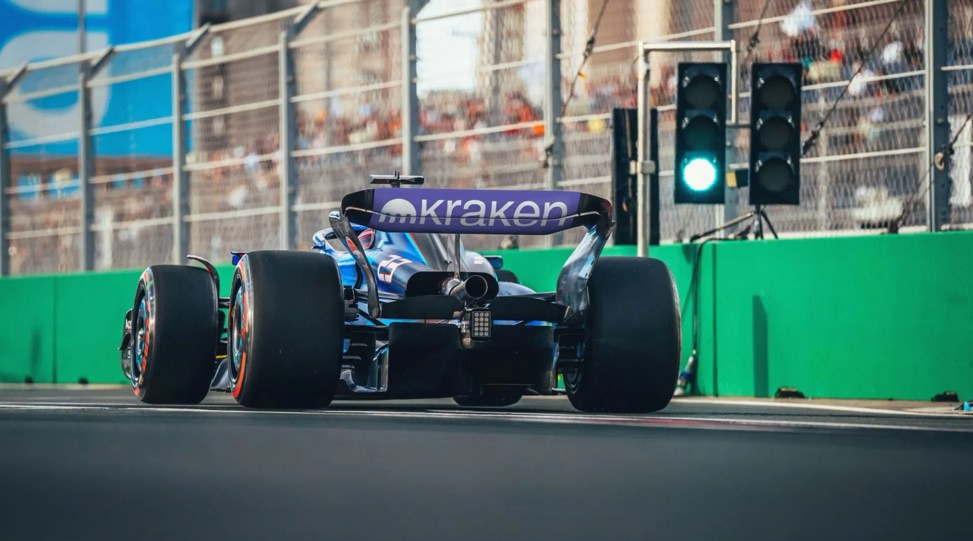
The Kraken branding behind an F1 car
Kraken has acquired Capitalise.ai, an Israel-based developer
of no-code trading automation tools, as it looks to make advanced strategy
design and execution accessible to a broader range of traders. The deal will
see Capitalise.ai’s technology integrated into Kraken Pro, with a phased
rollout planned later this year.
Kraken Eyes Trade Automation
Founded in 2015, Capitalise.ai created a platform that
converts natural-language instructions into executable trading strategies. The
system draws on both real-time and historical market data across equities,
crypto, FX, futures, and options, allowing users to build, backtest, and
automate trades using everyday text.
Kraken said the integration is aimed at lowering barriers
for retail and professional traders alike. “This acquisition gives Kraken Pro
clients a powerful new way to act on ideas in real time—testing, optimizing,
and executing bespoke strategies with unprecedented speed and confidence,” said
Shannon Kurtas, Head of Exchange at Kraken.
Capitalise.ai’s software has already been deployed by
several traditional finance brokers and exchanges. As part of the deal, Capitalise.ai’s co-founders Amir Shiovich and Shahar
Rabin, along with their product and engineering teams, will join Kraken to
continue development under the Pro business unit.
Capitalise.ai co-founders: Amir Shiovich (left), and Shahar Rabin
The acquisition highlights Kraken’s push to expand the scope
of its Pro platform beyond crypto trading. By adding Capitalise.ai’s no-code
technology, users will be able to automate strategies for digital assets, stocks, foreign exchange, and derivatives.
More Collaborations by Capitalise.ai
Capitalise.ai has been expanding its reach with
collaborations with various global firms. The most notable was last year when
the firm entered into a partnership with Microsoft to advance text-based
services in the financial markets.
The collaboration aimed to deliver improved tools for
traders, investors, and financial institutions, with a focus on streamlining
data use, enabling automation, and enhancing interaction with real-time market
information.
As part of the agreement, Microsoft will integrate
Capitalise.ai’s technology into its Microsoft Cloud for Financial Services.
This move is expected to extend the reach of Capitalise.ai’s platform,
leveraging Microsoft’s global footprint and cloud infrastructure to make the
solution accessible to a wider base of users.
Kraken has acquired Capitalise.ai, an Israel-based developer
of no-code trading automation tools, as it looks to make advanced strategy
design and execution accessible to a broader range of traders. The deal will
see Capitalise.ai’s technology integrated into Kraken Pro, with a phased
rollout planned later this year.
Kraken Eyes Trade Automation
Founded in 2015, Capitalise.ai created a platform that
converts natural-language instructions into executable trading strategies. The
system draws on both real-time and historical market data across equities,
crypto, FX, futures, and options, allowing users to build, backtest, and
automate trades using everyday text.
Kraken said the integration is aimed at lowering barriers
for retail and professional traders alike. “This acquisition gives Kraken Pro
clients a powerful new way to act on ideas in real time—testing, optimizing,
and executing bespoke strategies with unprecedented speed and confidence,” said
Shannon Kurtas, Head of Exchange at Kraken.
Capitalise.ai’s software has already been deployed by
several traditional finance brokers and exchanges. As part of the deal, Capitalise.ai’s co-founders Amir Shiovich and Shahar
Rabin, along with their product and engineering teams, will join Kraken to
continue development under the Pro business unit.
Capitalise.ai co-founders: Amir Shiovich (left), and Shahar Rabin
The acquisition highlights Kraken’s push to expand the scope
of its Pro platform beyond crypto trading. By adding Capitalise.ai’s no-code
technology, users will be able to automate strategies for digital assets, stocks, foreign exchange, and derivatives.
More Collaborations by Capitalise.ai
Capitalise.ai has been expanding its reach with
collaborations with various global firms. The most notable was last year when
the firm entered into a partnership with Microsoft to advance text-based
services in the financial markets.
The collaboration aimed to deliver improved tools for
traders, investors, and financial institutions, with a focus on streamlining
data use, enabling automation, and enhancing interaction with real-time market
information.
As part of the agreement, Microsoft will integrate
Capitalise.ai’s technology into its Microsoft Cloud for Financial Services.
This move is expected to extend the reach of Capitalise.ai’s platform,
leveraging Microsoft’s global footprint and cloud infrastructure to make the
solution accessible to a wider base of users.
Jared Kirui is an Editor at Finance Magnates with more than five years of experience in financial journalism. He covers online trading, fintech, payments, and crypto industries with a focus on companies, regulation and compliance, executive moves, trading technology, and market analysis.
His work has been featured in other media outlets, including Benzinga, ZyCrypto, The Distributed, and The Daily Hodl.
Education:
Bachelor of Commerce degree (Finance option), University of Nairobi
WhiteBIT secures brokerage license in Georgia to launch regulated crypto derivatives
FP Markets Winner Spotlight 🏆 | Global Broker of the Year 2025 #Trading #Broker #Innovation #Shorts
FP Markets Winner Spotlight 🏆 | Global Broker of the Year 2025 #Trading #Broker #Innovation #Shorts
FP Markets takes the spotlight as Global Broker of the Year 2025 at the Finance Magnates Awards.
Martin Stoilov, Head of Client Experience, shares that trust, innovation, and people played a key role in the company’s success, supported by a strong foundation of integrity and client-centricity.
Following this milestone, FP Markets continues to focus on growth, technology investment, and its core values of transparency and excellence.
👉 Be part of FM Awards 2026: https://awards.financemagnates.com/#nominate
FP Markets takes the spotlight as Global Broker of the Year 2025 at the Finance Magnates Awards.
Martin Stoilov, Head of Client Experience, shares that trust, innovation, and people played a key role in the company’s success, supported by a strong foundation of integrity and client-centricity.
Following this milestone, FP Markets continues to focus on growth, technology investment, and its core values of transparency and excellence.
👉 Be part of FM Awards 2026: https://awards.financemagnates.com/#nominate
In this video, we review @HolaPrimeMarketsOfficial, a multi-asset forex and CFDs broker offering different account types, trading platforms, and flexible trading conditions.
We cover the broker’s overall offering, including account options, trading environment, platforms like MT4 and MT5, and additional services such as managed accounts and fast withdrawals.
Watch the full video to see if Hola Prime Markets fits your trading needs.
📣 Stay up to date with the latest in finance and trading. Follow Finance Magnates for industry news, insights, and global event coverage.
Connect with us:
🔗 LinkedIn: /financemagnates
👍 Facebook: /financemagnates
📸 Instagram: https://www.instagram.com/financemagnates
🐦 X: https://x.com/financemagnates
🎥 TikTok: https://www.tiktok.com/tag/financemagnates
▶️ YouTube: /@financemagnates_official
#HolaPrime #ForexBroker #CFDTrading #FinanceMagnates #Trading #Forex #BrokerReview
In this video, we review @HolaPrimeMarketsOfficial, a multi-asset forex and CFDs broker offering different account types, trading platforms, and flexible trading conditions.
We cover the broker’s overall offering, including account options, trading environment, platforms like MT4 and MT5, and additional services such as managed accounts and fast withdrawals.
Watch the full video to see if Hola Prime Markets fits your trading needs.
📣 Stay up to date with the latest in finance and trading. Follow Finance Magnates for industry news, insights, and global event coverage.
Connect with us:
🔗 LinkedIn: /financemagnates
👍 Facebook: /financemagnates
📸 Instagram: https://www.instagram.com/financemagnates
🐦 X: https://x.com/financemagnates
🎥 TikTok: https://www.tiktok.com/tag/financemagnates
▶️ YouTube: /@financemagnates_official
#HolaPrime #ForexBroker #CFDTrading #FinanceMagnates #Trading #Forex #BrokerReview
Hola Prime Review: What You Need to Know | Full Breakdown by Finance Magnates
Hola Prime Review: What You Need to Know | Full Breakdown by Finance Magnates
In this video, we review @HolaPrime_Global, a proprietary trading firm offering evaluation programs and performance-based payouts in simulated market environments.
We cover how the challenge model works, including account types, profit splits (up to 95%), trading rules, and what it takes to reach a funded account. You’ll also learn about available platforms like MT4, MT5, cTrader, and more, along with insights into payouts, support, and trading conditions.
Watch the full video to see if Hola Prime fits your trading style.
📣 Stay up to date with the latest in finance and trading. Follow Finance Magnates for industry news, insights, and global event coverage.
Connect with us:
🔗 LinkedIn: /financemagnates
👍 Facebook: /financemagnates
📸 Instagram: https://www.instagram.com/financemagnates
🐦 X: https://x.com/financemagnates
🎥 TikTok: https://www.tiktok.com/tag/financemagnates
▶️ YouTube: /@financemagnates_official
#HolaPrime #PropFirm #Trading #FinanceMagnates #Forex #FuturesTrading #TradingReview #PropFirmReview
In this video, we review @HolaPrime_Global, a proprietary trading firm offering evaluation programs and performance-based payouts in simulated market environments.
We cover how the challenge model works, including account types, profit splits (up to 95%), trading rules, and what it takes to reach a funded account. You’ll also learn about available platforms like MT4, MT5, cTrader, and more, along with insights into payouts, support, and trading conditions.
Watch the full video to see if Hola Prime fits your trading style.
📣 Stay up to date with the latest in finance and trading. Follow Finance Magnates for industry news, insights, and global event coverage.
Connect with us:
🔗 LinkedIn: /financemagnates
👍 Facebook: /financemagnates
📸 Instagram: https://www.instagram.com/financemagnates
🐦 X: https://x.com/financemagnates
🎥 TikTok: https://www.tiktok.com/tag/financemagnates
▶️ YouTube: /@financemagnates_official
#HolaPrime #PropFirm #Trading #FinanceMagnates #Forex #FuturesTrading #TradingReview #PropFirmReview
Axi Winner Spotlight 🏆 | Global Most Innovative Broker 2025 #Innovation #Trading #Fintech #Broker
Axi Winner Spotlight 🏆 | Global Most Innovative Broker 2025 #Innovation #Trading #Fintech #Broker
Axi takes the spotlight at the Finance Magnates Awards, winning Global Most Innovative Broker 2025.
Olivia Xenofontos and Ivanna Openko share how the team will feel: proud, motivated, and ready to keep delivering.
They also describe the night as well-organized, focused, and enjoyable for all.
👉 Be part of FM Awards 2026.
Axi takes the spotlight at the Finance Magnates Awards, winning Global Most Innovative Broker 2025.
Olivia Xenofontos and Ivanna Openko share how the team will feel: proud, motivated, and ready to keep delivering.
They also describe the night as well-organized, focused, and enjoyable for all.
👉 Be part of FM Awards 2026.
Recognition that matters.
Built on transparency.
Driven by the industry.
The Finance Magnates Awards 2026.
Nominations are now open.
🔗 https://awards.financemagnates.com/?utm_source=SM&utm_medium=social&utm_campaign=recognition-matters
Recognition that matters.
Built on transparency.
Driven by the industry.
The Finance Magnates Awards 2026.
Nominations are now open.
🔗 https://awards.financemagnates.com/?utm_source=SM&utm_medium=social&utm_campaign=recognition-matters