The penalty for unauthorised crypto trading service providers goes up to eight years in jail.
Revolut has suspended its crypto offerings in Hungary, citing the “recently introduced” legislation.
Parliament and Danube riverside in Budapest, Hungary
Hungary, a Central European country with a population of over 9.5 million, has introduced strict laws criminalising trading on an “unauthorised crypto-asset exchange service” and imposing jail terms of up to five years for traders and eight years for service providers.
Significant Jail Time for Trading on “Unauthorised” Platforms
According to the country’s criminal code, which came into force on 1 July 2025, people trading on unauthorised crypto exchanges may face a jail term of up to two years if their trading volume is between 5 million and 50 million forints ($14,600 to $145,950). For amounts between 50 million and 500 million forints ($145,950 to $1.46 million), the term can go up to three years.
Traders dealing with over 500 million forints might face a penalty of up to five years in jail.
The criminal law also specifies punishments for providers of unauthorised “crypto-asset exchange service activities.” The penalty for them also depends on the volume handled.
Those who handled up to 50 million forints ($145,950) may face up to three years in prison, while handling up to 500 million forints ($1.46 million) could mean five years. For more than 500 million forints, the penalty goes up to eight years.
The Law Impacts Hungary’s Crypto Scene
Despite the strict laws, the local rules for crypto companies in the country remain unclear. Hungary’s Supervisory Authority for Regulatory Affairs (SZTFH) has 60 days to introduce compliance rules; however, no guidance exists in the meantime.
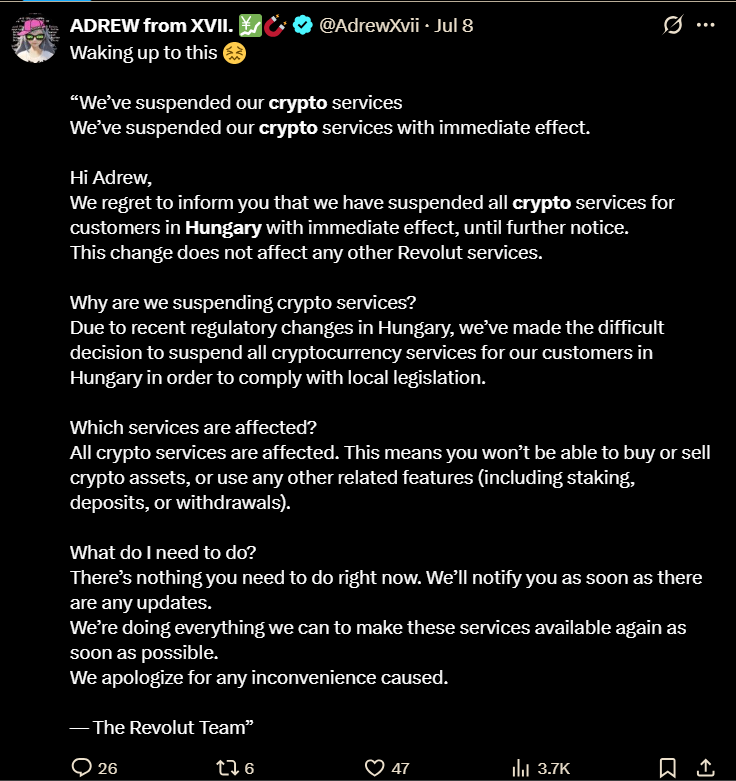
The impact of the criminal law is already visible in Hungary’s crypto industry. British fintech Revolut has withdrawn its services from Hungary due to the new laws, stopping all crypto services. The platform cited the “recently introduced Hungarian legislation” as the reason but has not provided a timeline to bring back its services.
A Revolut customer in Hungary claiming to have received this message
Hungary is part of the European Economic Area. This means the bloc’s Markets in Crypto-Assets Regulation (MiCA) regime also applies in Hungary.
Meanwhile, Hungary is not the only country to introduce jail time for unauthorised crypto service providers. The United States, the United Kingdom, Hong Kong, and South Korea are a few examples that criminalise the offering of unlicensed crypto trading activities, but few go after individual traders.
Recently, Singapore ordered local crypto companies to stop serving overseas clients unless they secure a licence under new rules. Unlicensed firms that continue overseas digital token operations now face a fine of up to SG$250,000 and/or up to three years in prison.
Hungary, a Central European country with a population of over 9.5 million, has introduced strict laws criminalising trading on an “unauthorised crypto-asset exchange service” and imposing jail terms of up to five years for traders and eight years for service providers.
Significant Jail Time for Trading on “Unauthorised” Platforms
According to the country’s criminal code, which came into force on 1 July 2025, people trading on unauthorised crypto exchanges may face a jail term of up to two years if their trading volume is between 5 million and 50 million forints ($14,600 to $145,950). For amounts between 50 million and 500 million forints ($145,950 to $1.46 million), the term can go up to three years.
Traders dealing with over 500 million forints might face a penalty of up to five years in jail.
The criminal law also specifies punishments for providers of unauthorised “crypto-asset exchange service activities.” The penalty for them also depends on the volume handled.
Those who handled up to 50 million forints ($145,950) may face up to three years in prison, while handling up to 500 million forints ($1.46 million) could mean five years. For more than 500 million forints, the penalty goes up to eight years.
The Law Impacts Hungary’s Crypto Scene
Despite the strict laws, the local rules for crypto companies in the country remain unclear. Hungary’s Supervisory Authority for Regulatory Affairs (SZTFH) has 60 days to introduce compliance rules; however, no guidance exists in the meantime.
The impact of the criminal law is already visible in Hungary’s crypto industry. British fintech Revolut has withdrawn its services from Hungary due to the new laws, stopping all crypto services. The platform cited the “recently introduced Hungarian legislation” as the reason but has not provided a timeline to bring back its services.
A Revolut customer in Hungary claiming to have received this message
Hungary is part of the European Economic Area. This means the bloc’s Markets in Crypto-Assets Regulation (MiCA) regime also applies in Hungary.
Meanwhile, Hungary is not the only country to introduce jail time for unauthorised crypto service providers. The United States, the United Kingdom, Hong Kong, and South Korea are a few examples that criminalise the offering of unlicensed crypto trading activities, but few go after individual traders.
Recently, Singapore ordered local crypto companies to stop serving overseas clients unless they secure a licence under new rules. Unlicensed firms that continue overseas digital token operations now face a fine of up to SG$250,000 and/or up to three years in prison.
Arnab Shome is an electronics engineer-turned-financial editor. He holds a Bachelor of Technology from the National Institute of Technology, Agartala. He entered the retail trading industry about a decade ago, covering the cryptocurrency market for Finance Magnates, and later expanded his coverage to include forex and CFDs as well.
His work at Finance Magnates includes C-level interviews, data-driven analysis, opinion pieces, and scoops of industry exclusives. He also contributes to Finance Magnates’ quarterly industry report.
Area of coverage:
1. CFD broker-related news
2. Industry-related Regulatory updates and developments
3. New retail trading trends
4. Prop trading industry updates
5. Executive interviews
Education:
Bachelor of Technology - National Institute of Technology, Agartala (India)
In this video, we review @HolaPrimeMarketsOfficial, a multi-asset forex and CFDs broker offering different account types, trading platforms, and flexible trading conditions.
We cover the broker’s overall offering, including account options, trading environment, platforms like MT4 and MT5, and additional services such as managed accounts and fast withdrawals.
Watch the full video to see if Hola Prime Markets fits your trading needs.
📣 Stay up to date with the latest in finance and trading. Follow Finance Magnates for industry news, insights, and global event coverage.
Connect with us:
🔗 LinkedIn: /financemagnates
👍 Facebook: /financemagnates
📸 Instagram: https://www.instagram.com/financemagnates
🐦 X: https://x.com/financemagnates
🎥 TikTok: https://www.tiktok.com/tag/financemagnates
▶️ YouTube: /@financemagnates_official
#HolaPrime #ForexBroker #CFDTrading #FinanceMagnates #Trading #Forex #BrokerReview
In this video, we review @HolaPrimeMarketsOfficial, a multi-asset forex and CFDs broker offering different account types, trading platforms, and flexible trading conditions.
We cover the broker’s overall offering, including account options, trading environment, platforms like MT4 and MT5, and additional services such as managed accounts and fast withdrawals.
Watch the full video to see if Hola Prime Markets fits your trading needs.
📣 Stay up to date with the latest in finance and trading. Follow Finance Magnates for industry news, insights, and global event coverage.
Connect with us:
🔗 LinkedIn: /financemagnates
👍 Facebook: /financemagnates
📸 Instagram: https://www.instagram.com/financemagnates
🐦 X: https://x.com/financemagnates
🎥 TikTok: https://www.tiktok.com/tag/financemagnates
▶️ YouTube: /@financemagnates_official
#HolaPrime #ForexBroker #CFDTrading #FinanceMagnates #Trading #Forex #BrokerReview
Hola Prime Review: What You Need to Know | Full Breakdown by Finance Magnates
Hola Prime Review: What You Need to Know | Full Breakdown by Finance Magnates
In this video, we review @HolaPrime_Global, a proprietary trading firm offering evaluation programs and performance-based payouts in simulated market environments.
We cover how the challenge model works, including account types, profit splits (up to 95%), trading rules, and what it takes to reach a funded account. You’ll also learn about available platforms like MT4, MT5, cTrader, and more, along with insights into payouts, support, and trading conditions.
Watch the full video to see if Hola Prime fits your trading style.
📣 Stay up to date with the latest in finance and trading. Follow Finance Magnates for industry news, insights, and global event coverage.
Connect with us:
🔗 LinkedIn: /financemagnates
👍 Facebook: /financemagnates
📸 Instagram: https://www.instagram.com/financemagnates
🐦 X: https://x.com/financemagnates
🎥 TikTok: https://www.tiktok.com/tag/financemagnates
▶️ YouTube: /@financemagnates_official
#HolaPrime #PropFirm #Trading #FinanceMagnates #Forex #FuturesTrading #TradingReview #PropFirmReview
In this video, we review @HolaPrime_Global, a proprietary trading firm offering evaluation programs and performance-based payouts in simulated market environments.
We cover how the challenge model works, including account types, profit splits (up to 95%), trading rules, and what it takes to reach a funded account. You’ll also learn about available platforms like MT4, MT5, cTrader, and more, along with insights into payouts, support, and trading conditions.
Watch the full video to see if Hola Prime fits your trading style.
📣 Stay up to date with the latest in finance and trading. Follow Finance Magnates for industry news, insights, and global event coverage.
Connect with us:
🔗 LinkedIn: /financemagnates
👍 Facebook: /financemagnates
📸 Instagram: https://www.instagram.com/financemagnates
🐦 X: https://x.com/financemagnates
🎥 TikTok: https://www.tiktok.com/tag/financemagnates
▶️ YouTube: /@financemagnates_official
#HolaPrime #PropFirm #Trading #FinanceMagnates #Forex #FuturesTrading #TradingReview #PropFirmReview
Axi Winner Spotlight 🏆 | Global Most Innovative Broker 2025 #Innovation #Trading #Fintech #Broker
Axi Winner Spotlight 🏆 | Global Most Innovative Broker 2025 #Innovation #Trading #Fintech #Broker
Axi takes the spotlight at the Finance Magnates Awards, winning Global Most Innovative Broker 2025.
Olivia Xenofontos and Ivanna Openko share how the team will feel: proud, motivated, and ready to keep delivering.
They also describe the night as well-organized, focused, and enjoyable for all.
👉 Be part of FM Awards 2026.
Axi takes the spotlight at the Finance Magnates Awards, winning Global Most Innovative Broker 2025.
Olivia Xenofontos and Ivanna Openko share how the team will feel: proud, motivated, and ready to keep delivering.
They also describe the night as well-organized, focused, and enjoyable for all.
👉 Be part of FM Awards 2026.
Recognition that matters.
Built on transparency.
Driven by the industry.
The Finance Magnates Awards 2026.
Nominations are now open.
🔗 https://awards.financemagnates.com/?utm_source=SM&utm_medium=social&utm_campaign=recognition-matters
Recognition that matters.
Built on transparency.
Driven by the industry.
The Finance Magnates Awards 2026.
Nominations are now open.
🔗 https://awards.financemagnates.com/?utm_source=SM&utm_medium=social&utm_campaign=recognition-matters
Tickmill Winner Spotlight | Broker of the Year 2025 (LATAM) 🏆 | Finance Magnates Awards #Trading
Tickmill Winner Spotlight | Broker of the Year 2025 (LATAM) 🏆 | Finance Magnates Awards #Trading
What helped Tickmill stand out this year?
In this Winner Spotlight, Johnny Khalil, Executive Director at Tickmill Europe, shares how listening closely to clients and delivering strong trading conditions made the difference.
A big thank you to the community whose support continues to drive progress every day.
👉 Think your brand has what it takes? Nominate for the 2026 Finance Magnates Awards: https://awards.financemagnates.com/#nominate
What helped Tickmill stand out this year?
In this Winner Spotlight, Johnny Khalil, Executive Director at Tickmill Europe, shares how listening closely to clients and delivering strong trading conditions made the difference.
A big thank you to the community whose support continues to drive progress every day.
👉 Think your brand has what it takes? Nominate for the 2026 Finance Magnates Awards: https://awards.financemagnates.com/#nominate