The German government recently sold a significant chunk of its seized Bitcoin stash.
Meanwhile, the Mt. Gox trustee has also started repaying creditors in Bitcoin and Bitcoin Cash.
The dollar value of Bitcoin remains extremely volatile. Although there were signs of recovery over the weekend, the value tumbled this morning (Monday) as the Asian markets opened. What is the cause of this dip? Is it due to the expected repayment from Mt. Gox or the Germans offloading their Bitcoin stash? Additionally, the US Feds’ decisions on rate cuts cannot be ignored.
A Bloody Week
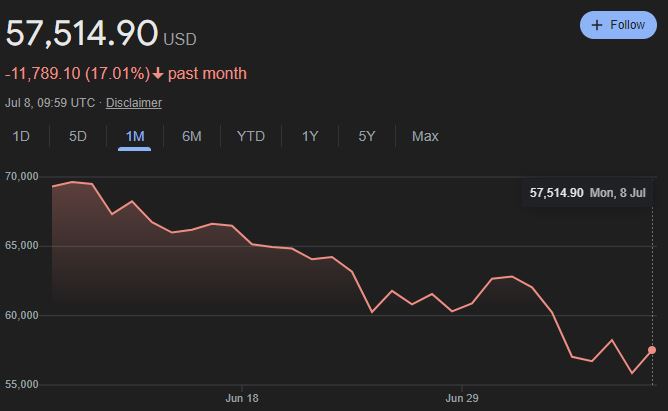
Bitcoin peaked at almost $74,000 earlier this year, boosted by the approval of the long-awaited spot Bitcoin exchange-traded funds (ETFs) in the United States. However, due to periodic volatility, the cryptocurrency is trading around $57,500, down by around 23 percent.
In the past week alone, the value of Bitcoin has decreased by about 10 percent.
As always, the reasons behind Bitcoin's volatility are mixed. However, this time, the bearish sentiments might have been triggered by a few events.
Bitcoin price movement in the past 1 month
A $9 Billion Payout
A prominent trigger might be the upcoming repayment to the creditors of the now-defunct crypto exchange Mt. Gox. After ten years of countless delays, the Mt. Gox administrator finally decided to repay the distressed creditors in Bitcoin and Bitcoin Cash.
At its peak, Mt. Gox handled 70 percent of all Bitcoin transactions. However, the exchange lost an estimated 740,000 Bitcoin, which led to its closure in 2014.
Recently, Mt. Gox-related Bitcoin wallets moved 47,228 Bitcoins. However, it was unclear if those Bitcoins were moved for the purpose of repayment. The anticipation of such a massive volume of Bitcoin hitting the market might have created selling pressure, resulting in the recent volatility.
The Mt. Gox payout is estimated to be $9 billion. However, experts believe that the $1.1 trillion Bitcoin market has the potential to absorb the pressure from the sell-off by the Mt. Gox creditors.
“Mt. Gox moved [a massive amount of] BTC, signalling the start of their repayment process, which has caused some market fear due to the large potential sell-off,” Willy Chuang, COO of crypto exchange WOO X, told crypto-focused publication Coindesk. “However, it's worth noting that despite these concerns, the long-term impact may be less severe as the market gradually absorbs the selling pressure.”
The German Sell-Off
Another major reason for the latest downward Bitcoin spiral might be the selling off of seized Bitcoins by German authorities. Earlier this year, German law enforcement seized 50,000 Bitcoins linked with a piracy website.
After months of holding onto those seized cryptocurrencies, the German government-linked wallets moved out 6,500 Bitcoins, worth about $425 million at the time. After a series of transactions, 1,000 of these Bitcoins were sent to two crypto exchanges, Kraken and Bitstamp. On-chain analyst Arkham also confirmed that the German government moved another 1,300 Bitcoins, worth $76 million, to Kraken, Bitstamp, and Coinbase on July 4, after which the Bitcoin price took a massive hit.
The German government also moved an additional 1,700 Bitcoins to an address likely moved “for an institutional service or OTC.”
Despite the sell-offs, the German government still holds a substantial amount of Bitcoins from the seizure. Similarly, the US government accumulated a sizable amount of Bitcoin from seizures against illegal operations over the years.
Is It the Feds?
Although a regular event, the US Federal Reserve’s decision might be another factor behind Bitcoin’s volatility. On Thursday, the Feds decided not to cut interest rates for another cycle. Even though rate cuts are not directly related to Bitcoin, higher interest rates always lure investors to keep their money away from risky investments like Bitcoin.
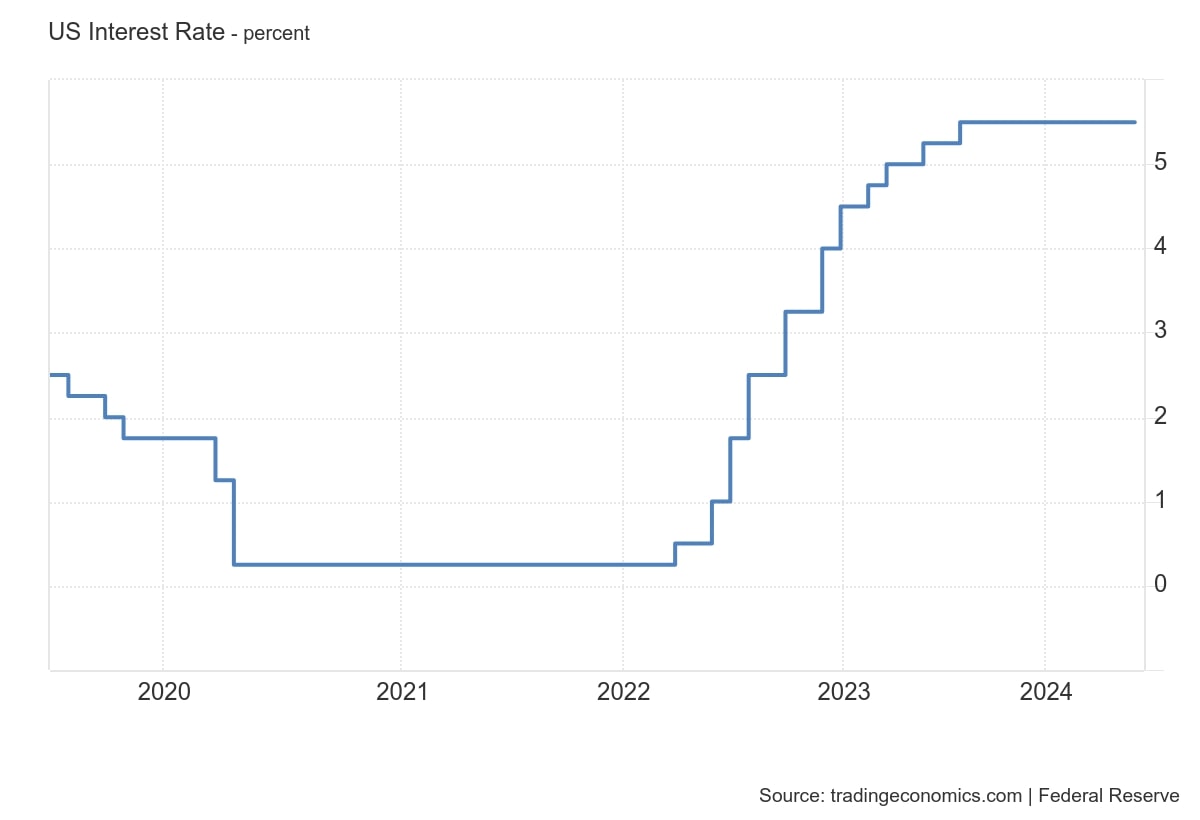
Currently, the Fed funds rate is at 5.5 percent, significantly higher compared to 0.25 percent in March 2022.
The US interest rate over the past 5 years
Room for Upward Movement
Bitcoin entered the mainstream financial market earlier this year when the Securities and Exchange Commission approved the spot Bitcoin ETFs. Prominent asset managers like BlackRock and Fidelity, along with nine other issuers, are now listing spot Bitcoin ETFs on American stock exchanges.
Further, the mining reward of Bitcoin was halved earlier this year, an event that has positively impacted the cryptocurrency's price movement historically.
Despite the recent volatility, many analysts are still optimistic about Bitcoin. According to analysts at crypto data and research firm CCData, Bitcoin is yet to reach the top of its current appreciation cycle and is likely to hit a fresh all-time high.
CCData pointed out that Bitcoin halvings always preceded a period of price expansion, which lasts between 12 to 18 months “before producing a cycle top.” These historical time frames have yet to pass after the latest halving on 19 April 2024.
“Moreover, we have observed a decline in trading activity on centralised exchanges for nearly two months following the halving event in previous cycles, which seems to have mirrored this cycle. This suggests that the current cycle could expand further into 2025,” the CCData report stated.
The dollar value of Bitcoin remains extremely volatile. Although there were signs of recovery over the weekend, the value tumbled this morning (Monday) as the Asian markets opened. What is the cause of this dip? Is it due to the expected repayment from Mt. Gox or the Germans offloading their Bitcoin stash? Additionally, the US Feds’ decisions on rate cuts cannot be ignored.
A Bloody Week
Bitcoin peaked at almost $74,000 earlier this year, boosted by the approval of the long-awaited spot Bitcoin exchange-traded funds (ETFs) in the United States. However, due to periodic volatility, the cryptocurrency is trading around $57,500, down by around 23 percent.
In the past week alone, the value of Bitcoin has decreased by about 10 percent.
As always, the reasons behind Bitcoin's volatility are mixed. However, this time, the bearish sentiments might have been triggered by a few events.
Bitcoin price movement in the past 1 month
A $9 Billion Payout
A prominent trigger might be the upcoming repayment to the creditors of the now-defunct crypto exchange Mt. Gox. After ten years of countless delays, the Mt. Gox administrator finally decided to repay the distressed creditors in Bitcoin and Bitcoin Cash.
At its peak, Mt. Gox handled 70 percent of all Bitcoin transactions. However, the exchange lost an estimated 740,000 Bitcoin, which led to its closure in 2014.
Recently, Mt. Gox-related Bitcoin wallets moved 47,228 Bitcoins. However, it was unclear if those Bitcoins were moved for the purpose of repayment. The anticipation of such a massive volume of Bitcoin hitting the market might have created selling pressure, resulting in the recent volatility.
The Mt. Gox payout is estimated to be $9 billion. However, experts believe that the $1.1 trillion Bitcoin market has the potential to absorb the pressure from the sell-off by the Mt. Gox creditors.
“Mt. Gox moved [a massive amount of] BTC, signalling the start of their repayment process, which has caused some market fear due to the large potential sell-off,” Willy Chuang, COO of crypto exchange WOO X, told crypto-focused publication Coindesk. “However, it's worth noting that despite these concerns, the long-term impact may be less severe as the market gradually absorbs the selling pressure.”
The German Sell-Off
Another major reason for the latest downward Bitcoin spiral might be the selling off of seized Bitcoins by German authorities. Earlier this year, German law enforcement seized 50,000 Bitcoins linked with a piracy website.
After months of holding onto those seized cryptocurrencies, the German government-linked wallets moved out 6,500 Bitcoins, worth about $425 million at the time. After a series of transactions, 1,000 of these Bitcoins were sent to two crypto exchanges, Kraken and Bitstamp. On-chain analyst Arkham also confirmed that the German government moved another 1,300 Bitcoins, worth $76 million, to Kraken, Bitstamp, and Coinbase on July 4, after which the Bitcoin price took a massive hit.
The German government also moved an additional 1,700 Bitcoins to an address likely moved “for an institutional service or OTC.”
Despite the sell-offs, the German government still holds a substantial amount of Bitcoins from the seizure. Similarly, the US government accumulated a sizable amount of Bitcoin from seizures against illegal operations over the years.
Is It the Feds?
Although a regular event, the US Federal Reserve’s decision might be another factor behind Bitcoin’s volatility. On Thursday, the Feds decided not to cut interest rates for another cycle. Even though rate cuts are not directly related to Bitcoin, higher interest rates always lure investors to keep their money away from risky investments like Bitcoin.
Currently, the Fed funds rate is at 5.5 percent, significantly higher compared to 0.25 percent in March 2022.
The US interest rate over the past 5 years
Room for Upward Movement
Bitcoin entered the mainstream financial market earlier this year when the Securities and Exchange Commission approved the spot Bitcoin ETFs. Prominent asset managers like BlackRock and Fidelity, along with nine other issuers, are now listing spot Bitcoin ETFs on American stock exchanges.
Further, the mining reward of Bitcoin was halved earlier this year, an event that has positively impacted the cryptocurrency's price movement historically.
Despite the recent volatility, many analysts are still optimistic about Bitcoin. According to analysts at crypto data and research firm CCData, Bitcoin is yet to reach the top of its current appreciation cycle and is likely to hit a fresh all-time high.
CCData pointed out that Bitcoin halvings always preceded a period of price expansion, which lasts between 12 to 18 months “before producing a cycle top.” These historical time frames have yet to pass after the latest halving on 19 April 2024.
“Moreover, we have observed a decline in trading activity on centralised exchanges for nearly two months following the halving event in previous cycles, which seems to have mirrored this cycle. This suggests that the current cycle could expand further into 2025,” the CCData report stated.
Arnab Shome is an electronics engineer-turned-financial editor. He holds a Bachelor of Technology from the National Institute of Technology, Agartala. He entered the retail trading industry about a decade ago, covering the cryptocurrency market for Finance Magnates, and later expanded his coverage to include forex and CFDs as well.
His work at Finance Magnates includes C-level interviews, data-driven analysis, opinion pieces, and scoops of industry exclusives. He also contributes to Finance Magnates’ quarterly industry report.
Area of coverage:
1. CFD broker-related news
2. Industry-related Regulatory updates and developments
3. New retail trading trends
4. Prop trading industry updates
5. Executive interviews
Education:
Bachelor of Technology - National Institute of Technology, Agartala (India)
Kraken Steps Up Speed Race with New Equinix Colocation Service for Crypto Traders
FP Markets Winner Spotlight 🏆 | Global Broker of the Year 2025 #Trading #Broker #Innovation #Shorts
FP Markets Winner Spotlight 🏆 | Global Broker of the Year 2025 #Trading #Broker #Innovation #Shorts
FP Markets takes the spotlight as Global Broker of the Year 2025 at the Finance Magnates Awards.
Martin Stoilov, Head of Client Experience, shares that trust, innovation, and people played a key role in the company’s success, supported by a strong foundation of integrity and client-centricity.
Following this milestone, FP Markets continues to focus on growth, technology investment, and its core values of transparency and excellence.
👉 Be part of FM Awards 2026: https://awards.financemagnates.com/#nominate
FP Markets takes the spotlight as Global Broker of the Year 2025 at the Finance Magnates Awards.
Martin Stoilov, Head of Client Experience, shares that trust, innovation, and people played a key role in the company’s success, supported by a strong foundation of integrity and client-centricity.
Following this milestone, FP Markets continues to focus on growth, technology investment, and its core values of transparency and excellence.
👉 Be part of FM Awards 2026: https://awards.financemagnates.com/#nominate
In this video, we review @HolaPrimeMarketsOfficial, a multi-asset forex and CFDs broker offering different account types, trading platforms, and flexible trading conditions.
We cover the broker’s overall offering, including account options, trading environment, platforms like MT4 and MT5, and additional services such as managed accounts and fast withdrawals.
Watch the full video to see if Hola Prime Markets fits your trading needs.
📣 Stay up to date with the latest in finance and trading. Follow Finance Magnates for industry news, insights, and global event coverage.
Connect with us:
🔗 LinkedIn: /financemagnates
👍 Facebook: /financemagnates
📸 Instagram: https://www.instagram.com/financemagnates
🐦 X: https://x.com/financemagnates
🎥 TikTok: https://www.tiktok.com/tag/financemagnates
▶️ YouTube: /@financemagnates_official
#HolaPrime #ForexBroker #CFDTrading #FinanceMagnates #Trading #Forex #BrokerReview
In this video, we review @HolaPrimeMarketsOfficial, a multi-asset forex and CFDs broker offering different account types, trading platforms, and flexible trading conditions.
We cover the broker’s overall offering, including account options, trading environment, platforms like MT4 and MT5, and additional services such as managed accounts and fast withdrawals.
Watch the full video to see if Hola Prime Markets fits your trading needs.
📣 Stay up to date with the latest in finance and trading. Follow Finance Magnates for industry news, insights, and global event coverage.
Connect with us:
🔗 LinkedIn: /financemagnates
👍 Facebook: /financemagnates
📸 Instagram: https://www.instagram.com/financemagnates
🐦 X: https://x.com/financemagnates
🎥 TikTok: https://www.tiktok.com/tag/financemagnates
▶️ YouTube: /@financemagnates_official
#HolaPrime #ForexBroker #CFDTrading #FinanceMagnates #Trading #Forex #BrokerReview
Hola Prime Review: What You Need to Know | Full Breakdown by Finance Magnates
Hola Prime Review: What You Need to Know | Full Breakdown by Finance Magnates
In this video, we review @HolaPrime_Global, a proprietary trading firm offering evaluation programs and performance-based payouts in simulated market environments.
We cover how the challenge model works, including account types, profit splits (up to 95%), trading rules, and what it takes to reach a funded account. You’ll also learn about available platforms like MT4, MT5, cTrader, and more, along with insights into payouts, support, and trading conditions.
Watch the full video to see if Hola Prime fits your trading style.
📣 Stay up to date with the latest in finance and trading. Follow Finance Magnates for industry news, insights, and global event coverage.
Connect with us:
🔗 LinkedIn: /financemagnates
👍 Facebook: /financemagnates
📸 Instagram: https://www.instagram.com/financemagnates
🐦 X: https://x.com/financemagnates
🎥 TikTok: https://www.tiktok.com/tag/financemagnates
▶️ YouTube: /@financemagnates_official
#HolaPrime #PropFirm #Trading #FinanceMagnates #Forex #FuturesTrading #TradingReview #PropFirmReview
In this video, we review @HolaPrime_Global, a proprietary trading firm offering evaluation programs and performance-based payouts in simulated market environments.
We cover how the challenge model works, including account types, profit splits (up to 95%), trading rules, and what it takes to reach a funded account. You’ll also learn about available platforms like MT4, MT5, cTrader, and more, along with insights into payouts, support, and trading conditions.
Watch the full video to see if Hola Prime fits your trading style.
📣 Stay up to date with the latest in finance and trading. Follow Finance Magnates for industry news, insights, and global event coverage.
Connect with us:
🔗 LinkedIn: /financemagnates
👍 Facebook: /financemagnates
📸 Instagram: https://www.instagram.com/financemagnates
🐦 X: https://x.com/financemagnates
🎥 TikTok: https://www.tiktok.com/tag/financemagnates
▶️ YouTube: /@financemagnates_official
#HolaPrime #PropFirm #Trading #FinanceMagnates #Forex #FuturesTrading #TradingReview #PropFirmReview
Axi Winner Spotlight 🏆 | Global Most Innovative Broker 2025 #Innovation #Trading #Fintech #Broker
Axi Winner Spotlight 🏆 | Global Most Innovative Broker 2025 #Innovation #Trading #Fintech #Broker
Axi takes the spotlight at the Finance Magnates Awards, winning Global Most Innovative Broker 2025.
Olivia Xenofontos and Ivanna Openko share how the team will feel: proud, motivated, and ready to keep delivering.
They also describe the night as well-organized, focused, and enjoyable for all.
👉 Be part of FM Awards 2026.
Axi takes the spotlight at the Finance Magnates Awards, winning Global Most Innovative Broker 2025.
Olivia Xenofontos and Ivanna Openko share how the team will feel: proud, motivated, and ready to keep delivering.
They also describe the night as well-organized, focused, and enjoyable for all.
👉 Be part of FM Awards 2026.
Recognition that matters.
Built on transparency.
Driven by the industry.
The Finance Magnates Awards 2026.
Nominations are now open.
🔗 https://awards.financemagnates.com/?utm_source=SM&utm_medium=social&utm_campaign=recognition-matters
Recognition that matters.
Built on transparency.
Driven by the industry.
The Finance Magnates Awards 2026.
Nominations are now open.
🔗 https://awards.financemagnates.com/?utm_source=SM&utm_medium=social&utm_campaign=recognition-matters