Ethena GmbH was found to have “serious deficiencies” in regulatory compliance, prompting prior sanctions in March.
The company had been operating under MiCA’s transitional arrangement.
Germany’s financial watchdog has made its first major
enforcement move under the European Union’s new crypto regulatory framework,
ordering Frankfurt-based Ethena GmbH to shut down operations and liquidate its
USDe stablecoin business.
The decision comes amid a broader push to impose
tighter oversight on crypto firms across the bloc. The Federal Financial
Supervisory Authority (BaFin) issued the order on Monday, instructing Ethena
GmbH to cease all authorized business activities and settle its outstanding
obligations.
BaFin had already identified what it called “serious
deficiencies” in Ethena’s organizational setup and compliance with the Markets
in Crypto-Assets Regulation (MiCA), leading to earlier supervisory sanctions in
March.
“Ethena GmbH took advantage of a transitional
arrangement under MiCAR to enter the German market. According to this
arrangement, issuers that issued asset-referenced tokens under the law
applicable before June 30, 2024, may continue to do so until they are granted
or denied authorization,” BaFin said.
MiCA Enforcement Begins with High-Profile Crypto Exit
Ethena GmbH, a local subsidiary of synthetic
stablecoin developer Ethena Labs, issued a dollar-pegged token known as USDe.
The company claimed to maintain its token’s value through a mix of
crypto-backed reserves and delta-hedging strategies.
However, BaFin found that the firm failed to meet MiCA’s strict requirements for transparency, asset segregation, and reserve adequacy.
Ethena had attempted to operate under MiCA’s
transitional rules, which allowed pre-existing issuers to function temporarily
while seeking full authorization. However, the company withdrew its license application on April 3, effectively ending its legal basis to operate in the EU.
Following this, BaFin prohibited further transactions
and ordered a structured redemption of all circulating USDe tokens. The company
must now execute this process under BaFin’s direct supervision. USDe is the fourth-largest stablecoin
globally with a $4.9 billion valuation, according to CoinMarketCap. It ranks behind Tether (USDT), USDC, and DAI.
In addition to halting operations, BaFin imposed a € 600,000 coercive penalty and froze Ethena’s ability to move or dispose of funds to ensure the payment of creditors' obligations.
Ethena Labs confirmed that it has shifted all relevant
users to a different entity, Ethena (BVI) Limited, stating that “no ongoing
relationship with Ethena GmbH” remains. The firm had already paused mint and
redeem functions for USDe in March when BaFin first stepped in.
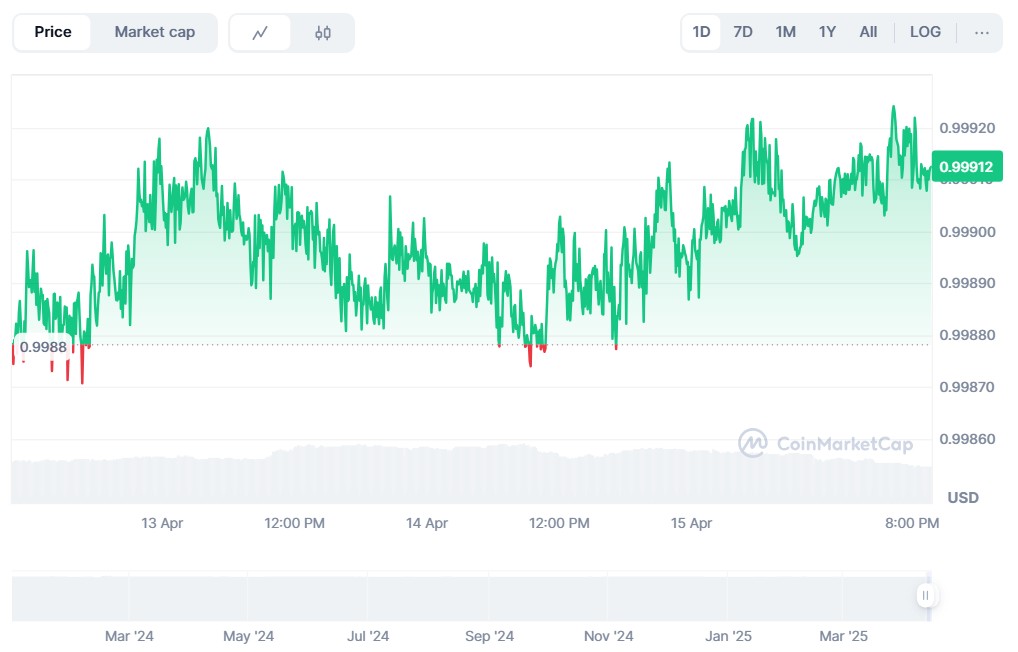
Ethena USDe trades slightly below the dollar peg, Source: CoinMarketCap
Europe's Stablecoin Landscape Under MiCA
Ethena’s forced exit underscores the growing
regulatory pressure on stablecoin issuers. MiCA requires issuers to hold
properly backed reserves, segregate user assets, and submit regular reports.
According to regulators, that model is now under
question. BaFin found that Ethena GmbH failed to meet MiCA’s organizational and
capital requirements, particularly those concerning asset segregation and
reserve quality.
Germany’s financial watchdog has made its first major
enforcement move under the European Union’s new crypto regulatory framework,
ordering Frankfurt-based Ethena GmbH to shut down operations and liquidate its
USDe stablecoin business.
The decision comes amid a broader push to impose
tighter oversight on crypto firms across the bloc. The Federal Financial
Supervisory Authority (BaFin) issued the order on Monday, instructing Ethena
GmbH to cease all authorized business activities and settle its outstanding
obligations.
BaFin had already identified what it called “serious
deficiencies” in Ethena’s organizational setup and compliance with the Markets
in Crypto-Assets Regulation (MiCA), leading to earlier supervisory sanctions in
March.
“Ethena GmbH took advantage of a transitional
arrangement under MiCAR to enter the German market. According to this
arrangement, issuers that issued asset-referenced tokens under the law
applicable before June 30, 2024, may continue to do so until they are granted
or denied authorization,” BaFin said.
MiCA Enforcement Begins with High-Profile Crypto Exit
Ethena GmbH, a local subsidiary of synthetic
stablecoin developer Ethena Labs, issued a dollar-pegged token known as USDe.
The company claimed to maintain its token’s value through a mix of
crypto-backed reserves and delta-hedging strategies.
However, BaFin found that the firm failed to meet MiCA’s strict requirements for transparency, asset segregation, and reserve adequacy.
Ethena had attempted to operate under MiCA’s
transitional rules, which allowed pre-existing issuers to function temporarily
while seeking full authorization. However, the company withdrew its license application on April 3, effectively ending its legal basis to operate in the EU.
Following this, BaFin prohibited further transactions
and ordered a structured redemption of all circulating USDe tokens. The company
must now execute this process under BaFin’s direct supervision. USDe is the fourth-largest stablecoin
globally with a $4.9 billion valuation, according to CoinMarketCap. It ranks behind Tether (USDT), USDC, and DAI.
In addition to halting operations, BaFin imposed a € 600,000 coercive penalty and froze Ethena’s ability to move or dispose of funds to ensure the payment of creditors' obligations.
Ethena Labs confirmed that it has shifted all relevant
users to a different entity, Ethena (BVI) Limited, stating that “no ongoing
relationship with Ethena GmbH” remains. The firm had already paused mint and
redeem functions for USDe in March when BaFin first stepped in.
Ethena USDe trades slightly below the dollar peg, Source: CoinMarketCap
Europe's Stablecoin Landscape Under MiCA
Ethena’s forced exit underscores the growing
regulatory pressure on stablecoin issuers. MiCA requires issuers to hold
properly backed reserves, segregate user assets, and submit regular reports.
According to regulators, that model is now under
question. BaFin found that Ethena GmbH failed to meet MiCA’s organizational and
capital requirements, particularly those concerning asset segregation and
reserve quality.
Jared Kirui is an Editor at Finance Magnates with more than five years of experience in financial journalism. He covers online trading, fintech, payments, and crypto industries with a focus on companies, regulation and compliance, executive moves, trading technology, and market analysis.
His work has been featured in other media outlets, including Benzinga, ZyCrypto, The Distributed, and The Daily Hodl.
Education:
Bachelor of Commerce degree (Finance option), University of Nairobi
WhiteBIT secures brokerage license in Georgia to launch regulated crypto derivatives
FP Markets Winner Spotlight 🏆 | Global Broker of the Year 2025 #Trading #Broker #Innovation #Shorts
FP Markets Winner Spotlight 🏆 | Global Broker of the Year 2025 #Trading #Broker #Innovation #Shorts
FP Markets takes the spotlight as Global Broker of the Year 2025 at the Finance Magnates Awards.
Martin Stoilov, Head of Client Experience, shares that trust, innovation, and people played a key role in the company’s success, supported by a strong foundation of integrity and client-centricity.
Following this milestone, FP Markets continues to focus on growth, technology investment, and its core values of transparency and excellence.
👉 Be part of FM Awards 2026: https://awards.financemagnates.com/#nominate
FP Markets takes the spotlight as Global Broker of the Year 2025 at the Finance Magnates Awards.
Martin Stoilov, Head of Client Experience, shares that trust, innovation, and people played a key role in the company’s success, supported by a strong foundation of integrity and client-centricity.
Following this milestone, FP Markets continues to focus on growth, technology investment, and its core values of transparency and excellence.
👉 Be part of FM Awards 2026: https://awards.financemagnates.com/#nominate
In this video, we review @HolaPrimeMarketsOfficial, a multi-asset forex and CFDs broker offering different account types, trading platforms, and flexible trading conditions.
We cover the broker’s overall offering, including account options, trading environment, platforms like MT4 and MT5, and additional services such as managed accounts and fast withdrawals.
Watch the full video to see if Hola Prime Markets fits your trading needs.
📣 Stay up to date with the latest in finance and trading. Follow Finance Magnates for industry news, insights, and global event coverage.
Connect with us:
🔗 LinkedIn: /financemagnates
👍 Facebook: /financemagnates
📸 Instagram: https://www.instagram.com/financemagnates
🐦 X: https://x.com/financemagnates
🎥 TikTok: https://www.tiktok.com/tag/financemagnates
▶️ YouTube: /@financemagnates_official
#HolaPrime #ForexBroker #CFDTrading #FinanceMagnates #Trading #Forex #BrokerReview
In this video, we review @HolaPrimeMarketsOfficial, a multi-asset forex and CFDs broker offering different account types, trading platforms, and flexible trading conditions.
We cover the broker’s overall offering, including account options, trading environment, platforms like MT4 and MT5, and additional services such as managed accounts and fast withdrawals.
Watch the full video to see if Hola Prime Markets fits your trading needs.
📣 Stay up to date with the latest in finance and trading. Follow Finance Magnates for industry news, insights, and global event coverage.
Connect with us:
🔗 LinkedIn: /financemagnates
👍 Facebook: /financemagnates
📸 Instagram: https://www.instagram.com/financemagnates
🐦 X: https://x.com/financemagnates
🎥 TikTok: https://www.tiktok.com/tag/financemagnates
▶️ YouTube: /@financemagnates_official
#HolaPrime #ForexBroker #CFDTrading #FinanceMagnates #Trading #Forex #BrokerReview
Hola Prime Review: What You Need to Know | Full Breakdown by Finance Magnates
Hola Prime Review: What You Need to Know | Full Breakdown by Finance Magnates
In this video, we review @HolaPrime_Global, a proprietary trading firm offering evaluation programs and performance-based payouts in simulated market environments.
We cover how the challenge model works, including account types, profit splits (up to 95%), trading rules, and what it takes to reach a funded account. You’ll also learn about available platforms like MT4, MT5, cTrader, and more, along with insights into payouts, support, and trading conditions.
Watch the full video to see if Hola Prime fits your trading style.
📣 Stay up to date with the latest in finance and trading. Follow Finance Magnates for industry news, insights, and global event coverage.
Connect with us:
🔗 LinkedIn: /financemagnates
👍 Facebook: /financemagnates
📸 Instagram: https://www.instagram.com/financemagnates
🐦 X: https://x.com/financemagnates
🎥 TikTok: https://www.tiktok.com/tag/financemagnates
▶️ YouTube: /@financemagnates_official
#HolaPrime #PropFirm #Trading #FinanceMagnates #Forex #FuturesTrading #TradingReview #PropFirmReview
In this video, we review @HolaPrime_Global, a proprietary trading firm offering evaluation programs and performance-based payouts in simulated market environments.
We cover how the challenge model works, including account types, profit splits (up to 95%), trading rules, and what it takes to reach a funded account. You’ll also learn about available platforms like MT4, MT5, cTrader, and more, along with insights into payouts, support, and trading conditions.
Watch the full video to see if Hola Prime fits your trading style.
📣 Stay up to date with the latest in finance and trading. Follow Finance Magnates for industry news, insights, and global event coverage.
Connect with us:
🔗 LinkedIn: /financemagnates
👍 Facebook: /financemagnates
📸 Instagram: https://www.instagram.com/financemagnates
🐦 X: https://x.com/financemagnates
🎥 TikTok: https://www.tiktok.com/tag/financemagnates
▶️ YouTube: /@financemagnates_official
#HolaPrime #PropFirm #Trading #FinanceMagnates #Forex #FuturesTrading #TradingReview #PropFirmReview
Axi Winner Spotlight 🏆 | Global Most Innovative Broker 2025 #Innovation #Trading #Fintech #Broker
Axi Winner Spotlight 🏆 | Global Most Innovative Broker 2025 #Innovation #Trading #Fintech #Broker
Axi takes the spotlight at the Finance Magnates Awards, winning Global Most Innovative Broker 2025.
Olivia Xenofontos and Ivanna Openko share how the team will feel: proud, motivated, and ready to keep delivering.
They also describe the night as well-organized, focused, and enjoyable for all.
👉 Be part of FM Awards 2026.
Axi takes the spotlight at the Finance Magnates Awards, winning Global Most Innovative Broker 2025.
Olivia Xenofontos and Ivanna Openko share how the team will feel: proud, motivated, and ready to keep delivering.
They also describe the night as well-organized, focused, and enjoyable for all.
👉 Be part of FM Awards 2026.
Recognition that matters.
Built on transparency.
Driven by the industry.
The Finance Magnates Awards 2026.
Nominations are now open.
🔗 https://awards.financemagnates.com/?utm_source=SM&utm_medium=social&utm_campaign=recognition-matters
Recognition that matters.
Built on transparency.
Driven by the industry.
The Finance Magnates Awards 2026.
Nominations are now open.
🔗 https://awards.financemagnates.com/?utm_source=SM&utm_medium=social&utm_campaign=recognition-matters