Musk retweeted a post on X highlighting Dogecoin's journey.
Dogecoin has soared more than 100% in the weekly chart, currently ranked sixth in the crypto chart.
Elon Musk, the world’s richest man and self-proclaimed Doge
father, is back to promoting the meme token following its skyrocketing prices. Musk
retweeted a post on X praising the achievement of the digital asset that once
started as an internet parody but is now worth billions of dollars.
The Tweet came from Melissa Chen, the co-founder of Ideas Beyond
Borders. In the post, which impressed the Tesla boss, Chen expressed her
enthusiasm about how DOGE has gained popularity since starting as just a meme
token.
From Meme to Mainstream
“I’m cracking up so badly listening to serious WSJ
journalists pronounce “DOGE” in their professional radio broadcasting voice in
the context of a serious news bit, and part of me cannot believe that it all
started from a meme. A govt agency was memed into existence Much wow,” she
wrote.
DOGE was one of the cryptocurrencies that led the recent
crypto rally. The meme token, which was created in 2013 from a dog meme, now
ranks sixth in the crypto asset list with a valuation of $58 billion. At the
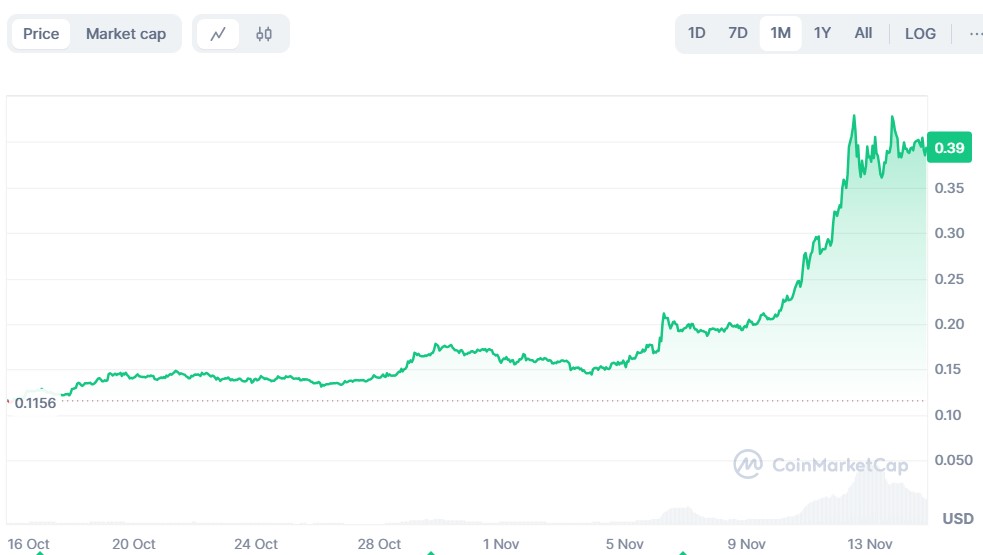
time of writing, the meme token was trading at $0.3977 after soaring over 105%
in the weekly chart.
Crypto Rally
According to a recent report by Finance Magnates, the
surge in DOGE prices and the bullish sentiment in the broader crypto space are linked to political and economic factors and general
market speculation.
DOGE Monthly Chart, Source: CoinMarketCap
The crypto community welcomed Donald Trump's return to the White House after his victory in the US election. During his campaign, Trump lured the crypto community with many promises, including
firing the Securities and Exchange Commission (SEC) Chair Gary Gensler if
re-elected.
In a July YouTube livestream by Sky News, the
President-elect and business mogul lauded Bitcoin, saying, "It is not just
a marvel of technology; it is a miracle of cooperation and human achievement. A
lot of relationships are formed. Obviously, there is competition, but there are
relationships. There is a friendship that is developed."
Interestingly, despite the positive gains, most industry experts believe that DOGE could still retreat from the current high before any attempt at trading at $1. However, there has been significant buying activity among large investors, also referred to as whales. DOGE rally is also boosted by strong trading volumes.
Elon Musk, the world’s richest man and self-proclaimed Doge
father, is back to promoting the meme token following its skyrocketing prices. Musk
retweeted a post on X praising the achievement of the digital asset that once
started as an internet parody but is now worth billions of dollars.
The Tweet came from Melissa Chen, the co-founder of Ideas Beyond
Borders. In the post, which impressed the Tesla boss, Chen expressed her
enthusiasm about how DOGE has gained popularity since starting as just a meme
token.
From Meme to Mainstream
“I’m cracking up so badly listening to serious WSJ
journalists pronounce “DOGE” in their professional radio broadcasting voice in
the context of a serious news bit, and part of me cannot believe that it all
started from a meme. A govt agency was memed into existence Much wow,” she
wrote.
DOGE was one of the cryptocurrencies that led the recent
crypto rally. The meme token, which was created in 2013 from a dog meme, now
ranks sixth in the crypto asset list with a valuation of $58 billion. At the
time of writing, the meme token was trading at $0.3977 after soaring over 105%
in the weekly chart.
Crypto Rally
According to a recent report by Finance Magnates, the
surge in DOGE prices and the bullish sentiment in the broader crypto space are linked to political and economic factors and general
market speculation.
DOGE Monthly Chart, Source: CoinMarketCap
The crypto community welcomed Donald Trump's return to the White House after his victory in the US election. During his campaign, Trump lured the crypto community with many promises, including
firing the Securities and Exchange Commission (SEC) Chair Gary Gensler if
re-elected.
In a July YouTube livestream by Sky News, the
President-elect and business mogul lauded Bitcoin, saying, "It is not just
a marvel of technology; it is a miracle of cooperation and human achievement. A
lot of relationships are formed. Obviously, there is competition, but there are
relationships. There is a friendship that is developed."
Interestingly, despite the positive gains, most industry experts believe that DOGE could still retreat from the current high before any attempt at trading at $1. However, there has been significant buying activity among large investors, also referred to as whales. DOGE rally is also boosted by strong trading volumes.
Jared Kirui is an Editor at Finance Magnates with more than five years of experience in financial journalism. He covers online trading, fintech, payments, and crypto industries with a focus on companies, regulation and compliance, executive moves, trading technology, and market analysis.
His work has been featured in other media outlets, including Benzinga, ZyCrypto, The Distributed, and The Daily Hodl.
Education:
Bachelor of Commerce degree (Finance option), University of Nairobi
WhiteBIT secures brokerage license in Georgia to launch regulated crypto derivatives
FP Markets Winner Spotlight 🏆 | Global Broker of the Year 2025 #Trading #Broker #Innovation #Shorts
FP Markets Winner Spotlight 🏆 | Global Broker of the Year 2025 #Trading #Broker #Innovation #Shorts
FP Markets takes the spotlight as Global Broker of the Year 2025 at the Finance Magnates Awards.
Martin Stoilov, Head of Client Experience, shares that trust, innovation, and people played a key role in the company’s success, supported by a strong foundation of integrity and client-centricity.
Following this milestone, FP Markets continues to focus on growth, technology investment, and its core values of transparency and excellence.
👉 Be part of FM Awards 2026: https://awards.financemagnates.com/#nominate
FP Markets takes the spotlight as Global Broker of the Year 2025 at the Finance Magnates Awards.
Martin Stoilov, Head of Client Experience, shares that trust, innovation, and people played a key role in the company’s success, supported by a strong foundation of integrity and client-centricity.
Following this milestone, FP Markets continues to focus on growth, technology investment, and its core values of transparency and excellence.
👉 Be part of FM Awards 2026: https://awards.financemagnates.com/#nominate
In this video, we review @HolaPrimeMarketsOfficial, a multi-asset forex and CFDs broker offering different account types, trading platforms, and flexible trading conditions.
We cover the broker’s overall offering, including account options, trading environment, platforms like MT4 and MT5, and additional services such as managed accounts and fast withdrawals.
Watch the full video to see if Hola Prime Markets fits your trading needs.
📣 Stay up to date with the latest in finance and trading. Follow Finance Magnates for industry news, insights, and global event coverage.
Connect with us:
🔗 LinkedIn: /financemagnates
👍 Facebook: /financemagnates
📸 Instagram: https://www.instagram.com/financemagnates
🐦 X: https://x.com/financemagnates
🎥 TikTok: https://www.tiktok.com/tag/financemagnates
▶️ YouTube: /@financemagnates_official
#HolaPrime #ForexBroker #CFDTrading #FinanceMagnates #Trading #Forex #BrokerReview
In this video, we review @HolaPrimeMarketsOfficial, a multi-asset forex and CFDs broker offering different account types, trading platforms, and flexible trading conditions.
We cover the broker’s overall offering, including account options, trading environment, platforms like MT4 and MT5, and additional services such as managed accounts and fast withdrawals.
Watch the full video to see if Hola Prime Markets fits your trading needs.
📣 Stay up to date with the latest in finance and trading. Follow Finance Magnates for industry news, insights, and global event coverage.
Connect with us:
🔗 LinkedIn: /financemagnates
👍 Facebook: /financemagnates
📸 Instagram: https://www.instagram.com/financemagnates
🐦 X: https://x.com/financemagnates
🎥 TikTok: https://www.tiktok.com/tag/financemagnates
▶️ YouTube: /@financemagnates_official
#HolaPrime #ForexBroker #CFDTrading #FinanceMagnates #Trading #Forex #BrokerReview
Hola Prime Review: What You Need to Know | Full Breakdown by Finance Magnates
Hola Prime Review: What You Need to Know | Full Breakdown by Finance Magnates
In this video, we review @HolaPrime_Global, a proprietary trading firm offering evaluation programs and performance-based payouts in simulated market environments.
We cover how the challenge model works, including account types, profit splits (up to 95%), trading rules, and what it takes to reach a funded account. You’ll also learn about available platforms like MT4, MT5, cTrader, and more, along with insights into payouts, support, and trading conditions.
Watch the full video to see if Hola Prime fits your trading style.
📣 Stay up to date with the latest in finance and trading. Follow Finance Magnates for industry news, insights, and global event coverage.
Connect with us:
🔗 LinkedIn: /financemagnates
👍 Facebook: /financemagnates
📸 Instagram: https://www.instagram.com/financemagnates
🐦 X: https://x.com/financemagnates
🎥 TikTok: https://www.tiktok.com/tag/financemagnates
▶️ YouTube: /@financemagnates_official
#HolaPrime #PropFirm #Trading #FinanceMagnates #Forex #FuturesTrading #TradingReview #PropFirmReview
In this video, we review @HolaPrime_Global, a proprietary trading firm offering evaluation programs and performance-based payouts in simulated market environments.
We cover how the challenge model works, including account types, profit splits (up to 95%), trading rules, and what it takes to reach a funded account. You’ll also learn about available platforms like MT4, MT5, cTrader, and more, along with insights into payouts, support, and trading conditions.
Watch the full video to see if Hola Prime fits your trading style.
📣 Stay up to date with the latest in finance and trading. Follow Finance Magnates for industry news, insights, and global event coverage.
Connect with us:
🔗 LinkedIn: /financemagnates
👍 Facebook: /financemagnates
📸 Instagram: https://www.instagram.com/financemagnates
🐦 X: https://x.com/financemagnates
🎥 TikTok: https://www.tiktok.com/tag/financemagnates
▶️ YouTube: /@financemagnates_official
#HolaPrime #PropFirm #Trading #FinanceMagnates #Forex #FuturesTrading #TradingReview #PropFirmReview
Axi Winner Spotlight 🏆 | Global Most Innovative Broker 2025 #Innovation #Trading #Fintech #Broker
Axi Winner Spotlight 🏆 | Global Most Innovative Broker 2025 #Innovation #Trading #Fintech #Broker
Axi takes the spotlight at the Finance Magnates Awards, winning Global Most Innovative Broker 2025.
Olivia Xenofontos and Ivanna Openko share how the team will feel: proud, motivated, and ready to keep delivering.
They also describe the night as well-organized, focused, and enjoyable for all.
👉 Be part of FM Awards 2026.
Axi takes the spotlight at the Finance Magnates Awards, winning Global Most Innovative Broker 2025.
Olivia Xenofontos and Ivanna Openko share how the team will feel: proud, motivated, and ready to keep delivering.
They also describe the night as well-organized, focused, and enjoyable for all.
👉 Be part of FM Awards 2026.
Recognition that matters.
Built on transparency.
Driven by the industry.
The Finance Magnates Awards 2026.
Nominations are now open.
🔗 https://awards.financemagnates.com/?utm_source=SM&utm_medium=social&utm_campaign=recognition-matters
Recognition that matters.
Built on transparency.
Driven by the industry.
The Finance Magnates Awards 2026.
Nominations are now open.
🔗 https://awards.financemagnates.com/?utm_source=SM&utm_medium=social&utm_campaign=recognition-matters