Historical data shows that prolonged increases in difficulty often coincide with significant market movements.
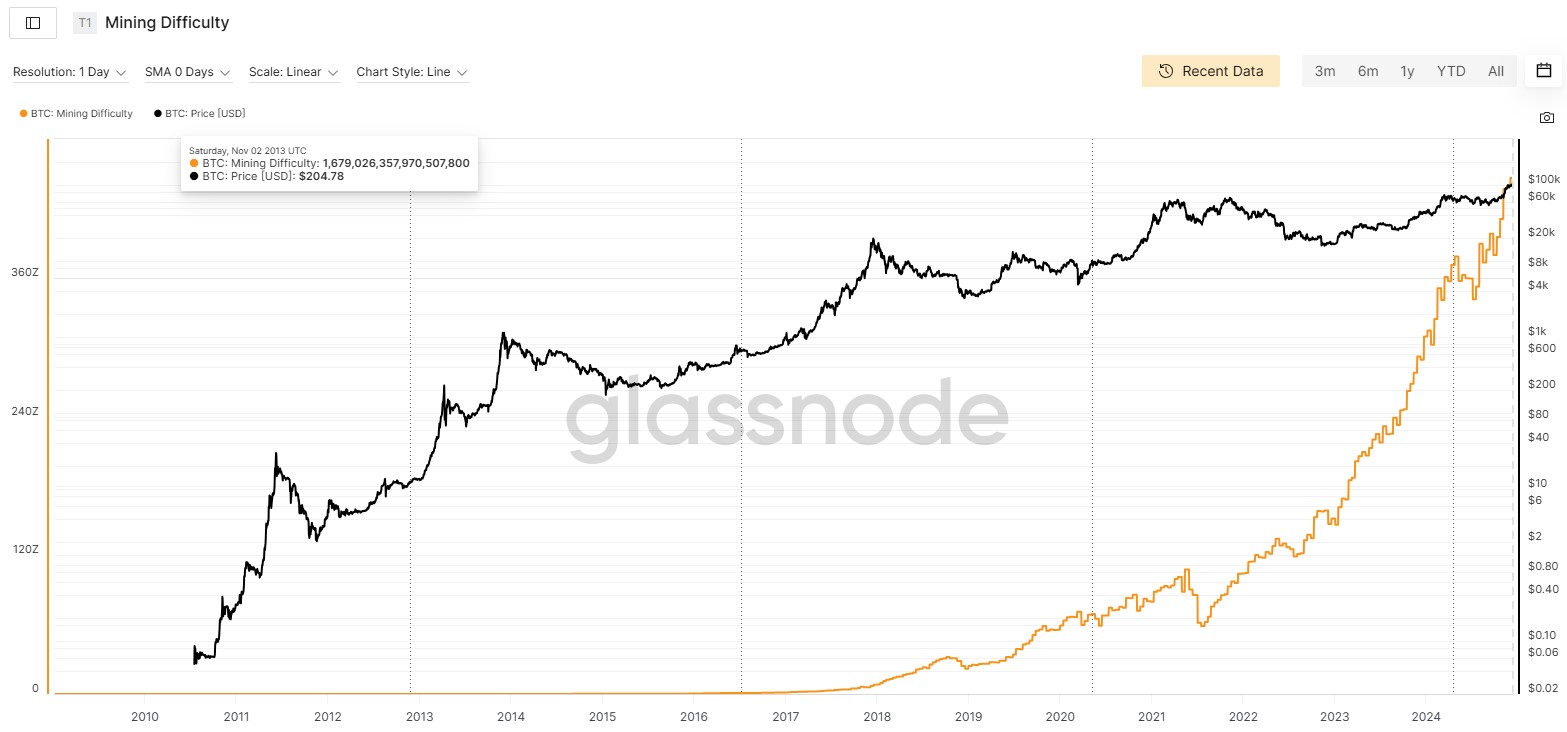
BTC network's mining difficulty has reached an all-time high of 110.45 trillion, reportedly marking the eighth consecutive increase.
Bitcoin is facing a downward trend of lower highs and
lower lows, with both technical and fundamental analyses showing a bearish
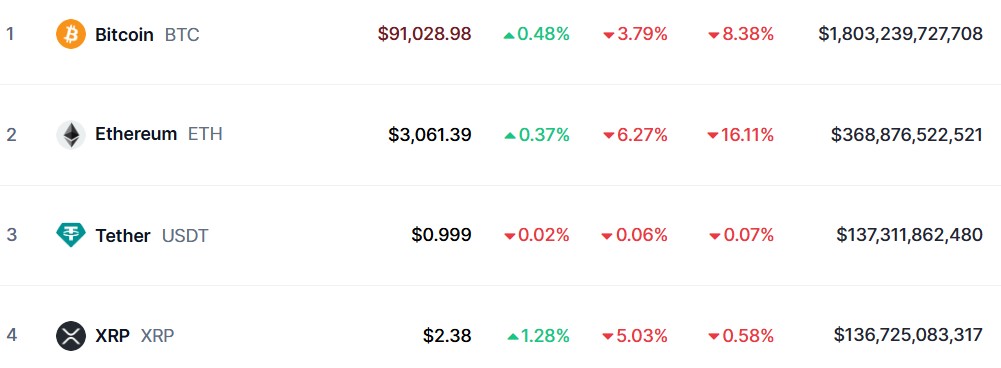
momentum. At the time of publication, the price on CoinMarketCap was 90,567,
representing a 3% and 8% decline in the past day and week, respectively.
Bitcoin's mining landscape has reached a remarkable
milestone. The network’s difficulty adjustment, a measure of how hard it is to
mine a block, has climbed for the eighth consecutive time, hitting an all-time
high of 110.45 trillion.
This marks a 110.45 trillion-fold increase in
difficulty since Bitcoin's inception, data from Glassnode showed. This reflects
the network's resilience and the intensifying competition among miners.
Source: Glassnode
The Difficulty Adjustment
Bitcoin’s difficulty adjustment recalibrates every
2,016 blocks, or approximately every two weeks, to maintain an average block
mining time of 10 minutes. This ensures that as the network’s computational
power, or hashrate, fluctuates, the mining process remains consistent.
Currently, the 7-day moving average for the hashrate
stands at an impressive 775 exahashes per second (EH/s), with projections
suggesting it could reach 1 zettahash before the next halving, according to
Coindesk.
Historically, such positive adjustments have coincided
with significant market turning points. In the bull market of 2021, difficulty reportedly
rose for nine consecutive adjustments, with the final increase aligning with
Bitcoin’s record high of $69,000.
Conversely, during the bear market of 2018, 17
positive adjustments led to a sharp market downturn, with Bitcoin falling from
$20,000 to a cycle low of $3,000, Coindesk reported. These patterns highlight a critical but ambiguous
trend: prolonged difficulty increases often indicate heightened market activity
but do not guarantee directional certainty.
Bitcoin Price, Source: CoinMarketCap
Challenges for Miners
The rising difficulty presents significant challenges
for miners, squeezing profit margins as competition intensifies. In response,
some companies, like MARA Holdings, have diversified their operations, pivoting
to high-performance computing and AI sectors.
Others, such as MARA, have adopted financial
strategies like issuing convertible bonds and lending Bitcoin to secure
additional revenue streams.
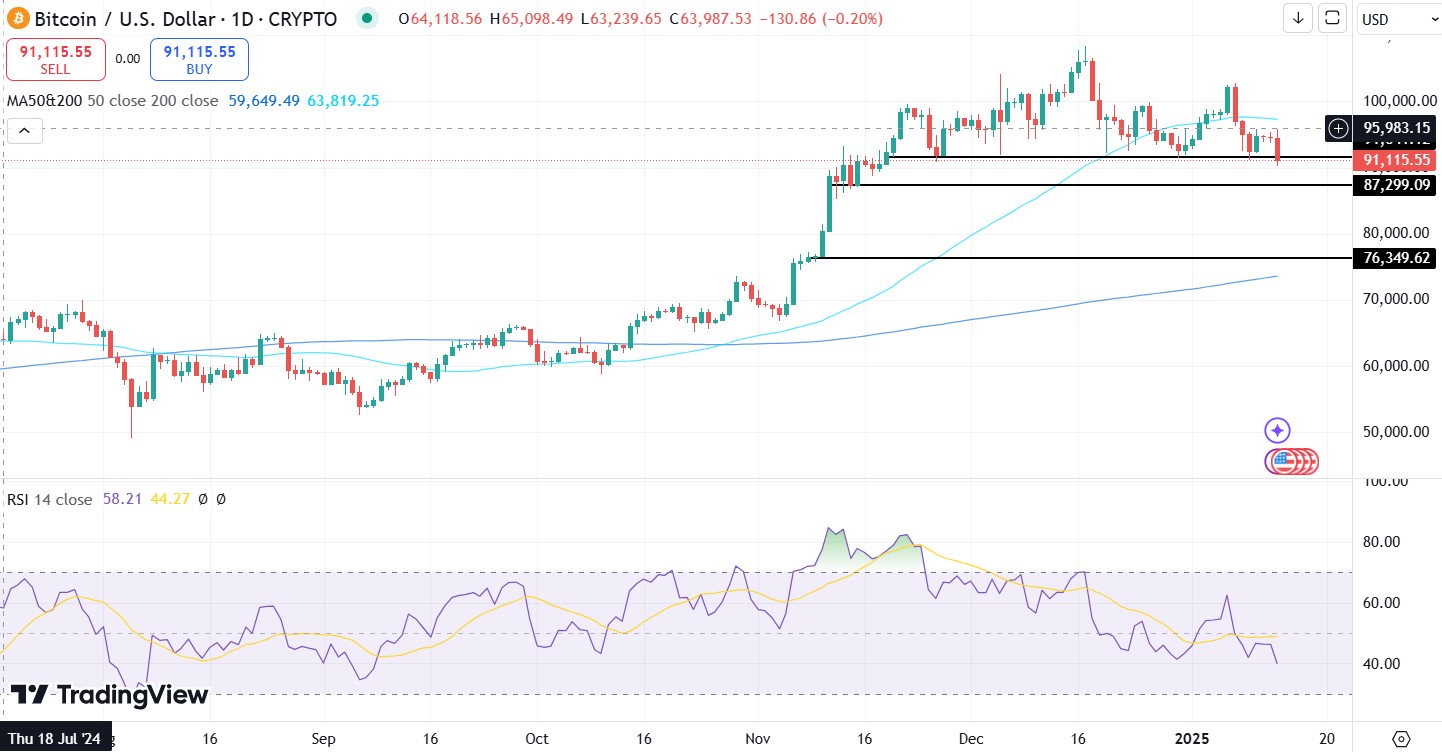
Bitcoin Technical Analysis, Source: TradingView
The surge in difficulty occurs against a backdrop of
volatile Bitcoin prices, which recently retreated to around $90k amid
macroeconomic uncertainties. Robust U.S. jobs data and expectations of steady
Federal Reserve interest rates have dampened risk appetite, further pressuring
the crypto market.
Currently, Bitcoin price is trading at an important
support level below which prices could drop further. If the current level does
not hold, the other support levels to watch are $87k and $76k.
Bitcoin is facing a downward trend of lower highs and
lower lows, with both technical and fundamental analyses showing a bearish
momentum. At the time of publication, the price on CoinMarketCap was 90,567,
representing a 3% and 8% decline in the past day and week, respectively.
Bitcoin's mining landscape has reached a remarkable
milestone. The network’s difficulty adjustment, a measure of how hard it is to
mine a block, has climbed for the eighth consecutive time, hitting an all-time
high of 110.45 trillion.
This marks a 110.45 trillion-fold increase in
difficulty since Bitcoin's inception, data from Glassnode showed. This reflects
the network's resilience and the intensifying competition among miners.
Source: Glassnode
The Difficulty Adjustment
Bitcoin’s difficulty adjustment recalibrates every
2,016 blocks, or approximately every two weeks, to maintain an average block
mining time of 10 minutes. This ensures that as the network’s computational
power, or hashrate, fluctuates, the mining process remains consistent.
Currently, the 7-day moving average for the hashrate
stands at an impressive 775 exahashes per second (EH/s), with projections
suggesting it could reach 1 zettahash before the next halving, according to
Coindesk.
Historically, such positive adjustments have coincided
with significant market turning points. In the bull market of 2021, difficulty reportedly
rose for nine consecutive adjustments, with the final increase aligning with
Bitcoin’s record high of $69,000.
Conversely, during the bear market of 2018, 17
positive adjustments led to a sharp market downturn, with Bitcoin falling from
$20,000 to a cycle low of $3,000, Coindesk reported. These patterns highlight a critical but ambiguous
trend: prolonged difficulty increases often indicate heightened market activity
but do not guarantee directional certainty.
Bitcoin Price, Source: CoinMarketCap
Challenges for Miners
The rising difficulty presents significant challenges
for miners, squeezing profit margins as competition intensifies. In response,
some companies, like MARA Holdings, have diversified their operations, pivoting
to high-performance computing and AI sectors.
Others, such as MARA, have adopted financial
strategies like issuing convertible bonds and lending Bitcoin to secure
additional revenue streams.
Bitcoin Technical Analysis, Source: TradingView
The surge in difficulty occurs against a backdrop of
volatile Bitcoin prices, which recently retreated to around $90k amid
macroeconomic uncertainties. Robust U.S. jobs data and expectations of steady
Federal Reserve interest rates have dampened risk appetite, further pressuring
the crypto market.
Currently, Bitcoin price is trading at an important
support level below which prices could drop further. If the current level does
not hold, the other support levels to watch are $87k and $76k.
Jared Kirui is an Editor at Finance Magnates with more than five years of experience in financial journalism. He covers online trading, fintech, payments, and crypto industries with a focus on companies, regulation and compliance, executive moves, trading technology, and market analysis.
His work has been featured in other media outlets, including Benzinga, ZyCrypto, The Distributed, and The Daily Hodl.
Education:
Bachelor of Commerce degree (Finance option), University of Nairobi
WhiteBIT secures brokerage license in Georgia to launch regulated crypto derivatives
FP Markets Winner Spotlight 🏆 | Global Broker of the Year 2025 #Trading #Broker #Innovation #Shorts
FP Markets Winner Spotlight 🏆 | Global Broker of the Year 2025 #Trading #Broker #Innovation #Shorts
FP Markets takes the spotlight as Global Broker of the Year 2025 at the Finance Magnates Awards.
Martin Stoilov, Head of Client Experience, shares that trust, innovation, and people played a key role in the company’s success, supported by a strong foundation of integrity and client-centricity.
Following this milestone, FP Markets continues to focus on growth, technology investment, and its core values of transparency and excellence.
👉 Be part of FM Awards 2026: https://awards.financemagnates.com/#nominate
FP Markets takes the spotlight as Global Broker of the Year 2025 at the Finance Magnates Awards.
Martin Stoilov, Head of Client Experience, shares that trust, innovation, and people played a key role in the company’s success, supported by a strong foundation of integrity and client-centricity.
Following this milestone, FP Markets continues to focus on growth, technology investment, and its core values of transparency and excellence.
👉 Be part of FM Awards 2026: https://awards.financemagnates.com/#nominate
In this video, we review @HolaPrimeMarketsOfficial, a multi-asset forex and CFDs broker offering different account types, trading platforms, and flexible trading conditions.
We cover the broker’s overall offering, including account options, trading environment, platforms like MT4 and MT5, and additional services such as managed accounts and fast withdrawals.
Watch the full video to see if Hola Prime Markets fits your trading needs.
📣 Stay up to date with the latest in finance and trading. Follow Finance Magnates for industry news, insights, and global event coverage.
Connect with us:
🔗 LinkedIn: /financemagnates
👍 Facebook: /financemagnates
📸 Instagram: https://www.instagram.com/financemagnates
🐦 X: https://x.com/financemagnates
🎥 TikTok: https://www.tiktok.com/tag/financemagnates
▶️ YouTube: /@financemagnates_official
#HolaPrime #ForexBroker #CFDTrading #FinanceMagnates #Trading #Forex #BrokerReview
In this video, we review @HolaPrimeMarketsOfficial, a multi-asset forex and CFDs broker offering different account types, trading platforms, and flexible trading conditions.
We cover the broker’s overall offering, including account options, trading environment, platforms like MT4 and MT5, and additional services such as managed accounts and fast withdrawals.
Watch the full video to see if Hola Prime Markets fits your trading needs.
📣 Stay up to date with the latest in finance and trading. Follow Finance Magnates for industry news, insights, and global event coverage.
Connect with us:
🔗 LinkedIn: /financemagnates
👍 Facebook: /financemagnates
📸 Instagram: https://www.instagram.com/financemagnates
🐦 X: https://x.com/financemagnates
🎥 TikTok: https://www.tiktok.com/tag/financemagnates
▶️ YouTube: /@financemagnates_official
#HolaPrime #ForexBroker #CFDTrading #FinanceMagnates #Trading #Forex #BrokerReview
Hola Prime Review: What You Need to Know | Full Breakdown by Finance Magnates
Hola Prime Review: What You Need to Know | Full Breakdown by Finance Magnates
In this video, we review @HolaPrime_Global, a proprietary trading firm offering evaluation programs and performance-based payouts in simulated market environments.
We cover how the challenge model works, including account types, profit splits (up to 95%), trading rules, and what it takes to reach a funded account. You’ll also learn about available platforms like MT4, MT5, cTrader, and more, along with insights into payouts, support, and trading conditions.
Watch the full video to see if Hola Prime fits your trading style.
📣 Stay up to date with the latest in finance and trading. Follow Finance Magnates for industry news, insights, and global event coverage.
Connect with us:
🔗 LinkedIn: /financemagnates
👍 Facebook: /financemagnates
📸 Instagram: https://www.instagram.com/financemagnates
🐦 X: https://x.com/financemagnates
🎥 TikTok: https://www.tiktok.com/tag/financemagnates
▶️ YouTube: /@financemagnates_official
#HolaPrime #PropFirm #Trading #FinanceMagnates #Forex #FuturesTrading #TradingReview #PropFirmReview
In this video, we review @HolaPrime_Global, a proprietary trading firm offering evaluation programs and performance-based payouts in simulated market environments.
We cover how the challenge model works, including account types, profit splits (up to 95%), trading rules, and what it takes to reach a funded account. You’ll also learn about available platforms like MT4, MT5, cTrader, and more, along with insights into payouts, support, and trading conditions.
Watch the full video to see if Hola Prime fits your trading style.
📣 Stay up to date with the latest in finance and trading. Follow Finance Magnates for industry news, insights, and global event coverage.
Connect with us:
🔗 LinkedIn: /financemagnates
👍 Facebook: /financemagnates
📸 Instagram: https://www.instagram.com/financemagnates
🐦 X: https://x.com/financemagnates
🎥 TikTok: https://www.tiktok.com/tag/financemagnates
▶️ YouTube: /@financemagnates_official
#HolaPrime #PropFirm #Trading #FinanceMagnates #Forex #FuturesTrading #TradingReview #PropFirmReview
Axi Winner Spotlight 🏆 | Global Most Innovative Broker 2025 #Innovation #Trading #Fintech #Broker
Axi Winner Spotlight 🏆 | Global Most Innovative Broker 2025 #Innovation #Trading #Fintech #Broker
Axi takes the spotlight at the Finance Magnates Awards, winning Global Most Innovative Broker 2025.
Olivia Xenofontos and Ivanna Openko share how the team will feel: proud, motivated, and ready to keep delivering.
They also describe the night as well-organized, focused, and enjoyable for all.
👉 Be part of FM Awards 2026.
Axi takes the spotlight at the Finance Magnates Awards, winning Global Most Innovative Broker 2025.
Olivia Xenofontos and Ivanna Openko share how the team will feel: proud, motivated, and ready to keep delivering.
They also describe the night as well-organized, focused, and enjoyable for all.
👉 Be part of FM Awards 2026.
Recognition that matters.
Built on transparency.
Driven by the industry.
The Finance Magnates Awards 2026.
Nominations are now open.
🔗 https://awards.financemagnates.com/?utm_source=SM&utm_medium=social&utm_campaign=recognition-matters
Recognition that matters.
Built on transparency.
Driven by the industry.
The Finance Magnates Awards 2026.
Nominations are now open.
🔗 https://awards.financemagnates.com/?utm_source=SM&utm_medium=social&utm_campaign=recognition-matters