How important is mining supply to Bitcoin liquidity, and what can we expect from the coming quarters?
Recent events in the Middle East have coincided with significant gaps in the crypto market.
bitcoin halving
The long-awaited day of the 4th phase of Bitcoin's halving is looming in the cryptocurrency sector. The
countdown to this event shows that it could happen around the final hours of Friday evening if
you are located in the Americas or Saturday morning if you are in Asia or
Europe.
According to the market metrics, the event is much anticipated and should be discounted well in advance of its actual occurrence. In contrast to unpredictable overnight barrages of rockets in the heat of the Middle East, the halving event has a clear outcome; the amount of BTC rewards
that miners get for completing a block will be reduced in half to 3.125 BTC
from the current 6.25.
This will inevitably lead to less supply from miners, but
does it change the liquidity of the overall market? We will attempt to answer that question in the coming paragraphs, and while at it, we
will highlight some challenges related to the current geopolitical
landscape and the resulting jittery market conditions we have recently observed.
Are Previous Halvings Linked to Liquidity Squeezes?
Every time 210,000 blocks are mined, the Bitcoin network's protocol cuts the amount of new rewards in half. As highlighted by the institutional research team at Coinbase, therefore, the newly
minted supply will drop from 900 Bitcoins per day to 450 Bitcoins per day. At
current market prices ($65,000 per BTC), this equates to roughly $30,000,000
worth of new supply per day or $900,000,000 per month.
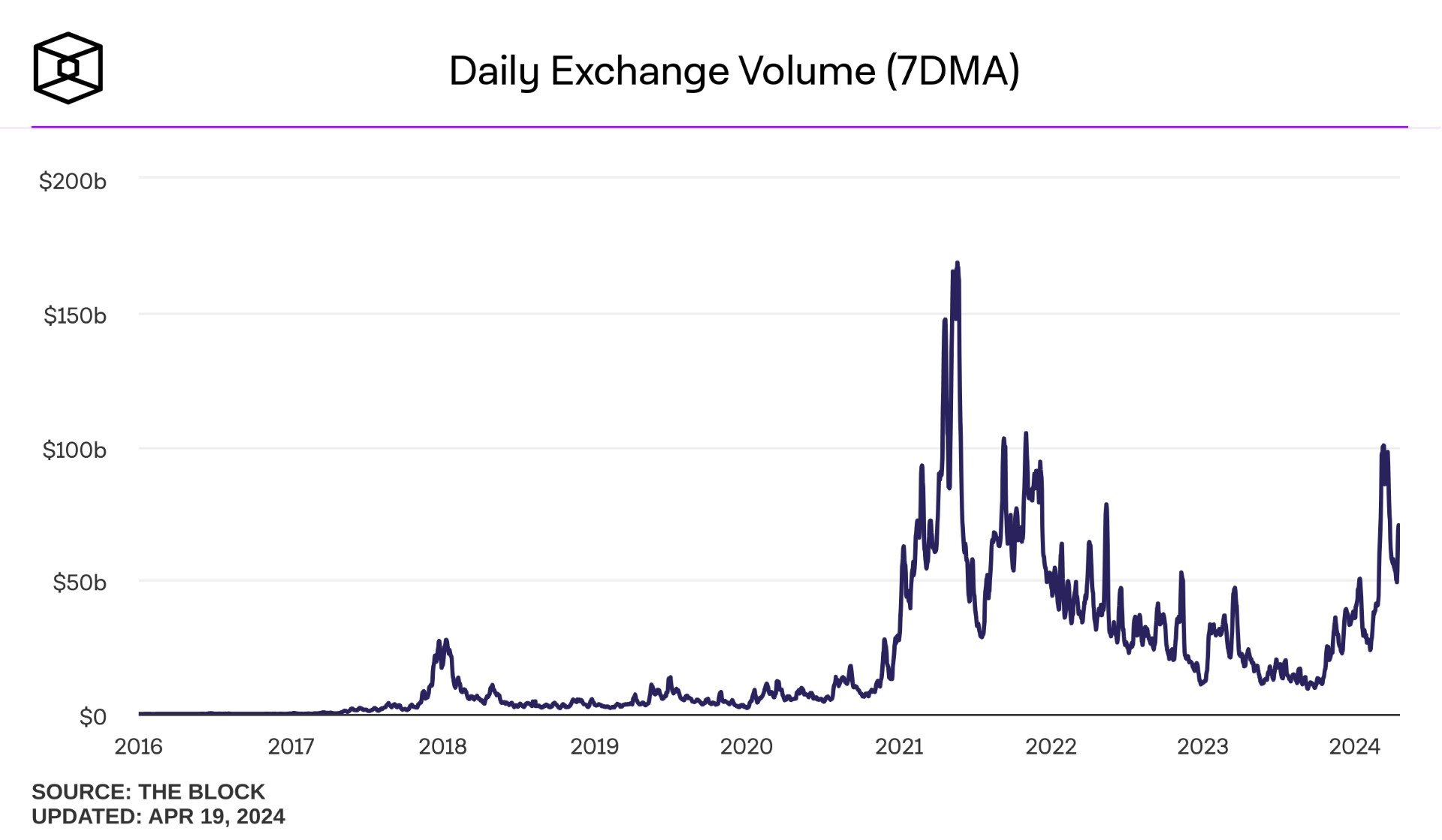
These figures are rather low compared to the average daily trading volumes across crypto exchanges, especially since the launch of BTC ETF trading, which triggered increased interest in the asset
class.
Source: The Block
The amount of tradable Bitcoin has been on the rise
during the recent bull run that accelerated since early Q4 2023. According to
the team at Coinbase Institutional Research, active BTC supply, defined as Bitcoin moved in the past three months, rose to 1.3 million. This figure is in comparison to 150,000, which was
mined during that time.
In a statement shared with Finance Magnates, Coinbase's Research
Analyst, David Han, mentioned that the decline in BTC mining issuance
could create new supply-side dynamics that are constructive in the longer term.
Han expressed his doubts as to whether that can result in
an imminent supply crunch: “We find that the largest contributors to increased
BTC supply during bull markets come from long-term wallets beginning to
activate instead of from newly mined BTC.”
Crypto and Fiat Liquidity Cycles – the Signal and the Noise
A widely held belief in the cryptocurrency community is that
halving events are usually followed by a significant rally in the value of
their digital assets. While there is some historical correlation to corroborate
this notion, science has long established that correlation does not imply
causation.
The logical fallacy where two events that occur at a similar
time have a cause-effect relationship is at the center of spurious
relationships: two events can be correlated, but that connection may not be
causal.
With only three halving events behind us and a fourth one
brewing, one can observe correlations, but not necessarily cause-effect
relationships. Halving events don’t perfectly coincide with central bank
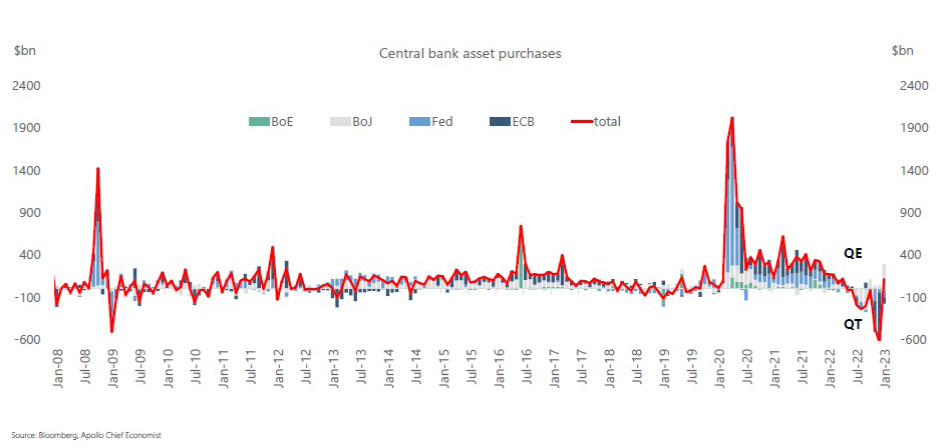
liquifying cycles, but as the chart below shows, there is some food for thought
for risk-management teams and traders alike.
Source: Bloomberg, Apollo Chief Economist
Around the first halving in 2012, the Fed launched the third
chapter of its post-financial crisis quantitative easing program (QE3), shortly
followed by the first US debt ceiling crisis and the loss of the reserve
currency issuer’s AAA rating.
The second one, in 2016, was followed by the Bank of England’s post-Brexit ramp-up of bond buying in tandem with the ECB’s asset purchase program. Fast-forward to 2020, and we all remember the central bank and fiscal policy bazookas firing left and right with fiat liquidity so ample that it ultimately caused the sharpest spike in inflationary pressures globally since the 1970s.
Geopolitical Blocks
It was an early morning in the Middle East, as a
well-telegraphed attack by Iran had been unleashed upon Israel. With all other
financial markets closed, it was up to crypto to reflect the current state of
mind (or compute).
The old Wall Street saying, “up the stairs, down the
elevator,” came to mind as BTC and ETH dropped in tandem in rapidly dwindling liquidity conditions. That night, Coinbase registered about $2 billion worth of liquidations, the company’s institutional research team
highlighted in a recent weekly market call.
In contrast to the rather gradual price action that unfolded in the aftermath of the October 7th attack on Israel by Hamas, the Iranian attack, despite being well-telegraphed before the weekend, did result in material price action across the crypto market.
At one point, Pax Gold, a crypto token supposed to be fully backed by gold, spiked about $1,000 at a time when the physical gold market, which is underpinning the coin's value, wasn’t open. The magnitude
of the attack certainly surprised market participants, while some automatic
“stop trading” commands must have been unleashed across algorithmic trading
strategies.
Events centered around geopolitical stress have certainly caused some leveraged players to rethink, not only in the crypto market. Jerome Powell's, the Chair of the Federal Reserve of the United States, higher rates for a longer period re-pivot raise questions about a widely expected easing of monetary policy.
To Bid, or Not to Bid
As the halving cycles come and go, the impact of these
events could lessen in time. Since most bitcoins have already been mined, the current market liquidity state is much more about the existing supply of BTC on the market than newly mined coins.
A supply crunch overnight is the least likely event, and if
very recent history is any guide, geopolitical tensions can create more
volatility or liquidity waves on cryptocurrency and traditional financial
markets.
Guided by risk-on and risk-off flows, cryptocurrencies have
been defying the trend occasionally, but at their core they remain a high-risk
asset with a digital store of value component behind it. Only time will tell whether or not that narrative has become a well-established characteristic, but so
far, so good.
As the halving event comes and passes us by, it is the
central banks that will have the ball in their court: ready to do whatever it
takes to address inflationary challenges or supply more fiat liquidity to the
monetary system.
With Bitcoin ETFs breaking new ground, the liquidity
situation for the king of crypto has significantly improved. As David Han outlined: “Net US spot ETFs inflows to date approximately offset the BTC that was
mined in the previous six months.”
The long-awaited day of the 4th phase of Bitcoin's halving is looming in the cryptocurrency sector. The
countdown to this event shows that it could happen around the final hours of Friday evening if
you are located in the Americas or Saturday morning if you are in Asia or
Europe.
According to the market metrics, the event is much anticipated and should be discounted well in advance of its actual occurrence. In contrast to unpredictable overnight barrages of rockets in the heat of the Middle East, the halving event has a clear outcome; the amount of BTC rewards
that miners get for completing a block will be reduced in half to 3.125 BTC
from the current 6.25.
This will inevitably lead to less supply from miners, but
does it change the liquidity of the overall market? We will attempt to answer that question in the coming paragraphs, and while at it, we
will highlight some challenges related to the current geopolitical
landscape and the resulting jittery market conditions we have recently observed.
Are Previous Halvings Linked to Liquidity Squeezes?
Every time 210,000 blocks are mined, the Bitcoin network's protocol cuts the amount of new rewards in half. As highlighted by the institutional research team at Coinbase, therefore, the newly
minted supply will drop from 900 Bitcoins per day to 450 Bitcoins per day. At
current market prices ($65,000 per BTC), this equates to roughly $30,000,000
worth of new supply per day or $900,000,000 per month.
These figures are rather low compared to the average daily trading volumes across crypto exchanges, especially since the launch of BTC ETF trading, which triggered increased interest in the asset
class.
Source: The Block
The amount of tradable Bitcoin has been on the rise
during the recent bull run that accelerated since early Q4 2023. According to
the team at Coinbase Institutional Research, active BTC supply, defined as Bitcoin moved in the past three months, rose to 1.3 million. This figure is in comparison to 150,000, which was
mined during that time.
In a statement shared with Finance Magnates, Coinbase's Research
Analyst, David Han, mentioned that the decline in BTC mining issuance
could create new supply-side dynamics that are constructive in the longer term.
Han expressed his doubts as to whether that can result in
an imminent supply crunch: “We find that the largest contributors to increased
BTC supply during bull markets come from long-term wallets beginning to
activate instead of from newly mined BTC.”
Crypto and Fiat Liquidity Cycles – the Signal and the Noise
A widely held belief in the cryptocurrency community is that
halving events are usually followed by a significant rally in the value of
their digital assets. While there is some historical correlation to corroborate
this notion, science has long established that correlation does not imply
causation.
The logical fallacy where two events that occur at a similar
time have a cause-effect relationship is at the center of spurious
relationships: two events can be correlated, but that connection may not be
causal.
With only three halving events behind us and a fourth one
brewing, one can observe correlations, but not necessarily cause-effect
relationships. Halving events don’t perfectly coincide with central bank
liquifying cycles, but as the chart below shows, there is some food for thought
for risk-management teams and traders alike.
Source: Bloomberg, Apollo Chief Economist
Around the first halving in 2012, the Fed launched the third
chapter of its post-financial crisis quantitative easing program (QE3), shortly
followed by the first US debt ceiling crisis and the loss of the reserve
currency issuer’s AAA rating.
The second one, in 2016, was followed by the Bank of England’s post-Brexit ramp-up of bond buying in tandem with the ECB’s asset purchase program. Fast-forward to 2020, and we all remember the central bank and fiscal policy bazookas firing left and right with fiat liquidity so ample that it ultimately caused the sharpest spike in inflationary pressures globally since the 1970s.
Geopolitical Blocks
It was an early morning in the Middle East, as a
well-telegraphed attack by Iran had been unleashed upon Israel. With all other
financial markets closed, it was up to crypto to reflect the current state of
mind (or compute).
The old Wall Street saying, “up the stairs, down the
elevator,” came to mind as BTC and ETH dropped in tandem in rapidly dwindling liquidity conditions. That night, Coinbase registered about $2 billion worth of liquidations, the company’s institutional research team
highlighted in a recent weekly market call.
In contrast to the rather gradual price action that unfolded in the aftermath of the October 7th attack on Israel by Hamas, the Iranian attack, despite being well-telegraphed before the weekend, did result in material price action across the crypto market.
At one point, Pax Gold, a crypto token supposed to be fully backed by gold, spiked about $1,000 at a time when the physical gold market, which is underpinning the coin's value, wasn’t open. The magnitude
of the attack certainly surprised market participants, while some automatic
“stop trading” commands must have been unleashed across algorithmic trading
strategies.
Events centered around geopolitical stress have certainly caused some leveraged players to rethink, not only in the crypto market. Jerome Powell's, the Chair of the Federal Reserve of the United States, higher rates for a longer period re-pivot raise questions about a widely expected easing of monetary policy.
To Bid, or Not to Bid
As the halving cycles come and go, the impact of these
events could lessen in time. Since most bitcoins have already been mined, the current market liquidity state is much more about the existing supply of BTC on the market than newly mined coins.
A supply crunch overnight is the least likely event, and if
very recent history is any guide, geopolitical tensions can create more
volatility or liquidity waves on cryptocurrency and traditional financial
markets.
Guided by risk-on and risk-off flows, cryptocurrencies have
been defying the trend occasionally, but at their core they remain a high-risk
asset with a digital store of value component behind it. Only time will tell whether or not that narrative has become a well-established characteristic, but so
far, so good.
As the halving event comes and passes us by, it is the
central banks that will have the ball in their court: ready to do whatever it
takes to address inflationary challenges or supply more fiat liquidity to the
monetary system.
With Bitcoin ETFs breaking new ground, the liquidity
situation for the king of crypto has significantly improved. As David Han outlined: “Net US spot ETFs inflows to date approximately offset the BTC that was
mined in the previous six months.”
Kalshi Defies U.S. Legal Tussle and Nevada Temporary Ban as Valuation Doubles to $22B
CMC Markets’ Artur Delijergijevs on Metals Demand, Volatility, & Stable Execution
CMC Markets’ Artur Delijergijevs on Metals Demand, Volatility, & Stable Execution
In this exclusive Executive Interview, Finance Magnates speaks with Artur Delijergijevs, Head of Systematic Market Making at CMC Markets, about the current state of metals demand and market volatility.
Delijergijevs offers a desk-level view on:
- Metals Demand: Why metals are seeing the strongest demand from both retail and institutional clients right now.
- The Safe-Haven Debate: Questioning whether gold still fits the classic safe-haven definition given large daily price movements.
- Volatile Market Prep: How a market-making desk prepares its systems and pricing for stressed market conditions and high-impact economic events.
- Hybrid Execution: Why the best execution model combines electronic speed with human relationship support, especially during volatility.
- AI in Workflow: Where CMC Markets is integrating machine learning for risk management and pricing, and the limitations of AI during stressed markets.
- Dubai's Role: The strategic importance of Dubai’s location for covering global trading sessions across Asia, Europe, and the US.
Watch to understand how CMC Markets maintains stable pricing and reliable execution quality in high-volatility environments.
#CMCmarkets #forex #metals #gold #trading #volatility #MarketMaking #iFXDubai #FinanceMagnates #Finance #Fintech #Execution #AlgorithmicTrading #RiskManagement
In this exclusive Executive Interview, Finance Magnates speaks with Artur Delijergijevs, Head of Systematic Market Making at CMC Markets, about the current state of metals demand and market volatility.
Delijergijevs offers a desk-level view on:
- Metals Demand: Why metals are seeing the strongest demand from both retail and institutional clients right now.
- The Safe-Haven Debate: Questioning whether gold still fits the classic safe-haven definition given large daily price movements.
- Volatile Market Prep: How a market-making desk prepares its systems and pricing for stressed market conditions and high-impact economic events.
- Hybrid Execution: Why the best execution model combines electronic speed with human relationship support, especially during volatility.
- AI in Workflow: Where CMC Markets is integrating machine learning for risk management and pricing, and the limitations of AI during stressed markets.
- Dubai's Role: The strategic importance of Dubai’s location for covering global trading sessions across Asia, Europe, and the US.
Watch to understand how CMC Markets maintains stable pricing and reliable execution quality in high-volatility environments.
#CMCmarkets #forex #metals #gold #trading #volatility #MarketMaking #iFXDubai #FinanceMagnates #Finance #Fintech #Execution #AlgorithmicTrading #RiskManagement
Finance Magnates Awards 2026 – Nominations Now Open
Finance Magnates Awards 2026 – Nominations Now Open
The Finance Magnates Awards 2026 nominations are now open. 🏆
From fintech innovators to leading brokers, this is where the finance industry celebrates its biggest achievements.
Winners will be announced at the Cyprus Gala Dinner on November 6, 2026.
Nominate your brand now.
https://awards.financemagnates.com/?utm_source=linkedin&utm_medium=video&utm_campaign=nominations-open
#FMAwards #FinanceMagnates #FintechAwards #Fintech #FinanceIndustry
The Finance Magnates Awards 2026 nominations are now open. 🏆
From fintech innovators to leading brokers, this is where the finance industry celebrates its biggest achievements.
Winners will be announced at the Cyprus Gala Dinner on November 6, 2026.
Nominate your brand now.
https://awards.financemagnates.com/?utm_source=linkedin&utm_medium=video&utm_campaign=nominations-open
#FMAwards #FinanceMagnates #FintechAwards #Fintech #FinanceIndustry
Finance Magnates Awards 2026 | Nominations Now Open 🏆#Fintech #FMAwards #TradingIndustry
Finance Magnates Awards 2026 | Nominations Now Open 🏆#Fintech #FMAwards #TradingIndustry
Lights on. Cameras ready. 🎬
Finance Magnates Awards 2026 nominations are now open. 🏆
#FMAwards #FinanceMagnates #FintechAwards #Fintech
Lights on. Cameras ready. 🎬
Finance Magnates Awards 2026 nominations are now open. 🏆
#FMAwards #FinanceMagnates #FintechAwards #Fintech
Exness sees trust as the key theme for growth in MENA Trading Growth for 2026
Exness sees trust as the key theme for growth in MENA Trading Growth for 2026
Mohammad Amer, Regional Commercial Director at Exness, sits down to discuss the booming MENA financial trading market. Find out why Dubai is key to the company's growth strategy, how a mobile-first generation is changing expectations, and why trust will be the defining theme for traders in 2026.
In this interview, you'll learn:
* Why Dubai and the MENA region are critical growth markets for fintech and online trading.
* How Exness is addressing the demands of mobile-first, younger traders through engineering, platform stability, and transparent conditions.
* The essential role local talent plays in providing a culturally relevant and compliant user experience.
* Mohammad Amer's outlook on the future of the online trading industry and why stronger controls and systems are necessary.
* Why "trust" isn't just a brand value, but has commercial value—and why he predicts 2026 will be the "Year of Trust."
Key Takeaways:
➡️ The MENA region is rapidly shaping global financial markets.
➡️ New traders expect stability, precise execution, and transparency.
➡️ Local expertise is key to regulatory compliance and user experience.
➡️ Future success belongs to firms capable of meeting rising standards across regulation and platform consistency.
Read the full article at: https://www.financemagnates.com/thought-leadership/exness-sees-trust-as-the-key-theme-for-growth-in-mena-trading-growth-for-2026/
#Exness #MENA #Trading #FinTech #Dubai #OnlineTrading #FinanceMagnates #MohammadAmer #Trust #MobileTrading
Mohammad Amer, Regional Commercial Director at Exness, sits down to discuss the booming MENA financial trading market. Find out why Dubai is key to the company's growth strategy, how a mobile-first generation is changing expectations, and why trust will be the defining theme for traders in 2026.
In this interview, you'll learn:
* Why Dubai and the MENA region are critical growth markets for fintech and online trading.
* How Exness is addressing the demands of mobile-first, younger traders through engineering, platform stability, and transparent conditions.
* The essential role local talent plays in providing a culturally relevant and compliant user experience.
* Mohammad Amer's outlook on the future of the online trading industry and why stronger controls and systems are necessary.
* Why "trust" isn't just a brand value, but has commercial value—and why he predicts 2026 will be the "Year of Trust."
Key Takeaways:
➡️ The MENA region is rapidly shaping global financial markets.
➡️ New traders expect stability, precise execution, and transparency.
➡️ Local expertise is key to regulatory compliance and user experience.
➡️ Future success belongs to firms capable of meeting rising standards across regulation and platform consistency.
Read the full article at: https://www.financemagnates.com/thought-leadership/exness-sees-trust-as-the-key-theme-for-growth-in-mena-trading-growth-for-2026/
#Exness #MENA #Trading #FinTech #Dubai #OnlineTrading #FinanceMagnates #MohammadAmer #Trust #MobileTrading
Paytiko CEO Razi Salih on Why Payment Orchestration is a MUST-HAVE for Brokers in 2026
Paytiko CEO Razi Salih on Why Payment Orchestration is a MUST-HAVE for Brokers in 2026
At iFX Expo Dubai, Finance Magnates spoke with Razi Salih, CEO at Paytiko, about the evolution of the payments ecosystem and why payment orchestration has shifted from an option to a necessity for brokers, prop firms, and exchanges.
Mr. Salih explains how global expansion, the need for deep localisation, and the sheer number of new payment methods, from instant banking to stablecoins, are driving this critical infrastructure shift.
#PaymentOrchestration #Fintech #Brokerage #TradingPayments #RaziSalih #Paytiko #iFXExpoDubai #Stablecoins #AIinFintech
At iFX Expo Dubai, Finance Magnates spoke with Razi Salih, CEO at Paytiko, about the evolution of the payments ecosystem and why payment orchestration has shifted from an option to a necessity for brokers, prop firms, and exchanges.
Mr. Salih explains how global expansion, the need for deep localisation, and the sheer number of new payment methods, from instant banking to stablecoins, are driving this critical infrastructure shift.
#PaymentOrchestration #Fintech #Brokerage #TradingPayments #RaziSalih #Paytiko #iFXExpoDubai #Stablecoins #AIinFintech