Backpack Exchange bought FTX's EU unit and MiFID II licence for $32.7 million.
The platform now offers 40 trading pairs of perpetual futures with 10x leverage.
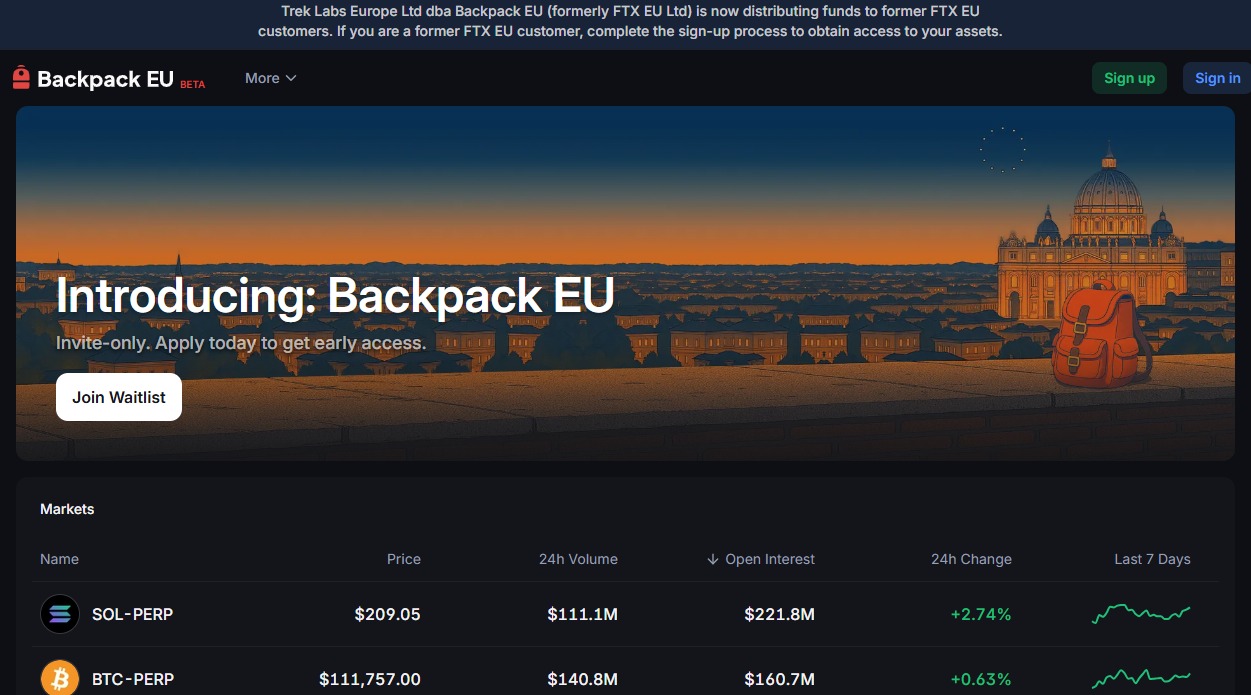
A screenshot of Backpack EU's website
Backpack Exchange, which acquired the European unit of the now-collapsed FTX, has launched perpetual futures trading in the European Union “after fulfilling [its] promise to refund former FTX EU customers.”
The Platform Is Still in Beta
The services remain in Beta, and prospective customers must sign up for the waitlist at Backpack EU.
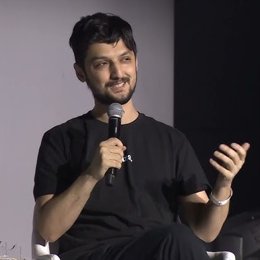
Armani Ferrante, CEO of Backpack (Photo: YouTube)
“We enter into the EU at a time when global regulators are providing clearer compliance frameworks, institutions are embracing crypto, and yet traders lack the regulated venues to meet the moment,” said Armani Ferrante, CEO of Backpack.
“We look forward to welcoming EU users to our platform and serving them in the years to come,” he added.
The exchange lists 40 trading pairs of perpetual futures, each with 10x leverage.
Perpetual futures differ from traditional futures contracts in one key way: they have no expiry date. While standard futures settle on a set date, perpetuals can be held indefinitely and instead use a funding rate mechanism—regular payments between long and short traders—to keep prices in line with the spot market.
This structure, popularised in crypto trading, allows continuous speculation and leverage without the need to roll over contracts.
Acquiring the Distressed FTX EU
Backpack EU announced its acquisition of FTX’s EU unit, which operated under a licence from the Cyprus Securities and Exchange Commission (CySEC), in early 2025. Reports valued the deal at $32.7 million.
Following the acquisition, Backpack also became liable for returning the funds of distressed FTX customers under the EU entity. FinanceMagnates.com reported earlier that the new owner began distributing claims to affected FTX EU customers in early 2025.
The latest announcement further emphasised that Backpack has been processing FTX EU customer claims since 2025.
Meanwhile, other major crypto brands have also entered Europe to offer perpetuals. Kraken, which obtained a MiFID II licence after acquiring a Cyprus broker, launched crypto derivatives in May. Coinbase also acquired a Cyprus-regulated broker but has yet to launch any product under its European licence.
Backpack Exchange, which acquired the European unit of the now-collapsed FTX, has launched perpetual futures trading in the European Union “after fulfilling [its] promise to refund former FTX EU customers.”
The Platform Is Still in Beta
The services remain in Beta, and prospective customers must sign up for the waitlist at Backpack EU.
Armani Ferrante, CEO of Backpack (Photo: YouTube)
“We enter into the EU at a time when global regulators are providing clearer compliance frameworks, institutions are embracing crypto, and yet traders lack the regulated venues to meet the moment,” said Armani Ferrante, CEO of Backpack.
“We look forward to welcoming EU users to our platform and serving them in the years to come,” he added.
The exchange lists 40 trading pairs of perpetual futures, each with 10x leverage.
Perpetual futures differ from traditional futures contracts in one key way: they have no expiry date. While standard futures settle on a set date, perpetuals can be held indefinitely and instead use a funding rate mechanism—regular payments between long and short traders—to keep prices in line with the spot market.
This structure, popularised in crypto trading, allows continuous speculation and leverage without the need to roll over contracts.
Acquiring the Distressed FTX EU
Backpack EU announced its acquisition of FTX’s EU unit, which operated under a licence from the Cyprus Securities and Exchange Commission (CySEC), in early 2025. Reports valued the deal at $32.7 million.
Following the acquisition, Backpack also became liable for returning the funds of distressed FTX customers under the EU entity. FinanceMagnates.com reported earlier that the new owner began distributing claims to affected FTX EU customers in early 2025.
The latest announcement further emphasised that Backpack has been processing FTX EU customer claims since 2025.
Meanwhile, other major crypto brands have also entered Europe to offer perpetuals. Kraken, which obtained a MiFID II licence after acquiring a Cyprus broker, launched crypto derivatives in May. Coinbase also acquired a Cyprus-regulated broker but has yet to launch any product under its European licence.
Arnab Shome is an electronics engineer-turned-financial editor. He holds a Bachelor of Technology from the National Institute of Technology, Agartala. He entered the retail trading industry about a decade ago, covering the cryptocurrency market for Finance Magnates, and later expanded his coverage to include forex and CFDs as well.
His work at Finance Magnates includes C-level interviews, data-driven analysis, opinion pieces, and scoops of industry exclusives. He also contributes to Finance Magnates’ quarterly industry report.
Area of coverage:
1. CFD broker-related news
2. Industry-related Regulatory updates and developments
3. New retail trading trends
4. Prop trading industry updates
5. Executive interviews
Education:
Bachelor of Technology - National Institute of Technology, Agartala (India)
Kraken Steps Up Speed Race with New Equinix Colocation Service for Crypto Traders
FP Markets Winner Spotlight 🏆 | Global Broker of the Year 2025 #Trading #Broker #Innovation #Shorts
FP Markets Winner Spotlight 🏆 | Global Broker of the Year 2025 #Trading #Broker #Innovation #Shorts
FP Markets takes the spotlight as Global Broker of the Year 2025 at the Finance Magnates Awards.
Martin Stoilov, Head of Client Experience, shares that trust, innovation, and people played a key role in the company’s success, supported by a strong foundation of integrity and client-centricity.
Following this milestone, FP Markets continues to focus on growth, technology investment, and its core values of transparency and excellence.
👉 Be part of FM Awards 2026: https://awards.financemagnates.com/#nominate
FP Markets takes the spotlight as Global Broker of the Year 2025 at the Finance Magnates Awards.
Martin Stoilov, Head of Client Experience, shares that trust, innovation, and people played a key role in the company’s success, supported by a strong foundation of integrity and client-centricity.
Following this milestone, FP Markets continues to focus on growth, technology investment, and its core values of transparency and excellence.
👉 Be part of FM Awards 2026: https://awards.financemagnates.com/#nominate
In this video, we review @HolaPrimeMarketsOfficial, a multi-asset forex and CFDs broker offering different account types, trading platforms, and flexible trading conditions.
We cover the broker’s overall offering, including account options, trading environment, platforms like MT4 and MT5, and additional services such as managed accounts and fast withdrawals.
Watch the full video to see if Hola Prime Markets fits your trading needs.
📣 Stay up to date with the latest in finance and trading. Follow Finance Magnates for industry news, insights, and global event coverage.
Connect with us:
🔗 LinkedIn: /financemagnates
👍 Facebook: /financemagnates
📸 Instagram: https://www.instagram.com/financemagnates
🐦 X: https://x.com/financemagnates
🎥 TikTok: https://www.tiktok.com/tag/financemagnates
▶️ YouTube: /@financemagnates_official
#HolaPrime #ForexBroker #CFDTrading #FinanceMagnates #Trading #Forex #BrokerReview
In this video, we review @HolaPrimeMarketsOfficial, a multi-asset forex and CFDs broker offering different account types, trading platforms, and flexible trading conditions.
We cover the broker’s overall offering, including account options, trading environment, platforms like MT4 and MT5, and additional services such as managed accounts and fast withdrawals.
Watch the full video to see if Hola Prime Markets fits your trading needs.
📣 Stay up to date with the latest in finance and trading. Follow Finance Magnates for industry news, insights, and global event coverage.
Connect with us:
🔗 LinkedIn: /financemagnates
👍 Facebook: /financemagnates
📸 Instagram: https://www.instagram.com/financemagnates
🐦 X: https://x.com/financemagnates
🎥 TikTok: https://www.tiktok.com/tag/financemagnates
▶️ YouTube: /@financemagnates_official
#HolaPrime #ForexBroker #CFDTrading #FinanceMagnates #Trading #Forex #BrokerReview
Hola Prime Review: What You Need to Know | Full Breakdown by Finance Magnates
Hola Prime Review: What You Need to Know | Full Breakdown by Finance Magnates
In this video, we review @HolaPrime_Global, a proprietary trading firm offering evaluation programs and performance-based payouts in simulated market environments.
We cover how the challenge model works, including account types, profit splits (up to 95%), trading rules, and what it takes to reach a funded account. You’ll also learn about available platforms like MT4, MT5, cTrader, and more, along with insights into payouts, support, and trading conditions.
Watch the full video to see if Hola Prime fits your trading style.
📣 Stay up to date with the latest in finance and trading. Follow Finance Magnates for industry news, insights, and global event coverage.
Connect with us:
🔗 LinkedIn: /financemagnates
👍 Facebook: /financemagnates
📸 Instagram: https://www.instagram.com/financemagnates
🐦 X: https://x.com/financemagnates
🎥 TikTok: https://www.tiktok.com/tag/financemagnates
▶️ YouTube: /@financemagnates_official
#HolaPrime #PropFirm #Trading #FinanceMagnates #Forex #FuturesTrading #TradingReview #PropFirmReview
In this video, we review @HolaPrime_Global, a proprietary trading firm offering evaluation programs and performance-based payouts in simulated market environments.
We cover how the challenge model works, including account types, profit splits (up to 95%), trading rules, and what it takes to reach a funded account. You’ll also learn about available platforms like MT4, MT5, cTrader, and more, along with insights into payouts, support, and trading conditions.
Watch the full video to see if Hola Prime fits your trading style.
📣 Stay up to date with the latest in finance and trading. Follow Finance Magnates for industry news, insights, and global event coverage.
Connect with us:
🔗 LinkedIn: /financemagnates
👍 Facebook: /financemagnates
📸 Instagram: https://www.instagram.com/financemagnates
🐦 X: https://x.com/financemagnates
🎥 TikTok: https://www.tiktok.com/tag/financemagnates
▶️ YouTube: /@financemagnates_official
#HolaPrime #PropFirm #Trading #FinanceMagnates #Forex #FuturesTrading #TradingReview #PropFirmReview
Axi Winner Spotlight 🏆 | Global Most Innovative Broker 2025 #Innovation #Trading #Fintech #Broker
Axi Winner Spotlight 🏆 | Global Most Innovative Broker 2025 #Innovation #Trading #Fintech #Broker
Axi takes the spotlight at the Finance Magnates Awards, winning Global Most Innovative Broker 2025.
Olivia Xenofontos and Ivanna Openko share how the team will feel: proud, motivated, and ready to keep delivering.
They also describe the night as well-organized, focused, and enjoyable for all.
👉 Be part of FM Awards 2026.
Axi takes the spotlight at the Finance Magnates Awards, winning Global Most Innovative Broker 2025.
Olivia Xenofontos and Ivanna Openko share how the team will feel: proud, motivated, and ready to keep delivering.
They also describe the night as well-organized, focused, and enjoyable for all.
👉 Be part of FM Awards 2026.
Recognition that matters.
Built on transparency.
Driven by the industry.
The Finance Magnates Awards 2026.
Nominations are now open.
🔗 https://awards.financemagnates.com/?utm_source=SM&utm_medium=social&utm_campaign=recognition-matters
Recognition that matters.
Built on transparency.
Driven by the industry.
The Finance Magnates Awards 2026.
Nominations are now open.
🔗 https://awards.financemagnates.com/?utm_source=SM&utm_medium=social&utm_campaign=recognition-matters